8 Waste Management Provider Mistakes That Cost You
Last Updated: October 30, 2026
Quick Summary
Choosing the right waste management provider means comparing quotes on total projected cost, not the lowest base rate, after auditing your waste volume and pickup needs. Verify fee mechanics, permits, insurance, and service-level commitments in writing before you sign.
- Run a waste audit first: track volume, generation, and accepted materials for two weeks.
- Score every provider 1 to 5 on the same checklist so quotes are comparable.
- Ask whether fuel surcharges are fixed or float with a published index.
- Compaction crushes waste on site so each container holds more before hauling.
- Confirm licensing, permits, and a certificate of insurance before signing.
Table of Contents
- Why the Wrong Waste Management Provider Drains Your Budget
- Mistake 1: Skipping a Waste Audit Before You Shop
- Mistake 2: Comparing Quotes Without a Waste Management Provider Checklist
- Mistake 3: Ignoring Waste Hauling Frequency and Pickup Schedule Fit
- Mistake 4: Signing Without Asking the Right Waste Management Contract Questions
- Mistake 5: Overlooking Dumpster Compaction Services That Cut Hauls
- Mistake 6: Failing to Verify Permits, Licensing, and Insurance Coverage
- Mistake 7: No Contingency Plan for Missed Pickups and Service Failures
- Frequently Asked Questions
Why the Wrong Waste Management Provider Drains Your Budget
Choosing the right waste management service provider is less about finding the lowest quote and more about avoiding the hidden costs that pile up after you sign.
Here is the core problem most guides miss. You are not really buying pickups. You are buying volume removed per haul. See why your business is paying for empty dumpster space to understand how this budget drain adds up.
Below, we break down the eight mistakes that drain budgets and show exactly how to avoid each one. The fixes are simple, but they only work if you apply them before the contract is signed.
Mistake 1: Skipping a Waste Audit Before You Shop
Most teams call haulers before they understand their own waste stream. That is backwards. A waste audit is a simple count of what you throw away, how much, and how often. It takes a day and saves real money.
Start with three numbers:
- Waste volume: how many cubic yards leave your site weekly
- Waste generation: which shifts or projects produce the most debris
- Accepted materials: what your stream actually contains
How to Right-Size Container Volume and Collection Frequency
Right-sizing means matching container size and pickup schedule to real volume, not guesses. Track your dumpsters for two weeks. Note fill level before each haul. If containers are consistently under half full, you are paying to haul empty space.
Two levers fix this:
- Container size: match the roll-off to your peak week, not your average
- Collection frequency: schedule pickups around actual fill rates
A common mistake is sizing up when a compaction step would solve the problem for less.
Mistake 2: Comparing Quotes Without a Waste Management Provider Checklist
Quotes are not comparable until you normalize them. A cheap base rate with extra fees is not cheaper. Use a waste management provider checklist so every bid answers the same questions.
Here is the scorecard we suggest. Score each provider 1 to 5 on every row, then total the columns.
| Criteria | Provider A | Provider B | Provider C |
|---|---|---|---|
| Service range and accepted materials | |||
| Collection frequency and flexibility | |||
| On-time pickup record | |||
| Customer reviews and reputation | |||
| Licensing, permits, insurance | |||
| Reporting and tracking | |||
| Contract terms and fees |
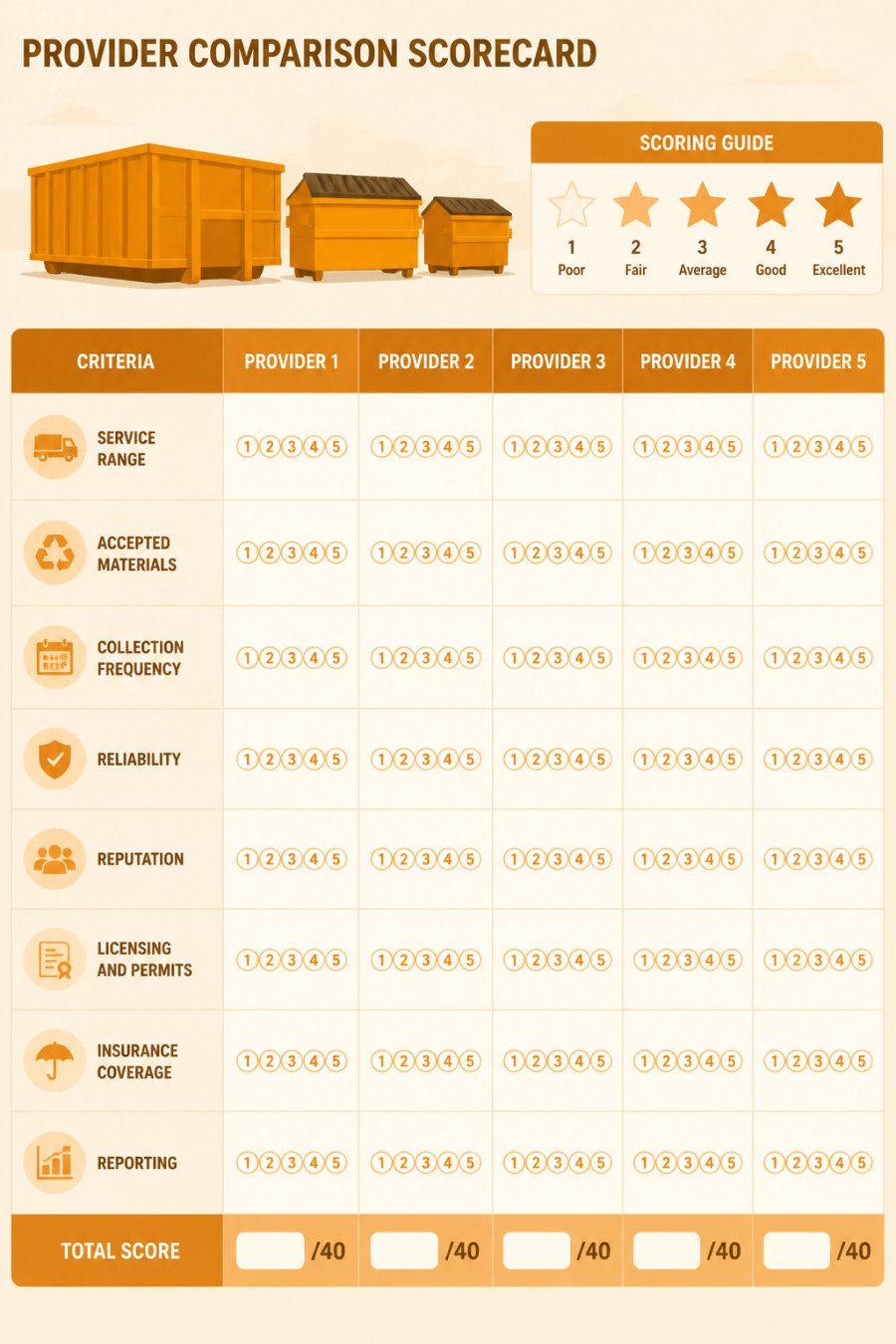
A Practical Provider Comparison Scorecard
Weight the rows that matter most to your operation. A distribution center should weight reliability and yard space. A construction firm should weight accepted materials and flexibility. For a deeper look at benchmarking quotes, see our waste hauling cost reduction guide.
Watch out: comparing only the base monthly rate hides overage and fuel fees that can double the real bill.
Mistake 3: Ignoring Waste Hauling Frequency and Pickup Schedule Fit
Pickup schedule fit decides whether you pay for service you do not need. A weekly schedule on a slow site wastes money. A biweekly schedule on a busy site causes overflow and emergency hauls.
Ask each provider:
- Can frequency change by season or project phase?
- What notice do schedule changes require?
- Are missed pickups credited?
The right waste hauling frequency flexes with your operational needs. If a provider locks you into one rigid schedule, you will pay for it in overages.
Mistake 4: Signing Without Asking the Right Waste Management Contract Questions
The fine print decides your total cost of service. Most guides tell you to 'read the contract' and stop there. That is not enough. You need to understand the specific fee mechanics that turn a low base rate into a high annual bill, and you need to compare quotes on a normalized, total-cost basis.
The Fee Mechanics That Drive True Cost
Ask each provider to explain, in writing, how each of these is calculated and when it applies:
- Fuel surcharges: Is the surcharge a fixed percentage of the base rate, or does it float with a published index? A floating surcharge can rise mid-contract without your approval.
- Environmental or regulatory fees: Are these pass-through charges fixed or variable? Ask what triggers a change.
- Contamination fees: What constitutes contamination (e.g., prohibited materials in a roll-off), how is it assessed, and what is the penalty per occurrence?
- Overage and overweight charges: What is the weight or volume threshold, and how is the overage billed, per ton, per yard, or per haul?
- Price escalators: Is there an annual increase cap? Is it tied to a published index (e.g., CPI) or is it at the provider's discretion? An uncapped escalator is a budget risk.
- Cancellation and renewal terms: What notice is required to cancel or change service? Does the contract auto-renew, and for how long? Are there early-termination fees?
Normalizing Quotes for True-Cost Comparison
A cheap base rate with aggressive fees is not cheaper. To compare fairly, build a simple total-cost model for each provider using your own volume estimates:
- Estimate your monthly hauls based on your waste audit (see Mistake 1).
- Apply each provider's base rate per haul.
- Add estimated fuel and environmental surcharges.
- Add a contingency line for overage and contamination based on your stream's risk.
- Project the annual escalator.
The provider with the lowest total projected cost, not the lowest base rate, is the better deal. Ask each provider to confirm your assumptions in writing before you sign.
Contract Questions to Ask Before You Sign
- What triggers overage or overweight fees, and how are they calculated?
- How much notice is required to cancel or change service?
- Who owns the container, and who pays for damage?
- Are fuel and environmental surcharges fixed or variable, and what index do they track?
- What is the escalation clause on renewal, and is it capped?
- What are the contamination rules and penalties?
- What are the auto-renewal and termination terms?
Get the answers in writing and attach them to the contract. For a deeper look at benchmarking quotes on a total-cost basis, see our waste hauling cost reduction guide.
Mistake 5: Overlooking Dumpster Compaction Services That Cut Hauls
Compaction is the single biggest lever most teams ignore. Dumpster compaction services crush waste on site so each container holds more before it is hauled. Fewer hauls mean lower fees and fewer truck trips.
Our dumpster compaction service crushes waste on site, which reduces the number of required hauls. To see how the savings add up, read our guide on how much dumpster compaction saves, and if you are ready to adopt it, here is how to make mobile waste compaction work for your facility.
Mistake 6: Failing to Verify Permits, Licensing, and Insurance Coverage
Unverified providers shift risk onto you. Check three things before you sign:
- Licensing and permits: confirm the provider holds current waste hauler permits
- Insurance coverage: request a certificate of insurance and verify limits
- Liability: confirm who is responsible for spills, damage, and disposal violations
A provider that cannot produce these documents is not worth the savings. Regulatory compliance is not optional, and the liability lands on the site that generated the waste.
Mistake 7: No Contingency Plan for Missed Pickups and Service Failures
Missed pickups cost more than one late haul. They cause overflow, safety issues, and emergency fees. Most guides tell you to 'have a backup plan' and leave it there. That is not a plan. A real contingency plan combines digital tracking, clear escalation procedures, and contractual service-level commitments.
Digital Tracking and Service Reporting
Ask each provider what digital tools they offer to track service and catch failures early:
- Pickup tracking: Can you see scheduled and completed pickups in a portal or app? Real-time or next-day visibility?
- Service alerts: Do you get automatic notifications for missed or delayed pickups?
- Diversion reports: Can the provider supply weight or volume data for recycling and diversion reporting?
- Invoice and data access: Are invoices itemized and downloadable? Can you export service data for your own records?
A provider without digital tracking leaves you blind to service failures until they become emergencies. Our guide on tracking waste management performance metrics shows how to use this data to catch problems early.
Escalation Procedures and Service-Level Commitments
Build a written escalation path before you need it:
- First contact: Who do you call for a missed pickup, and what is the response-time commitment?
- Backup contact: A named account manager or backup, not just a general call center.
- Credits or refunds: What is the credit policy for repeated failures or extended delays?
- Emergency response: What is the provider's commitment for emergency hauls, and at what cost?
Put these commitments in the contract as service-level terms. A provider that cannot meet a response time is a provider that will cost you money.
Questions to Ask About Contingency and Service Failures
- What is the response time for a missed pickup?
- Do you provide a named backup contact?
- What credits or refunds apply for repeated failures?
- What digital tracking and service alerts do you offer?
- What is the emergency haul commitment and cost?
Track performance against these commitments. A provider that meets them is worth keeping; one that does not is a budget risk.
Frequently Asked Questions
What should I look for in a waste management provider?
Start with service range and accepted materials, then confirm collection frequency matches your actual waste volume. Check licensing, permits, and insurance coverage before signing. Ask for customer reviews and references from operations like yours. Run every candidate through the same written checklist so you compare like for like instead of trading sales pitches.
How often should a business schedule waste pickups?
Base waste hauling frequency on measured volume, not habit. Track how full your containers are at each pickup for four to six weeks. If containers sit half empty, you are paying to haul air and can extend the schedule. If they overflow between pickups, add service or compact on site first. Right-sizing frequency after a waste audit usually beats adding containers, and it keeps the pickup schedule aligned with your actual generation.
Is dumpster compaction a good fit for my business?
Dumpster compaction services suit sites with bulky, crushable waste: shingles, cardboard, packaging, and construction debris. On-site crushing reduces roll-off volume, which means fewer hauls for the same material. If your waste is heavy and dense already, or mostly liquid, compaction adds little. For manufacturing plants, distribution centers, and roofing crews, it can reduce haul count. Ask for a walkthrough to confirm your waste stream fits.
What questions should I ask before signing a waste management contract?
Ask about contract length, renewal terms, and early termination fees. Confirm what triggers extra charges: overage, contamination, or missed-access fees. Get the pickup schedule in writing and ask how missed pickups are handled. Request proof of licensing and insurance coverage. Finally, ask whether pricing adjusts automatically and how much notice you get. Comparing these answers across providers shows the real total cost of service, not just the quoted rate.
The real challenge is not finding a hauler. It is stopping the slow bleed of overages, missed pickups, and half-empty hauls. Junk Crusher attacks that bleed directly with mobile on-site dumpster compaction that reduces roll-off volume by up to 70% and cuts the number of required hauls. Combined with dumpster rental sized to your actual volume, it turns waste from a fixed cost into a controlled one. Get started with Junk Crusher and book a crush to see how much empty space you are paying to haul.


