
Waste Hauling Cost Reduction for Businesses: 2026 Guide
Table of Contents
- Why Waste Hauling Costs Keep Climbing in 2026
- Start With a Waste Audit: Find What You're Actually Paying For
- Waste Hauling Contract Negotiation Tips That Cut Real Money
- Industrial Waste Compaction Benefits: Fewer Hauls, Lower Tipping Fees
- Calculating Waste Hauling ROI: A Simple Framework
- Source Reduction and Recycling Diversion: Shrinking the Waste Stream
- Technology and Logistics: Monitoring, Routing, and Fleet Optimization
- Conclusion: Build a Waste Hauling Cost Reduction Plan That Sticks
- Frequently Asked Questions
Last Updated: September 21, 2026
Why Waste Hauling Costs Keep Climbing in 2026
Waste hauling cost reduction for businesses starts with understanding that most of what you pay for is air. Haulers bill by volume, and an uncompacted dumpster is mostly empty space between boxes, shingles, and pallet wrap. At Junk Crusher, we built our entire service around that single fact.
Start With a Waste Audit: Find What You're Actually Paying For
A waste audit is a structured review of what your facility throws away, in what volume, and at what cost per ton or per haul. Without one, you are negotiating blind.
Run it in four steps:
- Sort a sample. Pull one week of dumpster contents and categorize by material: cardboard, organics, construction debris, hazardous waste, general trash.
- Weigh or estimate volume. Note how full each container is at pickup. A dumpster at 40% capacity is a red flag.
- Map the cost. List every line item: base hauling fee, tipping fees, fuel surcharge, overage charges, and container rental.
- Rank by opportunity. The waste stream with the highest cost per ton and the lowest diversion rate goes first.
Waste Hauling Contract Negotiation Tips That Cut Real Money
Contract negotiation is where the biggest, fastest savings live. Most commercial hauling agreements are written to favor the hauler, and they renew automatically unless you act.
- Index the escalator clause. Cap annual increases or tie them to a published index rather than a flat percentage.
- Remove automatic renewal. Convert to a fixed term with a renewal you must actively approve.
- Right-size containers. If your audit shows you never fill the dumpster, drop to a smaller size or fewer pickups.
- Ask for a diversion credit. Some haulers reduce rates when recyclable volume is separated.
Watch for These Hidden Fee Structures
Hidden fees are the quietest form of waste hauling cost overrun. Common ones include fuel surcharges that exceed actual fuel costs, "environmental" fees with no documentation, overage charges for exceeding a weight allowance, and container maintenance fees billed whether or not service is performed.
Industrial Waste Compaction Benefits: Fewer Hauls, Lower Tipping Fees
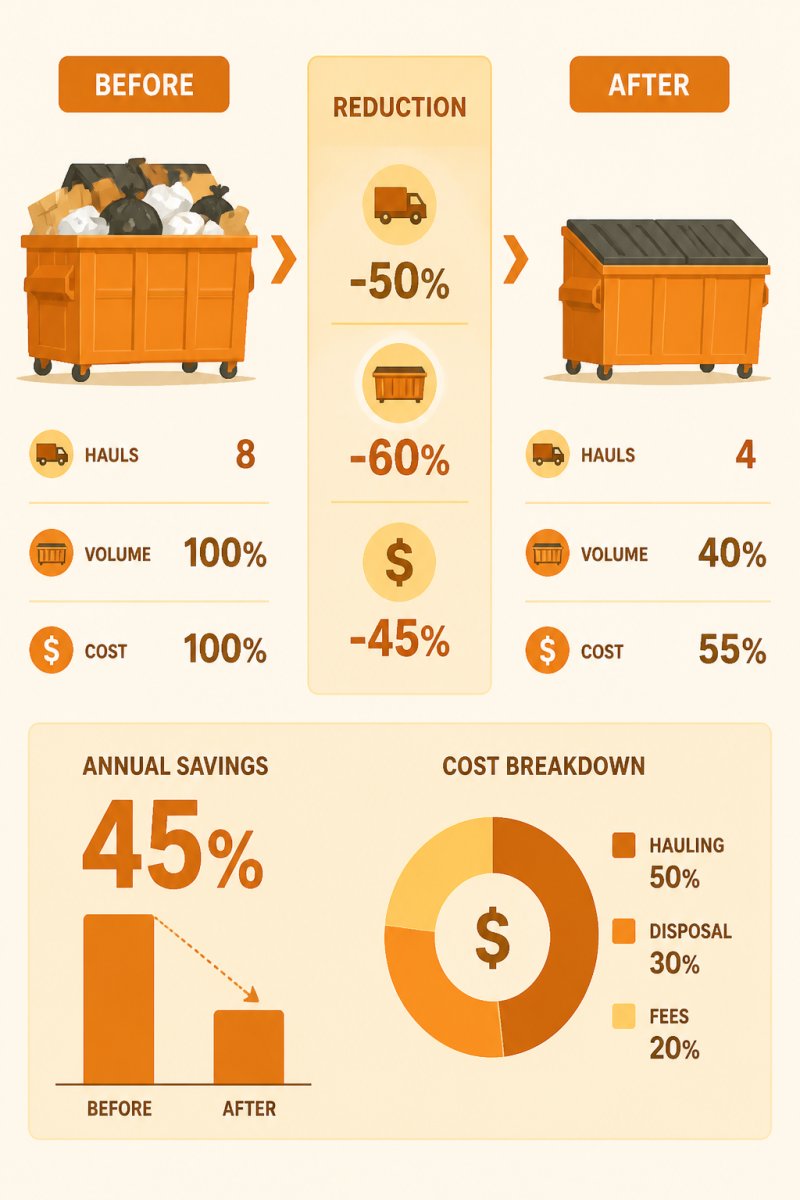
Industrial waste compaction benefits come down to one mechanism: you pay for volume, so you should ship the least volume possible. Mobile on-site compaction crushes the waste inside your roll-off dumpster, eliminating the empty space between items.
U.S. EPA waste reduction and recycling resources
Calculating Waste Hauling ROI: A Simple Framework
Waste hauling ROI is the total cost you avoid divided by the cost of the intervention. Most guides stop at that formula. The problem is that the biggest cost drivers in a commercial hauling bill are not the ones printed in bold on the invoice, they are the surcharges, escalators, and overage triggers buried in the contract.
Step 1: Baseline the Full Cost, Not the Headline Rate
Pull twelve months of invoices and build a line-item baseline. Do not accept a single "monthly service" total. Break out:
- Base hauling fee per pickup
- Tipping or disposal fee per ton (or per haul, depending on how your hauler prices)
- Fuel surcharge (often a percentage of the base, reset quarterly)
- Environmental or administrative fees
- Container rental or maintenance fees
- Overage charges for exceeding a weight or volume allowance
- Any "temporary" surcharge that has quietly become permanent
Step 2: Quantify the Volume You Are Actually Shipping
ROI on compaction depends on how much air you are paying to move. Two inputs matter:
- Average container fill level at pickup. If your dumpster is 40% full when the truck arrives, you are paying a full-haul price for less than half a haul of material.
- Compaction ratio for your waste stream. Cardboard, pallet wrap, and mixed packaging compact well; construction debris and heavy organics compact less. Use your own audit numbers rather than a generic figure.
Step 3: Recalculate Haul Count and Tipping Events
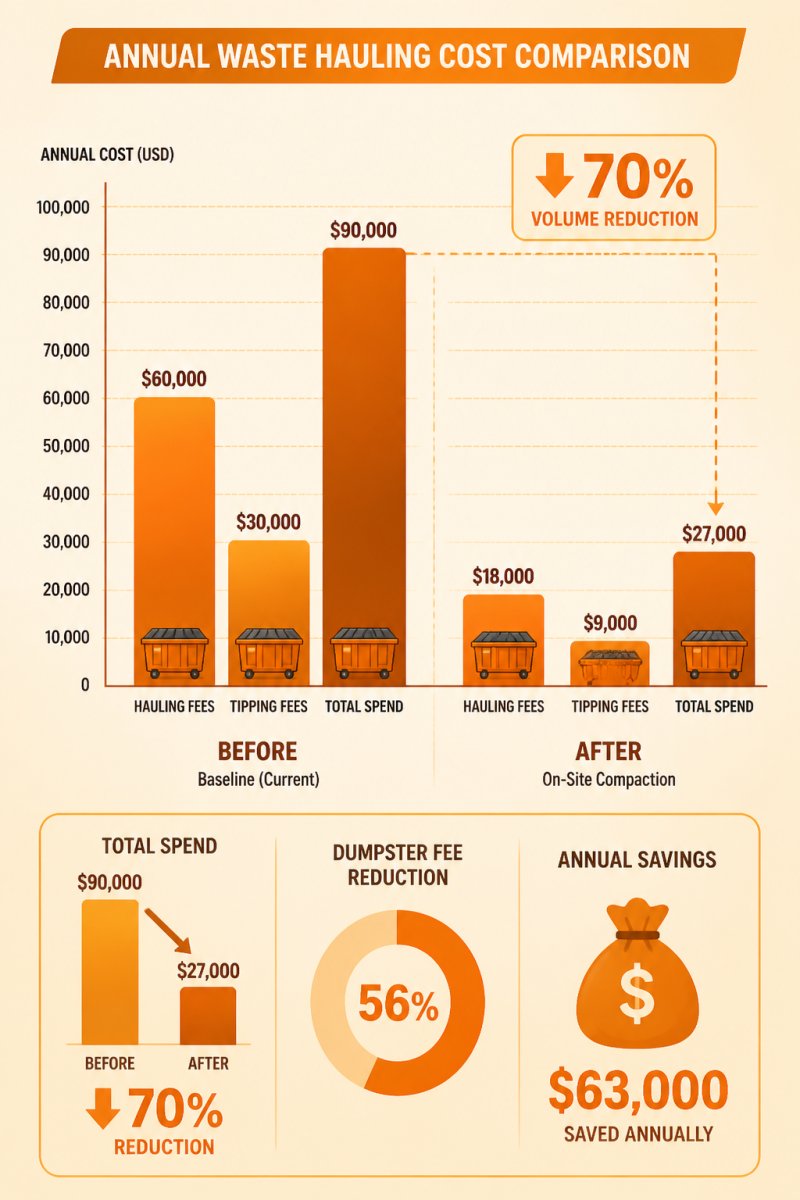
Divide your total waste volume by the compacted container capacity to get your new haul count. Then multiply by your per-haul rate and add back the tipping fees for the reduced number of disposal events. This is where the savings compound: fewer hauls means fewer base fees, fewer fuel surcharges, and fewer tipping events.
Step 4: Subtract the Intervention Cost, Including Contract Friction
Add the service fee, any equipment change, and, critically, any contract termination or renegotiation cost. If your current agreement has an automatic renewal clause, you may be locked in until the renewal window opens. That timing affects your payback period and should be modeled honestly.
Step 5: Divide Savings by Cost
The result is your return ratio. A ratio above 1.0 means the intervention pays for itself within the measurement period. Most practitioners find that compaction projects clear that bar quickly when fill levels are low and haul counts are high, but the math is site-specific.
Build Your Own ROI Calculator
| Input | Your Figure |
|---|---|
| Annual base hauling fees | $____ |
| Annual tipping / disposal fees | $____ |
| Annual fuel + environmental surcharges | $____ |
| Annual container rental / maintenance fees | $____ |
| Annual overage charges | $____ |
| Total annual spend (sum above) | $____ |
| Average container fill level at pickup | ____% |
| Hauls per month now | ____ |
| Estimated volume reduction from compaction | ____% |
| New hauls per month | ____ |
| Annual savings (base + tipping + surcharges avoided) | $____ |
| Service cost + any contract friction cost | $____ |
| ROI ratio (savings ÷ cost) | ____ |
Pricing depends on quantity, dates, and delivery, so request a quote for your specific sites rather than estimating from a generic table.
Source Reduction and Recycling Diversion: Shrinking the Waste Stream
Source reduction means generating less waste in the first place, and it is the cheapest ton of waste you will ever handle. Recycling diversion picks up what remains.
Practical moves for a commercial facility:
- Switch vendors to deliver in returnable containers instead of single-use packaging.
- Set up clearly labeled recycling stations at the point of generation, not in a far corner.
- Separate cardboard and organics, which are often the heaviest and most compactable streams.
- Track your waste diversion rate monthly as a KPI, alongside cost per ton.
Technology and Logistics: Monitoring, Routing, and Fleet Optimization
Technology turns guesswork into measurement, but only if the measurement is wired into your contract and your pickup schedule. Most guides describe bin-level sensors and routing software in the abstract. The tactical question is how that data reduces the line items on your invoice.
Bin-Level Monitoring: What It Actually Measures
Bin-level monitoring uses ultrasonic or weight sensors mounted inside a container to report fill percentage, and sometimes temperature or tilt, back to a dashboard. The output is a fill curve: how fast each container fills, and whether it is full at the moment the truck arrives.
How Monitoring Reduces Cost
Three mechanisms, in order of impact:
- Right-sizing containers. If a container never exceeds 60% fill, drop to a smaller size or reduce pickup frequency. This cuts the base hauling fee directly.
- On-demand pickup instead of fixed calendar. Instead of a Tuesday-and-Friday schedule regardless of fill, you schedule a pickup when the sensor crosses a threshold. Fewer hauls, same material moved.
- Overage avoidance. If your contract includes weight or volume allowances, monitoring tells you when you are approaching the trigger, before the overage charge hits.
The Hardware Trade-Off
IoT waste monitoring is still maturing, and the economics are site-specific. For a single small site with one container, the hardware and subscription cost may not pencil out against the savings from one fewer haul per month. For a distribution center, a plant, or a multi-site operation running several containers, the math usually works because the savings scale with haul count while the hardware cost scales with container count.
Routing and Fleet Optimization
For multi-site operations, routing software consolidates pickups across locations so a single truck services multiple containers on one route. The savings come from fewer truck trips, lower fuel spend, and less downtime waiting on a swap-out. The trade-off is that routing optimization only helps if your hauler is willing to adjust the schedule, which is a contract conversation, not a technology one.
Connecting Monitoring Data to Your Contract
This is the step most guides skip. Monitoring data is only valuable if you use it to renegotiate terms. Bring your fill-level data to your next contract review and use it to:
- Justify a smaller container size or reduced pickup frequency
- Push back on overage charges you can prove were triggered by a mis-sized container, not by actual volume
- Support a request to move from fixed-calendar pickup to on-demand or threshold-based service
Conclusion: Build a Waste Hauling Cost Reduction Plan That Sticks
Waste hauling cost reduction is not one fix. It is a sequence: audit what you throw away, renegotiate the contract that governs how it leaves, then shrink the volume you ship. Facilities that do all three consistently see the largest, most durable savings.
Frequently Asked Questions
How can businesses reduce waste disposal costs?
Start with a waste audit to see what you're actually paying for, then attack the biggest line items. On-site compaction can cut roll-off dumpster volume by up to 70%, which means fewer hauls and lower tipping fees. Renegotiating your hauling contract, right-sizing bin sizes, and setting up recycling diversion programs also reduce disposal costs. The combined effect of these steps is where the real savings live.
What factors influence commercial waste hauling rates?
Hauling rates depend on container size, pickup frequency, waste type, landfill distance, and local tipping fees. Heavy materials like shingles or construction debris cost more per haul than light commercial waste. Fuel surcharges and environmental fees also shift rates. Because so much of your bill reflects hauling empty space, reducing volume through compaction directly lowers what you pay per month.
How does on-site compaction reduce waste hauling frequency?
Mobile compactors crush waste inside your dumpster, so each container holds far more material before it's full. A roll-off that normally fills in a few days can last weeks, which means fewer truck trips and fewer hauling fees. For businesses with tight yard space, this also frees up room and reduces the number of dumpsters on site.
What are the hidden costs in commercial waste management contracts?
Common hidden costs include automatic annual escalators, fuel and environmental surcharges, overage fees when a bin is overweight, and long termination notice periods. Some contracts also charge for container maintenance or lock in automatic renewal. Reading the fine print before signing, and negotiating these clauses, is one of the most effective waste hauling contract negotiation tips for cutting long-term spend.
How can industrial facilities improve waste diversion rates?
Separate recyclables, organics, and general waste at the source, then train staff on what goes where. Set up clearly labeled bins and run periodic audits to catch contamination. Composting organic waste and finding recyclers for cardboard, metal, and pallets can push diversion rates higher. Higher diversion means less material going to landfill, which reduces both tipping fees and environmental impact.
How do I calculate waste hauling ROI before investing in compaction?
Track your current monthly hauling fees, tipping fees, and number of hauls. Estimate your volume reduction from compaction (up to 70% is typical), then calculate how many hauls you'd eliminate. Subtract the cost of the compaction service from your savings. If the net savings exceed your current spend by a meaningful margin, the ROI is there. Junk Crusher can help you model this for your sites.
