
How Much Does Dumpster Compaction Save? 2026 Guide
Table of Contents
- The Real Numbers Behind Dumpster Compaction Savings
- How On-Site Compaction Cuts Dumpster Hauling Frequency
- Compactor vs. Standard Dumpster: A Side-by-Side Comparison
- Mobile Trash Compactor Benefits for Jobsite Efficiency
- Commercial Waste Management Cost Reduction: Where the Savings Come From
- The Hidden Costs in Your Waste Hauler Contract
- Waste Stream Analysis: Which Materials Compact Best
- Conclusion: Running the Numbers Before You Sign Anything
- Frequently Asked Questions
Last Updated: September 10, 2026
The Real Numbers Behind Dumpster Compaction Savings
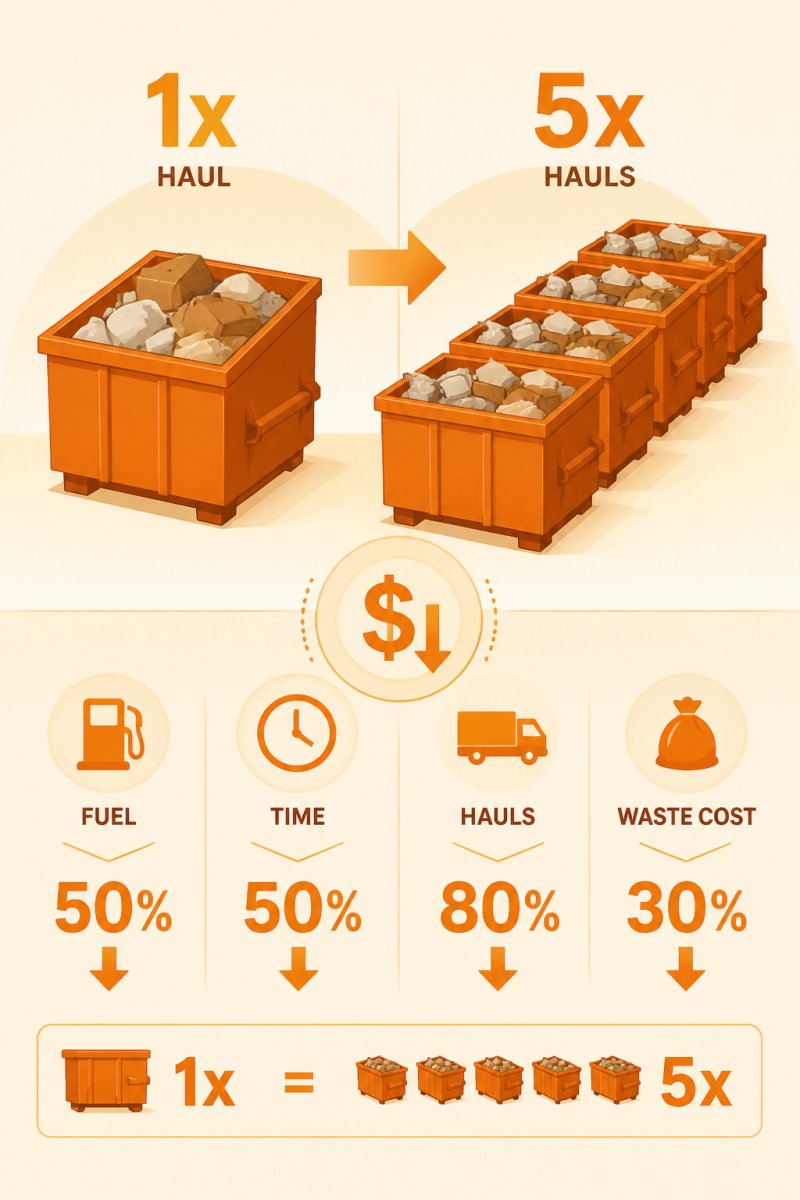
Dumpster compaction is the on-site process of crushing waste inside a roll-off container to increase its density, which means fewer hauls for the same amount of material. At Junk Crusher, we built our mobile service around one goal: stop paying to haul empty air.
The math is simple: if compaction cuts your volume by roughly half to two-thirds, you cut hauls by a similar share (the EPA). A site running four hauls a month can often drop to one or two.
How Compaction Ratios Turn Into Dollars
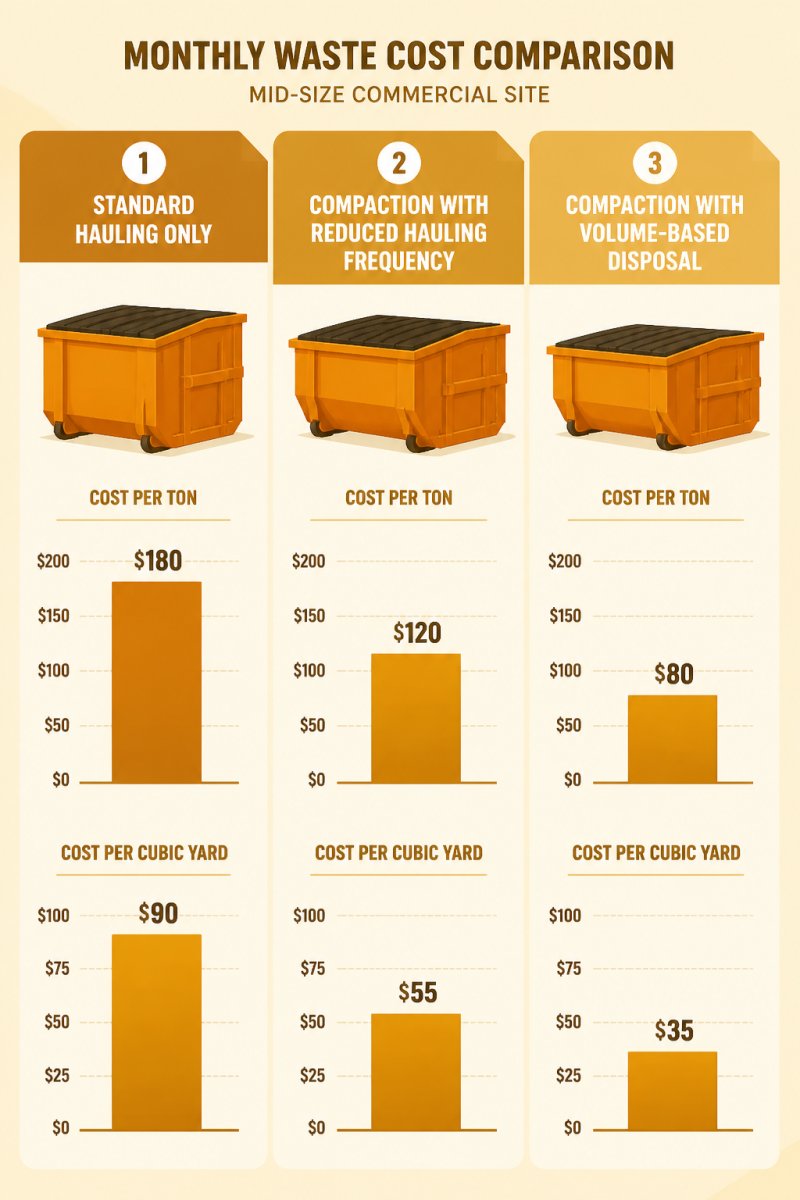
Compaction ratio is the measure of how much a compactor reduces waste volume compared with its loose state. A ratio of 3:1 means three loose cubic yards fit into one compacted cubic yard (the EPA).
The ratio drives every downstream saving. At 3:1, a dumpster that filled in a week now fills in three, and the same container carries three times the material per pull, so your recurring hauling costs fall in step with the volume reduction. Heavy materials like shingles or demolition debris gain less from bulk volume, which is why a waste stream analysis matters before you commit.
A Simple ROI Calculation You Can Run This Week
You do not need a spreadsheet to estimate your dumpster compaction return:
- Count your current hauls per month and the cost per haul on your invoice.
- Estimate your realistic compaction ratio for your main waste stream (2:1 for mixed light debris, higher for cardboard and packaging).
- Divide current hauls by the ratio to get your projected hauls.
- Multiply the haul reduction by your cost per haul for your monthly gross saving.
- Subtract the compaction service cost, then divide by that cost for your ROI percentage.
How On-Site Compaction Cuts Dumpster Hauling Frequency
On-site compaction reduces dumpster hauling frequency by increasing the density of waste already in the container. Instead of hauling a container full of air, you haul one packed with material.
Fewer hauls mean containers stay on site longer, fewer trucks queue in your yard, and your team spends less time coordinating pickups. For a facility juggling multiple containers, the reduction in waste management logistics is often worth as much as the direct disposal saving.
Volume Reduction Metrics by Waste Stream
Different materials compact at very different rates. Use these ranges as a starting point.
| Waste Stream | Typical Compaction Range | Effect on Haul Frequency |
|---|---|---|
| Cardboard and packaging | High | Largest reduction |
| Mixed commercial trash | Moderate to high | Moderate reduction |
| Roofing shingles | Low to moderate | Modest reduction |
| Construction debris | Moderate | Moderate reduction |
| Demolition material | Low | Small reduction |
Treat these as planning ranges, not guarantees. Actual results depend on container size, material mix, and how consistently compaction runs.
Compactor vs. Standard Dumpster: A Side-by-Side Comparison
A standard dumpster holds whatever you throw in it, including the air between items. A compacted dumpster holds the same container's worth of material, crushed to a fraction of its loose volume, a difference that shows up in how often you call for a haul and how much yard space you tie up.
| Factor | Standard Dumpster | Compacted Dumpster |
|---|---|---|
| Effective capacity | As-thrown volume | Multiplied by compaction ratio |
| Haul frequency | Higher | Lower |
| Yard space used | More containers | Fewer containers |
| Disposal efficiency | Lower | Higher |
| Setup demands | None | Scheduled compaction service |
Pros of compaction:
- Fewer hauls for the same material volume
- Better dumpster use per container
- Less yard congestion and fewer truck movements
Cons of compaction:
- Requires a scheduled service rather than a one-time rental
- Not every waste stream compacts well
- Needs clear site access for the compacting equipment
Mobile Trash Compactor Benefits for Jobsite Efficiency
Mobile compaction brings the equipment to your container instead of requiring you to move waste to a fixed compactor. The mobile trash compactor benefits show up fastest on tight sites where space and downtime both carry a cost.
A fixed compactor needs a permanent pad, power, and a dedicated location. A mobile unit arrives, compacts the containers you already have, and leaves, no pad to pour, no equipment to relocate between jobs. For roofing and renovation crews working from a residential driveway, that difference is the whole point.
The efficiency gain is about job site downtime. Every haul is a truck entering, positioning, and leaving, so fewer hauls mean fewer interruptions, often the saving operators notice first.
Junk Crusher's mobile service is built for exactly this pattern, and for clients who also need containers, our dumpster rental service covers 20 and 25 yard roll-offs alongside compaction.
Commercial Waste Management Cost Reduction: Where the Savings Come From
Commercial waste management cost reduction from compaction comes from four places, and most operators only count the first.
- Fewer hauls. The largest and most visible saving.
- Lower disposal fees. Many landfills and transfer stations charge by volume or a combination of volume and weight, so less volume means less of that charge (the EPA).
- Less labor and coordination. Fewer pickups mean fewer calls, gate checks, and staff time managing containers.
- Reduced footprint. Fewer truck trips lower fuel use and emissions, which matters for sustainability initiatives and reporting.
Every haul you eliminate is a truck trip you no longer generate, which shows up in your waste footprint metrics.
The Hidden Costs in Your Waste Hauler Contract
Your hauler contract is where the biggest, least visible costs hide, and where the compaction math either works or falls apart. Most operators negotiate the per-haul rate and ignore the billing structure underneath it, the structure that determines whether volume reduction becomes real savings or just a lighter container that costs the same to empty.
Tonnage Billing vs. Volume Billing: Why It Changes Everything
Waste haulers bill one of two ways, and the difference decides your compaction ROI:
- Volume-based billing charges by the container or cubic yard. A 20-yard roll-off costs the same to pull whether it holds loose or crushed cardboard, so compaction is close to a pure win: fewer pulls, each carrying more material for the same flat rate.
- Tonnage-based billing charges by weight, often a per-ton disposal fee plus a haul charge. Compaction does not reduce weight, so you save on the haul charge per pull but the per-ton fee stays flat, shrinking savings to the haul-frequency portion only.
- Hybrid billing, a flat haul charge plus a per-ton overage above an included weight, is the most common commercial structure. Crushing more material into one container can push you past the included weight and trigger overage charges that eat the haul savings.
How to Read Your Invoice Before You Compact
Pull three months of invoices and answer four questions:
- Is the recurring charge per pull, per ton, or both?
- Is there an included weight allowance per container, and what happens above it?
- Does the contract specify a minimum number of pulls per month regardless of fill level?
- Are fuel, environmental, and container rental fees fixed or variable?
If your contract is volume-based with no weight cap, compaction is straightforward. If it is tonnage-based or hybrid, model the weight before the volume.
Contract Clauses That Quietly Cancel Your Savings
Beyond the billing structure, read for these clauses before you sign or renew:
- Automatic annual escalators that raise your rate on a schedule you did not negotiate.
- Fuel and environmental surcharges added on top of the quoted rate, often compounding with the escalator.
- Minimum haul guarantees that bill you for pickups even when containers are not full, the direct enemy of compaction.
- Container rental fees that continue regardless of use, so fewer containers is a real saving only if the contract lets you return them.
- Exclusive service clauses that prevent you from adding on-site compaction equipment from another provider.
That last clause is the one most operators miss. If your contract locks you into their equipment or prohibits third-party processing on site, you may not be able to compact at all without renegotiating.
Renegotiating With Compaction Data in Hand
Compaction gives you leverage at renewal that you do not have today. When you can show a hauler that your pull count will drop by half, the honest conversation is about restructuring the rate rather than pretending the volume stays the same. Operators who bring actual compaction ratios and projected pull counts to the table tend to get a better per-pull rate than operators who simply ask for a discount, because the hauler can see the reduced service cost on their side.
The takeaway: compaction savings are real, but the contract decides how much of them you keep. Model your billing structure first, then your volume reduction.
Waste Stream Analysis: Which Materials Compact Best
A waste audit tells you which streams to compact and which to leave alone, but the useful version is quantitative. The materials that compact best share one trait: low bulk density. The ones that compact poorly are already dense, so crushing them yields little volume gain and risks an overweight container.
Bulk Density: The Number That Predicts Your Savings
Bulk density is weight per unit of volume, typically pounds per cubic yard for waste streams. It is the single best predictor of how much compaction will help you, because compaction reduces volume, not weight. A stream with low bulk density has a lot of air to squeeze out. A stream with high bulk density does not.
Use these ranges as planning starting points, not guarantees. Actual density varies with moisture, compaction history, and how the material was loaded.
| Waste Stream | Typical Bulk Density (lb/cu yd) | Typical Compaction Ratio | Effect on Haul Frequency |
|---|---|---|---|
| Cardboard, flattened | 50-150 | 4:1 to 8:1 | Largest reduction |
| Mixed packaging and film | 100-250 | 3:1 to 6:1 | Large reduction |
| Mixed commercial trash | 200-500 | 2:1 to 4:1 | Moderate reduction |
| Wood pallets and crating | 250-500 | 2:1 to 3:1 | Moderate reduction |
| Construction debris (mixed) | 400-800 | 1.5:1 to 3:1 | Modest reduction |
| Roofing shingles | 700-1,000 | 1.2:1 to 2:1 | Small reduction |
| Concrete, brick, rubble | 1,500-2,500 | 1:1 to 1.3:1 | Minimal reduction |
How to Estimate Savings Per Stream
Once you have a density estimate, the savings math becomes concrete. For each stream:
- Estimate the loose cubic yards your site generates per month.
- Multiply by the compaction ratio to get compacted cubic yards.
- Divide your current container volume by the compacted volume to get your new pull frequency.
- Multiply the pull reduction by your per-pull cost, but only if your contract bills by volume. If it bills by tonnage, apply the weight check below.
The Weight Check That Saves You From a Bad Decision
Before you compact any stream aggressively, run the weight math. Take your container's rated weight limit and divide it by the compacted density of the stream to see how many cubic yards you can put in before you hit the limit.
A 20-yard roll-off with a 4-ton (8,000 lb) limit, filled with compacted cardboard at 400 lb per cubic yard, hits its weight limit at 20 cubic yards, the full container. That works. The same container filled with compacted shingles at 1,200 lb per cubic yard hits the limit at under 7 cubic yards, so you can only fill a third before you are overweight. Compacting shingles into a 20-yard box is a losing move under tonnage billing.
This is why the smart play on a mixed site is separation. Compact the bulky, light material aggressively; leave the dense material in its own container and manage it by weight. That single change improves waste management optimization more than any equipment upgrade on a site handling more than one material type.
Running a Two-Week Audit That Actually Tells You Something
If you are unsure where your streams fall, run a short audit before you commit:
- Weigh each container before pickup using a portable scale or the hauler's ticket weight.
- Note the fill level and dominant material in each container.
- Divide weight by estimated volume to get a rough bulk density for that stream.
- Repeat for two weeks to smooth out one-off loads.
Most sites discover one or two streams doing most of the volume damage, and those are the streams worth compacting. The rest are better managed by weight and kept out of the compactor entirely.
Conclusion: Running the Numbers Before You Sign Anything
The honest answer to how much dumpster compaction saves is that it depends on your compaction ratio, your waste mix, and the fine print in your hauler contract. Operators who model all three before committing consistently find the saving is real; operators who assume a single headline number often find it is smaller than promised.
That is the gap Junk Crusher was built to close. Our mobile on-site compaction reduces roll-off volume by up to 70%, cuts the number of required hauls, and works across construction, demolition, and manufacturing sites. We pair that with a straightforward dumpster rental service offering 20 and 25 yard containers, so you are not coordinating two vendors.
Book a Crush with Junk Crusher and see what your own numbers look like before you commit to anything.
Frequently Asked Questions
How does on-site compaction reduce the number of dumpster hauls?
On-site compaction crushes waste inside the dumpster, increasing its density and freeing up air space. A roll-off that would normally fill in two days can last five or more, depending on the waste stream. That directly lowers dumpster hauling frequency, which is where most of the recurring cost sits. Fewer pulls mean fewer haul charges, fewer fuel surcharges, and less jobsite downtime waiting on a swap. For high-volume sites like distribution centers or roofing crews, the reduction in hauls is usually the single biggest line-item saving.
Is mobile compaction more cost-effective than renting additional dumpsters?
Renting extra dumpsters adds capacity but also adds rental fees, delivery charges, and yard space use. Mobile compaction increases the capacity of the dumpster you already have, so you avoid stacking containers on a tight site. You also sidestep the tonnage fees that come with heavier loads, because compaction does not add weight, it adds density. For most commercial operations, the math favors compaction once haul frequency crosses a certain threshold. Junk Crusher offers 20 and 25 yard dumpsters for sites that need a matched container setup.
What types of waste compact best, and which do not?
Cardboard, mixed packaging, roofing shingles, wood debris, and general construction waste compact well and show strong volume reduction. Metals and dense demolition rubble compact less because they are already heavy and low-volume. Food waste and liquids should not go into a dry compactor. A quick waste stream analysis before you commit tells you which containers to target first. Most facilities find that two or three waste streams account for the majority of their hauling spend, and those are the ones worth compacting.
How do I know if compaction will actually pay off for my site?
Pull three months of hauler invoices and note the number of pulls, the disposal fees, and any fuel or environmental surcharges. Then estimate your compaction ratio by waste type, typically two to four times volume reduction for mixed commercial waste. Multiply your current pull count by the expected reduction and compare that against the service cost. If the site fills a dumpster in under a week, compaction usually pays back quickly. If a dumpster lasts a month, the savings are smaller and a waste audit should come first.
