

Why Your Business Is Paying for Empty Dumpster Space
Table of Contents
- Why Your Business Is Paying for Empty Dumpster Space
- What Dumpster Pickup Frequency Actually Costs You
- How to Reduce Dumpster Pickups Without Slowing Down Your Site
- Dumpster Fill Level Monitoring: Stop Guessing, Start Measuring
- When a 20 Yard Dumpster Rental Beats Extra Pickups
- On-Site Compaction: The Fix for Hauling Air
- Conclusion
- Frequently Asked Questions
Last Updated: October 8, 2026
Why Your Business Is Paying for Empty Dumpster Space
Most operations managers have watched a truck pull up to a dumpster that is barely half full and haul it away anyway. That is the core problem behind why your business is paying for empty dumpster space. You are not buying waste removal. You are buying truck trips, and a truck trip costs the same whether the container is packed to the rim or sitting at 40 percent capacity.
At Junk Crusher, we work with manufacturing plants, distribution centers, and construction crews across Western Pennsylvania, and this is the single most common source of wasted spend we see. Below, we break down where the money goes, how to tell if your pickups are running too often, and the practical fixes that cut hauls without slowing your site down.
Empty dumpster space is the unused volume inside a roll-off container that gets hauled to the landfill anyway. Every haul bills you for the full container, not the waste inside it.
That definition matters because it reframes the whole problem. The goal is not fewer pickups for their own sake. The goal is making sure each pickup happens when the container is actually full.
What Dumpster Pickup Frequency Actually Costs You
Pickup frequency is the number of times your hauler empties a container in a set period, and it drives most of your waste bill. Hauling contracts usually bundle a base container rate with a per-pull charge, plus landfill tipping fees based on weight.
Here is the trap. Most commercial hauling agreements set a fixed pickup schedule rather than a fill-based one. The truck comes every week or every two weeks whether you need it or not.
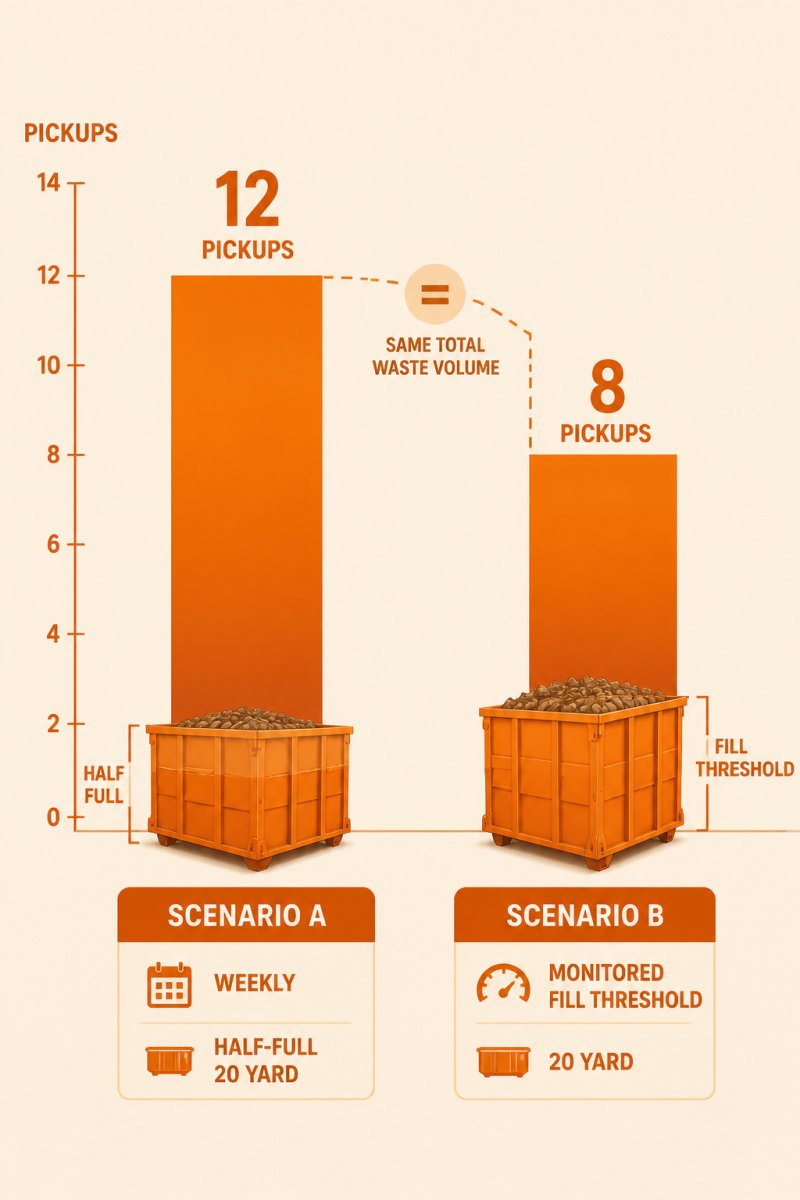
The Flat-Rate Trap in Commercial Hauling Contracts
Flat-rate hauling feels predictable, and that predictability is exactly what costs you. When a contract locks in a set number of pulls per month, the hauler has no incentive to optimize when they happen.
The result is a truck dispatched to a container that is not ready. You pay for the pull, the fuel, and the driver time. None of that changes based on how much debris was inside.
A common mistake is signing a multi-year agreement without a fill-threshold clause. Once that is locked in, you are paying for the schedule, not the service.
How to Tell If Your Dumpster Is Being Hauled Too Often
You do not need special equipment to spot the pattern. Look for these signals:
- The driver arrives and the container is visibly below the rim
- Your hauler swaps containers on a fixed day regardless of load
- You are renting extra containers to hold overflow between scheduled pulls
- Your site manager calls for an early swap "just to be safe"
- Debris is stacked beside the dumpster because the last pull came too soon
Two or more of these means you are paying for air.
How to Reduce Dumpster Pickups Without Slowing Down Your Site
The fastest way to cut pickups is to increase how much waste fits in each container. More material per haul means fewer hauls for the same job.
Start with the free fixes:
- Break down cardboard and pallets before they hit the container
- Keep heavy material and light material in separate dumpsters
- Assign one person to manage the dumpster throughout the shift
- Post a simple sign showing what goes in and what stays out
- Track how full the container is before each scheduled pickup
These steps cost nothing and often cut one or two pulls a month. But they only go so far. Loose debris will always leave gaps.
That is where compaction changes the math. On-site compaction presses the waste down so the same container holds far more material. Junk Crusher's mobile service crushes dumpster waste where it sits, reducing roll-off volume by up to 70 percent. Fewer cubic yards of air means fewer trucks on the road.
Dumpster Fill Level Monitoring: Stop Guessing, Start Measuring
Fill level monitoring is the practice of tracking how full a container actually is so pickups are triggered by data instead of a calendar. It is the difference between guessing and knowing.
You have two paths, and both work.
Low-Tech Tracking That Works on a Busy Jobsite
Not every site needs sensors. A simple manual log does the job:
- Mark a line inside the container at the halfway point
- Have the site lead note the fill level at the end of each shift
- Log the date, level, and any large debris drop
- Call for a pickup only when the log shows the container at or near full
- Review the log monthly against your hauler invoices
This takes about two minutes a day. Over a month, it tells you exactly how often you were paying for a container that was not ready.
For larger operations running multiple sites, sensor-based monitors that report fill percentage remotely are worth the cost. They remove the human step and give you a dashboard across every location.
| Tracking Method | Effort | Best For | What It Catches |
|---|---|---|---|
| Visual line + paper log | Low | Single sites, small crews | Obvious early pickups |
| Shift checklist in a shared app | Medium | Multi-crew jobsites | Pattern of too-frequent pulls |
| Remote fill sensors | Higher setup | Multi-site operations | Real-time fill across locations |
Whichever you pick, the point is the same: replace the calendar with a measurement.
When a 20 Yard Dumpster Rental Beats Extra Pickups
A 20 yard dumpster rental often solves a capacity problem that extra pickups only paper over. If your site fills a smaller container before the scheduled pull, the instinct is to add a second dumpster or call for an early haul. Both add cost.
Sizing up is usually cheaper than hauling more often. A 20 yard container holds roughly four to five pickup truck loads of debris, which covers most roofing tear-offs, renovation cleanouts, and light commercial jobs.
Here is how to decide:
- Stay with your current size if the container is rarely more than half full at pickup
- Move to a 20 yard if you regularly overflow before the scheduled pull
- Add compaction instead of size if your waste is bulky and light
- Combine a larger container with compaction if you run high volume daily
We offer 20 and 25 yard dumpsters for commercial clients, and pairing the right size with on-site crushing is where most of the savings land. You can review container options on our dumpster rental page.
The trade-off is space. A larger container needs more yard room, and tight urban sites may not have it. That is the one case where compaction alone beats upsizing.
On-Site Compaction: The Fix for Hauling Air
On-site compaction is the direct answer to paying for empty space. Instead of hauling a container of loosely packed debris, you crush it down first and haul a dense, full load.
The process is simple. A mobile unit comes to your site, compacts the waste inside your existing container, and leaves. No new equipment to buy, no container swap, no long shutdown.
What it changes:
- Fewer hauls for the same volume of waste
- Less yard space tied up in overflow containers
- Fewer truck trips, which cuts fuel use and emissions
- Less downtime waiting on unscheduled pickups
For roofing crews dealing with shingles, the weight matters as much as the volume. Compaction lets you get closer to the container's weight limit before you call for a pull, so you stop paying for trips that haul mostly air.
Conclusion
The hard part is not knowing that empty space costs money. It is changing a hauling routine that has run on autopilot for years. Start with a fill log, size your container correctly, and compact before you haul.
That is what we do at Junk Crusher. Our mobile compaction service reduces roll-off volume by up to 70 percent, cuts dumpster fees, and lowers your truck-trip count across every site you run. Book a Crush with Junk Crusher and stop paying to haul air.
Frequently Asked Questions
Why is my business dumpster being emptied when it is not full?
Most commercial hauling contracts run on a fixed schedule, so the truck arrives whether the container is full or not. If your dumpster sits at 40 percent when the driver shows up, you are paying to move air. The other common cause is a locked-in pickup frequency set years ago when your waste volume was higher. Review your service agreement and compare the scheduled pickups against your actual fill levels for a month before you renegotiate.
How do businesses reduce the number of dumpster pickups?
Start by tracking fill levels daily so you know when a container is genuinely full. Then separate heavy, dense material like shingles, cardboard, and demolition debris from bulky lightweight waste, since dense loads fill a dumpster faster by weight. Compacting waste on site is the biggest lever: crushing material in the container lets you fit more into the same space, so the hauler visits less often for the same volume of debris. Adjust your pickup frequency to match the new reality.
Does compacting waste reduce dumpster hauling frequency?
Yes. Compaction increases the density of material inside the container, so more waste fits before the dumpster is full. That directly cuts the number of hauls needed for a given amount of debris. For operations generating bulky waste like cardboard, packaging, or construction debris, the reduction in haul count is where the savings show up.
When should a business choose a larger dumpster instead of more frequent pickups?
A larger container makes sense when your waste volume is steady and you have the yard space to hold it. A 20 yard dumpster rental fits mid-size renovation projects, roofing tear-offs, and warehouse cleanouts where debris accumulates fast but hauling is expensive. If space is tight or volume spikes unpredictably, on-site compaction of a smaller container often beats renting a bigger one, because you avoid paying for a large container that sits half empty between hauls.


