
Waste Compactor Installation Requirements for Businesses
Last Updated: November 9, 2026
Quick Summary
Waste compactor installation for businesses requires room for the equipment and a service truck, a load-bearing pad, a power supply sized to the unit's nameplate rating, and early local code review covering permits, zoning, fire separation, and drainage. OSHA machine guarding standards also govern guarding, lockout/tagout, and training.
- Measure weekly waste volume, dominant materials, and whether the pad, drainage, and electrical service can support the unit.
- Ask your local authority early about permits, zoning for outdoor compacting, and fire separation distances.
- A stationary compactor needs a reinforced pad, drainage, permits, and a dedicated service and disconnect.
- A self-contained compactor adds liquid-tight containment for wet or food-heavy waste streams.
- Mobile on-site compaction needs clear access for the service vehicle and no power at the site.
Table of Contents
- Waste Compactor Installation Requirements for Businesses: What to Plan First
- Commercial Trash Compactor Site Preparation and Power Needs
- Waste Compactor Safety Standards OSHA and Local Code Checks
- What to Include on Your Installation Checklist
- Choosing Between a Fixed Compactor and On-Site Compaction
- Next Step: Get Your Site Assessed Before You Order Anything
- Frequently Asked Questions
Waste Compactor Installation Requirements for Businesses: What to Plan First
Waste compactor installation requirements for businesses typically involve room for the equipment and a service truck, a load-bearing pad, a power supply sized to the unit, and local code review.
Commercial Trash Compactor Site Preparation and Power Needs
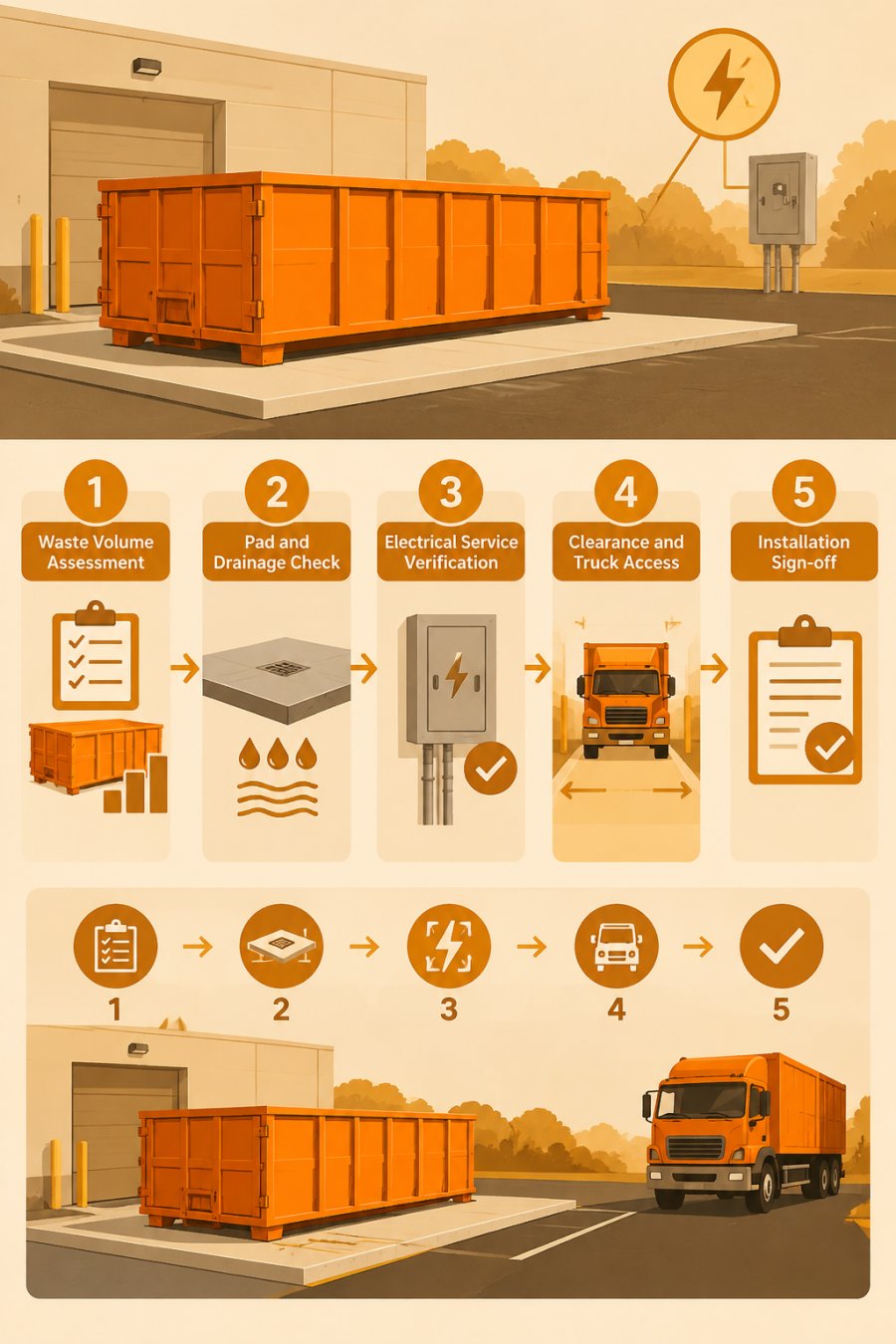
Start by measuring your waste stream: weekly volume, dominant materials, and whether the pad, drainage, and electrical service can support the unit. Match power to the nameplate rating of the equipment you are considering. See our guides on how to make mobile waste compaction work for your facility and the service schedule for mobile waste compaction.
Waste Compactor Safety Standards OSHA and Local Code Checks
Treat safety and code review as a design input. OSHA's machine guarding standards govern guarding, lockout/tagout, and training, while permits, zoning, fire separation, and drainage come from your local authority, so ask early whether the site needs a permit, whether zoning allows outdoor compacting, and what fire separation distances apply. Compare commercial trash pickup versus compaction and traditional versus on-site waste compacting if you are still deciding.
What to Include on Your Installation Checklist
A written checklist gives your installer, electrician, and hauler one shared reference. A compactor a hauler cannot service is equipment you paid for and cannot use.
Choosing Between a Fixed Compactor and On-Site Compaction
A stationary or self-contained compactor means capital outlay, a permanent pad, dedicated power, and maintenance. A mobile on-site compaction service brings equipment to your existing dumpster, crushes in place, and leaves the container ready for a normal haul. Our guide on whether waste compaction is safe for dumpsters answers that directly.
| Approach | Site Work Required | Power Needed | Best For |
|---|---|---|---|
| Stationary compactor | Reinforced pad, drainage, permits | Dedicated service and disconnect | High-volume, single-site operations |
| Self-contained compactor | Pad plus liquid-tight containment | Dedicated service | Wet or food-heavy waste streams |
| Mobile on-site compaction | Clear access for the service vehicle | None at the site | Sites wanting volume reduction without construction |
Next Step: Get Your Site Assessed Before You Order Anything
The requirements are the same whether you buy equipment or bring in a service, and the assessment decides which path fits, so if space or power is tight, start with a walkthrough rather than a purchase order.
Junk Crusher provides mobile on-site dumpster compaction for commercial clients across Western Pennsylvania. We crush waste in your existing roll-off container, which can reduce dumpster volume by up to 70% and reduce the number of hauls your site needs. Results vary by site, and pricing depends on quantity, dates, and delivery. Book a crush at your site or contact us for a quote.
Frequently Asked Questions
What are the electrical requirements for a commercial trash compactor?
Most commercial compactors run on three-phase power with a dedicated disconnect switch, but voltage and amperage vary by model and compactor type. Stationary units often need a specific circuit sized to the motor, while self-contained units may need more. Confirm the nameplate rating before ordering equipment, and have a licensed electrician verify your service panel can carry the load. If your site lacks the right service, plan for an upgrade before delivery day.
Do I need a concrete pad for a waste compactor?
A reinforced concrete pad is standard for most stationary and self-contained compactors because the equipment and loaded container are heavy. The pad should be level, sized to the compactor footprint plus clearance for operation and maintenance, and graded for drainage. Confirm thickness and reinforcement with the equipment supplier and a local contractor. Skipping a proper pad can cause settling, misalignment, and costly repairs.
How much space is required for a standard commercial compactor installation?
Space depends on compactor size and container length, but plan for the unit footprint, clearance for the loading door and safety interlocks, and room for the hauler truck to approach and pull the container. Leave access for maintenance and technician inspection. Measure your yard or loading area before choosing a model, and confirm truck turning radius. Tight sites may suit a mobile compaction service instead of a permanent install.


