
Is Waste Compaction Safe for Dumpsters? A 2026 Guide
Table of Contents
- How Waste Compaction Works and Why It Matters
- The Real Safety Risks of Compacting Dumpsters
- Structural Integrity and Material Fatigue in Steel Dumpsters
- Mobile Dumpster Compaction Benefits for Busy Job Sites
- Dumpster Maintenance and Safety: An Inspection Checklist
- Best Smash My Trash Alternatives for On-Site Compaction
- Conclusion
- Frequently Asked Questions
Last Updated: September 22, 2026
How Waste Compaction Works and Why It Matters
Waste compaction is the mechanical process of pressing refuse into a smaller volume inside a container so fewer hauling trips are needed. Whether it is safe for dumpsters depends on the equipment doing the crushing and the condition of the container receiving it. This guide covers where the real risks sit, how to spot a dumpster no longer fit to be compacted, and the safety protocols that keep crews safe.
Manual Tamping vs. Mobile Mechanical Compaction
Manual tamping means a worker leaning into an open-top dumpster with a pole, a board, or their own weight to press debris down. It is the oldest method on a job site and the most dangerous: workers balance on the rim above unstable material that can shift without warning.
The Real Safety Risks of Compacting Dumpsters
Every safety risk in dumpster compaction traces back to the material, the machine, or the container. Knowing which one you are dealing with tells you what to control.
Crushing, Puncture, and Flying Debris Hazards
Crushing hazards exist wherever a person can be caught between moving equipment and a fixed surface. During compaction, that zone is the space between the ram and the container walls; anyone inside it when a cycle starts is at serious risk, which is why a hard perimeter is non-negotiable.
Hydraulic and Electrical Dangers on Site
Hydraulic systems operate under extreme pressure. A pinhole leak can inject fluid into skin, a medical emergency rather than a minor injury. Hoses routed across wet ground create trip hazards, and a hose run over by equipment can fail without warning.
Structural Integrity and Material Fatigue in Steel Dumpsters
Steel dumpsters are engineered to resist vertical, distributed loads, waste pressing down on the floor and outward against the walls. Compaction applies a different load profile: a concentrated, cyclical point force from above, often off-center, often on a partially full container. That mismatch is the most overlooked factor in compaction safety.
How Steel Actually Fails Under Compaction
Structural steel has a yield point, the stress at which it stops springing back and starts deforming permanently. Below that point, the container flexes and returns; above it, every cycle adds permanent strain. Compaction rarely pushes a sound container past yield in one pass. The damage accumulates instead.
Three mechanisms drive most field failures:
- Low-cycle fatigue at welds. Weld toes are geometric stress risers. Repeated flexing initiates hairline cracks that grow with each cycle until the joint separates.
- Local buckling of side walls. A ram pressing off-center bows the wall outward. Once the wall bows, it carries load less efficiently and bows further on the next pass.
- Floor yield under point load. The floor is typically the thinnest structural member relative to the load it carries. A ram concentrating force over a small area can push the floor past yield, producing the characteristic center dip.
Why Gauge and Container Class Matter
Not all dumpsters are built to the same duty class. Light-duty containers for household or light commercial refuse use thinner steel than heavy-duty containers rated for construction debris. The difference shows up in wall and floor gauge, the number and spacing of structural ribs, and how the floor is reinforced at the rails.
Signs of Container Deformation and Compromised Load Capacity
Container deformation is any permanent change to the shape of the dumpster that was not there when it was delivered: bowed side walls, a floor that dips in the center, doors that no longer seat properly, and weld seams with visible cracking.
| Warning Sign | What It Indicates | Action |
|---|---|---|
| Bowed side walls | Local buckling from off-center compaction | Stop compaction, inspect seams |
| Cracks at weld points | Low-cycle fatigue at stress risers | Remove from compaction service |
| Floor dipping in center | Structural yield under point load | Reduce load, schedule inspection |
| Doors not seating | Frame distortion | Repair before next cycle |
| Rust perforation | Thinning steel, reduced section | Retire the container |
The Liability and Insurance Angle Most Guides Skip
Compaction changes the risk profile of a container, which can affect how a loss is handled. If a dumpster fails during hauling and shows evidence of progressive deformation that was never documented, an insurer may treat the loss as a maintenance failure rather than a sudden accident, a distinction that can affect coverage.
Mobile Dumpster Compaction Benefits for Busy Job Sites
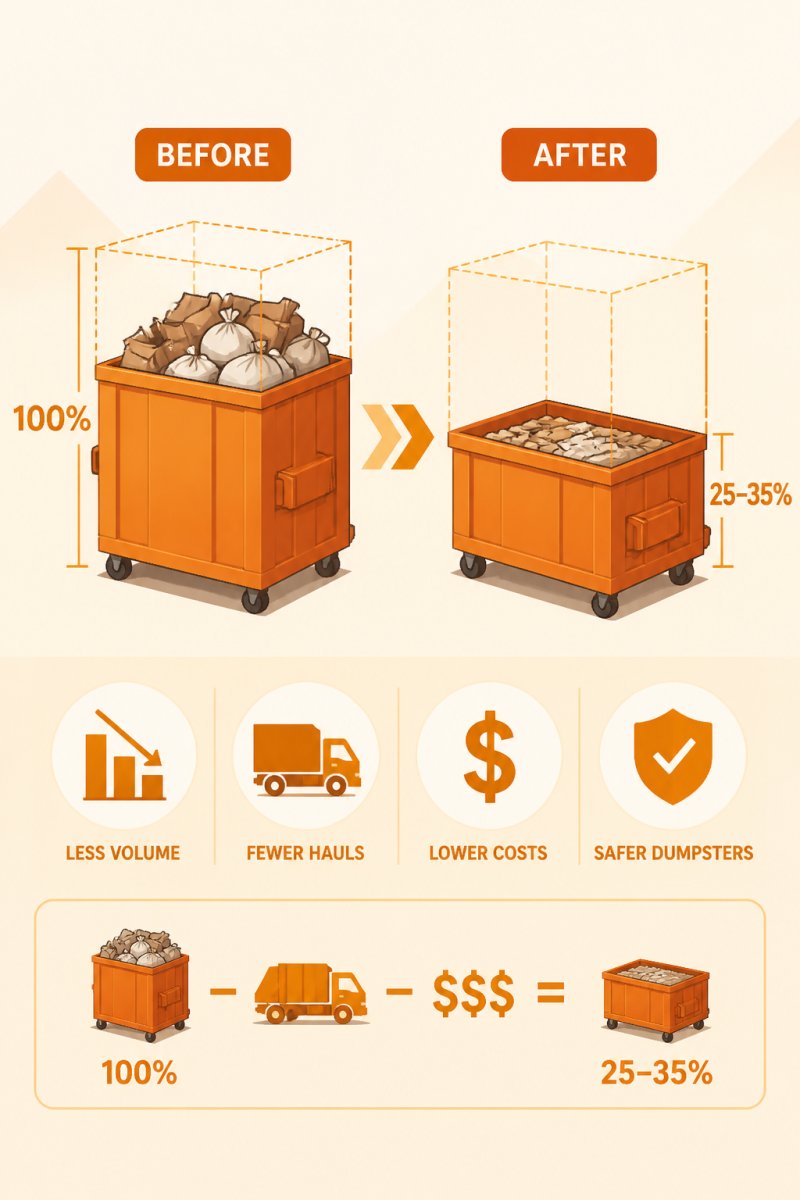
Mobile dumpster compaction benefits start with hauling frequency. Because material is pressed down, each container holds more usable volume, meaning fewer pulls and less money spent moving air.
Dumpster Maintenance and Safety: An Inspection Checklist
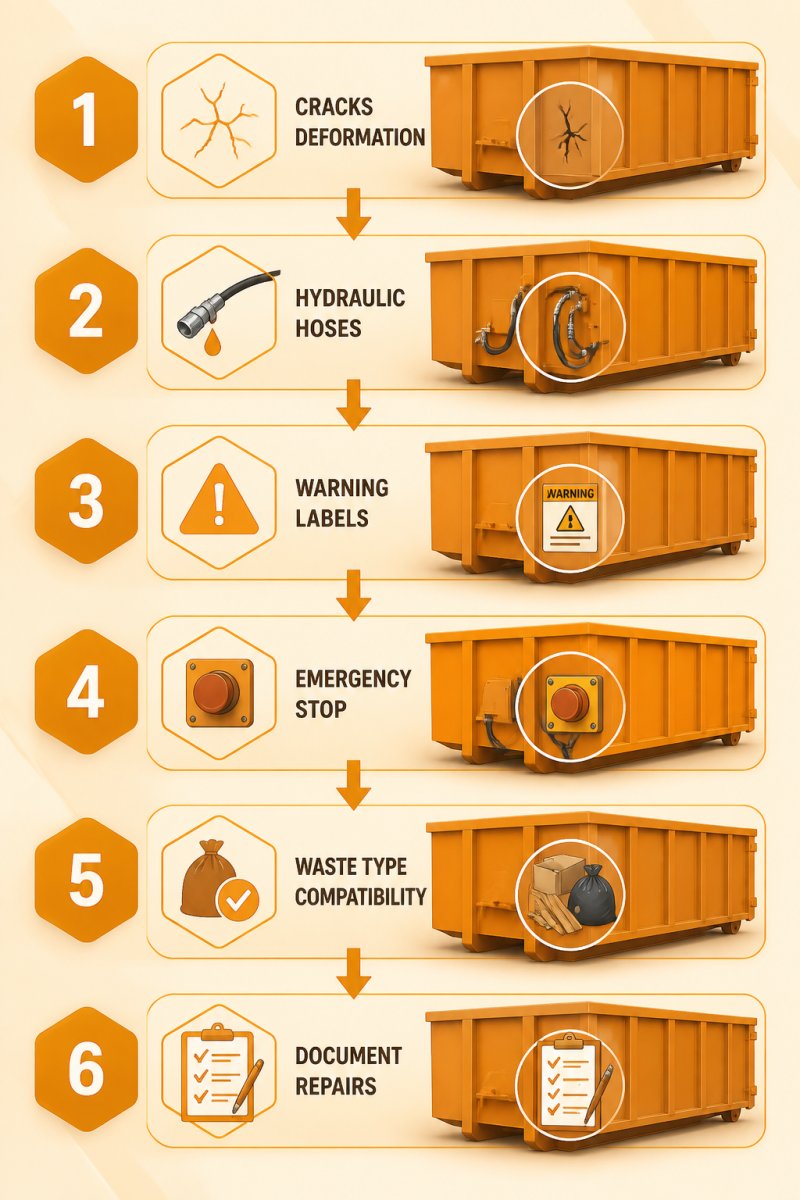
Run this checklist before any compaction cycle. It takes a few minutes and it is the difference between a routine job and an incident report. Each item has a pass/fail criterion so the decision is not a judgment call in the moment.
Pre-Compaction Inspection
- Walk the container perimeter. Pass: no new cracks, bowing, or weld separation. Fail: any visible crack or permanent bow, pull from service.
- Check the floor. Pass: flat, no soft spots, no perforation. Fail: center dip, spongy feel underfoot, or rust holes, pull from service.
- Confirm doors. Pass: open, close, and seat flush against the frame. Fail: misalignment or gaps, repair before next cycle.
- Inspect hydraulic hoses. Pass: no abrasion, bulging, or damp fittings. Fail: any of those, replace before the next cycle.
- Verify labels and placards. Pass: warning labels and capacity placards legible. Fail: illegible, replace before operation.
- Test the emergency stop. Pass: unit halts immediately when actuated. Fail: any delay, lock out the unit until repaired.
- Confirm waste compatibility. Pass: dry, rigid, non-hazardous material. Fail: wet, organic, liquid, or hazardous, do not compact.
- Clear personnel and set the perimeter. Pass: no one inside the container or within the swing radius. Fail: hold the cycle until the area is clear.
- Document findings. Pass: log completed and repairs scheduled. Fail: do not return the container to compaction service.
Emergency Shutdown Procedure
The checklist covers the normal case; this procedure covers the abnormal one, a hose rupture, a jammed ram, a container deforming mid-cycle, or a person entering the perimeter. Every operator on site should be able to execute it without looking it up.
- Hit the emergency stop. Do not attempt to reverse the ram first. Stop the cycle, then diagnose.
- Isolate the power. For electric units, disconnect at the source. For hydraulic units, shut down the prime mover and relieve system pressure per the manufacturer's procedure.
- Establish and hold the exclusion zone. Keep everyone clear of the container and the unit until pressure is confirmed released. A jammed ram can release stored energy without warning.
- Account for personnel. Confirm every crew member is outside the perimeter before anyone approaches the equipment.
- Do not reach into the container. Never place hands, tools, or body weight into a container with a jammed or partially cycled ram.
- Document and tag out. Record the event, tag the unit out of service, and do not restart until the fault is corrected and the container is re-inspected.
Best Smash My Trash Alternatives for On-Site Compaction
Anyone comparing on-site compaction providers should weigh four things: how the equipment handles their waste stream, how often it can be serviced, how the process protects the container, and whether the provider documents what they did.
Conclusion
The challenge with dumpster compaction is not the technology but the discipline around it. Containers fatigue, hoses fail, and crews get complacent, all manageable with a checklist and a schedule.
Frequently Asked Questions
Does mobile waste compaction cause structural damage to dumpsters?
Mobile compaction can stress a dumpster's steel walls and floor, especially if the container is older or already showing material fatigue. Reputable operators inspect the dumpster before every cycle and avoid overloading. If you see bowing, cracked welds, or a warped floor, stop compacting and have the container repaired or replaced. Standard open-top dumpsters are not built for unlimited pressure, so pairing compaction with regular inspections keeps the container within its load capacity.
What types of waste are safe to compact in a standard dumpster?
Dry, non-hazardous debris compacts well: cardboard, wood pallets, drywall, roofing shingles, and general construction waste. Never compact hazardous waste, liquids, food waste, or anything that can explode or ignite. Wet waste and organic materials add weight without reducing volume, which can push the dumpster over its load limit. If you are unsure whether a material is safe, ask your compaction provider or check local disposal rules before the cycle begins.
Are there OSHA safety standards for dumpster compaction?
OSHA does not publish a single standard for dumpster compaction, but several general rules apply. The lockout/tagout standard (29 CFR 1910.147) covers hazardous energy control during maintenance. Machine guarding (29 CFR 1910.212) applies to exposed moving parts, and the powered industrial trucks standard (29 CFR 1910.178) covers forklifts used near the container. Employers must also provide PPE and train workers on crushing, hydraulic, and electrical hazards before any compaction work.
How does professional mobile compaction differ from manual compaction?
Manual compaction means a worker with a tamper or a machine pushes waste down inside the dumpster. It is slow, puts the worker near crushing and puncture hazards, and rarely gets more than a modest volume reduction. Professional mobile compaction uses a heavy hydraulic ram mounted on a truck or trailer to press waste down from outside the container. The operator stays clear of the crush zone, and volume reduction can reach up to 70%, which cuts hauling frequency and recurring hauling fees.
