
Traditional vs On-Site Waste Compacting: 2026 Guide
Table of Contents
- How Traditional Waste Hauling Works and Where It Falls Short
- What On-Site Waste Compacting Changes
- Traditional vs On-Site Compacting: Side-by-Side Comparison
- Mobile Dumpster Compaction: How a Service Call Works
- Commercial Waste Compactor Options for Different Facilities
- Waste Compaction for Construction Sites: Shingles, Debris, and Tight Lots
- Total Cost of Ownership and Break-Even Analysis
- Frequently Asked Questions
Last Updated: October 7, 2026
How Traditional Waste Hauling Works and Where It Falls Short
Traditional waste hauling means renting a container, filling it over days or weeks, and paying a hauler to pull it away whether it is full or not. At Junk Crusher, we see the same pattern across manufacturing plants, warehouses, and roofing crews: the dumpster leaves half empty, and the invoice never changes.
The U.S. Environmental Protection Agency's waste management guidance makes the core point plainly. Waste hauling is billed by volume and truck trips, not by weight alone, so every cubic yard of air you ship is a cubic yard you paid for.
The Empty-Space Problem
Cardboard, shingles, and mixed debris do not settle. A 20-yard roll-off loaded with flattened boxes might hold 30% material and 70% air. The hauler charges for the container, not the contents. Over a year, that gap compounds: more pulls, more invoices, more yard space tied up in containers that are technically "full" but visually half empty.
When Traditional Hauling Still Makes Sense
Traditional hauling fits when waste volume is genuinely low, when a site has no room for equipment access, or when a project runs only a few weeks. Small offices and light retail rarely generate enough material to justify anything else.
What On-Site Waste Compacting Changes
On-site waste compacting is the process of crushing waste inside the container at your facility before it is hauled, so each dumpster holds more material and leaves less often.
The change is structural, not cosmetic. According to the EPA's sustainable materials management overview, reducing the number of collection trips is one of the more direct ways a business lowers the emissions tied to its waste stream.
The Compacting Process, Step by Step
- Site review. We confirm container type, access, and waste stream before scheduling.
- Equipment arrival. A mobile compaction unit comes to your location.
- Compaction cycle. Waste inside the roll-off is crushed down, typically in repeated passes.
- Capacity check. The container is assessed and compacted again if room remains.
- Hauling. The container leaves full, not half empty, and the cycle repeats.
A typical service call takes well under an hour on site, which matters when your crew is mid-shift and the yard is already tight.
Traditional vs On-Site Compacting: Side-by-Side Comparison
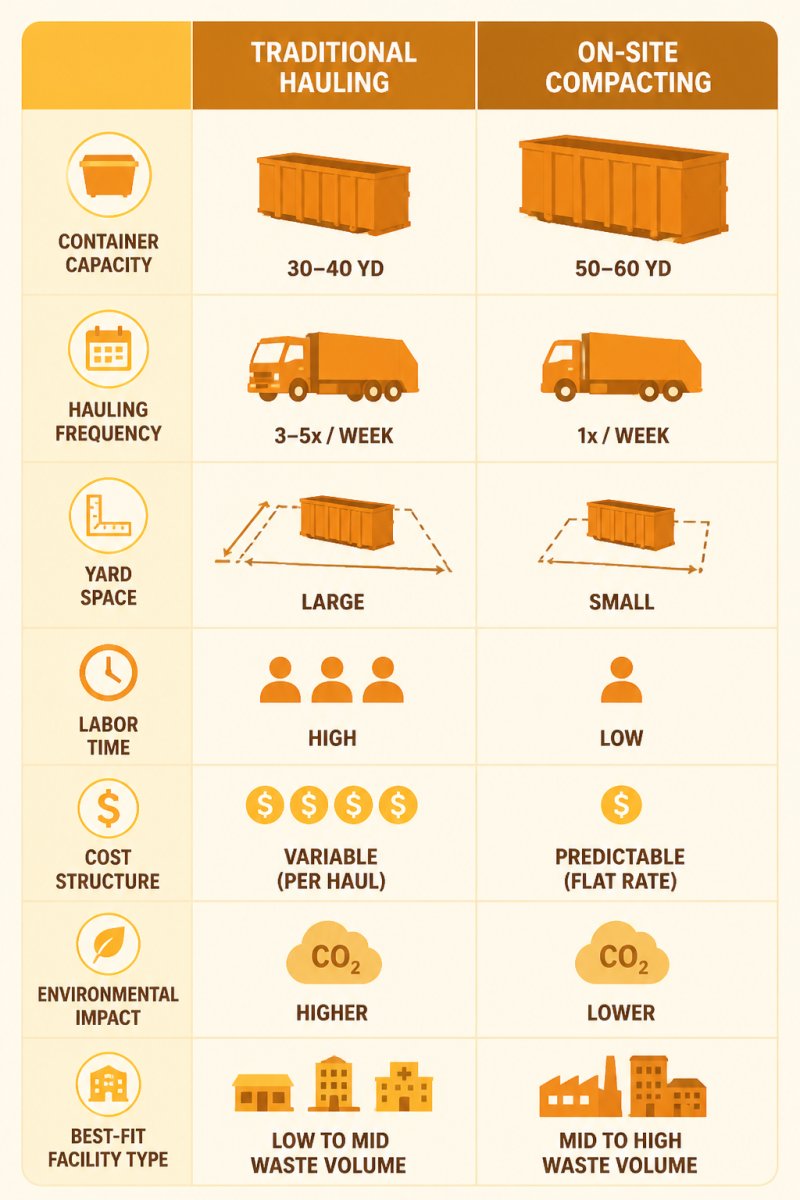
Traditional hauling wins on simplicity and upfront cost; on-site compacting wins on volume, hauling frequency, and yard efficiency.
| Criteria | Traditional Hauling | On-Site Compacting |
|---|---|---|
| Container capacity used | Low, often half empty | High, material compressed |
| Hauling frequency | Frequent | Fewer pulls |
| Yard space | More containers needed | Fewer containers on site |
| Labor time | Repeated container swaps | One scheduled service call |
| Cost structure | Per pull, per container | Per service, fewer hauls |
| Environmental impact | More truck trips | Fewer truck trips |
| Best fit | Low-volume sites | High-volume, tight sites |
Mobile Dumpster Compaction: How a Service Call Works
Mobile dumpster compaction is a service where the compaction equipment travels to your site rather than sitting permanently in your yard. That distinction matters for construction and demolition work, where the container location changes as the project moves.
Junk Crusher provides this service for commercial clients across Western Pennsylvania, crushing waste inside your roll-off dumpster on site to reduce volume by up to 70% and cut the number of hauls you pay for.
What to Expect On-Site
- A scheduled arrival window that fits your operating hours
- Compaction performed in your existing roll-off container
- No permanent equipment installation or long-term lease
If your site also needs containers, we offer dumpster rental alongside compaction so the whole cycle stays with one provider.
Commercial Waste Compactor Options for Different Facilities
Choosing a commercial waste compactor setup comes down to four variables: waste volume, waste stream, available space, and collection access. Most competitors list equipment types without tying them to those variables, which is why so many sites end up with a compactor that is oversized, undersized, or pointed at the wrong material.
The Four Selection Variables
- Volume. Measure cubic yards per week, not containers per week. A site filling one 20-yard container twice a week moves roughly 40 cubic yards; one filling it monthly moves about 5. The first has a compaction case; the second usually does not.
- Waste stream. Dry, bulky material (cardboard, pallet wrap, shingles, wood) compacts well. Wet or putrescible material needs a self-contained unit that controls leachate. Hazardous, regulated medical, and electronic waste should never enter a general compactor.
- Space. A stationary compactor needs a concrete pad, power, and clearance for container swaps. A self-contained unit needs a similar footprint but no separate container. Mobile compaction needs only access for the service vehicle and the existing container.
- Collection access. If a haul truck cannot reach the container, no compactor type solves the problem. Confirm turning radius, overhead clearance, and gate width before selecting equipment.
Equipment Types and Where They Fit
- Stationary compactor. Installed on a pad, pairs with a container swapped when full. Best for high-volume, dry waste at a fixed location, distribution centers, manufacturing plants, retail backrooms.
- Self-contained compactor. Compactor and container in one unit. Best for wet or high-volume waste where leachate control matters, food processing, some healthcare streams, grocery.
- Mobile compaction. Equipment travels to the existing container. Best for construction and demolition, roofing, and sites where the container location changes or permanent installation is impractical.
| Facility Type | Typical Waste Stream | Selection Driver | Recommended Approach |
|---|---|---|---|
| Distribution center | Cardboard, pallet wrap | High dry volume, fixed location | Stationary or mobile compaction |
| Manufacturing plant | Packaging, general waste | Mixed stream, fixed location | Stationary or mobile compaction |
| Commercial construction | Mixed debris, wood | Changing container location | Mobile compaction on site |
| Roofing contractor | Shingles, tear-off debris | Heavy, bulky, tight lots | Mobile compaction on site |
| Healthcare facility | General waste, regulated streams | Stream separation required | Stationary compactor with strict stream control |
| Grocery or food service | Wet, putrescible waste | Leachate control | Self-contained compactor |
| Small office or light retail | Low-volume general waste | Low volume, no equipment space | Traditional hauling |
Contamination Limits and Stream Separation
A compactor does not sort. Whatever goes in comes out as one stream. That creates three hard limits:
- Recyclables mixed into general waste become general waste. The volume savings are real, but the recycling value is gone. If cardboard volume justifies a baler or separate recycling container, keep it out of the compactor.
- Wet waste contaminates dry waste. A self-contained unit handles wet material; a stationary unit pointed at mixed wet and dry waste produces leachate and odor problems.
- Regulated and hazardous streams require separate handling. Medical waste, solvents, batteries, and electronics have their own disposal chains and should never enter a general compactor.
Operational Trade-Offs to Plan For
Every compactor type adds operational requirements traditional hauling does not:
- Training. Staff need to know what can and cannot go in, and how to load it so the compactor cycles efficiently.
- Loading routine. Compactors work best loaded in consistent batches, not a steady trickle that never fills a cycle.
- Downtime. Stationary and self-contained units need scheduled maintenance; mobile compaction needs a service window that fits your operating hours.
If your site also needs containers, we offer dumpster rental alongside compaction so the whole cycle stays with one provider.
Waste Compaction for Construction Sites: Shingles, Debris, and Tight Lots
Waste compaction for construction sites solves a specific problem: heavy, bulky material in a small footprint. Roofing tear-off, shingles, and mixed demolition debris leave a dumpster looking full at 40% capacity.
Tight lots make it worse. With no room for a second container, the only lever left is how much the first one holds.
For project managers, the gain is fewer hauling interruptions during the busiest phase of a job.
Total Cost of Ownership and Break-Even Analysis
Total cost of ownership for waste handling is not the invoice from your hauler. It is the sum of container rental, hauling fees, labor spent on swaps and loading, yard space tied up in containers, and downtime while a full container waits for a pull. Traditional hauling hides part of that cost because the invoice only shows pulls, not the empty space inside each one.
The Inputs You Need Before You Compare
Pull six numbers from your last three months of waste invoices and your operations log:
- Container rental, monthly charge per container, including any fuel or environmental surcharges.
- Hauling fee per pull, the all-in charge each time a container leaves.
- Pulls per month, count every pull, including emergency overflow pulls.
- Labor hours per swap, time your staff spends staging, loading, or waiting on a swap, multiplied by a loaded labor rate.
- Yard space cost, the monthly rent or opportunity cost of the square footage each container occupies, including access clearance.
- Downtime cost, production or project hours lost while a full container blocks work or waits for a pull.
Most practitioners find items 4 through 6 change the answer. A site paying for three containers when one compacted container would do is paying rent, labor, and downtime on two containers that are not earning anything.
A Transparent Break-Even Method
The break-even calculation is a ratio, not a guess:
- Current monthly hauling cost = (pulls per month) × (hauling fee per pull) + (containers) × (monthly rental).
- Compacted monthly hauling cost = (pulls per month ÷ volume reduction factor) × (hauling fee per pull) + (containers) × (monthly rental).
- Compaction service cost = the quoted per-service or per-month charge for the compaction service.
The volume reduction factor drives everything. A container leaving half full has a reduction factor near 2; one packed with flattened cardboard or shingles can see 3 or higher. Set that factor by measuring: estimate the material in a typical container before compaction, then measure again after a pass. Do that twice and you have a site-specific number instead of a vendor claim.
A Worked Example
Assume a site runs two 20-yard containers, pays for four pulls per month, and each pull is billed at a flat rate. If compaction cuts pulls to two per month and the compaction service costs less than the two eliminated pulls, the site breaks even in the first month. If the site also eliminates one container rental and one swap per week of labor, break-even moves earlier.
| Cost Factor | Traditional Hauling | On-Site Compacting |
|---|---|---|
| Container rental | Per container, per month | Per container, per month, often fewer containers |
| Hauling fees | Every pull | Fewer pulls, same fee per pull |
| Labor for swaps and loading | Repeated | Reduced to scheduled service windows |
| Yard space cost | Higher, more containers and clearance | Lower, fewer containers on site |
| Downtime | Swap waiting time, overflow pulls | Scheduled, predictable |
| Service or equipment cost | None beyond rental | Compaction service charge |
What Changes the Answer
Three variables move the break-even more than anything else:
- How empty your containers leave. A container leaving at 40% capacity has more room for savings than one leaving at 80%.
- How far the hauler travels. Longer hauls mean higher per-pull fees, making each eliminated pull worth more.
- How much labor is tied up in swaps. Sites pulling a container weekly spend more staff time on waste than sites pulling monthly.
If your site also needs containers, we offer dumpster rental alongside compaction so the whole cycle stays with one provider.
Frequently Asked Questions
What is the difference between traditional waste hauling and on-site waste compaction?
Traditional waste hauling picks up dumpsters on a fixed schedule regardless of how full they are, so you pay to transport empty air. On-site waste compacting crushes material inside the dumpster before pickup, which can reduce waste volume by up to 70 percent. That means fewer hauls, lower disposal costs, and less yard space tied up in containers. The right choice depends on your waste stream, site layout, and collection schedule.
How does mobile dumpster compaction work?
A mobile compaction unit travels to your site and compacts the waste already inside your roll-off dumpster. The process takes minutes per container, not hours, so it fits between deliveries or shift changes without disrupting operations. Once compacted, the container holds significantly more material before it needs to be hauled. You keep your existing dumpster and hauler relationship while gaining the volume reduction of a commercial waste compactor.
Can on-site compaction reduce the number of dumpster hauls?
Yes. Because compacted waste takes up less space, each container holds more material before it is full. For facilities generating steady waste streams, this can cut hauling frequency substantially. Fewer hauls mean lower transport costs, less truck traffic in your yard, and a smaller carbon footprint. The exact reduction depends on your material mix and how often you currently schedule pickups.
What materials can be compacted in a commercial dumpster?
Cardboard, packaging waste, general refuse, wood debris, and roofing shingles compact well. Recyclables can be compacted if your hauler accepts compacted material. Avoid compacting liquids, hazardous waste, or anything that could damage equipment. If your waste stream includes heavy or abrasive material, confirm suitability with your compaction provider before scheduling service.
When is a traditional dumpster service a better choice than mobile compaction?
Traditional service works well for low-volume sites, locations with limited access for compaction equipment, or facilities whose waste stream is mostly liquid or non-compactable. If your dumpsters rarely fill before pickup, compaction may not deliver enough savings to justify the change. The best approach is to compare your current hauling costs and collection schedule against compaction service pricing for your specific site.
Waste costs creep up quietly, one half-empty haul at a time, until the annual spend is hard to justify. Junk Crusher brings mobile dumpster compaction to your site, reduces roll-off volume by up to 70%, and cuts the number of hauls you pay for, all without permanent equipment or a long-term lease. We serve construction sites, distribution centers, and manufacturing facilities across Western Pennsylvania. Book a Crush with Junk Crusher and start paying for material instead of air.


