Industrial Trash Compactor Errors: Safe Diagnostic Guide
Last Updated: November 2, 2026
Quick Summary
To troubleshoot trash compactor errors safely, lock out and tag the main power first, then read the exact fault code on the control panel before guessing at a cause. Fix the underlying problem before resetting, and call a technician for hydraulic leaks, a pump or motor that will not run, or repeated codes after a reset.
- Shut off and lock out main power before opening any panel or access door.
- Write down the exact error code and light pattern before diagnosing.
- A reset clears a fault but does not repair a jam or low fluid level.
- Call a technician for a ram stuck away from home position or repeated codes.
- Check hydraulic fluid level and color weekly to prevent repeat faults.
Table of Contents
- Safety First: Isolate Power Before You Troubleshoot Industrial Trash Compactor Errors
- Industrial Compactor Error Codes and Control-Panel Diagnostics
- How to Reset a Garbage Compactor and Clear Common Faults
- When to Call a Technician and How to Prevent Downtime
- Frequently Asked Questions
Safety First: Isolate Power Before You Troubleshoot Industrial Trash Compactor Errors
A stopped compactor is costly, but the first step is not a repair. Before touching a control panel or opening an access door, shut off and lock out the main power, industrial compactors run on high voltage and store hydraulic pressure, both dangerous even when the machine looks dead. This guide covers the safe way to handle trash compactor errors.
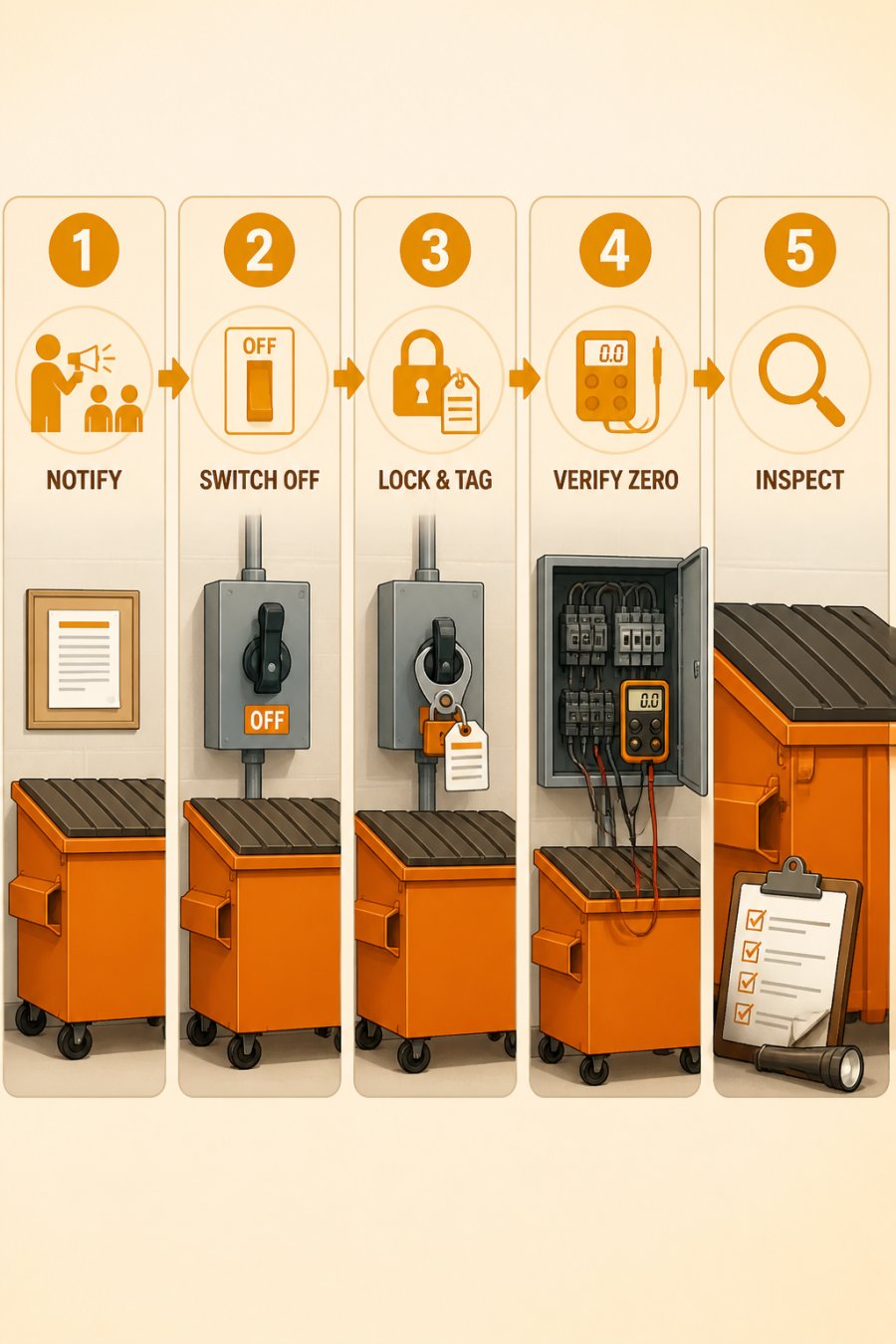
Lock out in this order: notify every operator, flip the main disconnect to OFF, apply your lock and tag, test the controls to confirm zero power, then open the panel. Skipping the lock lets a coworker restart the unit while your hands are inside.
Industrial Compactor Error Codes and Control-Panel Diagnostics
Error codes are your fastest clue, so read the panel before guessing at a cause, write down the exact code and light pattern. You can also compare on-site compacting against traditional dumpster setups to decide whether service or replacement is the better path.
| Panel Signal | Likely Cause | Safe Operator Check |
|---|---|---|
| No lights, no response | Power supply or main disconnect issue | Confirm the disconnect is ON and the breaker has not tripped |
| Fault code at cycle start | Loading door or interlock not made | Check the door is fully closed and the interlock switch is clean |
| Ram will not return home | Hydraulic or sensor fault | Note the code and stop; this needs a technician |
How to Reset a Garbage Compactor and Clear Common Faults
Most faults clear with a proper reset, but only after you fix the cause, a reset does not repair a jam or low fluid level. It is also worth checking whether you are paying for empty space in your industrial dumpsters, which affects whether compaction is working efficiently. Confirm the disconnect is ON and your lock is removed, close and latch the loading door, release the emergency stop, clear any jam by hand (never with power on), press reset, then run one test cycle and watch the ram return home.
If the compactor won't stop running or cycles on its own, the control circuit has a fault, shut it down and call a technician. Never reach into the chamber to clear a jam while the unit has power; use a tool, not your hands. After a reset, top off hydraulic fluid to the marked level and check hoses and fittings for leaks, a small leak today becomes a pump failure later. Following a recommended service schedule helps prevent the error from recurring.
A simple maintenance checklist prevents most repeat calls:
- Check hydraulic fluid level and color weekly
- Inspect hoses and fittings for leaks
- Clean the door interlock switch
- Test the emergency stop
- Log every fault code and reset
When to Call a Technician and How to Prevent Downtime
Call a pro for hydraulic leaks you cannot trace, a pump or motor that will not run, a ram stuck away from home position, or repeated error codes after a reset. Document every fault with the code, time, and what the machine was doing. A framework for tracking waste management performance metrics can help you spot patterns behind recurring faults. Prevention beats repair: keep fluid clean, clear jams early, and stick to the service schedule. If a breakdown leaves you with more waste than your equipment can handle, Junk Crusher's dumpster rental service offers 20 and 25 yard dumpsters, and dumpster compaction can reduce the volume of waste you need to haul. Pricing depends on quantity, dates, and delivery, so request a quote for current rates.
Frequently Asked Questions
How do I reset an industrial trash compactor?
Press the reset button on the control panel after clearing the fault, then confirm the loading door is fully closed and the emergency stop is pulled out. If the unit does not restart, check the main disconnect switch and inspect for a waste jam. Never reach into the chamber to clear a jam before isolating power. If the reset does not hold, the issue is likely a failed interlock or hydraulic fault that needs a technician.
What are the most common reasons an industrial trash compactor will not start?
The usual culprits are a tripped breaker or open main disconnect, a loading door that is not fully closed, an engaged emergency stop, or a failed door interlock switch. A jammed ram or low hydraulic fluid can also prevent the cycle from starting.
When should I stop troubleshooting and call a qualified technician?
Stop and call a technician if you see hydraulic fluid leaks, smell burning wiring, find damaged hoses or fittings, or if the pump or motor fails to respond after power and interlock checks pass. Any fault inside the control panel or involving the hydraulic pump, motor, or ram should be handled by a qualified service technician. Operators should limit themselves to safe external checks.
When a compactor keeps failing, the real fix may be less waste volume and fewer hauls. Junk Crusher brings mobile on-site dumpster compaction to your site, reducing roll-off volume by up to 70% and cutting dumpster fees by up to 56%. Our service fits construction sites, distribution centers, and manufacturing plants, and it lowers truck trips and your carbon footprint. Get started with Junk Crusher and book a crush to see how much empty space you can stop paying for.


