
Waste Compaction Downtime for Manufacturing Sites
Table of Contents
- Why Waste Compaction Downtime Costs More Than You Think
- Primary Causes of Industrial Trash Compactor Downtime
- Industrial Waste Compactor Maintenance Checklist
- Mobile Dumpster Compaction Services: Reducing Scheduled Downtime
- Waste Hauling Cost Reduction Strategies That Protect Uptime
- Root Cause Analysis and Lean Integration for Compactor Reliability
- Emergency Response Protocols When Compaction Equipment Fails
- Frequently Asked Questions
Last Updated: September 11, 2026
Why Waste Compaction Downtime Costs More Than You Think
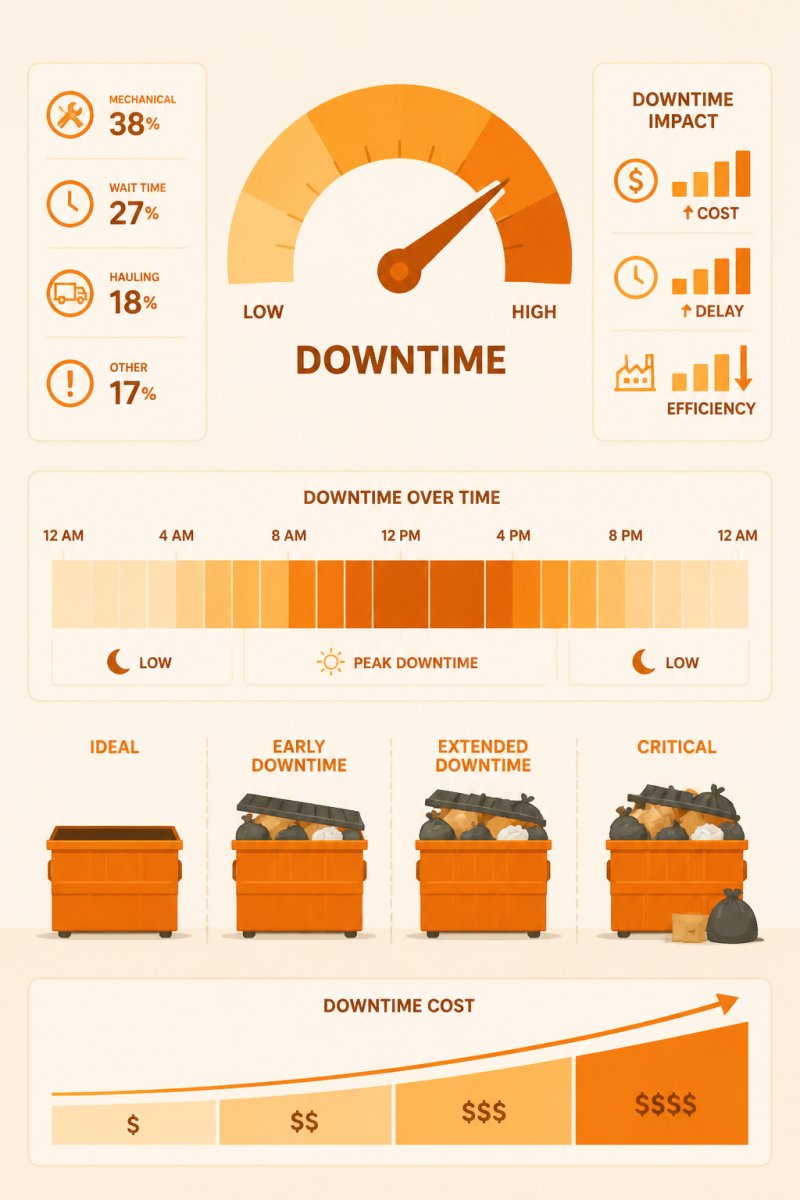
Waste compaction downtime is the period when a trash compactor stops working and your waste stream keeps coming. At Junk Crusher, we see plants treat that stoppage as a housekeeping problem. It is not. It is a production problem wearing a janitor's uniform.
The cascade is predictable. Trash backs up at the baler or compactor. Crews divert labor to hand-hauling debris. Trailers sit half-loaded because nobody can top them off. Then a hauler arrives on a fixed schedule and bills you for air.
Downtime Costs by the Numbers: OEE and Throughput Impact
Overall Equipment Effectiveness, or OEE, is the standard measure of how much productive time a plant actually gets from its equipment (nist.gov). Waste handling rarely appears in the OEE calculation, which is exactly why it gets ignored until it hurts.
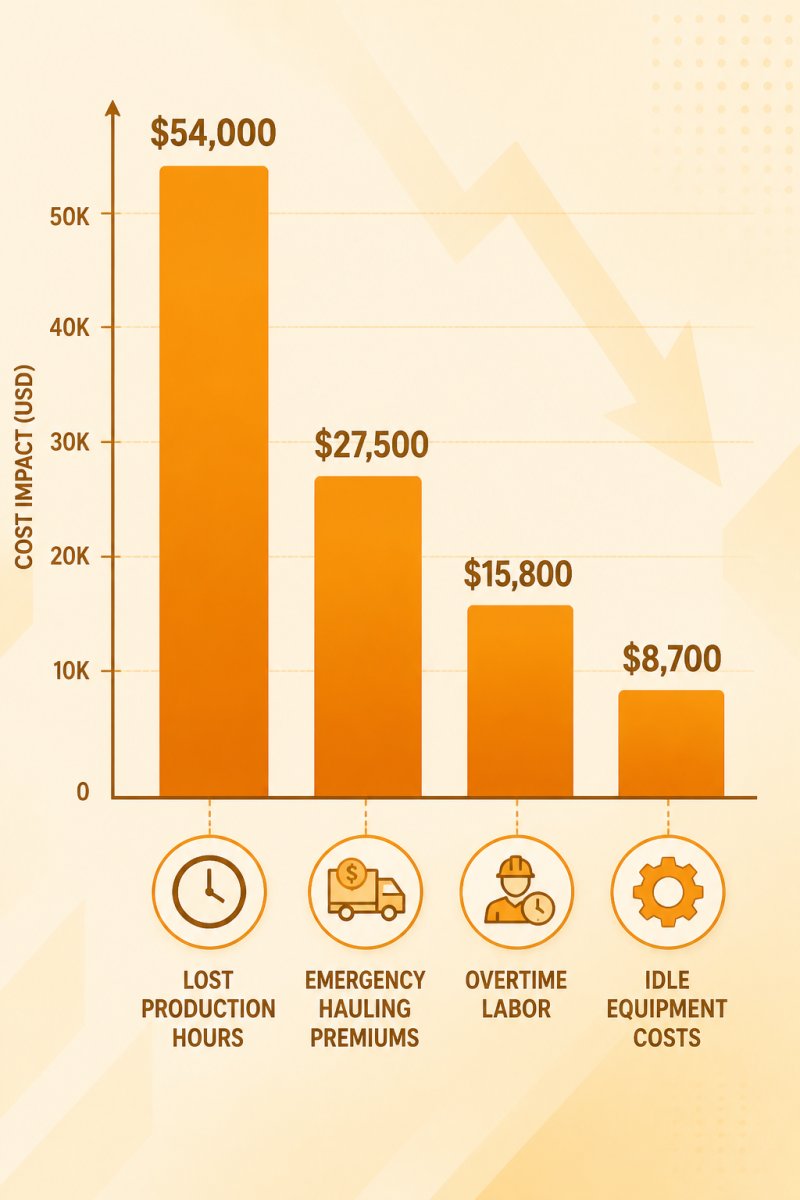
Here is the trap. A compactor failure does not just cost you the compactor. It costs you the labor reassigned to manual waste handling, the trailer capacity you cannot fill, and the emergency haul you book when the yard overflows. Those costs land in different budget lines, so nobody adds them up.
Primary Causes of Industrial Trash Compactor Downtime
An industrial trash compactor fails for a short list of reasons, and most of them are preventable. The key is separating mechanical failures from logistics failures, because they need completely different fixes.
Hydraulic System Failures and Mechanical Breakdowns
Hydraulic systems cause the majority of hard stops (peer-reviewed research). Seals weep, fluid overheats, hoses chafe, and pressure drops until the ram stalls mid-cycle. Mechanical failures follow close behind: worn ram guides, jammed material, and limit switches that stop signaling position.
A common mistake is running to failure instead of to schedule. When a plant only calls a technician after the ram stops moving, every repair becomes an emergency with premium labor and expedited parts.
Hauling Delays and Waste Collection Interval Mismatches
Hauling delays are the quiet downtime. Your compactor works fine, but the container sits full for two extra days because the collection interval does not match your actual generation rate. During that gap, waste piles up, the yard gets congested, and safety compliance gets harder to maintain.
Mismatched collection intervals are the single most common waste stream management error we see. The schedule was set years ago and never revisited after production volumes changed.
Industrial Waste Compactor Maintenance Checklist
A preventative maintenance schedule turns unpredictable breakdowns into planned, scheduled downtime. That distinction matters, because scheduled downtime can be worked around. Unscheduled maintenance cannot.
The checklist below is organized by interval, not by component, because interval is what a plant manager can actually schedule around a production calendar. Adjust the hour thresholds to your cycle volume and material type, a plant running 400 cycles a day will hit wear points roughly twice as fast as one running 200.
Daily and Per-Shift Checks
- Test limit switches and safety interlocks before the first cycle of each shift
- Listen for changes in hydraulic pump pitch during the first three cycles
- Confirm the ram returns fully to home position before loading
- Clear jammed material immediately; never force a stalled ram
- Verify container fullness against the collection schedule
Weekly Checks
- Inspect hydraulic fluid level, color, and temperature
- Check for weeping at cylinder seals and fittings
- Grease ram guides and pivot points per manufacturer interval
- Walk the power feed and confirm no chafed conduit or loose connections
Interval-Based Checks (250 / 500 / 1,000 Hours)
- 250 hours: inspect hoses and fittings for chafing, weeping, or cracking
- 500 hours: replace hydraulic filters; sample fluid for contamination
- 1,000 hours: inspect ram guides for wear; check structural welds on the charge chamber
- 1,000 hours: verify pressure relief valve setpoint against the manufacturer spec
The Diagnostic Layer Most Checklists Skip
A checklist tells you what to inspect. It does not tell you what a fault means. When the ram stalls or the cycle slows, the symptom alone will not point you to the fix. Use this three-branch triage before you call a technician:
- Mechanical: Is there visible fluid loss, unusual noise, or a physical obstruction? Check seals, hoses, and jammed material first.
- Electrical: Does the motor hum without moving, or does the control panel show a fault code? Check limit switches, interlocks, and motor overloads.
- Process: Does the unit run fine but back up repeatedly at the same time of day or the same production run? That is a waste-generation mismatch, not a compactor fault.
Most practitioners find that roughly half of "compactor failures" reported by operators trace back to the process branch, the machine is fine, but the waste stream is arriving faster than the compaction cycle can absorb it (the EPA).
Keep critical spare parts on site: seals, filters, hose assemblies, and at least one limit switch. A $200 part on the shelf beats a two-day wait for expedited shipping every time.
Mobile Dumpster Compaction Services: Reducing Scheduled Downtime
Mobile dumpster compaction services bring the compaction equipment to your container instead of requiring you to buy and maintain a stationary unit. A service truck crushes the waste already sitting in your roll-off dumpster, then leaves.
For manufacturing sites, the appeal is straightforward. You avoid capital outlay on a stationary compactor, you avoid the maintenance burden entirely, and you can compress waste on a schedule that matches your production rhythm. Junk Crusher provides this service to manufacturing facilities, distribution centers, and construction sites, and the process typically takes minutes per container rather than hours. If you need extra capacity while a compactor is down, Dumpster Rental is also available in 20- and 25-yard sizes to keep the waste stream contained.
The operational benefit is that compaction becomes a scheduled event you plan around, not a breakdown you react to.
Waste Hauling Cost Reduction Strategies That Protect Uptime
Waste hauling cost reduction starts with a blunt question: how much of what you pay to haul away is actually waste, and how much is empty space?
That question matters more than most plant managers realize, because hauling is almost always billed by container, not by weight. A 20-yard roll-off that leaves half full still costs the same as one that leaves packed. The air inside it is the most expensive thing you ship.
The Metric That Changes the Conversation
Stop tracking cost per pickup. Start tracking cost per ton hauled. The two diverge sharply once you begin compacting, and the second one is the number your controller actually cares about.
A common pattern: a plant pays a flat rate per roll-off pull, pulls four containers a month, and assumes the cost is fixed. Once compaction is introduced and the same material fits in two containers, the per-pull rate does not change, but the cost per ton hauled drops by roughly half. The savings never show up on the hauling invoice. They show up in the annual total.
Strategies That Hold Up in Practice
- Compact before hauling. Every cubic yard of air you remove is a cubic yard of capacity you did not pay for. This is the single highest-leverage change for most sites.
- Right-size container count to actual generation rate, not historical habit. Count what you generate in a week, then size the container fleet to that number with a small buffer.
- Align collection frequency with production cycles. If your plant runs heavy Monday through Thursday and light on Friday, a fixed weekly pull will over-serve some days and under-serve others.
- Separate recyclable streams. Corrugated, metals, and rigid plastics often carry lower disposal weight charges when segregated, and some carry rebate value.
- Audit the hauling invoice quarterly. Fuel surcharges, environmental fees, and container rental line items drift over time. A 15-minute review each quarter catches most of it.
Where Compaction Fits Into the OEE Picture
If your plant tracks Overall Equipment Effectiveness, waste handling shows up in the Availability component, but only if you count it. Most OEE calculations exclude waste equipment entirely, which is exactly why compaction downtime gets ignored until it hurts.
The fix is to treat the compactor as a production support asset. Log its uptime the same way you log a CNC or a packaging line. Once it appears in the OEE dashboard, it stops being invisible.
| Problem | Fix | Operational Impact |
|---|---|---|
| Container leaves half full | Compact before haul | More material per haul, lower cost per ton |
| Yard congestion | Reduce container count | Better site flow, fewer safety incidents |
| Emergency hauls | Match collection interval to output | Fewer premium pickups |
| Manual waste handling labor | On-site compaction | Labor returned to production |
| Invisible downtime | Add compactor to OEE tracking | Downtime gets budgeted, not absorbed |
Root Cause Analysis and Lean Integration for Compactor Reliability
Most guides stop at "maintain your compactor." That is not a reliability strategy; it is a hope. The plants that actually eliminate compaction downtime treat failures the way they treat any other production defect.
Run a simple root cause analysis on every stoppage. Ask why five times. A stalled ram is rarely the root cause. It is usually the symptom of a missed seal replacement, which traces back to a maintenance schedule nobody owns.
This is where Lean Manufacturing and Six Sigma thinking earns its keep. Waste handling is a non-value-added process, which makes it a prime target for elimination and simplification. Map the waste stream the same way you map a production cell. Identify where material waits, where it gets handled twice, and where it blocks throughput. Compaction that happens on a schedule removes an entire category of waiting.
Emergency Response Protocols When Compaction Equipment Fails
Every site needs a written response plan for compaction equipment failure, because improvising during a breakdown is how small problems become expensive ones.
A workable protocol has four parts:
- Stop and isolate. Lock out the equipment and prevent loading until a technician clears it.
- Contain the waste stream. Designate an overflow area so material does not block production or fire exits.
- Escalate on a timer. Set a threshold, such as four hours, that triggers a call for backup hauling or mobile compaction.
- Document and review. Log the failure, the response time, and the root cause within 24 hours.
The escalation timer is the part most facilities skip, and it is the part that prevents a two-hour repair from becoming a two-day production bottleneck.
Waste compaction downtime is a throughput problem disguised as a maintenance line item, and the plants that treat it that way are the ones that stop paying for empty space. Junk Crusher exists to close that gap with mobile on-site dumpster compaction that reduces roll-off volume, cuts the number of required hauls, and returns labor to production where it belongs. If your yard is congested and your hauling invoices keep climbing, book a crush with Junk Crusher and see what your waste stream looks like when the air is squeezed out of it.
Frequently Asked Questions
What are the primary causes of industrial compactor downtime?
The most common causes are hydraulic system failures, mechanical breakdowns in the ram or power unit, and hauling delays when collection intervals don't match waste generation rates. Hydraulic leaks, worn seals, and contaminated fluid account for many unscheduled maintenance events. Mechanical issues like bent rams or jammed cycles often stem from overloading. Hauling delays happen when full containers sit waiting for pickup, forcing production slowdowns. Tracking failure patterns by type helps facility managers prioritize preventative maintenance and spare parts inventory.
How does waste compaction downtime impact manufacturing productivity?
When a compactor goes down, waste backs up on the production floor, creating safety compliance risks and blocking material flow. Operators divert labor to manual waste handling, which reduces throughput and pulls staff from core tasks. If hauling delays compound the problem, trailers may sit loaded but unshipped. These cascading effects show up in OEE metrics as reduced availability and lower performance rates. Facilities that track downtime cost per hour can quantify the financial impact and justify investments in preventative maintenance or mobile compaction services.
How can mobile dumpster compaction services reduce facility downtime?
Mobile compaction services bring the crushing equipment to your site on a scheduled basis, compacting waste directly in your roll-off dumpsters. This reduces waste volume by up to 70%, which means fewer hauls and longer intervals between pickups. Because the service is scheduled, it doesn't interfere with production shifts. Facilities avoid the capital cost and maintenance burden of owning a stationary compactor. The service works well for manufacturing sites, distribution centers, and construction jobsites that generate consistent waste volumes but don't want equipment downtime risk.
What are the financial implications of inefficient waste management in manufacturing?
Inefficient waste management drives up disposal costs through more frequent hauls, higher labor hours for manual handling, and potential regulatory fines for safety or environmental violations. Production bottlenecks caused by waste backup can delay shipments and reduce equipment uptime. Total cost of ownership calculations should include hauling fees, labor, equipment maintenance, and the opportunity cost of lost production. Reducing waste volume through compaction can cut hauling frequency and lower disposal costs, though exact savings depend on your waste stream, location, and current service terms.
