

Stop Paying for Empty Space in Industrial Dumpsters
Table of Contents
- Why You're Paying for Air in Industrial Dumpsters
- How to Measure Unused Capacity Before You Change Anything
- Commercial Dumpster Size Guide: Match Container to Waste Volume
- Commercial Dumpster Compaction: Fit More Waste in the Same Container
- Industrial Dumpster Pickup Frequency: Stop Hauling Half-Full Containers
- Commercial Dumpster Rental Terms That Lock In Empty-Space Charges
- Negotiating Service Changes and Avoiding Hidden Fees
- Frequently Asked Questions
Last Updated: October 21, 2026
Why You're Paying for Air in Industrial Dumpsters
Most industrial sites don't overpay because their hauler is dishonest. They overpay because nobody measures what's actually inside the box when the truck arrives. If you want to stop paying for empty space in industrial dumpsters, the fix starts with a hard look at fill levels, pickup frequency, and container size, not with a new vendor.
Here's the uncomfortable part: a roll-off container that gets hauled at half capacity still bills you for the full haul. You pay for the truck, the tipping fee, and the fuel. The air above your waste rides along for free, and you cover the tab. This guide from Junk Crusher covers how to find that wasted capacity, right-size your containers, and renegotiate the terms that lock the waste in place.
Below, we'll show you exactly how to audit your current setup, then walk through the sizing, compaction, and contract levers that actually cut the bill. Most operations find at least one of these levers is stuck wide open.
How to Measure Unused Capacity Before You Change Anything
You can't fix what you haven't measured. A practical capacity audit takes a few weeks and answers one question: how full is each container when it leaves your yard?
Run it in four steps:
- Photograph fill level on pickup day. Take the same angle every time, before the truck arrives. A photo log beats memory.
- Record container size in cubic yards. Confirm the number on your rental agreement, not the number someone remembers.
- Compare hauled volume to waste generated. If your production or jobsite output hasn't changed but hauls have, something's off.
- Flag containers routinely under half full. These are your empty-space offenders.
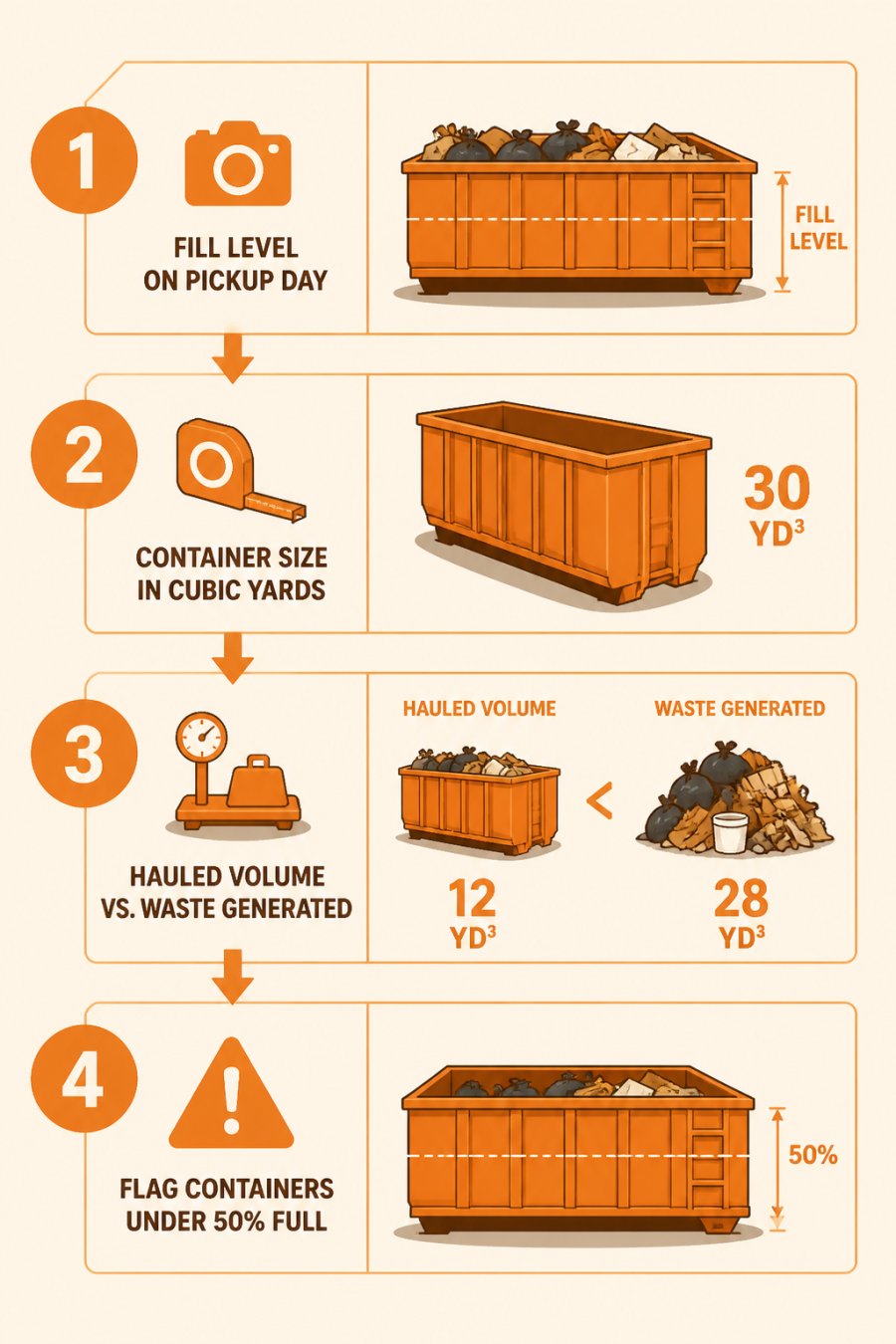
A common mistake is auditing for one week and calling it done. Waste volume swings with production schedules and project phases, so track at least three to four pickup cycles before you draw conclusions.
Commercial Dumpster Size Guide: Match Container to Waste Volume
Sizing is where most waste budgets quietly leak. A container that's too large gets hauled half full; one that's too small forces extra pickups. The right size is the one that fills up right around the time you need it collected.
| Container Size | Typical Use | Watch For |
|---|---|---|
| 10 cubic yards | Small renovation debris, light retail waste | Overflows fast on heavy material |
| 20 cubic yards | Mid-size construction, warehouse packaging | Half-full hauls if waste is bulky and light |
| 30 cubic yards | Larger demolition, high-volume facilities | Overage risk on heavy debris |
| 40 cubic yards | Big industrial streams, light bulky waste | Empty-space charges if volume is low |
Right-Sizing With Operational Data, Not Guesswork
Most size guides stop at the table above. That's not enough for an industrial site, because the right container depends on your production schedule, waste density, and pickup rhythm, not a generic label. Here's a repeatable method you can run in a spreadsheet.
Step 1: Estimate weekly waste volume in cubic yards. Pull production or project data for a representative period. If you generate a predictable number of units per shift, estimate the cubic yards of waste per unit from a sample week.
Step 2: Convert to container fill rate. Divide your weekly volume by the container capacity. A 20-cubic-yard container receiving 10 cubic yards per week fills in two weeks.
Step 3: Match pickup frequency to fill rate. Set the pickup interval so the container is 80-90% full at collection. That buffer prevents overflow without paying for air.
Step 4: Account for seasonal and production variation. Waste volume swings with production schedules, project phases, and seasonal demand. Track at least three to four pickup cycles before you commit to a size change.
Step 5: Test a smaller container or longer interval. If the data shows consistent under-fill, request a smaller container or a longer interval. Many haulers will adjust without penalty when you present the data.
That's the theory. In practice, the fix is usually a smaller container, a longer interval, or on-site compaction, and we'll get to that last one next.
Commercial Dumpster Compaction: Fit More Waste in the Same Container
Commercial dumpster compaction is the practice of crushing waste on-site so more material fits in the same container. It directly attacks the empty-space problem because bulky, low-density waste (cardboard, packaging, shingles, mixed debris) traps a lot of air between pieces.
Compaction doesn't shrink your waste; it shrinks the space around it. A container that would normally haul at partial capacity can leave full, which means fewer trucks, fewer hauls, and less money spent moving air. Industry guidance on reducing waste disposal costs consistently points to volume reduction and right-sizing as core levers.
Junk Crusher's mobile service crushes dumpster waste on-site and can reduce roll-off dumpster volume by up to 70%, which cuts the number of hauls a site needs. For operations paying per pull, that's the difference between hauling a full box and hauling a half-empty one.
Waste-Stream Separation and What Can Be Compacted
Not everything should go in the crusher. Separate recyclables and hazardous materials first, then compact the bulky, non-hazardous debris that wastes the most space. Cardboard, packaging film, wood, and mixed construction debris compact well. Liquids, chemicals, and anything your hauler flags as prohibited stay out.
Industrial Dumpster Pickup Frequency: Stop Hauling Half-Full Containers
Industrial dumpster pickup frequency should match how fast the container actually fills, not a calendar someone set years ago. If your hauler collects every week but the box is half full, you're paying for a truck trip you didn't need.
Two ways to fix it: extend the interval, or compact so the container fills before the scheduled pickup. The first is a phone call. The second changes the math permanently, because every future haul carries more waste.
Ask your provider for the pickup schedule in writing and compare it to your photo log. If the log shows consistent under-fill, request a schedule change. Many haulers will adjust frequency without penalty, especially when you frame it as a service-level correction rather than a complaint.
Commercial Dumpster Rental Terms That Lock In Empty-Space Charges
Commercial dumpster rental terms are where empty-space charges hide. The container size and pickup schedule are visible; the billing structure behind them often isn't.
Read these clauses closely:
- Initial term and renewal term. Auto-renewals can lock a mismatched container size in place for another year.
- Written notice requirements. Changing service often needs notice well ahead of renewal.
- Weight limits and overweight fees. Heavy debris can trigger overage charges even on a half-full box.
- Extra pickup and rental extension fees. These add up fast on active jobsites.
Billing Models and Cost-per-Use Comparisons
Flat monthly billing rewards the hauler for showing up, full or not. Per-pull billing charges you each time the truck comes, so a half-full haul costs the same as a full one. The model that fits your operation depends on your waste stream.
| Billing Model | How You're Charged | Best Fit |
|---|---|---|
| Flat monthly | Fixed fee regardless of fill | Steady, predictable volume |
| Per pull | Each haul billed separately | Variable or project-based volume |
| Weight-based | Charged by tonnage | Heavy debris streams |
| Compaction service | Fee offset by fewer hauls | Bulky, low-density waste |
Per-pull billing makes empty-space waste most visible, because every half-full haul is a line item you can point to. That's also where compaction pays off fastest.
Negotiating Service Changes and Avoiding Hidden Fees
Negotiation works best when you bring data. Before you call your provider, assemble the photo log, the haul records, and the contract terms you want changed. Then ask for specific adjustments: a smaller container, a longer interval, or a move to per-pull billing.
Avoiding hidden fees comes down to preparation. Guidance on avoiding hidden fees in rental agreements stresses reviewing the paperwork and planning ahead, which is exactly the use a documented audit gives you. Confirm weight limits, prohibited materials, and notice periods in writing. Get any schedule change confirmed by email so it doesn't quietly revert.
If your provider won't budge on container size or frequency, compaction is the lever that doesn't require their permission. We can crush on-site, cut the haul count, and show the savings against your current bill. Waste-cost reduction strategies back the same sequence: audit first, then right-size, then reduce volume.
Frequently Asked Questions
How can I reduce the number of industrial dumpster pickups?
Start by checking fill level on pickup day for four to six weeks. If containers leave under half full, you have two levers: reduce pickup frequency or compact waste on site so each haul carries more material. Commercial dumpster compaction can cut roll-off volume by up to 70%, which often means fewer hauls for the same waste stream. Pair that with a schedule review so you are not paying for a truck to move air. Ask your hauler for a written service change before the next renewal term.
Can compacting dumpster waste reduce pickup frequency?
Yes. Compaction removes trapped air and crushes bulky items like cardboard, shingles, and packaging so more material fits in the same container. Junk Crusher reports reducing roll-off dumpster volume by up to 70%, which directly lowers how often a container needs hauling. The practical result is fewer truck trips, lower hauling charges, and less yard space tied up in containers. Confirm what your waste stream contains first, since not every material compacts well or is allowed in a compactor.
How can I tell whether my dumpster is being hauled before it is full?
Look at the container on the morning of your scheduled pickup. If the waste line sits well below the top edge, you are paying to haul empty space. Note the fill level for several consecutive pickups and compare it to your production or project volume. Consistent half-full pickups point to an oversized container or an excessive collection schedule. Bring that record to your service provider, because documented fill levels are the strongest argument for changing commercial dumpster rental terms.
How should a business choose the right dumpster size?
Measure waste generated per week in cubic yards rather than guessing from container labels. Track how full your current container is at each pickup, then match size to actual volume plus a buffer for busy periods. A commercial dumpster size guide is useful for reference, but your own fill data beats any generic chart. If bulky, low-density material fills containers fast, compaction may let a smaller container handle the same load. Review the size again whenever your production or project mix changes.
How can I review a commercial dumpster service agreement?
Read three things closely: the initial term and renewal term, the written notice required to change or cancel service, and every additional fee listed. Watch for automatic renewal clauses, overweight fees, and charges for extra pickups or rental extensions. Compare the cost per pickup against what you actually generate. If containers are routinely half full, request a schedule or size change in writing before the notice window closes. Keep a copy of the amended terms so billing matches what you agreed.
Empty space in your containers is a solvable problem, but it needs measurement before it needs a new vendor. If your audit shows bulky, low-density waste filling half a box, Junk Crusher can help. Our mobile on-site compaction reduces roll-off volume by up to 70%, cuts the number of hauls, and trims the truck trips that drive up costs and emissions. Book a Crush and see how much of your waste bill is really just air.


