
How Long Waste Hauling Setup Takes for Commercial Sites
Last Updated: November 13, 2026
Quick Summary
Waste hauling setup typically takes 2 to 5 business days for roll-off dumpsters and 3 to 7 business days for commercial front-load accounts, though best-case timelines can be as short as 1 to 2 business days. The clock starts when you place the order and stops at your first scheduled pickup.
- Compaction service setup typically takes 5 to 10 business days due to the required site visit and hauling plan approval.
- Get a written confirmation with a delivery window, since a verbal order is not a scheduled delivery.
- Failed deliveries from locked gates, low wires, or soft surfaces restart the setup clock.
- First pickup timing depends on existing route cycles, not your order date.
- Have your service address, waste volume estimate, and billing contact ready before you call.
Table of Contents
- How Long Waste Hauling Setup Takes: The Short Answer
- Typical Setup Times by Service Type
- The Commercial Dumpster Delivery Timeline, Step by Step
- Waste Hauling Service Requirements You Need in Place First
- Setting a Dumpster Pickup Schedule That Matches Your Volume
- How a Dumpster Compaction Service Shortens the Setup Cycle
- Book a Crush and Get Your Waste Setup Moving
- Frequently Asked Questions
How Long Waste Hauling Setup Takes: The Short Answer
Waste hauling setup timing depends on the account type, the equipment, and whether a permit is involved. The clock starts when you place the order and stops when a truck empties the container for the first time. At Junk Crusher, we work with plants, warehouses, and construction crews across Western Pennsylvania, and the pattern is consistent: paperwork is fast, logistics is slow.
Most of the delay sits in three places. Account approval, equipment availability, and site access. Fix those early and the rest moves quickly.
Waste hauling setup is the process of opening a collection account, placing equipment, and getting your first scheduled pickup on the calendar. It is a short chain of dependent steps, and each one can stall the next.
Below, we break down realistic timelines by service type, the steps in order, and the delays that catch most operations managers off guard.
Typical Setup Times by Service Type
Setup time is not one number. It depends on the service model, the equipment, and how much of the work happens before you call. The table below gives realistic best-case and typical ranges for the most common waste-hauling setups, along with the single biggest factor that pushes a job toward the long end.
| Service Type | Best-Case Setup | Typical Setup | Main Delay Factor |
|---|---|---|---|
| Residential curbside trash | 1 business day | 2-3 business days | Cart stock and route availability |
| Commercial front-load account | 2 business days | 3-7 business days | Site survey scheduling and container size |
| Roll-off dumpster rental (20-25 yard) | 1 business day | 2-5 business days | Equipment stock and permit for street placement |
| Dumpster compaction service | 3 business days | 5-10 business days | Site visit and hauling plan approval |
| Junk removal (one-time) | Same day | 1-3 business days | Crew and truck availability |
| Starting a hauling business (new carrier) | 2 weeks | 4-8 weeks | Licensing, insurance, and vehicle registration |
Roll-off dumpsters are available in 20-yard and 25-yard sizes. Delivery timing depends on equipment availability and whether street placement requires a permit, so confirm the delivery window when you order.
Compaction service involves a site visit and a hauling plan tailored to your waste stream. It reduces the number of containers and pickups needed once service starts.
If you are weighing a standard pickup account against an on-site compaction setup, our breakdown of commercial trash pickup vs compaction for business waste walks through the trade-offs side by side.
The Commercial Dumpster Delivery Timeline, Step by Step
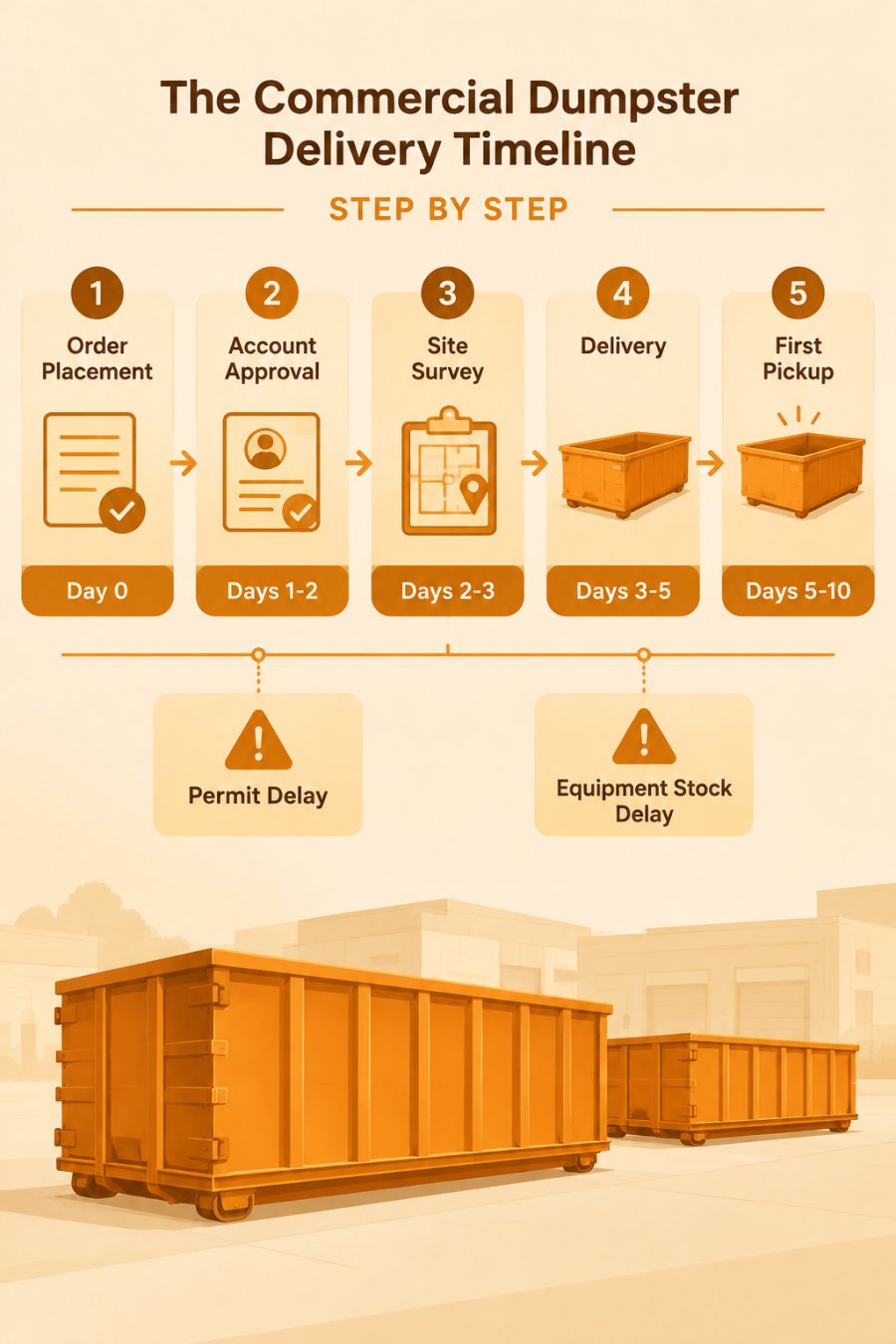
Step 6: First pickup (days 5-10). Your collection route gets assigned. The first scheduled pickup lands on the next route cycle for your address. Route frequency, not your order date, sets this timing. A site on a twice-weekly route may get its first pickup sooner than a site on a weekly route.
What Happens Before the Truck Arrives
Three things need to be true before a truck can drop a container. The site must be accessible, the pad must be clear, and the order must be confirmed in the hauler's system.
A common mistake is assuming a verbal order is a scheduled delivery. Get a confirmation with a delivery window in writing, the wait between order and delivery is where most frustration builds.
Watch out: If your site has a locked gate, a low overhead wire, or a soft surface that cannot support a loaded truck, the delivery will fail and you will restart the clock. Confirm access details before the survey, not after.
Factors That Push the Timeline Longer
Most delays fall into five buckets. Knowing them lets you plan around them.
- Equipment stock: The size you need may be out on another job. Ask the hauler to confirm stock before you commit to a delivery date.
- Permitting: Street placement, right-of-way rules, and homeowner-association restrictions can add days. Start the permit application as soon as placement is confirmed.
- Site access: Gate codes, turning room, overhead clearance, and pad condition all affect whether a truck can deliver on the first attempt.
- Route scheduling: First pickup depends on existing route cycles, not your order date.
- Incomplete information: Missing volume estimates, billing contacts, or waste-type details force the hauler to pause and follow up.
Waste Hauling Service Requirements You Need in Place First
You can shorten setup by having your requirements ready before you call. Haulers ask the same questions every time.
- A clear service address with gate codes and site contact
- Waste type and volume estimate so the right equipment gets assigned
- Site access details: truck turning room and overhead clearance
- Payment method and billing contact for account setup
- Any local permit or placement rules for containers on public property
Local rules on container placement vary by municipality, so confirm what applies to your address before you order.
Cost is the other piece. If hauling fees are eating your budget, our guide to lowering dumpster hauling fees covers proven strategies to review before you sign a new contract.
Setting a Dumpster Pickup Schedule That Matches Your Volume
The right pickup frequency depends on how fast the container fills.
Start by tracking fill rate for two weeks. Note how full the container is before each pickup. If it is routinely full days early, you are over-scheduled. If it is half empty, you are paying for air.
Then match frequency to that data:
For a deeper set of tactics, see reducing waste hauling frequency with seven practical tips that work.
How a Dumpster Compaction Service Shortens the Setup Cycle
A dumpster compaction service crushes waste on site so each container holds more before it needs hauling.
For plants and jobsites, the practical win is yard space and fewer truck trips. Our mobile dumpster compaction service pricing guide covers pricing models and how to calculate the return before you commit.
Book a Crush and Get Your Waste Setup Moving
Setup time is mostly about dependencies. Get your site details, volume estimate, and payment ready, and the timeline shrinks to days instead of weeks.
At Junk Crusher, we compact waste on site, which reduces hauling volume and the number of hauls required. Our mobile compaction service works with roll-off dumpsters, and we serve sites across Western Pennsylvania.
Ready to stop paying for empty space? Book a crush to get started.
Setup should not take weeks of back-and-forth. Junk Crusher brings mobile compaction to your site, reduces dumpster volume, and cuts the number of hauls you schedule. Get started with Junk Crusher and put a simpler waste plan in place.
Frequently Asked Questions
How long does it take to set up waste hauling service?
Setup timing depends on how quickly you supply site access details and confirm the delivery window. Contact Junk Crusher to confirm the timeline for your site.
What can delay a new waste hauling setup?
The most common delays are an unconfirmed delivery window, a locked gate or missing access code, a pad that is not ready for the truck, and paperwork that sits unsigned. To avoid a stall, confirm the drop spot, gate access, and payment method before the order is placed, and ask Junk Crusher for the delivery window in writing so you can have someone on site.
How often should a commercial dumpster be emptied?
Emptying frequency should follow fill rate, not a fixed calendar. Track how full the container is before each pickup and adjust the pickup schedule from there. On-site compaction packs more material into the same container, which reduces the number of hauls needed.
Can on-site dumpster compaction reduce hauling frequency?
Yes. Mobile compaction crushes material inside the container so more waste fits in the same footprint, which cuts the number of truck trips needed for the same volume. Ask Junk Crusher about how a compaction visit is scheduled around your operations. Fewer hauls also mean fewer truck trips through the yard, which helps sites tracking emissions or yard congestion. Ask for a walkthrough to see how the process fits your material type before you commit.


