
Onsite Waste Compaction Service: Cut Hauling Costs
Table of Contents
- How Onsite Waste Compaction Service Works
- Waste Volume Reduction Metrics You Can Expect
- Waste Hauling Cost Reduction: The Math Behind Fewer Pickups
- Mobile Waste Compaction vs. Traditional Commercial Dumpster Rental
- Industries That Benefit Most From Onsite Compaction
- Safety Protocols and Regulatory Compliance
- Preventative Maintenance and Service Reliability
- Frequently Asked Questions
Last Updated: September 26, 2026
How Onsite Waste Compaction Service Works
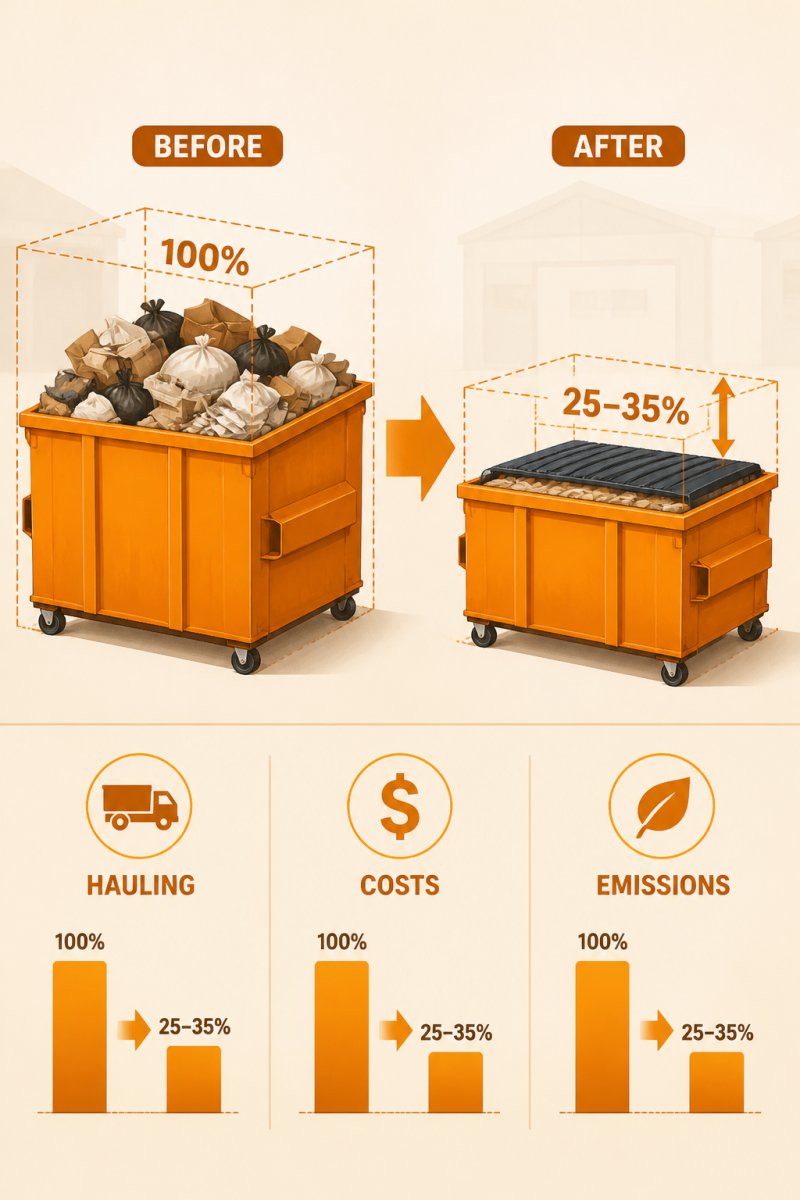
Onsite waste compaction is the process of crushing dumpster contents at your facility before hauling, so trucks carry dense material instead of air. At Junk Crusher, we bring mobile compaction equipment directly to commercial sites across Western Pennsylvania, pressing general trash, cardboard, and construction debris down inside the container. The result is fewer pickups, fuller loads, and a waste stream that behaves predictably.
The mechanics are straightforward. A compaction unit fits over or into your roll-off container and applies hydraulic force to the material inside. Waste that once filled a container at the halfway mark now settles near the top, and your hauler collects weight rather than empty space.
Mobile vs. Stationary Compaction: What Fits Your Site
Mobile compaction travels to your site on a truck and works with the containers you already rent. Stationary compaction means installing a permanent unit, typically a self-contained compactor or a larger industrial system bolted to a concrete pad with power run to it.
For most construction, roofing, and distribution operations, mobile is the practical choice. There's no pad to pour, no electrical work, no equipment purchase, and no long-term lease. You get the volume reduction without the capital commitment.
Stationary systems make sense when a single location generates steady, high-volume waste year-round and has the space and budget for permanent infrastructure. If your waste profile changes with each project, mobile wins.
Waste Volume Reduction Metrics You Can Expect
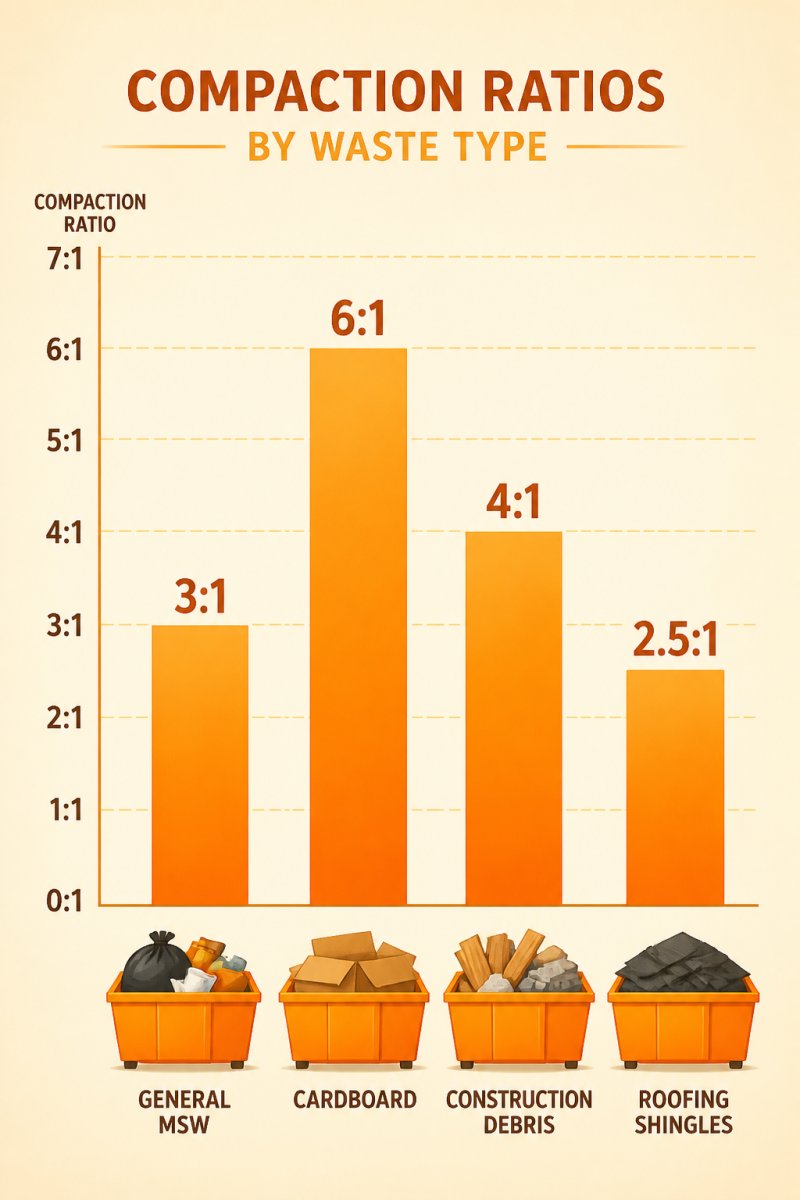
Compaction ratios vary by material, and knowing yours prevents disappointment. Loose, bulky waste compresses dramatically. Dense, heavy waste compresses less because it's already tight.
Here's what to expect across common waste types:
| Waste Type | Typical Compaction Ratio | What It Means for Your Container |
|---|---|---|
| General MSW | 3:1 | Three loads become one |
| Cardboard | 6:1 | Baled density, major space savings |
| Construction debris | 4:1 | Fewer pulls per project phase |
| Roofing shingles | 2.5:1 | Heavier material, moderate gains |
Compaction Ratio by Waste Type
Cardboard is the standout. Distribution centers and warehouses generating pallet and packaging waste often see the container fill at a fraction of its previous rate, which directly cuts disposal frequency.
Roofing shingles are the opposite case. They're heavy and dense already, so the ratio is modest. The savings still come, but through reduced hauling frequency rather than dramatic volume collapse.
The practical takeaway: measure your current fill rate for two weeks before committing. That baseline tells you exactly what compaction will change.
Waste Hauling Cost Reduction: The Math Behind Fewer Pickups
Waste hauling cost reduction comes from one lever: fewer trucks leaving your site. Every haul carries a fixed cost regardless of how full the container is, so the goal is to make each pull count.
Build Your Baseline First
Before you can calculate savings, you need two weeks of honest data. Track:
- How many pulls you schedule per month
- How full the container actually is at pickup (eyeball it: quarter, half, three-quarters, full)
- What material is dominating the stream (cardboard, mixed trash, debris, shingles)
- Whether your hauler bills by volume or by weight
That last point changes everything. If you're volume-billed, compaction changes your cost structure immediately because you're paying for space, not weight. If you're weight-billed, the savings come from fewer pulls instead, same per-ton rate, fewer trips.
The Simple Payback Calculation
Here's the structure most operations managers use. It works with your own numbers, not ours:
- Current monthly hauls × per-haul cost = current monthly hauling spend
- Apply your expected compaction ratio to get new effective capacity per container
- New monthly hauls = current hauls ÷ compaction ratio (rounded up, since you can't schedule a fraction of a truck)
- New monthly spend = new hauls × per-haul cost
- Monthly savings = step 1 minus step 4
- Payback period = service cost ÷ monthly savings
A site pulling a container twice a week that moves to roughly one pull every week and a half is the pattern most operations see once compaction is running. The per-haul charge stays the same, but you're paying it far less often.
What Changes the Math
Three variables move the result more than anything else:
- Compaction ratio for your dominant material. Cardboard-heavy streams compress far more than shingle-heavy ones, so the same service produces very different savings.
- Whether you can consolidate containers. A compacted container often replaces two staged containers, which frees yard space and can reduce the number of pickup locations on site.
- Scheduling friction. Fewer hauls means fewer truck trips through your yard, less coordination with your team, and a smaller carbon footprint from the hauling fleet.
Junk Crusher's mobile service is designed around this math, with volume reductions that can reach up to 70% depending on the waste stream. The exact figure for your site depends on your baseline, which is why the two-week tracking step matters more than any published ratio.
Mobile Waste Compaction vs. Traditional Commercial Dumpster Rental
Traditional commercial dumpster rental gives you a container and a pickup schedule. You pay for capacity you may not be using, and you pay again every time the truck arrives.
Mobile waste compaction changes the economics of the same container. You keep your roll-off, add compaction, and stretch what each rental period holds. For operations comparing the two, the decision usually comes down to waste volume and how predictable it is.
If your site generates steady, high-volume waste, compaction pays for itself through reduced disposal frequency. If you generate very little waste, standard rental remains simpler.
For sites that need additional capacity alongside compaction, Junk Crusher's dumpster rental options cover 20 and 25 yard containers.
Industries That Benefit Most From Onsite Compaction
Manufacturing plants, distribution centers, commercial construction firms, and roofing contractors see the fastest returns. Each generates bulky waste that compacts well and each pays for hauling on a recurring schedule.
Warehouses with tight yard space gain a second benefit: a compacted container means fewer containers staged on the property, which frees up room for trailers and equipment movement.
Demolition and renovation crews benefit too, particularly on projects where dumpster capacity constrains the schedule. When a container fills mid-day, work stops. Compaction keeps it in service longer.
Safety Protocols and Regulatory Compliance
Safe compaction starts with site setup. The unit needs a level surface, clear overhead clearance, and a exclusion zone around the working area while it operates. Operators should never stand inside or reach into a container during a compaction cycle.
On the compliance side, waste handling in Pennsylvania falls under state environmental regulations and local municipal requirements. Facilities should confirm their waste stream classification, maintain required documentation, and verify that haulers are properly permitted.
A few practical protocols to build into your routine:
- Establish a marked exclusion zone before the unit arrives
- Confirm no prohibited materials are in the container
- Brief site staff on the compaction schedule
- Keep spill kits accessible near the container
- Document waste types for compliance records
For current requirements, check with the Pennsylvania Department of Environmental Protection on waste transportation and disposal rules, and review [EPA guidance on industrial waste management(/blog/industrial-waste-management-efficiency-tips) | epa.gov] for federal framework.
Preventative Maintenance and Service Reliability
Equipment reliability is what makes compaction worth it. A unit that breaks down mid-project costs you the savings and the schedule.
Preventative maintenance on compaction equipment focuses on hydraulic systems, seals, and wear points. Regular inspection catches small issues before they become downtime. Operators should watch for slow cycle times, hydraulic leaks, and unusual noise, all of which signal service is due.
Service reliability matters most for multi-site operations. If you run several locations, confirm your provider can schedule consistent visits across all of them rather than concentrating on one area. Junk Crusher serves commercial clients throughout Western Pennsylvania with scheduled mobile service.
OSHA standards for powered industrial equipment provide the baseline safety framework for operating compaction machinery on commercial sites.
Waste management costs creep up quietly, one haul at a time, until they're a line item nobody wants to defend.
Frequently Asked Questions
How does mobile waste compaction work?
A mobile compaction unit arrives at your site, drives up to your roll-off dumpster, and uses hydraulic force to crush the contents inside. The process takes minutes per dumpster, compressing waste like cardboard, construction debris, and general trash. Because the material is denser, you fit more waste per container, which means fewer hauls and lower disposal costs. Junk Crusher brings the equipment to your location, so there is no permanent installation or dedicated space required.
Can onsite compaction reduce the number of dumpster hauls?
Yes. Compaction increases waste density so each dumpster holds more material before it needs to be emptied. For many businesses, this cuts hauling frequency. Fewer hauls translate directly to lower waste hauling cost reduction and less truck traffic on your site. The exact reduction depends on your waste stream composition and current dumpster utilization, but the principle holds: denser waste means fewer pickups.
Is mobile waste compaction suitable for construction debris?
Mobile compaction handles most construction and demolition debris, including wood, drywall, cardboard, and roofing shingles. Heavy materials like concrete and metal may need separate handling, but the majority of jobsite waste compacts well. Project managers in the Greater Pittsburgh area use onsite compaction to stretch dumpster capacity on tight sites, reducing debris management costs and keeping projects on schedule without adding more containers.
How much space can be saved by compacting commercial waste?
Compaction can reduce waste volume by up to 70%, depending on the material. That means a 20-yard dumpster effectively holds the equivalent of a much larger container. For facilities with limited yard space, this frees up room for operations and improves dumpster utilization. Fewer containers on site also means less clutter and better traffic flow for delivery trucks and equipment.
