
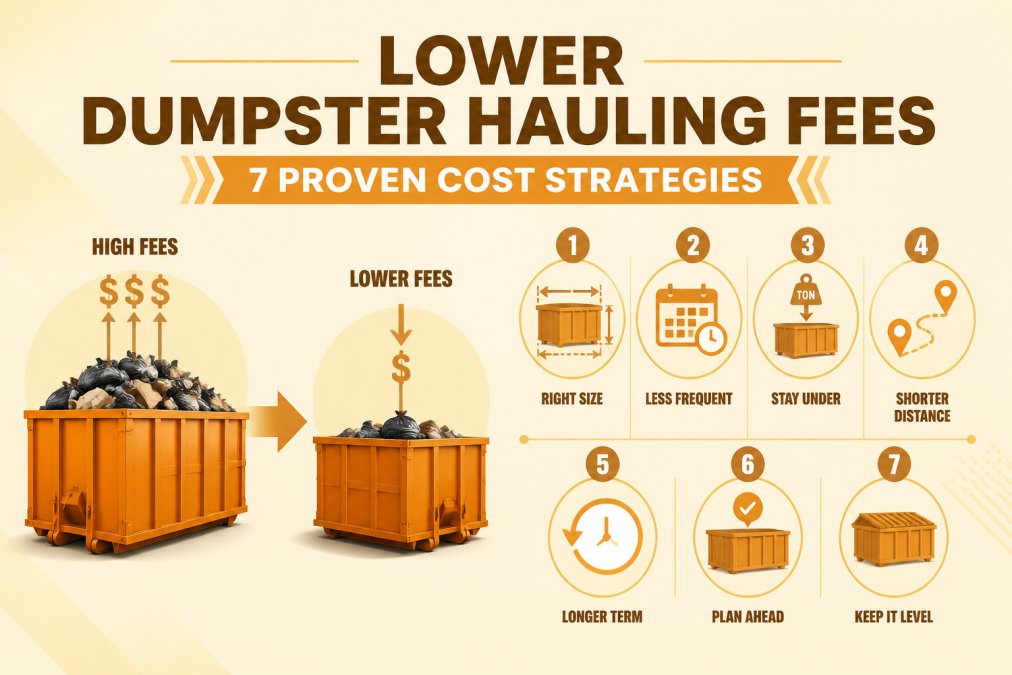
Lower Dumpster Hauling Fees: 7 Proven Cost Strategies
Table of Contents
- Why Your Dumpster Hauling Bill Is Higher Than It Should Be
- Step 1: Audit Your Waste Stream to Find Hidden Savings
- Step 2: Understand the Real Dumpster Rental Costs and Fees
- Step 3: Master Load Efficiency to Maximize Every Cubic Yard
- Step 5: Negotiate Better Contracts and Hauling Rates
- Step 6: How to Optimize Dumpster Pickup Schedules for Lower Fees
- Step 7: Evaluate Dumpster Compaction Benefits for Heavy Waste
- Your Action Plan for Lower Dumpster Hauling Fees
- Frequently Asked Questions
Last Updated: September 6, 2026
Most facility and project managers assume their dumpster hauling fees are fixed costs, but the invoice tells a different story. Hidden charges like tipping fees, environmental surcharges, and administrative fees often inflate the final bill by a significant margin. This guide from Junk Crusher breaks down seven proven strategies to lower dumpster hauling fees, from auditing your waste stream to negotiating better contracts. We'll show you how to identify the specific line items driving your costs and the exact steps to reduce them.
Dumpster hauling fees are the total charges for renting a container, transporting it, and disposing of its contents. The key insight most managers miss is that you are not just paying for weight and distance; you are paying for every inefficiency in your waste handling process. Whether you manage a construction site in Pittsburgh or a distribution center in Erie, the principles for cutting costs remain the same.
Why Your Dumpster Hauling Bill Is Higher Than It Should Be
The biggest mistake is treating every hauler invoice as a take-it-or-leave-it expense. Most bills are padded with charges that can be reduced or eliminated through better planning. Understanding the breakdown of your bill is the first step toward meaningful savings.
Common cost drivers include low load efficiency, frequent pickups, and a lack of awareness about what is actually in your dumpster. When you pay to haul air because waste is loosely packed, or when you schedule pickups on a fixed weekly calendar rather than by fill level, you are overspending. According to the EPA's guidelines on sustainable materials management, source reduction and efficient waste handling are the most effective ways to lower disposal costs.
Step 1: Audit Your Waste Stream to Find Hidden Savings
A waste stream audit is the process of categorizing everything you throw away to identify disposal inefficiencies. Start by sorting a representative sample of your dumpster contents by material type: construction debris, packaging, organics, and recyclables. Many businesses find that a significant portion of their waste is recyclable or could be diverted entirely.
- Weigh each category to understand your true tonnage breakdown.
- Identify materials that could be recycled, reused, or donated.
- Check which items are driving your weight and tipping fees.
This audit reveals whether you are paying premium disposal rates for materials that a recycler would take for free. For roofing contractors dealing with shingles, or plants generating cardboard waste, the savings from diversion can be substantial.
Step 2: Understand the Real Dumpster Rental Costs and Fees
Dumpster rental costs are not a single price; they are a bundle of separate charges. Your invoice typically includes a base rental rate for the container, a transport or hauling fee, and a tipping fee for landfill disposal. Many haulers also add environmental fees, fuel surcharges, and administrative costs.
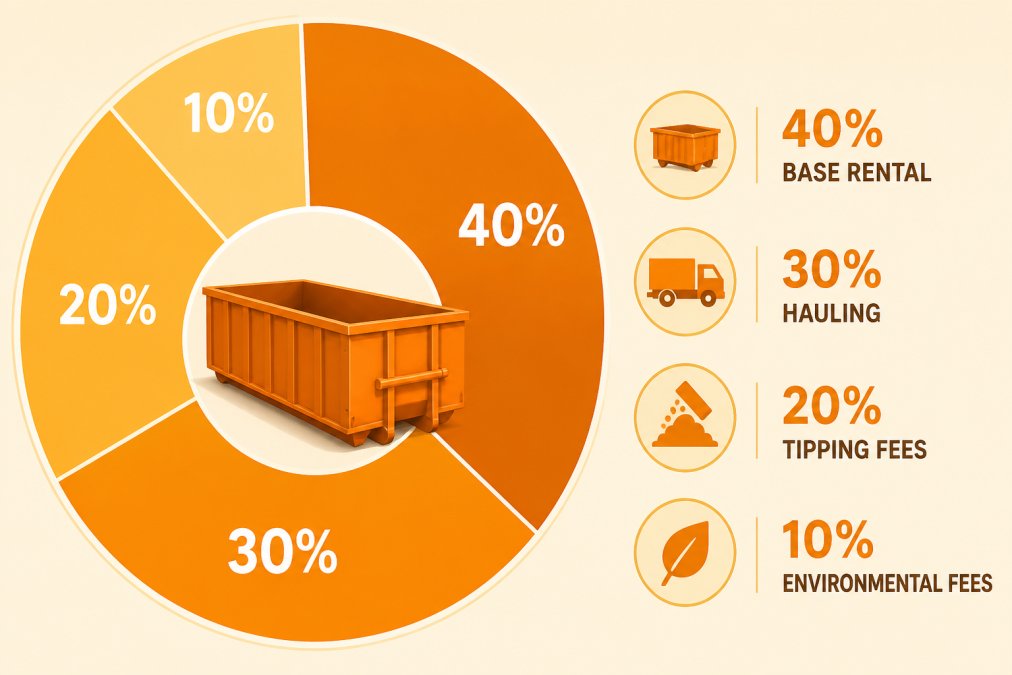
The most common surprise is the overage charge. If your load exceeds the agreed-upon weight limit, haulers apply a penalty rate per ton. Load weight varies significantly by material and moisture content. Wet debris from a demolition project can easily double in weight, so protecting loads from rain before pickup is a simple way to avoid overage fees.
| Fee Component | Typical Share | How to Reduce It |
|---|---|---|
| Base Rental | ~40% | Choose the right dumpster size for your project |
| Hauling/Transport | ~30% | Reduce pickup frequency with compaction |
| Tipping Fees | ~20% | Divert recyclables from the landfill |
| Environmental Fees | ~10% | Confirm what these cover before signing |
Step 3: Master Load Efficiency to Maximize Every Cubic Yard
Cubic yardage is the measure of container capacity, and most loads only use about 60% of available space. Load efficiency means breaking down bulky waste and leveling the load so every cubic yard is filled before the hauler arrives.
A common mistake is tossing large items like pallets, drywall, or furniture into the dumpster whole. Break down and flatten these items to eliminate air pockets. For construction debris, load heavy items first, then layer lighter materials on top. Level the load at the end so you are not paying for a partially filled container. This approach directly reduces dumpster rental costs by minimizing the number of hauls required.
Step 5: Negotiate Better Contracts and Hauling Rates
Most hauling rates are negotiable, but the conversation only works if you speak the hauler's language. Instead of asking for a blanket discount, you need to target the specific line items that carry the highest markup. The most common hidden charges are 'environmental surcharges,' 'administrative fees,' and 'fuel recovery fees.' These are often pass-through costs that the hauler marks up by a percentage before adding them to your bill.
Before you sign or renew a service agreement, use a script that forces transparency. Here is a direct approach to use with a sales representative:
"I need a line-item breakdown of the environmental surcharge and the administrative fee. What is the exact per-ton cost from the landfill or transfer station, and what percentage markup are you adding for handling? Also, is the fuel surcharge tied to a published index like the EIA's weekly retail diesel prices, or is it a flat rate?"
This line of questioning works because it signals that you understand the cost structure. A hauler who is padding these fees will often adjust them rather than lose the account. If the representative cannot answer, that is a red flag that the fees are not directly tied to disposal costs.
Another powerful tactic is to request a 'tipping fee disclosure.' Landfill tipping fees are public record in most states, and they vary significantly by region. For example, the average municipal solid waste tipping fee can range from under $40 per ton in some states to over $90 per ton in others, according to industry surveys (peer-reviewed research). If your hauler charges a tipping fee that is significantly higher than the local average, ask for the specific landfill name and the rate they are paying. You can often verify this information through state environmental agency databases or local public works departments.
Finally, use your waste audit data as leverage. If you can guarantee a consistent, sorted waste stream, you reduce the hauler's sorting and processing risk. Propose a contract that includes a lower rate for 'clean loads' that meet specific contamination thresholds. This creates a win-win: you get a lower fee, and the hauler gets a predictable, low-risk load.
A common pattern is that haulers will not proactively offer these discounts. You must ask. The negotiation is not about demanding a lower price; it is about restructuring the contract to remove inflated pass-through costs and align the rate with your actual waste profile.
Step 6: How to Optimize Dumpster Pickup Schedules for Lower Fees
How to optimize dumpster pickup schedules starts with matching service intervals to actual fill rates rather than a fixed calendar. If your dumpster is only half full when the weekly pickup arrives, you are paying for empty space. Switch to on-call pickups or adjust the schedule based on project phases.
Track how quickly your dumpster fills over a few weeks to establish a data-driven schedule. For sites with variable debris volume, such as construction, a pickup schedule tied to milestones is more efficient than a set day. Reducing hauling frequency is the single most effective way to cut transport fees and fuel surcharges.
Step 7: Evaluate Dumpster Compaction Benefits for Heavy Waste
For operations generating bulky or heavy waste, volume reduction is the single biggest lever you can pull. Dumpster compaction is the process of crushing and densifying waste on-site to reduce its volume before hauling. This approach is useful for materials like shingles, drywall, and packaging that take up significant space without filling the weight limit.
However, before you invest in compaction equipment or a mobile compaction service, you need to run a cost-benefit analysis against the alternative: hauling the waste yourself.
The DIY Hauling Option
If you have access to a truck and a trailer, hauling waste directly to a landfill or transfer station can be cheaper for small, infrequent loads. The cost structure is straightforward: you pay the per-ton tipping fee at the gate, plus your own fuel and labor. For a single load of under 5 tons, this is often the most economical route. The trade-off is time. Loading a trailer, driving to the landfill, waiting in line, and unloading can take a full day for a small crew. When you factor in the hourly cost of your employees, the 'cheap' DIY option can quickly become more expensive than a professional service.
The Compaction Service Option
On the other side of the spectrum, a mobile compaction service densifies waste on-site, which means you pay for fewer truck trips. The key metric to evaluate is 'cost per ton hauled.' If your waste is bulky but light, you are paying for air. Compaction can increase the density of a load by up to 70%, meaning you might reduce your hauling frequency from four pickups to one for the same volume of waste (the EPA).
Here is a practical framework for deciding which model fits your operation:
- Loads under 5 tons, infrequent: DIY hauling is likely the cheapest option if your labor is not a bottleneck.
- Loads over 5 tons, weekly or more frequent: A professional service with compaction is usually more cost-effective because it reduces the number of trips and the associated transport fees.
- Tight jobsites with limited space: Compaction reduces the footprint of the waste pile, which can be critical in urban or constrained environments.
The 'Hidden' Cost of Weight
One factor many managers overlook is the interaction between compaction and weight limits. Compaction increases density, which can push a load closer to the legal weight limit for the truck. This is not a problem if the hauler charges by volume, but if you are paying by weight, you need to ensure that the denser load does not trigger overage fees. A good rule of thumb is to ask your hauler whether their rate is based on 'pulled weight' or 'estimated volume' before you commit to a compaction strategy.
For many facilities, the move to fewer, denser hauls is the clearest path to reduced waste disposal costs. The decision is not about which service is 'better' in the abstract; it is about matching the hauling model to your specific waste volume, weight profile, and labor constraints.
Your Action Plan for Lower Dumpster Hauling Fees
Lower dumpster hauling fees require a shift from passive billing to active management. Start by auditing your waste stream, then scrutinize every line item on your next invoice. Apply the load efficiency techniques and negotiate a contract that reflects your actual waste profile.
The final step is evaluating whether on-site compaction makes sense for your operation. For many facilities, the move to fewer, denser hauls is the clearest path to reduced waste disposal costs. Junk Crusher's mobile compaction service is designed for construction sites, distribution centers, and manufacturing facilities looking to simplify cleanup and boost operational profits.
Frequently Asked Questions
How can I reduce my waste management bill without switching haulers?
Start with a waste stream audit to identify what you're throwing away and how often. You can often reduce hauling frequency by maximizing load efficiency through better loading practices or on-site compaction. Review your service agreement for hidden fees like environmental surcharges or administrative costs. Use this information to negotiate a better rate or adjust your pickup schedule to match actual fill rates.
Does compacting waste actually save money on hauling fees?
Yes, compaction directly reduces the volume of waste in each dumpster, which means fewer hauls are needed to remove the same amount of debris. Fewer hauls translate to lower transport and tipping fees. Mobile compaction services can reduce dumpster volume by up to 70%, potentially cutting the number of required waste management hauls significantly. This approach proves most valuable for heavy or bulky waste streams like roofing shingles or construction debris.
What is the cheapest way to get rid of junk for a business?
The cheapest method depends on your waste volume and type. For small amounts, consider if items can be donated or recycled to reduce waste. For ongoing commercial waste, optimizing your dumpster rental is usually most cost-effective. This means auditing your waste stream, ensuring you're not paying for a dumpster that's too large, and maximizing space through proper loading. For high-volume waste, on-site compaction can lower dumpster hauling fees by reducing trip frequency.
How do I determine if my dumpster is being hauled too frequently?
Track how full your dumpster is on its scheduled pickup day for two to three weeks. If it is consistently less than 75% full, you are likely paying for unnecessary hauls. Calculate your waste generation rate to match a pickup schedule that aligns with when the dumpster actually reaches capacity. Adjusting your service interval can lead to direct savings on transport and rental costs.
Managing waste hauling costs is an ongoing challenge, but the right strategy turns it into a competitive advantage. Junk Crusher helps Western Pennsylvania businesses cut waste management expenses through on-site compaction that reduces hauling frequency and volume. Book a Crush today to see how our service can simplify your waste management and improve your bottom line.
