

How to Plan Site Logistics for Safer Construction Projects
Last Updated: November 21, 2026
Quick Summary
Good site logistics planning improves project safety because it removes the conflicts that cause most injuries, including crowded work zones, blind corners, and cluttered paths. When everyone knows where deliveries go, where debris lands, and which route is clear, fewer people improvise and fewer hazards appear.
- A site logistics plan maps how people, materials, equipment, and waste move through a jobsite.
- Follow six planning steps, each with a clear owner and a review checkpoint.
- Keep a clear emergency lane for fire and rescue vehicles at all times.
- Place containers close to work but out of walkways, and match haul frequency to the pace of work.
- Review the plan at each phase change, after any near miss, and when a new subcontractor mobilizes.
Table of Contents
- Why Site Logistics Planning Improves Project Safety
- How to Make a Site Logistics Plan
- Site Logistics Plan Example: What a Safety-First Plan Looks Like
- Building a Construction Site Traffic Management Plan
- Construction Debris Management Plan: Dumpsters, Staging, and Housekeeping
- Emergency Access and Public Protection in Site Logistics
- Measuring Safety Outcomes and Updating the Plan
- Book a Crush and Put Your Logistics Plan to Work
- Frequently Asked Questions
Why Site Logistics Planning Improves Project Safety
A site logistics plan is a written map of how people, materials, equipment, and waste move through a jobsite from start to finish. Poor planning tends to show up as overflowing dumpsters, blocked walkways, and crews stepping around debris. Good site logistics planning improves project safety because it removes the conflicts that cause most injuries, including crowded work zones, blind corners, and cluttered paths.
The logic is simple. When everyone knows where deliveries go, where debris lands, and which route is clear, fewer people improvise. Fewer surprises mean fewer hazards.
Below, this guide breaks down how to build a plan, what a strong example looks like, and how to keep it current as the site changes.
How Poor Logistics Creates Jobsites Hazards
Most jobsite hazards are not freak accidents. They are predictable results of poor organization.
A common mistake is treating logistics as an afterthought. Deliveries show up with nowhere to stage. Debris piles up near walkways because the dumpster is full. Workers cut through active work zones because the marked path is blocked.
These small failures stack up fast:
- Cluttered paths cause trips and falls
- Blocked emergency routes slow response when seconds matter
- Overloaded dumpsters spill debris into work areas
- Mixed delivery and foot traffic creates struck-by risks
- Poor housekeeping hides hazards under scrap and packaging
The OSHA guidance on construction site housekeeping treats clear walkways and prompt debris removal as basic safety requirements, not optional extras. When logistics planning handles these needs up front, housekeeping stops being a daily scramble.
If you want a ready-made compliance check, our team put together an OSHA compliance checklist for construction site housekeeping you can run against your own site.
How to Make a Site Logistics Plan
A site logistics plan is a living document that assigns every movement on site a time, a place, and an owner. It covers deliveries, storage, equipment, waste, traffic, and emergencies. It changes as the project moves through phases.
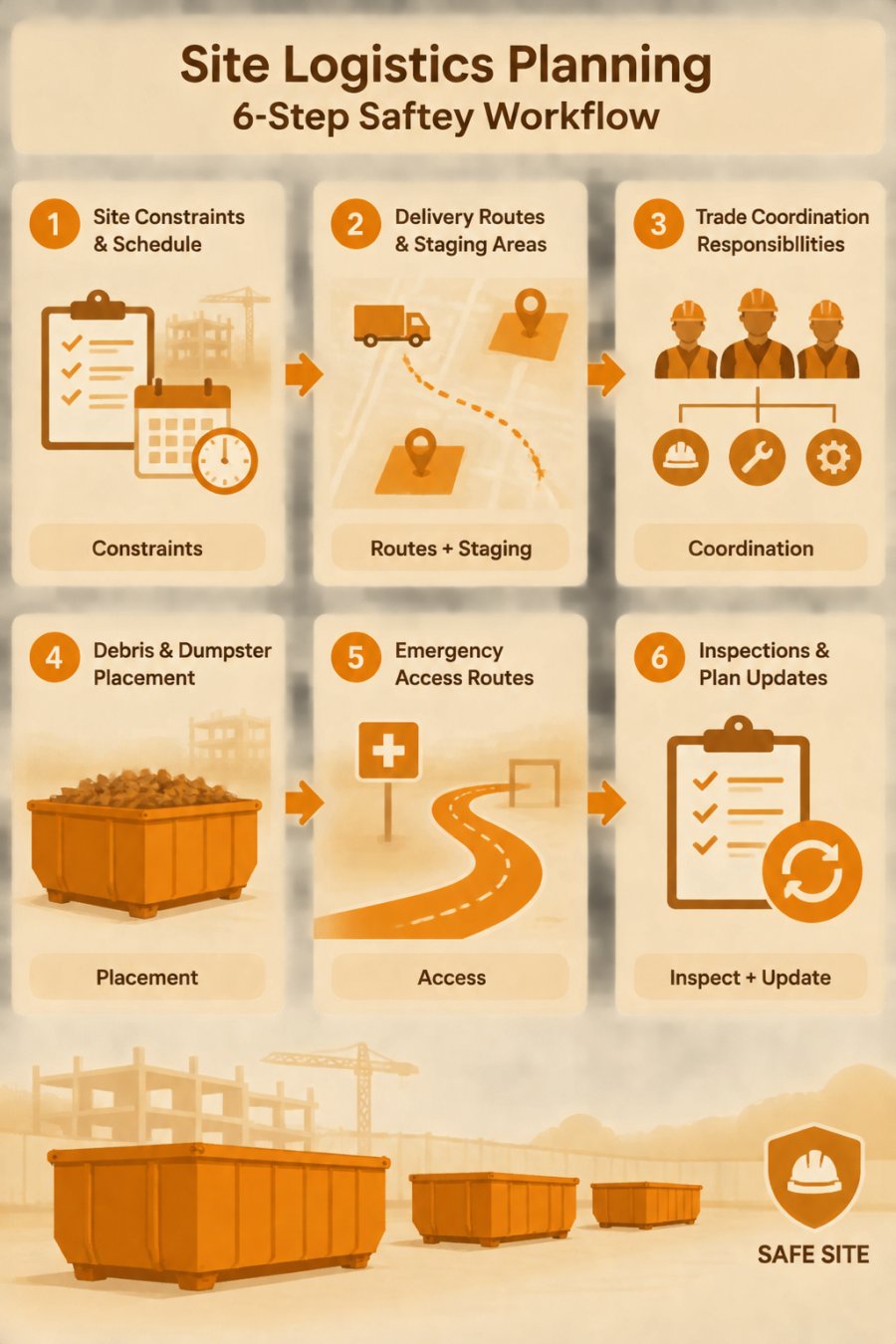
The plan does not need to be long. It needs to be specific. Vague plans ("keep the site tidy") fail. Specific plans ("dumpster staged at the north gate, swapped every Tuesday and Friday") work.
Step-by-Step Planning Workflow
Follow these six steps in order. Each one builds on the last, and each has a clear owner and a review checkpoint.
-
Define site constraints and the project schedule. The project manager and safety lead walk the site together before any work starts. Note property lines, slope, soil conditions, overhead power lines, and any public access points. Match these constraints to the construction sequence so you know what happens when. Review checkpoint: the superintendent signs off on the constraint map before delivery routes are drawn.
-
Map delivery routes and staging areas. The logistics lead (see step 3) drafts a route map showing where trucks enter, where they wait, where they turn, and where materials land. Keep delivery traffic physically separated from pedestrian routes. Mark blind corners and backing zones in red. Review checkpoint: the route map is walked by the superintendent and the crane operator before the first delivery.
-
Assign trade coordination responsibilities. Name one person who owns logistics for the project, typically a logistics coordinator or the general superintendent on smaller jobs. Give each subcontractor a written storage and cleanup zone, and include those zones in the subcontract. Review checkpoint: each trade's foreman signs the zone map at the pre-construction meeting.
-
Plan debris and dumpster placement. Put containers close to the work but out of walkways. Plan for bulky waste like shingles, packaging, and offcuts. Decide haul frequency based on the pace of the work, not a fixed calendar. Review checkpoint: the logistics lead and the waste hauler confirm placement and swap schedule before the first container lands.
-
Set emergency access routes. Keep a clear lane for fire, ambulance, and rescue vehicles at all times. Mark it on the site map in red and keep it free of stored materials, debris, and parked equipment. Review checkpoint: the safety lead walks the emergency lane weekly and documents any blockage.
-
Schedule inspections and plan updates. Review the plan at each phase change, after any near miss, and whenever a new subcontractor mobilizes. Do not wait for the monthly safety meeting. Review checkpoint: the logistics lead updates the plan and reissues it to all foremen within 48 hours of a phase change.
Watch out: the most common failure is treating the plan as a one-time kickoff document. A plan that is not updated when the crane moves or a new trade mobilizes becomes a hazard map, not a safety tool.
Here are the six planning steps, each with its own review checkpoint.
| Step | What to do | Review checkpoint |
|---|---|---|
| 1 | Define site constraints and project schedule | Superintendent signs off on constraint map |
| 2 | Map delivery routes and staging areas | Superintendent and crane operator walk route map |
| 3 | Assign trade coordination responsibilities | Each trade's foreman signs zone map |
| 4 | Plan debris and dumpster placement | Logistics lead and hauler confirm placement and swap schedule |
| 5 | Set emergency access routes | Safety lead walks emergency lane weekly |
| 6 | Schedule inspections and plan updates | Plan reissued to all foremen within 48 hours |
Site Logistics Plan Example: What a Safety-First Plan Looks Like
Here is a short example of how the pieces fit together on a phased commercial build.
Site access: One truck entrance on the east side, one crew entrance on the west.
Staging: Materials land in a marked zone near the crane, then move to floor-level storage by trade. Long-lead items get a dedicated, labeled spot.
Waste: Two roll-off dumpsters sit at the north edge, away from walkways. Debris goes out at the end of each shift, not at the end of the week.
Emergency access: A clear lane stays open around the building perimeter at all times. The plan marks it in red on the site map.
Updates: The logistics lead reviews the plan at every phase change and after any near miss.
The plan reads like a map with rules attached.
If you are sizing containers within a plan like this, our guide on how to optimize jobsite dumpster capacity covers loading and organizing containers safely.
Building a Construction Site Traffic Management Plan
A construction site traffic management plan controls how vehicles and people share the site. It separates trucks from workers, sets speed limits, and marks pedestrian routes. It also covers public roads where site traffic meets the street.
Start with the routes. Map where delivery trucks enter, turn, and exit. Note any blind spots, tight corners, or backing zones. Backing accidents are a leading cause of struck-by injuries on construction sites, so plan routes that avoid reversing where possible.
Then protect pedestrians with physical separation, not just signage:
- Mark walkways with cones, tape, or barriers
- Keep pedestrian routes physically separated from vehicle routes
- Add spotters or a traffic marshal at busy gates
- Set clear delivery windows to reduce congestion
- Protect public sidewalks and crossings with barricades and signage
Site coordination matters here. When trade coordination is poor, five trucks show up at once and the gate becomes chaos. A delivery schedule shared with every subcontractor prevents that pileup.
Emergency Access and Response Planning
Emergency access is the part of a traffic plan that people skip until they need it. Keep a clear lane for fire and rescue vehicles at all times. Mark it on the site map and keep it free of stored materials, debris, and parked equipment.
Response planning goes beyond the lane. Designate a muster point that is uphill and upwind of the main work area, and mark it on the site map. Post evacuation routes at each gate and in the site trailer.
Watch out: emergency lanes are the first thing to get blocked when a delivery arrives early and the staging area is full.
Public Protection and Accessibility
On urban and residential jobsites, the public walks past your fence every day. Plan for:
- Secure fencing around the site perimeter
- Covered walkways where pedestrians pass under work
- Signage warning of overhead work and falling debris
- Barriers that keep the public away from vehicle routes
- A contact number posted for neighbors to report concerns
- Accessible pedestrian detours that meet local ADA requirements, with firm, stable surfaces and detectable warnings at crossings
If the site is near a school, coordinate delivery windows with school arrival and dismissal times. A truck turning into a gate at 8:15 a.m. is a different risk than the same truck at 10:00 a.m.
Contingency planning belongs here too. What happens if the crane breaks down mid-lift? Where do crews go if a fire starts? Write the answers down before you need them, and post them where crews can see them.
Construction Debris Management Plan: Dumpsters, Staging, and Housekeeping
A construction debris management plan sets out how waste leaves the site. It names the containers, the staging spots, the haul schedule, and who keeps it all clean.
Bulky debris causes real problems. Shingles, packaging, and offcuts fill a dumpster fast, and an overflowing container spills into work zones. That creates trip hazards and blocks access.
A workable plan covers:
- Container placement close to work but clear of walkways
- Staging areas for debris that cannot go straight into a dumpster
- Haul frequency matched to the pace of the work
- Housekeeping duties assigned by trade
- On-site processing options that shrink waste volume before hauling
If you plan to process waste on site, check what permits you need first. Our article on what permits you need for on-site waste processing walks through the requirements.
This is also where compaction changes the math. Junk Crusher's mobile dumpster compaction service crushes waste on site, reducing roll-off dumpster volume by up to 70%. Fewer hauls mean fewer trucks crossing the site.
Emergency Access and Public Protection in Site Logistics
Emergency access is the part of a logistics plan that people skip until they need it. Keep a clear lane for fire and rescue vehicles at all times. Mark it on the site map and keep it free of stored materials, debris, and parked equipment.
Public protection matters just as much. On urban and residential jobsites, the public walks past your fence every day. Plan for:
- Secure fencing around the site perimeter
- Covered walkways where pedestrians pass under work
- Signage warning of overhead work and falling debris
- Barriers that keep the public away from vehicle routes
- A contact number posted for neighbors to report concerns
Contingency planning belongs here too. What happens if the crane breaks down mid-lift? Where do crews go if a fire starts? Write the answers down before you need them.
Measuring Safety Outcomes and Updating the Plan
A logistics plan is only as good as its follow-through. Track a few simple measures to see if the plan is working:
- Near misses reported each week
- Housekeeping inspection scores by area
- Emergency route clear or blocked
- Dumpster overflow incidents
- Delivery delays and gate congestion
Review these at your safety meetings. When a number gets worse, update the plan. Changing site conditions, a new phase, or a new subcontractor can all throw off a plan that worked last month.
Tying truck trips to outcomes helps make the case for better logistics. Our article on how to cut your carbon footprint by minimizing truck trips shows how fewer hauls reduce both risk exposure and emissions.
Book a Crush and Put Your Logistics Plan to Work
A strong plan still needs the right equipment behind it. If your dumpsters fill up before the haul arrives, your carefully mapped walkways and staging zones fall apart. Junk Crusher's mobile compaction service crushes waste on site, which reduces the volume hauled from site.
Our service reduces roll-off dumpster volume by up to 70%. We serve construction sites, distribution centers, and manufacturing facilities in Western Pennsylvania.
Book a Crush to see how Junk Crusher's compaction service fits your site.
Frequently Asked Questions
What is site logistics planning?
Site logistics planning is the process of mapping how people, materials, equipment, and waste move through a construction site before work begins. It covers site layout, delivery scheduling, material staging, vehicle and pedestrian routes, crane operations, and debris removal. A written site logistics plan assigns responsibilities to each trade and sets inspection points, so hazards are identified and mitigated before crews arrive rather than after an incident.
Who creates a site logistics plan?
On most commercial projects, the general contractor's project manager or site superintendent leads the effort, with input from trade contractors, the safety manager, and the logistics coordinator. Each trade supplies its delivery schedule, equipment needs, and staging requirements. The plan is then reviewed by ownership and, where required, local permitting authorities. Updating it as site conditions change is a shared responsibility, not a one-time task.
How should construction debris and dumpster locations be included in a site logistics plan?
Place dumpsters away from pedestrian routes, emergency exits, and crane swing zones, and label them on the site layout drawing. Schedule pickups so haul trucks do not conflict with delivery windows. For high-volume debris like shingles or demolition material, on-site compaction reduces the number of hauls and the space dumpsters occupy. Junk Crusher's mobile compaction service crushes dumpster waste on site, cutting roll-off volume by up to 70%.
What should a construction site logistics plan include?
A complete plan includes a site layout drawing with work zones, material storage and staging areas, vehicle and pedestrian routes, traffic control points, equipment and crane placement, temporary facilities and utilities, dumpster and debris locations, emergency access routes, and a communication protocol for trade coordination. It should also name who owns each section, list inspection intervals, and describe how the plan will be updated when the project schedule or site constraints change.


