

OSHA Compliance Checklist for Construction Site Housekeeping
Quick Summary
A construction site housekeeping checklist is a daily walkthrough that marks each item pass or fail, covering walkways, scrap lumber, debris, material storage, waste containers and emergency exits. Under 29 CFR 1926.25, crews must keep work areas cleared of debris, including scrap lumber with protruding nails, and store materials so they do not create a hazard.
- Walk the site before the first crew starts and again before the last crew leaves.
- Scrap lumber with protruding nails must be removed or bent over.
- Each failed item needs a named corrective action, a due time and a follow-up check.
- Assign a named owner to each checklist row, such as the site supervisor or crew lead.
- Keep signed inspection sheets on site as records.
Table of Contents
- Daily Construction Site Inspection Checklist for Housekeeping
- OSHA 1926.25 Housekeeping Requirements in Practice
- Next Step: Assign Housekeeping Owners and Schedule Waste Removal
- Frequently Asked Questions
OSHA Compliance Checklist for Construction Site Housekeeping
Last Updated: November 11, 2026
Daily Construction Site Inspection Checklist for Housekeeping
Construction site housekeeping is one of the most overlooked parts of jobsite safety. Scrap lumber, loose debris and blocked walkways cause trips, falls and struck-by injuries. This checklist gives crews a simple daily walkthrough. For more ideas, see practical ways to streamline jobsite cleanup.
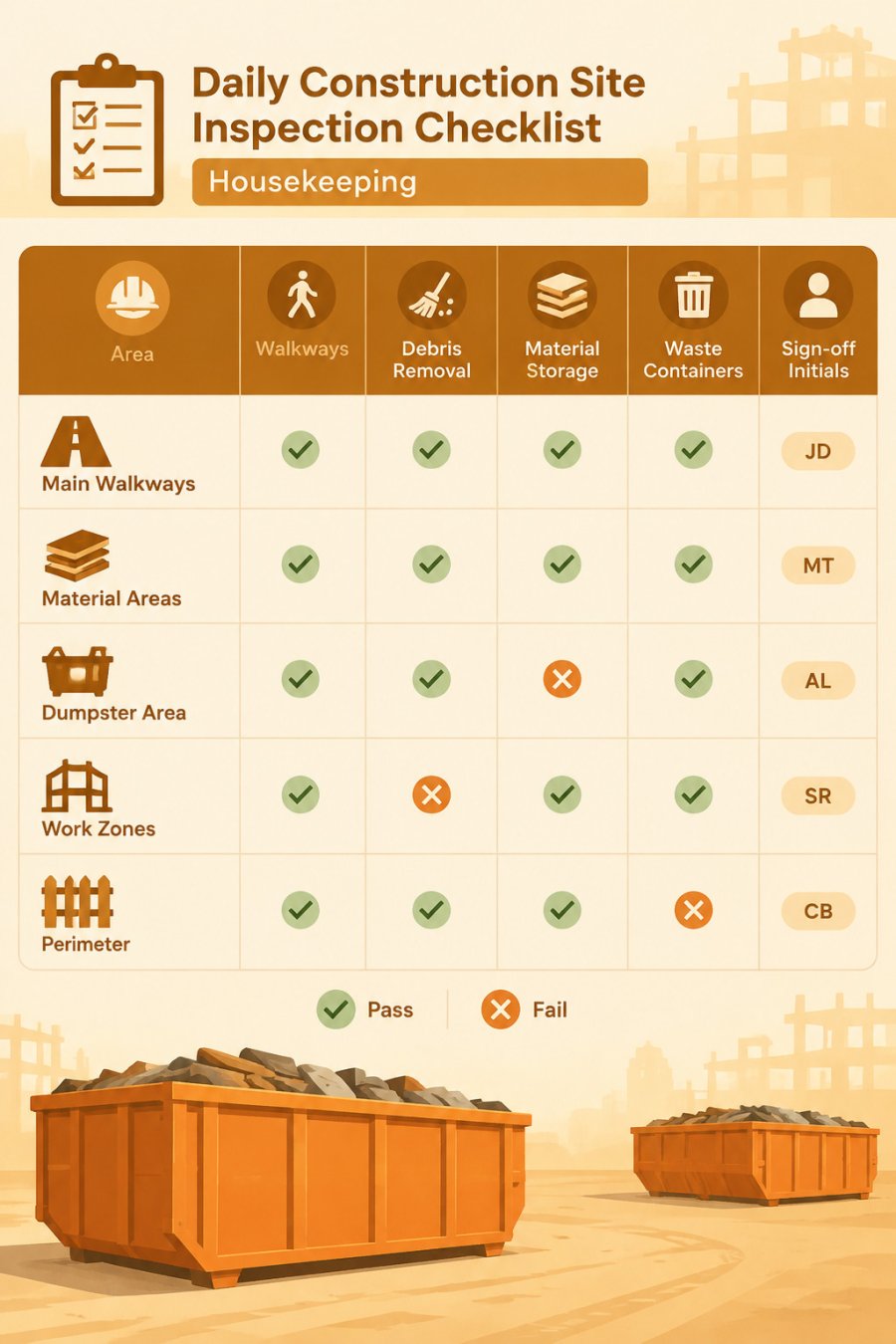
Walk the site before the first crew starts and again before the last crew leaves, marking each item pass or fail:
- Walkways and aisles: Clear, marked and free of cords, hoses and loose material
- Scrap lumber: Protruding nails removed or bent over; scrap stacked, not scattered
- Debris: Cleared from work areas, stairs and access routes
- Material storage: Stacked stable, away from edges and exits
- Waste containers: Lids closed, not overfilled, placed for safe access
- Emergency exits and fire equipment: Unobstructed and visible
- Sign-off: Supervisor initials and time of inspection
Any fail needs a named corrective action, a due time and a follow-up check. Keep signed sheets on site.
| Checklist Area | Pass Standard | Frequency | Owner |
|---|---|---|---|
| Walkways and aisles | Clear and marked | Start and end of shift | Site supervisor |
| Scrap lumber | Nails removed or bent | Daily | Crew lead |
| Waste containers | Covered, not overfilled | Daily | Site supervisor |
OSHA 1926.25 Housekeeping Requirements in Practice
The core federal rule is 29 CFR 1926.25 in OSHA's Construction standards. Its brevity leads crews to treat it as a general instruction, so breaking it into parts makes it usable on a daily sheet.
The standard does three things that matter on site. First, it requires that debris, including scrap lumber with protruding nails, be kept cleared from work areas. Second, it requires that materials be stored so they do not create a hazard. Third, it requires that waste be removed or collected in a way that keeps walking and working surfaces safe. 29 CFR 1926.25 Housekeeping
Record conditions the standard names, such as protruding nails, as compliance requirements; label extras like color-coded bins as recommended practice.
A practical mapping for the checklist:
- Walkways and aisles support keeping work areas free of hazards.
- Scrap lumber and nails map to the protruding-nail language in 1926.25.
- Debris clearance maps to the duty to keep work areas cleared.
- Material storage supports the rule that stored materials not create a hazard.
- Waste containers support safe debris removal.
A checklist citing 1926.25 must show which item satisfies which duty, or it will not survive an audit.
Next Step: Assign Housekeeping Owners and Schedule Waste Removal
Housekeeping holds up only when a named person is accountable for each zone. Write the owner's name on each checklist row.
Use three roles: the site supervisor owns the walkthrough and signs the sheet; the crew lead owns the active zone; each trade foreman owns the debris its crew generates.
Check walkways and waste containers each shift, storage and exits daily, and after weather events or major deliveries.
When a line on the checklist fails, use this sequence:
- Write the specific finding, such as scrap with exposed nails at the north stair landing.
- Name the person who will correct it.
- Set a due time, such as before the next crew starts.
- Take a dated photo before and after correction.
- Record closeout with the verifier's initials.
Keep these records together so any finding can be traced from discovery to closure. A log with date, zone, finding, owner, due time, photo reference and closeout initials is enough for most sites.
Keep ordinary debris and sharp scrap in separate, marked containers, and handle chemical containers under your hazard communication program.
For debris volume, Dumpster Rental provides 20 and 25 yard dumpsters. Position containers clear of walkways and emergency access, and schedule hauls before overflow. To cut hauling frequency with on-site compaction, review the practical steps.
Once owners, frequencies and the correction log are set, run tomorrow's walkthrough and record the first findings.
Frequently Asked Questions
What are the OSHA requirements for construction site housekeeping?
OSHA 1926.25 requires employers to keep work areas, passageways and stairs in and around buildings or other structures free from accumulations of debris and scrap that could cause slips, trips or falls. Scrap lumber with protruding nails must be removed or made safe. Debris should be removed through chutes or other safe means, not thrown from heights without protection. Treat these requirements as the baseline for every daily walkthrough and sign-off on your site.
How often should a construction site be cleaned to meet safety standards?
OSHA does not set a fixed cleaning frequency in 1926.25, but the standard expects debris to be cleared as work progresses. Most crews complete a walkthrough at the start and end of each shift, clearing walkways, aisles and exits as they go. Schedule dumpster pickups or compaction before containers overflow, since full containers and debris piles around them are a common source of citations.
What should be included in a daily construction site cleanup checklist?
A practical daily checklist covers clear walkways and aisles, removed scrap lumber and protruding nails, materials stacked in designated areas, cords and hoses routed out of travel paths, waste containers that are not overfilled, and emergency exits kept open. Use a pass/fail field for each item, record the inspector's name and time, and log any corrective action with a completion date. Keep the signed checklists on file for review.


