

Cut Carbon Footprint by Minimizing Truck Trips
Table of Contents
- Why Truck Trips Are the Hidden Carbon Cost of Construction
- Construction Truck Trip Reduction: A Step-by-Step Playbook
- Construction Logistics Planning That Prevents Extra Miles
- On-Site Dumpster Compaction: Fewer Hauls, Lower Emissions
- Construction Waste Management Best Practices for Fewer Truck Trips
- Quantifying Emissions Avoided per Trip and per Project
- Tools and Data Workflows to Track Trip Count and Emissions
- Frequently Asked Questions
Last Updated: October 17, 2026
Why Truck Trips Are the Hidden Carbon Cost of Construction
Every material delivery, every debris haul, every equipment move burns diesel. That gap matters, because reduced carbon footprint by minimizing truck trips for construction management is one of the few climate wins that also cuts cost.
At Junk Crusher, we see this every week on jobsites across Western Pennsylvania. A crew pays for a dumpster, fills it partway, and calls for a swap.
Freight transport is a major source of greenhouse gas emissions in the United States, according to the U.S. Environmental Protection Agency's inventory of transportation emissions. Fewer trips mean less fuel burned and less CO2 released.
The math is simple. A truck that never leaves the yard produces zero emissions. Below, we'll show you a step-by-step playbook for cutting trips without slowing the job.
Construction Truck Trip Reduction: A Step-by-Step Playbook
Construction truck trip reduction starts with counting what you already move. You cannot cut trips you never measured. This five-step playbook is sequenced the way most construction managers actually work a job, baseline first, then prevention, then consolidation, then scheduling, then verification.
Step 1: Build a One-Week Trip Baseline
Log every truck that enters or leaves the site for one full week. Capture four fields per trip: date and time, load type (material, debris, equipment, concrete), round-trip distance, and whether the truck left full, partial, or empty. Include vendor deliveries, roll-off hauls, ready-mix, and equipment moves.
Most teams find two surprises. First, a meaningful share of roll-off containers leave only partly packed. Second, a cluster of deliveries arrives outside the crew's actual work window and sits idle. Both are trip waste you can remove without touching the schedule.
Step 2: Prevent Trips Before You Optimize Them
The cheapest trip is the one you never schedule. Before consolidating anything, ask whether the load needs to move at all:
- Can material be staged at the supplier and released in phase-sized batches instead of full-project drops?
- Can debris be sorted and compacted on site so one container does the work of two or three?
- Can equipment be shared across adjacent phases instead of mobilized twice?
- Can offcuts, forms, and pallets be reused on site rather than hauled out and replaced?
Trip prevention is where construction differs from general freight. A freight manager can only optimize the trips they are given; a construction manager can redesign the job so fewer trips are needed.
Step 3: Consolidate Loads and Fill the Truck
Combine partial loads into full truckloads. Order materials in larger batches when laydown area allows. Group debris pickups so one truck handles several containers on a single run. Match container size to actual debris flow, an oversized container that fills slowly can stall a tight site and force an emergency haul, which is worse than two right-sized hauls.
Load consolidation cuts total trip count without touching the schedule. It also lowers freight cost per unit moved, which is why it survives budget reviews.
Step 4: Schedule Deliveries Around Site Readiness
A truck that arrives before the crew is ready sits idle and burns fuel. Time deliveries to match the actual work sequence, not the supplier's dispatch convenience. Practical mechanics that prevent repeat trips:
- Book delivery windows, not delivery days, and confirm the window the morning of.
- Use just-in-time delivery for bulky items that clog the site and block access.
- Share a single delivery plan across the GC, subs, and suppliers so two vendors do not arrive for the same trade on the same morning.
- Confirm site readiness, gate access, laydown space, unloading equipment, and crew availability, before the truck rolls.
- Sequence mass-haul and earthmoving moves so cut and fill balance on site, reducing off-site haul trips entirely.
Delivery scheduling is where most projects leak trips. Fix it and the miles drop fast.
Step 5: Verify and Lock In the Gain
Compare the post-change trip count to your baseline. If the count did not drop, the change did not work, revisit Steps 2 through 4. Lock in the gain by writing the trip target into the phase plan and reviewing it at each phase closeout.
| Step | What You Do | Trip Impact |
|---|---|---|
| Baseline | Log one week of truck traffic with load status | Finds half-empty and idle hauls |
| Prevent | Stage, sort, share, reuse before scheduling | Removes trips entirely |
| Consolidate | Combine partial loads; right-size containers | Fewer total trips |
| Schedule | Book windows; share delivery plan; balance mass-haul | Ends idle waiting and repeat trips |
| Verify | Compare to baseline; set phase trip target | Locks in the reduction |
Construction Logistics Planning That Prevents Extra Miles
Good construction logistics planning removes trips before they happen. The goal is fewer truck miles and fewer empty trips, not faster trucks.
Start with route optimization. Plan the shortest safe path between the yard, the supplier, and the site. Add backhauling where possible, so a truck that drops a load picks up another on the way back.
Distance traveled is the number to watch. Every avoided mile is avoided fuel consumption and avoided emissions.
- Plan routes before dispatch, not during
- Fill trucks completely before they leave
- Avoid empty return runs with backhauling
- Set a target trip count per phase
On-Site Dumpster Compaction: Fewer Hauls, Lower Emissions
On-site dumpster compaction crushes waste inside the container so each haul carries far more material. That single change attacks the problem at its root: fewer hauls, fewer truck trips, less fuel burned.
Junk Crusher brings mobile compaction to your site and reduces roll-off dumpster volume by up to 70%. A container that once needed three swaps may need one.
Our clients also see up to 56% reduction in dumpster fees. The savings come from paying for material hauled, not for empty air.
- Fewer hauling trips per project
- Less idling at the gate
- More usable yard space
- Lower transport emissions overall
Construction Waste Management Best Practices for Fewer Truck Trips
Construction waste management best practices all point the same direction: keep material out of the truck. Sort debris at the source so recyclables never ride to a landfill.
Set up separate containers for cardboard, metal, and mixed debris. Full containers get hauled; half-full ones waste a trip. Compaction helps here too, packing more waste into each load.
Lean management thinking applies directly. Every haul is a step in a process. Remove the waste in the process and the truck trips fall out with it.
Quantifying Emissions Avoided per Trip and per Project
Most guides tell you to "count fewer trips" and stop there. A transparent method is what lets you report a real number to an owner, a client, or a sustainability reviewer. The approach below uses only inputs a construction manager already has or can get from a hauler invoice.
The Per-Trip Formula
Emissions avoided per trip = round-trip distance × fuel use per mile × emissions factor for the fuel.
Three inputs, each obtainable:
- Round-trip distance, from your trip log or a route planner. Use the actual loaded-out and return-leg distance, not a straight-line estimate.
- Fuel use per mile, from the hauler's telematics, the vehicle's published fuel economy, or a fleet average for the truck class. A heavy roll-off truck and a pickup are not interchangeable, so match the factor to the vehicle actually removed.
- Emissions factor, the standard diesel factor published by the U.S. Environmental Protection Agency for greenhouse gas equivalencies. Use the same factor across all trips so the comparison is consistent.
Worked Example
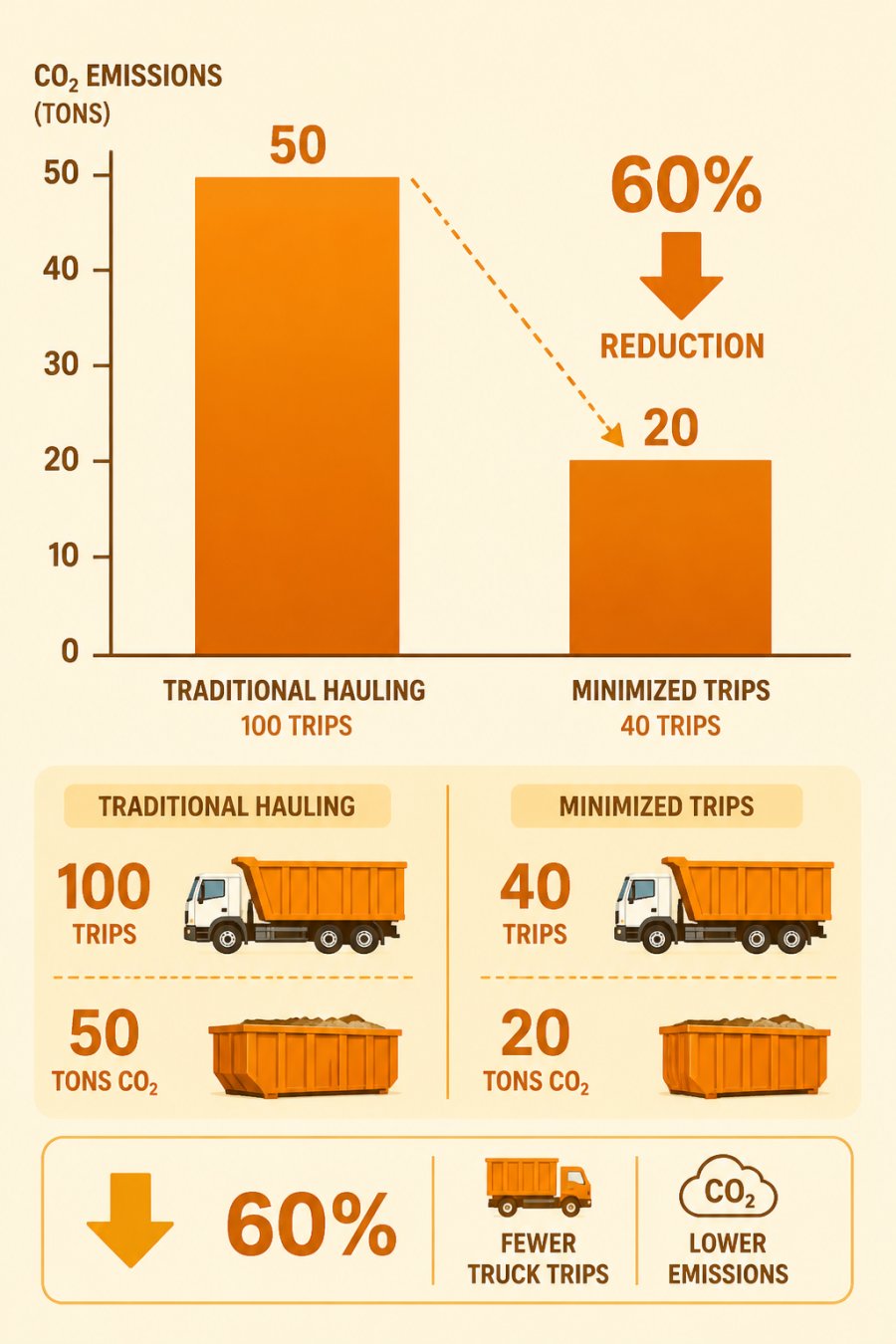
A project drops from 100 hauls to 40 hauls, avoiding 60 round trips. At roughly 40 miles round trip, that is 2,400 truck miles removed.
Adjusting for Payload and Load Factor
A trip that leaves half empty is not the same as a full one. Two adjustments keep the number honest:
- Payload adjustment, if a consolidation change lets one truck carry what previously took two, count the removed trip at the payload it actually displaced, not at an average.
- Load factor, record whether each removed trip was full, partial, or empty. Empty return legs are the easiest trips to defend as avoided, because the load carried was zero.
Reporting Structure That Survives Review
Build a one-page record per project with four columns: phase, trips removed, round-trip miles removed, and estimated CO2 avoided. Add the fuel and emissions factors you used in a footnote so a reviewer can reproduce the math. Track the trip count per phase and per season; over a year those records become a carbon reduction history you can show clients and regulators without re-deriving anything.
For waste hauling specifically, on-site compaction gives you a clean, measurable drop in trips, the trip count on your hauler invoices is the input, and the formula above turns it into a defensible emissions figure.
Tools and Data Workflows to Track Trip Count and Emissions
Trip tracking does not need expensive software. A shared spreadsheet works for most crews.
From there, build a simple dashboard. Track trip count, mileage, and estimated emissions side by side. Compare phases to spot where extra miles creep in.
Better data workflows help in three ways:
- They prove savings to owners and clients
- They flag empty or partial loads early
- They turn carbon reduction into a number, not a claim
For waste hauling specifically, on-site compaction gives you a clean, measurable drop in trips. Junk Crusher handles the crushing, and you keep the trip count record.
If you need extra container capacity alongside compaction, our dumpster rental service covers 20 and 25 yard options.
Cutting truck trips is one of the rare moves that lowers both your carbon footprint and your costs. The playbook is straightforward: map your loads, consolidate before dispatch, schedule around site readiness, and compact waste on site so fewer hauls do more work.
Frequently Asked Questions
How does reducing truck trips lower construction emissions?
Every truck trip burns fuel and releases carbon dioxide and other greenhouse gases. Fewer trips mean less fuel consumed and lower emissions. For construction managers, minimizing truck trips through load consolidation, route optimization, and on-site compaction directly cuts the carbon footprint of material deliveries and waste hauling. For example, compacting dumpster waste on site can reduce hauling volume by up to 70%, translating to fewer hauls and significantly lower transport emissions.
What construction waste management practices reduce hauling?
Key practices include on-site compaction of dumpster waste, source separation of recyclables, just-in-time delivery scheduling, and consolidating loads. Using a mobile compaction service can crush debris like shingles and heavy materials, allowing more waste per container and fewer pickups. Pair this with construction logistics planning that groups deliveries and pickups to minimize empty miles. These practices not only cut truck trips but also lower disposal costs and improve site safety.
How does on-site dumpster compaction reduce waste hauling?
On-site dumpster compaction uses a mobile crusher to compress waste inside a roll-off dumpster, reducing its volume by up to 70%. This means each dumpster holds more waste, so you need fewer hauls to dispose of the same amount. Fewer hauls translate to fewer truck trips, less fuel burned, and lower emissions. It also reduces the number of dumpsters needed on site, saving space and rental costs. Junk Crusher offers this service for construction sites in Western Pennsylvania.
How should construction managers plan debris pickups to minimize trips?
Construction managers should schedule pickups based on actual fill levels rather than fixed intervals. Using sensors or visual checks to monitor dumpster capacity prevents unnecessary hauls. Coordinate pickups with material deliveries to combine trips, and use route optimization software to plan the most efficient paths. On-site compaction extends the time between pickups, further reducing trips. Documenting trip counts and fuel use helps track progress and identify further reduction opportunities.


