
Benefits of Compacting Waste On Site: 2026 Guide
Table of Contents
- What On-Site Waste Compaction Actually Does to Your Dumpster Volume
- How to Lower Commercial Waste Hauling Fees With Compaction
- Commercial Waste Reduction Strategies That Work With Compaction
- Space Efficiency and Site Safety Gains From a Smaller Dumpster Footprint
- Environmental Impact: Landfill Diversion and Fewer Truck Trips
- Best Smash My Trash Alternatives for Western PA Operations
- Labor Efficiency and Operational Workflow After Compaction
- Frequently Asked Questions
Last Updated: September 24, 2026
What On-Site Waste Compaction Actually Does to Your Dumpster Volume
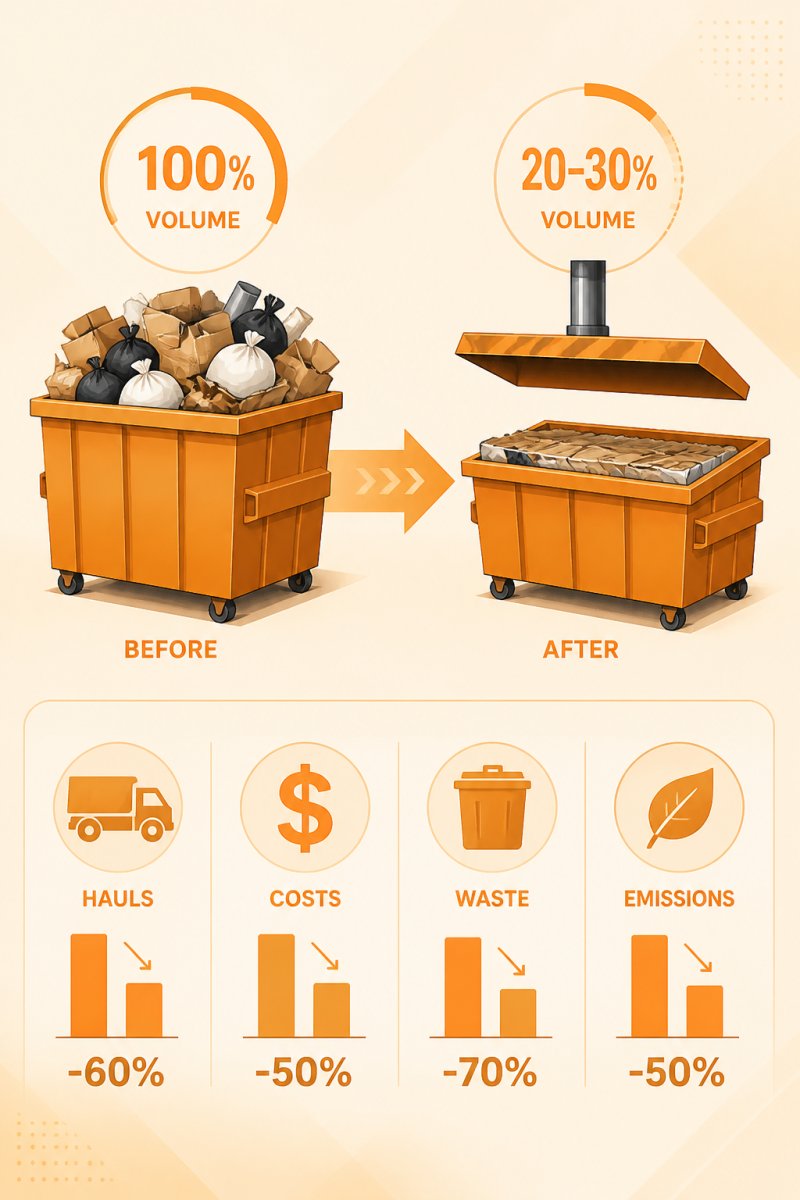
On-site waste compaction is the mechanical crushing of dumpster contents to reduce the physical volume waste occupies before hauling. A mobile unit presses material inside your existing roll-off container, so the same dumpster holds far more between pickups.
Loose debris, cardboard, shingles, and packaging leave enormous air space. Compacting waste collapses that void, raising the density of what sits in the container.
Haulers bill on volume and trip frequency, not on how tightly you packed the box. Junk Crusher built its mobile service around this gap: instead of paying to haul empty space, facilities crush material on site and cut trips.
How to Lower Commercial Waste Hauling Fees With Compaction
The fastest way to lower commercial waste hauling fees is to reduce pickup frequency, because most hauling contracts price each trip.
Haulers charge for the truck, driver, fuel, and landfill tipping fee on every run. When your container fills in two days, you pay for a pickup every two days; compacting waste on site stretches that interval.
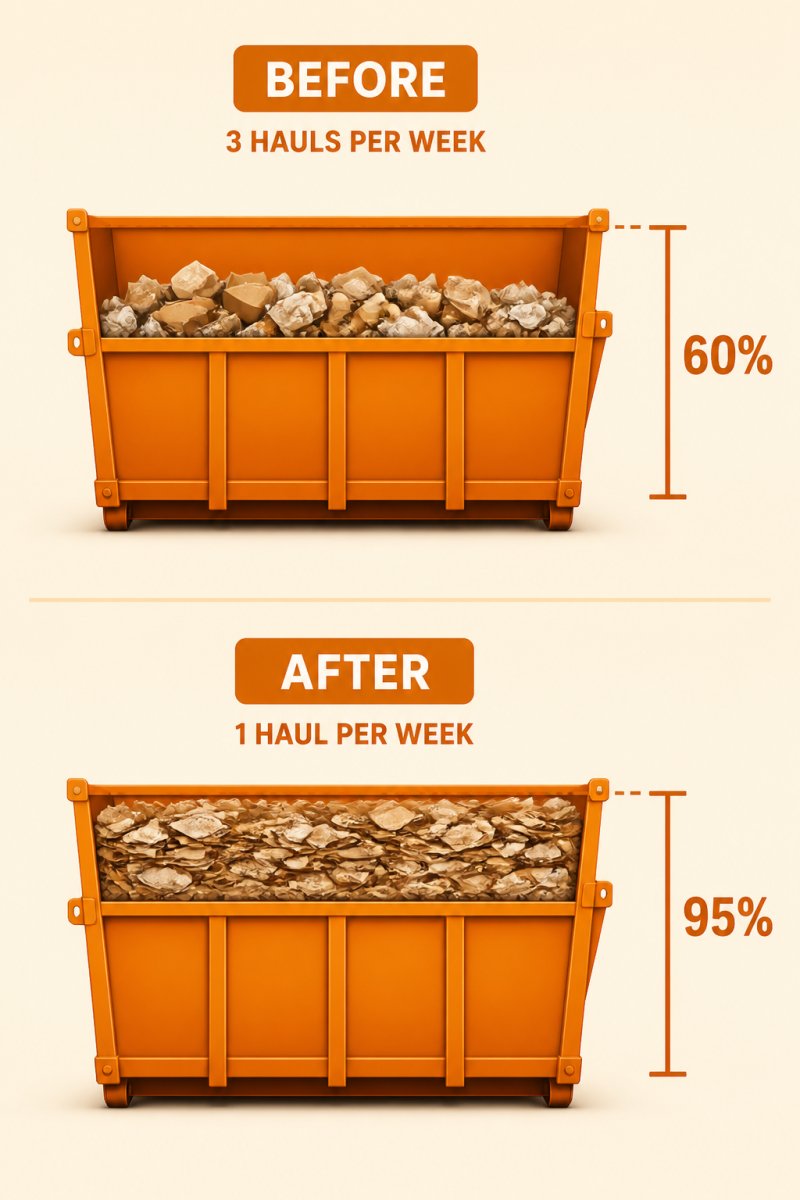
A 20-yard roll-off that normally fills in a day may hold three or four days of compacted material. That shift alone can cut weekly hauls dramatically. Clients who switch to scheduled compaction can see a significant reduction in dumpster fees.
Calculating Your ROI: Hauling Frequency vs. Equipment Costs
Use this framework to prove compaction savings before you sign.
Step 1, Baseline your current spend. Pull three months of hauler invoices. Record:
- Pickups per month (P)
- Cost per pickup (C)
- Any container rental or fuel surcharge line items (F)
Monthly baseline = (P × C) + F
Step 2, Estimate your volume reduction ratio (VRR). VRR is the percentage of container volume you expect to eliminate through compaction. It varies by material:
- Corrugated cardboard and mixed packaging: commonly 3:1 to 5:1
- Wood pallets and crates: commonly 2:1 to 4:1
- Drywall and roofing shingles: commonly 2:1 to 3:1
- Mixed construction debris: commonly 1.5:1 to 2.5:1
Use a conservative VRR for the first projection and a mid-range VRR for the optimistic case.
Step 3, Project new pickup frequency. New pickups per month = P ÷ VRR
If you run 12 pickups per month and your VRR is 2.5, your projected schedule drops to roughly 5 pickups.
Step 4, Compare against compaction service cost. Monthly savings = (P − New pickups) × C
Then subtract the compaction service fee, converting per-crush billing to a monthly figure using your expected crush frequency.
Step 5, Calculate payback period. Payback (months) = Upfront or onboarding cost ÷ Monthly net savings
If the service is billed monthly with no upfront cost, payback is immediate as long as monthly net savings are positive. If there is a lease or setup fee, divide it by monthly net savings to get months until break-even.
Contract structures that change the math. Not all hauling contracts respond the same way to fewer pickups:
- Per-pull pricing: Savings scale directly with reduced pickups. This is the best case.
- Flat monthly fee with unlimited pulls: Reducing pickups does not lower the invoice. You need to renegotiate the contract or switch to per-pull pricing to capture savings.
- Minimum pull commitments: Some contracts require a minimum number of hauls per month. Check your agreement before projecting savings.
- Fuel and environmental surcharges: These often scale with pickups, so fewer trips reduces them too. Add them to your per-pickup cost for a more accurate baseline.
A note on equipment costs. A stationary compactor's capital cost, plus installation, power, and maintenance, usually pushes payback well beyond a service model. A mobile service that brings the compaction unit to your existing container is the lower-risk entry point.
Commercial Waste Reduction Strategies That Work With Compaction
Compaction works best alongside source separation, not instead of it. The biggest savers combine a waste audit, segregation at the point of generation, and scheduled crushing.
Identify your heaviest, bulkiest streams. Corrugated cardboard, wood pallets, drywall, and roofing shingles compact well; food waste, liquids, and hazardous material do not belong in a crusher.
Pair compaction with these habits:
- Stage cardboard separately so it can be baled or crushed on its own cycle.
- Keep a labeled container for non-compactable items to avoid equipment damage.
- Schedule compaction before the container hits overflow, not after.
The EPA's guidance on sustainable materials management outlines how source reduction and recycling fit together, and compaction slots directly into that hierarchy by shrinking what heads to the landfill.
Waste Stream Analysis: What Belongs in the Crusher
Not every material should meet the compaction plate. Knowing what to feed the unit protects the equipment and keeps your recycling clean.
| Material | Compact? | Why |
|---|---|---|
| Corrugated cardboard | Yes | Collapses well, high volume reduction |
| Wood pallets and crates | Yes | Bulky, compacts into dense loads |
| Roofing shingles | Yes | Heavy but highly compressible |
| Drywall and plaster | Yes | Breaks down under pressure |
| Food waste | No | Creates odor and leachate issues |
| Liquids and chemicals | No | Hazardous, damages equipment |
| Aerosol cans | No | Pressure risk during crushing |
Space Efficiency and Site Safety Gains From a Smaller Dumpster Footprint
A smaller dumpster footprint frees yard space and reduces overflow hazards. Fewer containers mean fewer trip points, less clutter, and cleaner traffic flow.
On tight jobsites, the dumpster competes with staging, parking, and equipment access.
Environmental Impact: Landfill Diversion and Fewer Truck Trips
Fewer truck trips is the clearest environmental win from compaction. Every haul avoided is a diesel trip avoided, lowering the carbon footprint of your waste disposal logistics.
Regulatory Compliance: What Facility Managers Need to Check Before Compacting
Compaction touches several regulatory areas that most benefit-list articles ignore. Before you install or schedule a compaction service, verify these items with your local authority having jurisdiction (AHJ).
- Lockout/tagout procedures (29 CFR 1910.147) if your staff interacts with compaction equipment
- Personal protective equipment (29 CFR 1910.132) for workers handling waste
- Machine guarding (29 CFR 1910.212) for any stationary compaction equipment on site
Connecting Compaction to ESG Reporting
If your organization publishes an ESG or sustainability report, compaction gives you two easy-to-track metrics:
- Haul count reduction: Fewer diesel trips is a Scope 3 emissions reduction you can quantify using standard freight emission factors.
- Diversion rate: The percentage of total waste diverted from landfill through recycling and recovery. Compaction supports higher diversion rates by making on-site segregation feasible.
Best Smash My Trash Alternatives for Western PA Operations
Facilities searching for mobile compaction services in Western Pennsylvania want on-site crushing without locking into a national provider. Junk Crusher is a local mobile compaction service built for this region.
Labor Efficiency and Operational Workflow After Compaction
Labor hours drop when crews stop babysitting the dumpster. Fewer trips to a full container, fewer hauler calls, and fewer overflow cleanups add up across a week.
Compaction changes the workflow in three ways:
- Cleanup becomes a scheduled task instead of an emergency.
- Site crews spend less time managing waste and more time on billable work.
- Hauler coordination drops to a predictable calendar.
Frequently Asked Questions
How does on-site waste compaction reduce hauling costs?
Compacting waste on site increases the density of material inside your dumpster, so you fit more waste into the same container. Instead of paying for multiple hauls of loosely packed debris, you pay for fewer pickups because each load is fuller. For operations with high waste volume, this can cut hauling frequency significantly, lowering collection fees and reducing the labor hours spent managing overflow.
What types of businesses benefit most from mobile dumpster compaction?
Construction sites, roofing companies, manufacturing plants, distribution centers, and large warehouses see the biggest gains. These operations generate heavy, bulky waste like shingles, cardboard, pallets, and industrial debris that compacts well. If your dumpster fills up before the scheduled pickup or you regularly pay for extra hauls, compaction likely pays for itself by reducing hauling frequency and improving site cleanliness.
Is on-site waste compaction environmentally friendly?
Yes. Compacting waste reduces the number of truck trips needed to haul material away, which lowers fuel consumption and carbon emissions. It also improves landfill diversion when paired with proper waste segregation, since more material can be processed per load. Fewer hauls mean less traffic, less diesel exhaust, and a smaller operational carbon footprint for your site.
What is the difference between a stationary compactor and mobile compaction services?
A stationary compactor is a permanent piece of equipment installed at your facility, requiring upfront purchase, installation, and maintenance. Mobile compaction services bring the equipment to your site on a scheduled basis, compacting waste directly in your existing dumpster. Mobile services suit operations with changing locations or multiple sites, while stationary units fit high-volume single-location facilities with consistent waste streams.
