
Construction Site Waste Management Solutions: 2026 Guide
Table of Contents
- What Construction and Demolition Debris Actually Costs You
- Building a Construction Waste Management Plan Template That Works
- On-Site Dumpster Compaction Services: What They Do and When to Use Them
- How to Reduce Dumpster Hauling Frequency Without Slowing the Job
- Waste Tracking Tools and Audit Methods Most Contractors Skip
- LEED Documentation, Diversion Rates, and Circular Construction
- Hazardous Waste, Washout, and Regulatory Compliance
- Conclusion
- Frequently Asked Questions
Last Updated: October 1, 2026
What Construction and Demolition Debris Actually Costs You
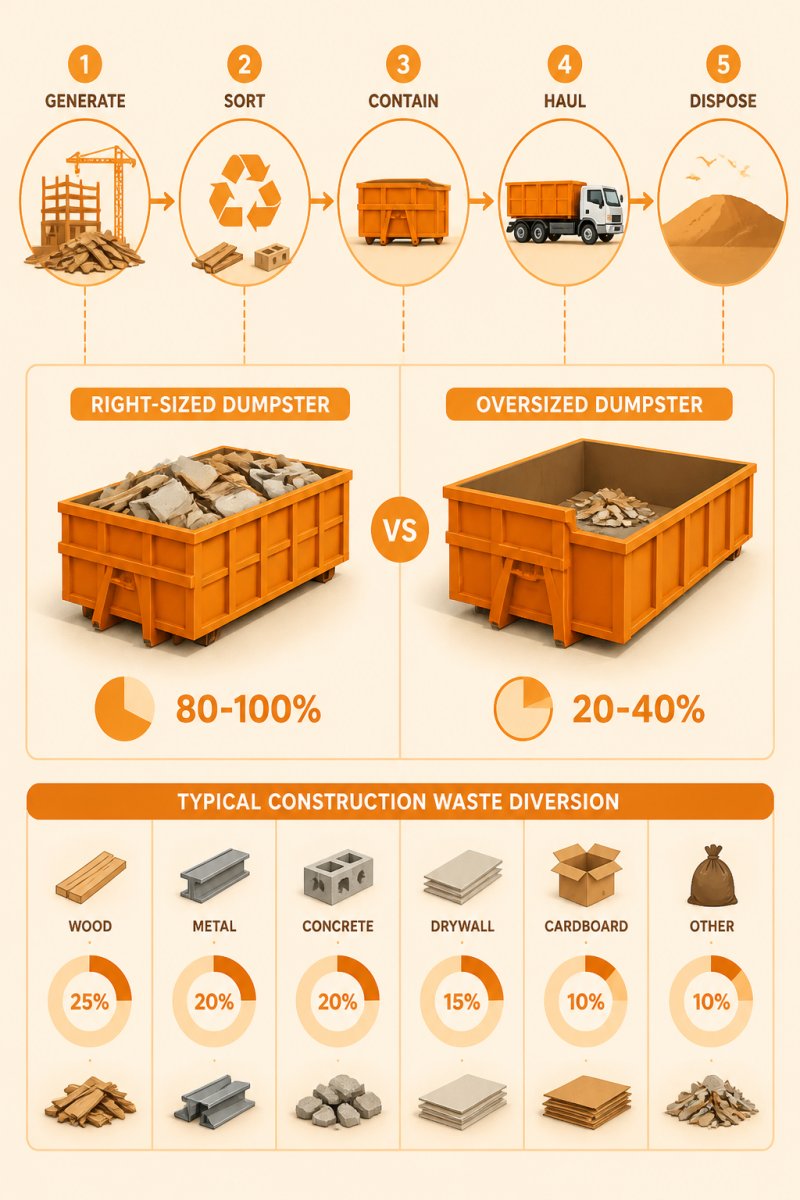
Construction site waste management solutions are the systems, equipment, and processes that control how debris moves from your jobsite to its final destination. They cover everything from the dumpsters you rent to the compaction equipment that crushes what's inside them. At Junk Crusher, we've watched contractors pay for air for years: a roll-off container leaves the site half full, and the hauler bills for the whole truck.
Building a Construction Waste Management Plan Template That Works
A construction waste management plan template is a written document that identifies every waste stream on your project, assigns handling procedures to each, and sets measurable diversion targets. Most templates fail because they're written for the permit reviewer, not the crew. The fix is to build the plan around what actually happens on site, who touches the material, where it goes, and how it gets documented.
The Eight Sections Every Plan Needs
- Waste stream inventory. List every material type by CSI division. Division 02 (site work) generates soil, rock, and clearing debris. Division 03 (concrete) generates washout, formwork, and rebar. Division 09 (finishes) generates drywall, ceiling tile, flooring, and paint. If a division is on your schedule, its waste stream belongs in the plan.
- Estimated volumes. Cubic yards per material, per phase. Pull quantities from your takeoff and apply a waste factor. A common pattern is 10-15% waste on drywall and 5-10% on framing lumber, but the number that matters is the one you measure on your own past jobs.
- Segregation procedures. What goes in which container, and where the container sits. Name the container by size and material, "20-yard drywall-only", not "recycling bin."
- Hauling schedule. Container sizes, pickup frequency, and the triggers that change them. Tie pickups to production milestones, not calendar dates.
- Recycling and salvage vendors. Named contacts, not placeholders. Include the material each vendor accepts, their contamination limits, and whether they pay for material or charge a tipping fee.
- Hazardous materials protocol. Identification, storage, and the disposal chain. This section should name who on site is authorized to handle regulated material and where the manifests live.
- Diversion targets. Percentage goals by material type, not one project-wide number. A 75% overall target is meaningless if you can't say which streams get you there.
- Documentation. Weight tickets, manifests, and photo logs. Assign one person to own the file, and state where it's stored.
What Separates a Working Plan From a Shelf Document
Three things separate plans that get followed from plans that get filed:
- It's written at the crew's reading level. If a laborer on their first day can't tell which container a scrap of drywall goes in, the plan will be ignored. Use material names, not waste codes.
- It names people, not roles. "Site superintendent" is a role. A name and a phone number is an owner.
- It has a review cadence. Update the plan at each phase transition. The waste stream after rough-in looks nothing like the waste stream during finish work, and a plan that doesn't change with the phase is a plan nobody reads.
Compliance and Review
Most jurisdictions require a waste management plan as a condition of the building permit, and many require diversion reporting before final inspection. Requirements vary by municipality, so confirm the local ordinance before mobilization. Build the documentation section so it produces the report the inspector will ask for, weight tickets and vendor receipts organized by material type, rather than reconstructing it after the fact.
On-Site Dumpster Compaction Services: What They Do and When to Use Them
On-site dumpster compaction services crush the contents of your roll-off container in place, typically reducing waste volume by up to 70%. That means fewer hauls for the same amount of debris.
| Waste Type | Compacts Well? | Best Handling |
|---|---|---|
| Drywall and plaster | Yes | On-site compaction |
| Framing lumber | Yes | Compaction after segregation |
| Roofing shingles | Yes | Compaction in dedicated container |
| Concrete and masonry | No | Separate container, no compaction |
| Soil and dirt | No | Dedicated bulk container |
| Scrap metal | No | Recycling stream |
How to Reduce Dumpster Hauling Frequency Without Slowing the Job
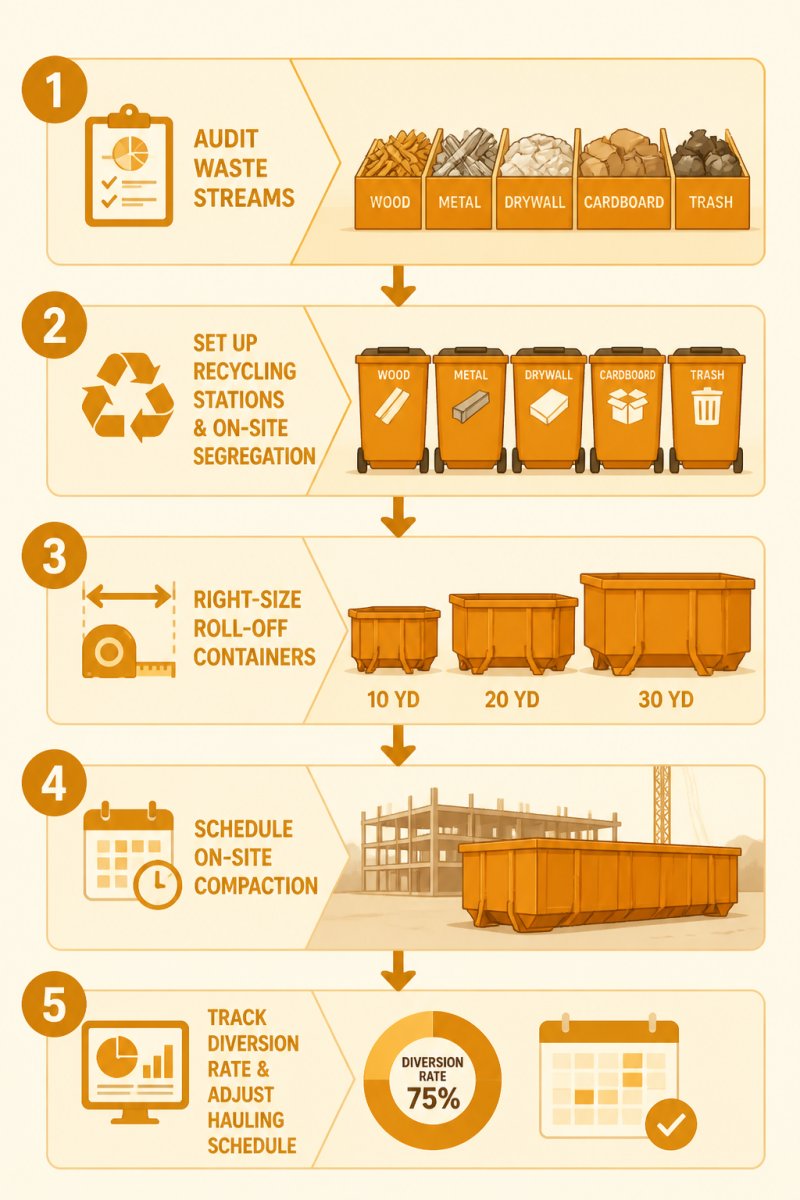
You reduce dumpster hauling frequency by increasing the density of what leaves the site, not by delaying pickups. Three levers do most of the work: segregation, scheduling, and container sizing.
Segregation, Scheduling, and Sizing
Set up recycling stations at the point of generation, not at the far corner of the site. Crews sort when the bin is ten feet away, not a hundred.
Waste Tracking Tools and Audit Methods Most Contractors Skip
Waste tracking tools range from a shared spreadsheet with weight tickets to full transportation management platforms. Most contractors skip tracking entirely, which is why they can't explain their disposal costs month to month. The gap on this topic isn't the software, it's the audit method that tells you what to put in it.
How to Run a Site Waste Audit: A Four-Phase Method
A waste audit is a structured measurement of what your project generates, where it goes, and what it costs. Done properly, it takes one full production day per phase and produces the baseline every other waste decision depends on.
Phase 2, Collect the data. For each container, record:
- Container size and material type
- Estimated fill percentage at the start and end of the audit day
- Number of hauls and haul dates
- Destination (landfill, recycling facility, salvage yard)
- Weight ticket number, if the load is weighed
What to Track Between Audits
A full audit is a periodic event. Between audits, track a smaller set of fields on every haul:
| Data Field | Why It Matters |
|---|---|
| Haul date | Reveals whether pickups track production or the calendar |
| Container size and material | Shows whether sizing matches the stream |
| Destination | The only way to prove diversion |
| Weight or estimated volume | The denominator for every diversion calculation |
| Cost per haul | Connects waste to the project budget |
When Software Earns Its Cost
Digital platforms add value when you're running multiple sites, when a general contractor requires digital diversion reporting, or when haul volume is high enough that manual entry becomes a bottleneck. They handle route optimization, manifest storage, and report generation that would otherwise consume office hours. For a single-site renovation, the spreadsheet wins on cost and simplicity. The decision point is whether the reporting burden has outgrown the person doing it.
Reporting Cadence
Report monthly to your project manager and at each phase transition to ownership. The monthly report should show diversion rate, disposal spend, and the action items from the last audit. The phase-transition report should reset the baseline, because the waste stream has changed.
LEED Documentation, Diversion Rates, and Circular Construction
LEED certification documentation requires proof, not estimates. You need weight tickets, vendor receipts, and manifests that trace each material from your site to its end destination.
Hazardous Waste, Washout, and Regulatory Compliance
Hazardous waste handling follows a separate track from your general debris. Solvents, adhesives, lead paint residue, and asbestos-containing materials require licensed disposal and manifest documentation under federal rules.
Conclusion
Waste costs on a construction site rarely come from one big mistake. They come from dozens of half-full containers hauled at full price. Getting control means planning the waste stream, segregating on site, and compacting what you can before it leaves.
Frequently Asked Questions
What is a construction waste management plan?
A construction waste management plan (CWMP) is a written document that identifies the types of construction and demolition debris a project will generate, how each material will be sorted and processed, and where it will go for recycling or disposal. It also names the people responsible for each step. Many general contractors now require a CWMP before mobilization because it supports regulatory compliance, project cost control, and sustainability goals such as a measurable waste diversion rate.
How can construction sites reduce waste?
Start with a waste stream analysis so you know which materials dominate your debris. Then set up on-site segregation with labeled recycling stations for concrete, metal, cardboard, and wood, and keep trash separate from salvageable materials. Order materials to exact dimensions to cut offcuts, and use on-site dumpster compaction services to fit more debris into each roll-off container. Together these steps raise your waste diversion rate and cut disposal fees.
What are the benefits of on-site waste compaction?
On-site compaction crushes bulky debris inside a roll-off container, which can reduce dumpster volume by up to 70%. That means fewer hauls, lower disposal fees, and fewer truck trips to the landfill, which lowers your carbon footprint. For sites with tight space, it also frees up yard area because you need fewer containers on the ground. Junk Crusher provides mobile compaction for construction, demolition, and manufacturing sites in Western Pennsylvania.
How do you manage hazardous waste on a construction site?
Hazardous materials such as solvents, lead paint waste, and some adhesives must never go into a general roll-off container. Store them in labeled, sealed containers on an impermeable surface away from storm drains, and keep them separated from construction and demolition debris. Under U.S. rules, hazardous waste disposal requires proper manifests and licensed transporters. Train crews on what qualifies as hazardous, and check your disposal permits before any material leaves the site.
What is the most effective way to dispose of construction debris?
The most effective approach combines sorting and processing at the source with volume reduction before hauling. Segregate recyclable material recovery streams (concrete, metal, clean wood, cardboard) into dedicated containers, and compact the remaining bulk waste on site so each roll-off container carries more payload. This cuts landfill avoidance tonnage, reduces disposal fees, and produces the diversion records you need for LEED certification documentation.
Do I need a dumpster rental if I use an on-site compaction service?
Yes. Compaction reduces the volume inside the container, but you still need roll-off containers on site to hold the debris. Junk Crusher offers 20 and 25 yard dumpsters alongside its mobile compaction service, so you can size the container to your waste stream and schedule compaction between hauls. Pricing depends on container size, service frequency, and delivery location, so request a quote for your project.
How do I know whether compaction will work for my type of debris?
Compaction works best on bulky, compressible material such as shingles, wood framing, drywall, cardboard, and general job site debris. It is not suitable for concrete slabs, large metal, or hazardous waste, which go to separate recycling or disposal streams. If your site generates a heavy mix of shingles and demolition debris, ask the service provider to review your waste stream analysis and confirm the crusher can handle your material before you commit.


