How to Choose On-Demand vs Contract Waste Management
Last Updated: October 31, 2026
Quick Summary
On-demand waste management is a pay-as-you-go model where collection happens when you call, while contract waste management is a scheduled service agreement with recurring pickups and predictable billing. Choose on-demand for variable or project-based volume, and contracted service for steady, predictable waste streams.
- On-demand pickup carries no contract term, but per-pull pricing runs higher than contracted rates.
- Contracted service bills for the container, not the contents, so partially filled dumpsters are hauled at full price.
- Check automatic renewal clauses, which often require notice 30 to 90 days before the term ends.
- Negotiate a price escalation cap, such as 3% or 5% annually, rather than an uncapped escalator.
- Mobile dumpster compaction can cut hauls in half and let you stay on a smaller contract or drop to on-demand.
Table of Contents
- On-Demand vs Contract Waste Management: Key Differences
- Commercial Waste Management Services: Pros and Cons by Service Type
- Waste Management Contract Terms to Review Before Signing
- Construction Waste Management: Matching Service to Jobsite Demand
- Mobile Dumpster Compaction: A Hybrid That Cuts Hauling Frequency
- Choosing Your Waste Service: A Decision Framework by Business Type
- Frequently Asked Questions
On-Demand vs Contract Waste Management: Key Differences
Choosing between on-demand and contract waste management services comes down to one question: can you predict your waste volume, or does it swing with the job? On-demand pickup means you schedule hauls when containers fill. Contracted service locks in a fixed collection schedule, usually with a fixed monthly bill. We work with manufacturers, contractors, and distribution centers across Western Pennsylvania, and businesses that overpay are often using the model that does not match their volume pattern.
Here is the distinction that matters. On-demand waste management is a pay-as-you-go model where collection happens when you call, while contract waste management is a scheduled service agreement with recurring pickups and predictable billing. Everything else, from cost control to service reliability, flows from that difference.
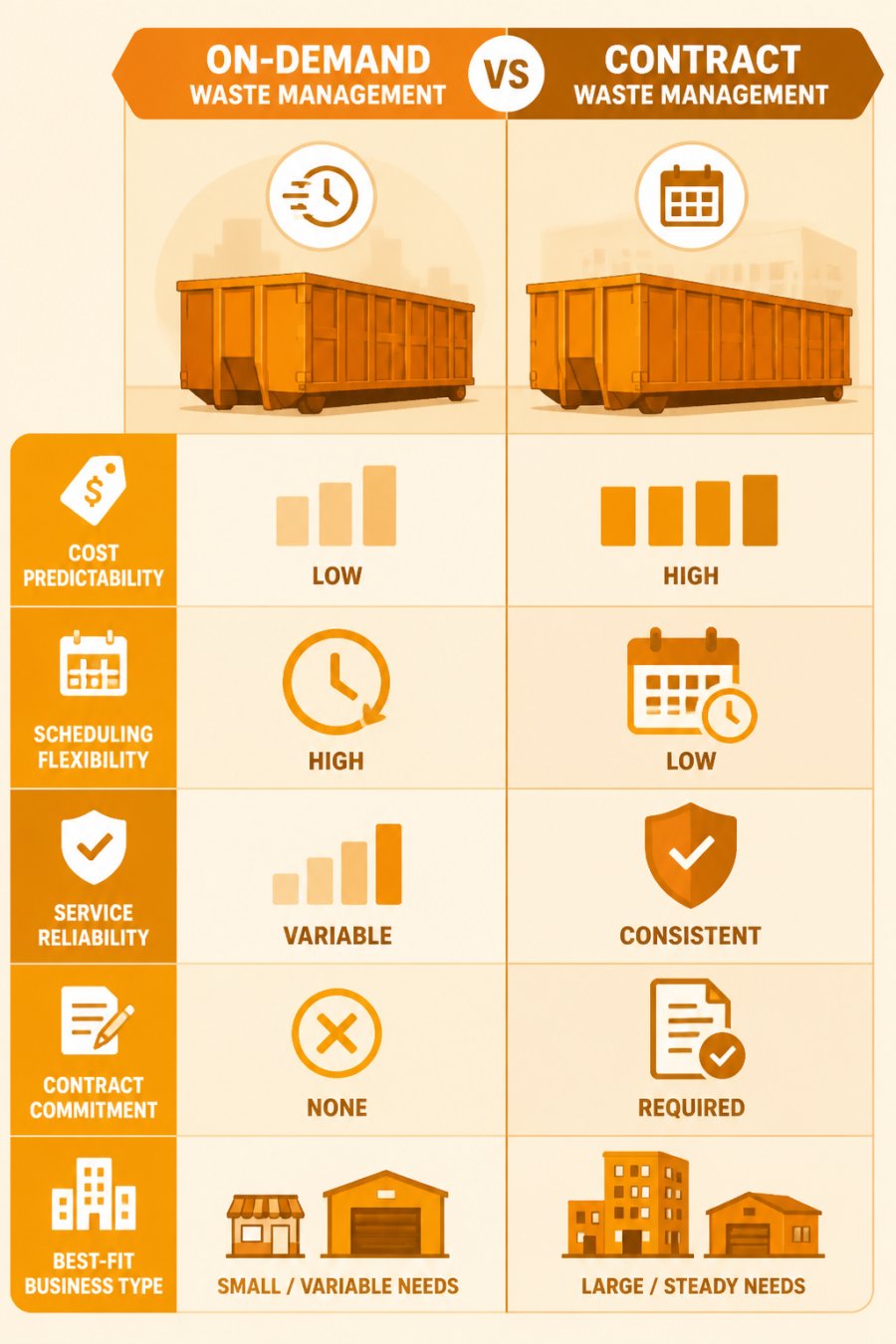
The two models diverge across five practical criteria:
| Criteria | On-Demand Pickup | Contracted Service |
|---|---|---|
| Cost predictability | Varies with volume | Fixed monthly bill |
| Scheduling flexibility | High, you call when full | Fixed collection schedule |
| Service reliability | Depends on provider response | Defined in service agreement |
| Contract commitment | None | Multi-month to multi-year term |
| Best fit | Variable demand, project work | Steady, predictable waste streams |
How On-Demand Pickup Works
You rent a container, fill it, and call for a haul when it is full. No collection schedule, no monthly minimum, no contract term. The trade-off is that you carry the volume risk in both directions: a slow month costs you nothing extra, but a heavy month means multiple hauls at per-pull rates. On-demand suits project work, seasonal swings, and businesses still learning their waste volume.
How Contracted Service Works
A hauler commits to a collection schedule, typically weekly or biweekly, and you pay a recurring rate whether the container is full or half empty. That predictability is worth real money for steady generators. The catch is that contracted service bills for the container, not the contents, so a partially filled dumpster still gets hauled at full price.
Commercial Waste Management Services: Pros and Cons by Service Type
Commercial waste management services split into three broad models, and each has an honest downside worth naming before you sign anything. The table below summarizes the trade-offs, but the real differences show up in the total cost of ownership.
| Service Type | Pros | Cons |
|---|---|---|
| On-demand hauling | No contract commitment; pay only for hauls you request; easy to scale up or down | Per-pull pricing runs higher than contracted rates; you are at the back of the queue during busy periods |
| Contracted collection | Predictable budget; guaranteed pickup frequency; often the lowest per-haul rate | You pay for empty space; contract terms can be hard to exit |
| Hybrid compaction service | Fewer hauls because each container holds more; lower total spend on high-volume streams | Requires a service partner with equipment and scheduling that fits your site |
A common mistake is comparing only the per-haul rate. The number that matters is cost per unit of waste removed, and that is where volume reduction changes the math entirely. For example, a business generating 10 cubic yards of loose waste per week might pay for two 20-yard dumpster hauls per month under an on-demand model. With compaction, that same waste might fit into a single 20-yard dumpster, cutting hauls in half. When evaluating providers, ask for a breakdown of all fees: container rental, fuel surcharges, environmental fees, overage charges, and missed pickup fees. These line items often determine the true cost difference between models.
Waste Management Contract Terms to Review Before Signing
The clauses that cost businesses the most are rarely the ones people read first. Before signing a waste management contract, check these five terms and understand the mechanisms behind them:
- Automatic renewal - Many agreements renew quietly unless you give notice in a set window, often 30 to 90 days before the term ends. Miss the window and you are locked in for another year. Calendar the notice deadline immediately upon signing.
- Price escalation - Look for annual increases tied to an index (like the Consumer Price Index) rather than a flat cap. An uncapped escalator can compound year over year. Negotiate a cap, such as 3% or 5% annually, or tie increases to a published index with a ceiling.
- Container minimums - Some contracts bill a minimum pull charge even in light months. If your waste volume fluctuates, you may pay for empty space. Ask for a minimum volume threshold or a reduced rate for light months.
- Missed pickup remedies - Confirm what credit you receive when collection does not happen. A service agreement that defines reliability without a remedy is one-sided. Look for a service-level agreement (SLA) that specifies credits for missed pickups, such as a percentage off the monthly bill or a free extra pickup.
- Exit and termination fees - Know the cost of leaving early before you commit. Termination fees can be several months' worth of service. Negotiate a buyout clause or a shorter initial term if your waste profile is uncertain.
Missed pickups deserve special attention. Insist on a written remedy: for example, a credit of 10% of the monthly fee for each missed pickup, or a guaranteed pickup within 24 hours of a complaint.
If you want a fuller picture of where providers go wrong, read about the waste management provider mistakes that drive up cost and lock businesses into bad terms.
Construction Waste Management: Matching Service to Jobsite Demand
Construction waste management rarely fits a fixed schedule, because demand changes with the phase. A demolition phase generates heavy debris fast. A finish-out phase produces far less. Contracted weekly pickup either over-serves the quiet phases or under-serves the loud ones.
The practical approach is to plan pickups by phase. Size containers for the heaviest phase, then adjust frequency as the job moves from demolition to framing to finish work. On-demand hauling gives you that flexibility without renegotiating a contract mid-project.
For a deeper look at planning by phase, see the construction site waste management solutions guide.
Mobile Dumpster Compaction: A Hybrid That Cuts Hauling Frequency
Mobile dumpster compaction is the hybrid model most comparisons miss. A mobile crusher comes to your site, compacts the contents of your roll-off dumpster in place, and you keep filling the same container instead of paying for a haul. Junk Crusher's mobile compaction service reduces roll-off dumpster volume, which means fewer hauls for the same amount of waste.
That changes the on-demand versus contract math. If compaction cuts your haul count, you can often stay on a smaller contract or drop to on-demand entirely. The savings come from not paying to haul empty space. If you want to compare equipment and service options, find the best mobile dumpster crusher for business before committing.
Choosing Your Waste Service: A Decision Framework by Business Type
Use this framework to pick a model by waste profile:
- Steady, predictable volume (distribution centers, plants running consistent shifts): contracted collection, with compaction if volume is high
- Variable or project-based volume (construction, roofing, renovation): on-demand pickup, sized to the heaviest phase
- High volume with tight yard space (manufacturing, warehouses): compaction service paired with either model
- Multi-location operations: contracted baseline plus on-demand overflow, reviewed quarterly
Whichever model you choose, the next step is reducing hauling cost within it. Our guide to waste hauling cost reduction for businesses covers the levers that work under each service type.
The real challenge is not picking a model. It is that many businesses pay for hauling empty space every month without realizing it. Junk Crusher brings mobile compaction to your site, reduces dumpster volume, and reduces the number of hauls you pay for. We serve construction sites, distribution centers, and manufacturing facilities across Western Pennsylvania. Book a crush to see how much of your waste spend is going to air.
Frequently Asked Questions
What is the difference between on-demand and contract waste management?
On-demand waste management means you schedule pickups as needed, giving you flexibility for variable waste volumes. Contract waste management locks in scheduled collection, often at a lower per-pickup rate but with a fixed term and less flexibility. On-demand suits businesses with unpredictable waste streams, while contracts fit operations with steady, predictable volume.
Is on-demand waste pickup better for businesses with changing waste volumes?
Yes, on-demand pickup works well when your waste volume fluctuates, such as seasonal production or project-based work. You avoid paying for scheduled pickups you don't need. However, if your volume is consistently high, a contract may offer better per-pickup pricing. Track your waste estimate over a few months to decide.
What services are typically included in a waste management contract?
A typical commercial waste management contract covers scheduled collection, container rental, and disposal. Review contract terms for pickup frequency, container size, service area, missed pickup remedies, and renewal clauses. Some contracts include recycling services or waste diversion reporting. Confirm what happens if your waste volume changes mid-term.
Can businesses combine scheduled waste pickup with on-demand service?
Yes, a hybrid model pairs a base contract for predictable volume with on-demand pickups for overflow waste. This balances cost control with flexibility. You might also add mobile dumpster compaction to reduce hauling frequency on the contracted side, stretching your container capacity further before scheduling extra pickups.


