
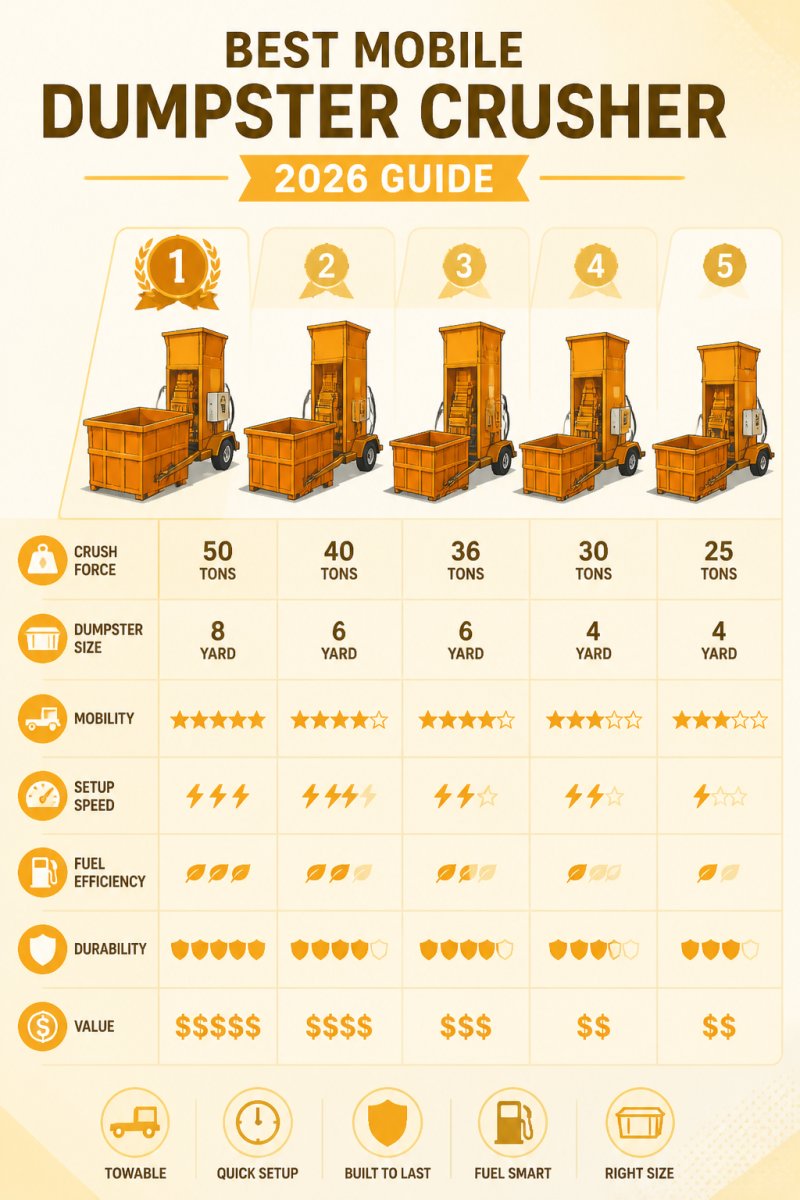
Best Mobile Dumpster Crusher for Business: 2026 Guide
Table of Contents
- Why Mobile Waste Compaction Benefits Your Bottom Line
- How Mobile Compaction Works: Equipment and On-Site Process
- Comparing Top Mobile Dumpster Crusher Services
- Smash My Trash Alternatives for Commercial Waste
- Commercial Waste Management Cost Reduction: Real Numbers
- How to Choose the Right Mobile Dumpster Crusher Service
- Conclusion: Cut Hauling Costs and Boost Efficiency
- Frequently Asked Questions
Last Updated: September 9, 2026
Commercial waste hauling is one of the few operational costs that scales linearly with inefficiency. Every partially filled roll-off container that leaves your site represents money spent hauling empty space, and most operations managers don't realize how much volume they're paying to transport until they see the math. A best mobile dumpster crusher for business changes that equation by compacting waste on-site before the hauler ever arrives, and this guide from Junk Crusher breaks down how the technology works, what it costs, and which service model fits different operational profiles (the EPA).
Mobile waste compaction is the process of mechanically densifying loose debris inside an open-top container using hydraulic pressure. For facilities generating consistent waste streams, the financial impact is immediate: fewer hauls, lower disposal fees, and reduced labor spent managing overflowing containers.
Below, we'll examine how mobile compaction equipment works on-site, compare the leading service providers, and walk through a practical framework for choosing the right solution. We'll also address the regulatory and safety considerations that most marketing pages skip.
Why Mobile Waste Compaction Benefits Your Bottom Line
The financial case for mobile compaction rests on three measurable outcomes: reduced hauling frequency, lower disposal costs, and improved operational efficiency. When waste volume drops, the number of required hauls drops proportionally, which means fewer truck trips, less downtime waiting for container swaps, and a smaller carbon footprint from reduced transportation.
Mobile dumpster crusher services deliver these savings without requiring capital investment in stationary compactors. Instead of purchasing equipment and dedicating permanent yard space, businesses schedule on-site compaction as needed. This pay-per-service model makes the technology accessible to operations that couldn't justify the upfront cost of traditional compaction infrastructure.
The environmental angle matters too. Waste diversion and sustainability goals increasingly factor into corporate reporting, and reducing truck trips is one of the most direct ways to cut transportation-related emissions. EPA sustainable materials management guidance emphasizes source reduction and volume minimization as preferred strategies over disposal, which aligns closely with what mobile compaction achieves.
How Mobile Compaction Works: Equipment and On-Site Process
A mobile compaction unit is essentially a hydraulic press mounted on a truck chassis. The vehicle positions itself alongside a roll-off dumpster, and a hydraulic arm or compactor head extends into the container, applying thousands of pounds of pressure to densify the waste. The process repeats in sections until the entire container is compressed.
The on-site service typically follows this sequence:
- Schedule a compaction visit at your facility or jobsite
- The mobile unit arrives and positions next to the target container
- The operator compacts waste in controlled passes, densifying material layer by layer
- The unit moves to additional containers or departs
- Your hauler arrives on the normal schedule to collect a denser, more efficient load
The entire process for a single container usually takes a short amount of time depending on waste type and volume. Dense materials like concrete and metal respond differently to compaction than bulky items like cardboard and packaging, so operators adjust technique based on the waste stream.
Hydraulic compaction equipment is rated by applied force. Commercial units generate enough pressure to handle mixed construction debris, manufacturing scrap, and general industrial waste without damaging the container itself.
Comparing Top Mobile Dumpster Crusher Services
The mobile compaction market includes national technology providers, regional service operators, and equipment-focused companies. Understanding the differences helps match the right provider to your operational needs, service area, and waste profile.
Junk Crusher: On-Site Crushing for Western PA
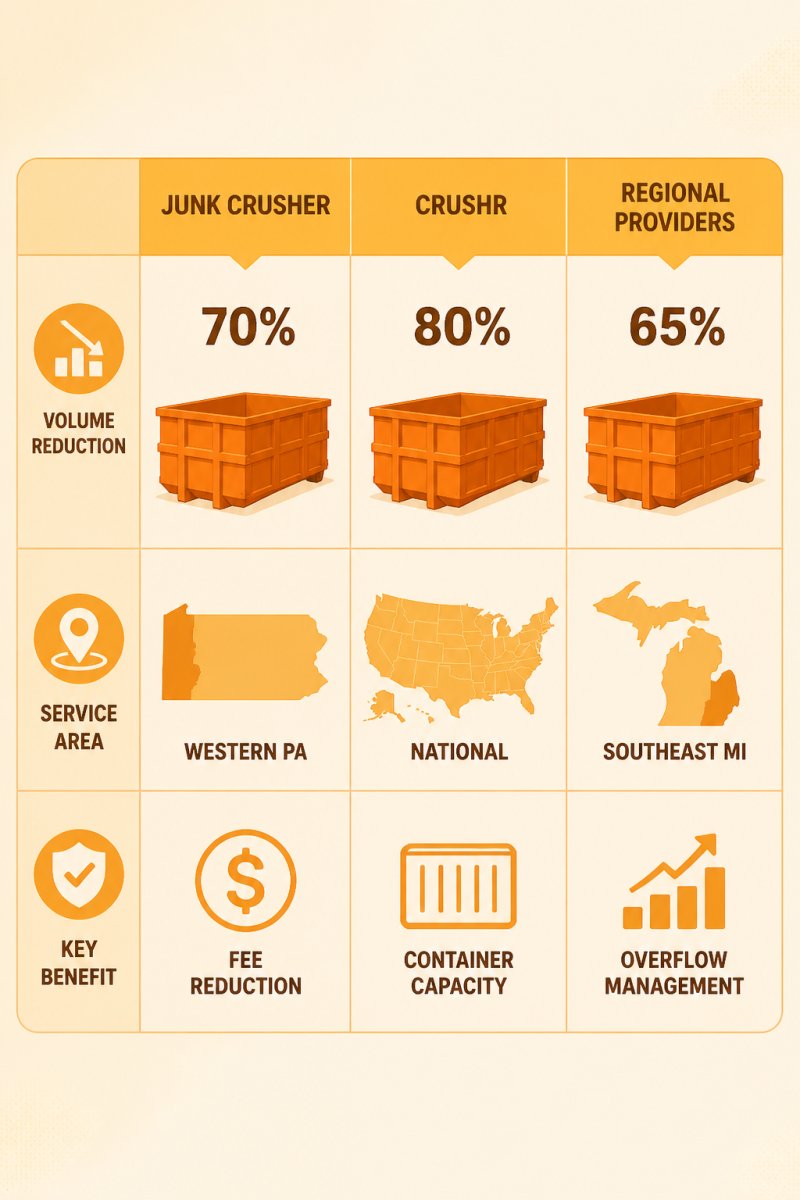
Our top pick for commercial operations in Western Pennsylvania is Junk Crusher. The service specializes in mobile on-site dumpster waste compaction for construction sites, distribution centers, and manufacturing facilities, reducing roll-off dumpster volume by up to 70 percent. That volume reduction translates directly into fewer required hauls and measurable cost savings, with clients typically seeing up to a 56 percent reduction in dumpster fees.
What distinguishes Junk Crusher is the operational focus on eliminating wasted spend. The service is designed around the reality that most commercial waste is bulky but not dense, meaning containers fill up by volume long before they approach weight limits. Compacting that material on-site means you're not paying for hauling empty space, and jobsite downtime drops because containers don't overflow between scheduled pickups.
The service area covers Western Pennsylvania, which makes it the practical choice for facilities in Pittsburgh and the surrounding region. For businesses operating across multiple sites in the area, Junk Crusher can service locations on a regular schedule, integrating compaction into existing waste management workflows. The company also offers Dumpster Rental for businesses that need container service alongside compaction.
Crushr: Patented Mobile Compaction Technology
Crushr operates on a patented mobile compaction platform. The technology is designed to maximize dumpster space and reduce recurring hauling fees.
The Crushr model is franchise-based, meaning service availability depends on finding an operator in your region. The equipment itself is purpose-built for mobile compaction, and the company reports strong results for businesses that can access the service. The primary limitation is geographic: if no Crushr operator serves your area, the technology isn't accessible regardless of how well it performs.
Regional Providers: Mobile Dumpster Crusher
Mobile Dumpster Crusher operates as a regional service provider in Southeast Michigan. The service emphasizes prompt on-site response and helps businesses maintain productivity when regular haulers are delayed.
This provider illustrates the broader trend of regional operators filling the gap between national franchises and traditional waste haulers. The tradeoff is geographic restriction: businesses outside Southeast Michigan can't access the service, which reinforces the importance of finding a provider that covers your specific operating area.
Smash My Trash Alternatives for Commercial Waste
Businesses researching mobile compaction frequently encounter Smash My Trash, a well-known brand in the space. While that company has built name recognition, the service model relies on a network of franchise operators, which means availability and quality can vary significantly by region. For operations managers evaluating options, the practical question isn't brand awareness, it's which provider can actually service your facilities on a schedule that matches your waste generation patterns.
A regional provider like Junk Crusher offers advantages that national franchises often can't match: direct account management, familiarity with local waste haulers and disposal facilities, and scheduling flexibility based on your specific operational needs. When your current waste hauler knows your sites and you're considering a change, the integration question matters more than the equipment brand.
The decision framework comes down to three factors: service area coverage, waste stream compatibility, and integration with existing hauling contracts. A provider that checks all three boxes will deliver consistent savings; one that misses any of them creates operational friction that erodes the financial benefit.
Commercial Waste Management Cost Reduction: Real Numbers
The economics of mobile compaction are compelling because the savings compound across multiple cost categories. Reduced hauling frequency directly lowers hauling fees, while denser loads mean each individual haul carries more waste, improving cost-per-haul efficiency. Facilities that compact waste also spend less on container rentals because they need fewer containers to handle the same volume.
Volume reduction is the primary driver. When waste volume drops, a facility generating enough waste to fill a container every week might only need a haul every two to three weeks. That reduction in disposal frequency cascades through the entire waste management budget.
The operational savings extend beyond direct hauling costs. Fewer container swaps mean less equipment downtime at loading docks and jobsites. Reduced truck traffic improves site safety and cuts the carbon footprint associated with waste transportation. And because compacted containers are less likely to overflow, facilities avoid the cleanup costs and regulatory exposure associated with scattered debris.
| Cost Category | Without Compaction | With Mobile Compaction | Impact |
|---|---|---|---|
| Hauling frequency | Weekly pickups | Every 2-3 weeks | Fewer truck trips |
| Cost per haul | Full rate per container | Same rate, denser load | Better cost-per-haul |
| Container use | 60-70% by volume | Near capacity | Less wasted space |
| Jobsites | Frequent downtime | Reduced interruptions | Higher productivity |
How to Choose the Right Mobile Dumpster Crusher Service
Selecting a mobile compaction provider requires evaluating more than just the equipment specifications. The right partner must align with your waste profile, service area, and operational constraints.
Start by documenting your current waste generation. Track how many containers you fill per week, what materials dominate your waste stream, and how often your hauler currently visits. This baseline tells you whether compaction will deliver meaningful savings or whether your waste is already dense enough that volume reduction won't move the needle.
Next, verify service area coverage. Mobile compaction is inherently geographic, and a provider that doesn't service your facilities can't help you regardless of their technology. For operations in Western Pennsylvania, this means confirming the provider has local capacity and scheduling flexibility.
Evaluate waste stream compatibility. OSHA guidance on waste handling safety notes that different material types present different handling risks, and the same applies to compaction. A provider should demonstrate experience with your specific waste categories, whether that's roofing shingles, construction debris, manufacturing scrap, or mixed commercial refuse.
Finally, review the integration process with your current hauler. The best mobile compaction service coordinates seamlessly with your existing waste management contract, scheduling compaction visits before hauler pickups so every load leaves at maximum density.
Conclusion: Cut Hauling Costs and Boost Efficiency
The case for mobile waste compaction comes down to a simple operational truth: most commercial waste is bulky, not heavy, and paying to transport that bulk is pure waste. Mobile compaction services solve this by densifying waste on-site, reducing hauling frequency, cutting disposal costs, and shrinking the carbon footprint of your waste transportation.
For facilities in Western Pennsylvania, Junk Crusher offers the most direct path to these savings. Our mobile on-site compaction service reduces roll-off dumpster volume by up to 70 percent, cutting dumpster fees by up to 56 percent while reducing jobsite downtime and simplifying waste management across construction, manufacturing, and distribution operations. We work alongside your existing hauler to integrate compaction into your current schedule, and we also offer Dumpster Rental for businesses that need container service alongside compaction.
Book a Crush with Junk Crusher and see how much your waste operation can save when you stop paying to haul empty space.
Frequently Asked Questions
How does mobile waste compaction reduce hauling costs?
Mobile waste compaction reduces hauling costs by increasing the density of waste inside your roll-off dumpster. This means you fit more debris in the same container, so you need fewer hauls. Services report volume reductions of 65-80%, which can translate to up to a 56% reduction in dumpster fees. Fewer hauls also mean less time spent coordinating with your waste hauler and less money spent on hauling fees.
What types of businesses benefit most from dumpster crushing?
Businesses generating large volumes of bulky, compressible waste benefit most. This includes commercial construction firms with drywall and lumber, roofing companies with shingles, manufacturing plants with packaging materials, and distribution centers with cardboard. If your waste stream is dense or heavy, like concrete or metal, compaction may offer less benefit. An on-site assessment can determine if your waste profile is a good fit for a mobile dumpster crusher.
Are there alternatives to Smash My Trash for commercial waste?
Yes, several alternatives to Smash My Trash exist, depending on your region. Junk Crusher provides mobile dumpster compaction services in Western Pennsylvania. Crushr operates through local providers in various markets. You can also search for independent regional services that offer mobile compaction. When evaluating alternatives, confirm their service area, equipment specifications, and ask for client references to ensure they can handle your specific waste stream.
What should I look for when hiring a mobile waste compaction service?
Start by verifying the service area covers your sites. Ask about their equipment and its compaction force to ensure it handles your waste types. Request case studies or references from businesses similar to yours. Clarify how they coordinate with your existing waste hauler and their scheduling flexibility. Finally, ask for a detailed cost breakdown showing potential savings, not just a flat fee, to project your return on investment.
Is a mobile dumpster crusher right for my business?
A mobile dumpster crusher is right for your business if you regularly fill roll-off dumpsters with compressible waste like cardboard, drywall, shingles, or packaging. If you pay for frequent hauls or often need extra dumpsters to manage overflow, compaction can reduce your rental needs and disposal frequency. However, if your waste is mostly dense materials such as concrete or metal, the volume reduction may not justify the service.
