How Do You Review a Commercial Dumpster Rental Agreement?
Last Updated: November 25, 2026
Quick Summary
You review a commercial dumpster rental agreement by confirming seven things in writing before signing: the parties, the rental period and start date, container size, pickup frequency, weight limit and overage terms, every fee on the schedule, and the liability and cancellation clauses. Getting all seven confirmed on paper removes most surprise charges later.
- Treat the dumpster rental agreement as a scope-of-work document, not paperwork.
- Hidden fees usually sit in a separate fee schedule page, so scan it line by line.
- Two quotes with the same monthly rate can land far apart once haul and tipping charges are added.
- Prohibited materials commonly include tires, liquids, hazardous waste, and batteries.
- Ask the vendor to send a revised agreement with your negotiated changes written in, and keep that email.
Table of Contents
- How Do You Review a Commercial Dumpster Rental Agreement?
- Dumpster Rental Agreement Checklist for Operations Teams
- Hidden Fees in Dumpster Rental Agreements and How to Spot Them
- Roll-Off Dumpster Rental Terms: Liability, Prohibited Materials, and Cancellation
- Frequently Asked Questions
How Do You Review a Commercial Dumpster Rental Agreement?
You review a commercial dumpster rental agreement by checking seven things in writing before you sign: who the parties are, the rental period and start date, the container size, the pickup frequency, the weight limit and overage terms, every fee on the schedule, and the liability and cancellation clauses. Get all seven confirmed on paper and you remove most of the surprise charges that show up later.
The bill often shocks people more than the contract does.
So here is the short version of how to review commercial dumpster rental agreements. Read the paperwork line by line. Ask what each line means. Write down every answer.
Below, we walk through each step and flag the clauses that tend to cost the most money.
Dumpster Rental Agreement Checklist for Operations Teams
A dumpster rental agreement is the contract that sets your container size, rental period, service schedule, weight limit, fees, and liability terms. Treat it as a scope-of-work document, not paperwork.
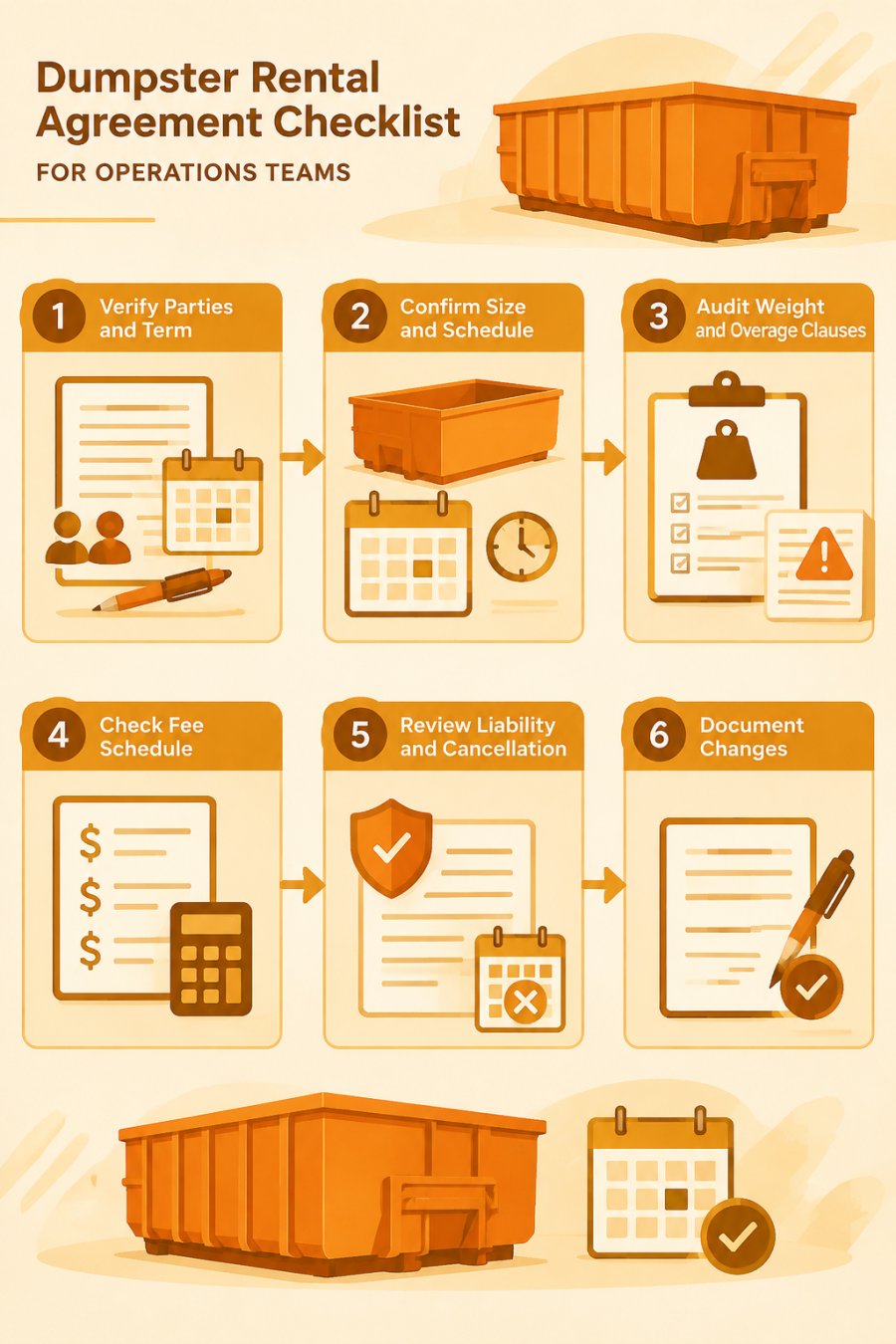
Run this checklist before signing:
- Confirm the legal name of both parties and the service address
- Note the start date, rental period, and renewal terms
- Match container size to your actual debris volume
- Confirm pickup frequency and the request process
- Find the weight limit and the overage rate per ton
- List every line on the fee schedule
- Read the liability, prohibited materials, and cancellation clauses
- Get any negotiated change in writing
A verbal promise about extra pickups means little once the invoice arrives, which is why disputes often trace back to a single missing line in the written agreement.
Here is the checklist to run through before signing a commercial dumpster rental agreement.
| Checklist item | What to confirm |
|---|---|
| Parties and address | Legal name of both parties and service address |
| Term | Start date, rental period, and renewal terms |
| Container size | Match size to actual debris volume |
| Pickup frequency | Frequency and the request process |
| Weight limit | Limit and overage rate per ton |
| Fee schedule | List every line on the schedule |
| Liability and cancellation | Read liability, prohibited materials, cancellation clauses |
| Negotiated changes | Get any change in writing |
Hidden Fees in Dumpster Rental Agreements and How to Spot Them
Hidden fees hide in plain sight, usually in a fee schedule attached as a separate page. Scan for these line items:
- Delivery and pickup charges listed apart from the rental rate
- Fuel surcharges that adjust without notice
- Overage or excess weight fees charged per ton
- Relocation fees for moving a container on site
- Contamination fees for unaccepted material
- Early termination penalties buried in the term clause
A common mistake is comparing only the headline rental price. Two quotes with the same monthly rate can land far apart once haul and tipping charges are added.
Ask for a sample invoice with real numbers on it. For proven ways to bring those charges down, see how to lower dumpster hauling fees.
If you have already spotted fees that look off, our guide on how to lower commercial waste hauling fees covers invoice audits and negotiation tactics. And before you sign or dispute a bill, learn how to read haul, tipping and fuel lines so you know what each charge actually covers.
Roll-Off Dumpster Rental Terms: Liability, Prohibited Materials, and Cancellation
Liability terms decide who pays when something goes wrong. Read them twice.
Check who covers damage to the container, the pavement, and any property nearby. Confirm whether you need to provide your own insurance certificate.
Then read the prohibited materials list. Common exclusions include tires, liquids, hazardous waste, and batteries. Putting a banned item in the container can trigger a rejection fee and a removal demand.
Cancellation and early termination deserve the same attention. Find out:
- How much notice you must give to cancel
- Whether the rental period auto-renews
- What penalty applies if you end the contract early
For operations teams weighing container options, our comparison of a roll-off dumpster vs permanent container breaks down which setup fits different sites. If your waste stream includes industrial material, read industrial waste disposal regulations before you finalize prohibited materials terms.
One more move pays for itself: ask the vendor to send a revised agreement with your negotiated changes written in. Keep that email. A signed change order beats a phone call every time.
Reviewing the agreement is the cheap part. Living with an oversized container and too many hauls is what drains the budget. At Junk Crusher, we crush dumpster waste on site, which cuts roll-off volume by up to 70% and reduces how often trucks roll to your gate. That means fewer hauls, lower fees, and less downtime on your site. Get started with Junk Crusher and book a crush to see what your current container is really costing you.
Frequently Asked Questions
What should a commercial dumpster rental agreement include?
A complete commercial dumpster rental agreement should name the parties, rental period and start date, container size, pickup frequency, weight limit and overage rate, base rental price, and any additional fees. It should also define acceptable and prohibited materials, state who handles contamination or damage, and spell out cancellation and renewal terms. If any of these are missing, ask for them in writing before signing.
How do you spot hidden fees in a dumpster rental contract?
Read the fee schedule line by line and compare it to the quoted price. Watch for delivery and pickup surcharges, fuel or environmental fees, overage charges per ton, contamination fees, and late-pickup or early-termination penalties. Ask the vendor to confirm in writing which fees are included and which are billed separately, then keep that confirmation with the signed agreement.
What happens if a dumpster rental agreement does not specify pickup dates?
Without specified pickup dates or a service schedule, pickup may default to on-call, which can leave a full container sitting on site and delay your project. Ask the vendor to add a pickup frequency, a maximum response time for pickup requests, and a start date to the contract. Document the change in writing so both sides have the same expectation.


