
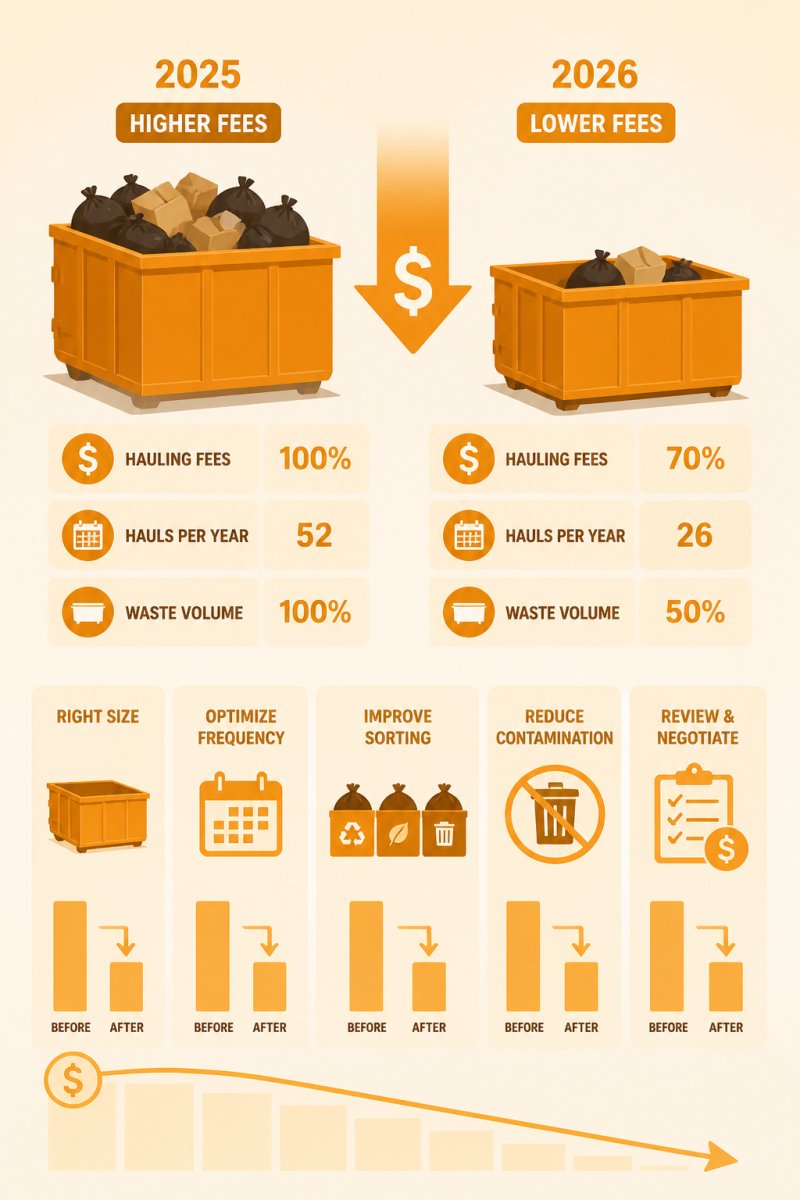
How to Lower Commercial Waste Hauling Fees in 2026
Table of Contents
- Why Commercial Waste Hauling Fees Keep Rising
- Waste Hauling Contract Negotiation Tips That Save Money
- How to Audit Waste Disposal Invoices for Hidden Fees
- Industrial Waste Compaction Benefits for High-Volume Sites
- Right-Sizing Container Size and Collection Schedule
- Comparing Pricing Models: Flat Rate vs Usage-Based
- How to Lower Commercial Waste Hauling Fees Long-Term
- Conclusion
- Frequently Asked Questions
Last Updated: September 28, 2026
Why Commercial Waste Hauling Fees Keep Rising
Commercial waste hauling fees are the recurring charges a business pays to have its trash collected, transported, and disposed of, and they climb for reasons that have little to do with how much trash you actually make. Fuel costs move. Landfill tip fees move. Labor moves. Your invoice, though, often moves on a schedule written into a contract you signed years ago and never revisited.
At Junk Crusher, we work with plants, warehouses, and jobsites across Western Pennsylvania, and the pattern is consistent: most operators are paying for air. A roll-off container fills to the brim with cardboard, shingles, or packaging scrap, yet the truck hauls a load that is mostly empty space.
That is the whole problem in one sentence. You are billed on volume and frequency, not on weight alone.
Below, we break down how to lower commercial waste hauling fees using eight levers, from contract language to on-site compaction. None of them require switching haulers on day one.
Waste Hauling Contract Negotiation Tips That Save Money
The fastest savings hide in your existing service agreement, not in a new bid. Pull the contract and read four things: the term, the escalation clause, the termination window, and the auto-renewal trigger.
A service contract for waste hauling typically runs 12 to 60 months. The longer the term, the more room the hauler has to raise rates mid-stream. But the term itself is rarely the trap. The trap is how the contract ends.
Watch for Evergreen Clauses and Automatic Price Escalation
Evergreen clauses renew your contract automatically unless you give written notice inside a specific window, often 30 to 90 days before the end date. Miss that window and you are locked in for another full term at whatever price escalation the contract allows.
Check for these:
- Auto-renewal language with a short opt-out window
- Annual increases tied to a vague index rather than a fixed cap
- Evergreen clauses buried in an addendum instead of the main agreement
- Notice requirements that demand certified mail or a specific address
If your contract has no cap on annual increases, that is your first negotiation target. A common pattern is an escalation clause tied to the Consumer Price Index with no floor or ceiling, which means your rate can rise even when landfill tip fees and diesel prices fall.
Termination Windows and Early Exit Fees
Most guides tell you to negotiate a lower rate. Fewer explain how to get out of a bad contract without paying a penalty that wipes out the savings.
Read the termination section for three things:
- Notice period. How many days before the renewal date must you notify the hauler in writing? Calendar it 120 days out so you never miss it.
- Early termination fee. Some contracts charge a flat fee; others charge the remaining months multiplied by the average monthly bill. A 24-month remaining term on a $900 monthly bill can mean a five-figure exit cost.
- Liquidated damages language. This is a clause that sets a fixed penalty for breaking the contract. It is enforceable in most states, but it must be a reasonable estimate of the hauler's loss, not a punishment.
Use Your Tonnage and Diversion Rate Data as Leverage
Haulers price on assumptions. When you show them real numbers, the assumptions break.
Gather two figures before you call:
- Tonnage per pick-up, from your weight tickets
- Diversion rate, the share of material kept out of the landfill
How to Audit Waste Disposal Invoices for Hidden Fees
A waste disposal invoice audit means matching every line item against your contract and your weight tickets, then challenging anything that does not reconcile. Do it once a quarter. Errors compound quietly.
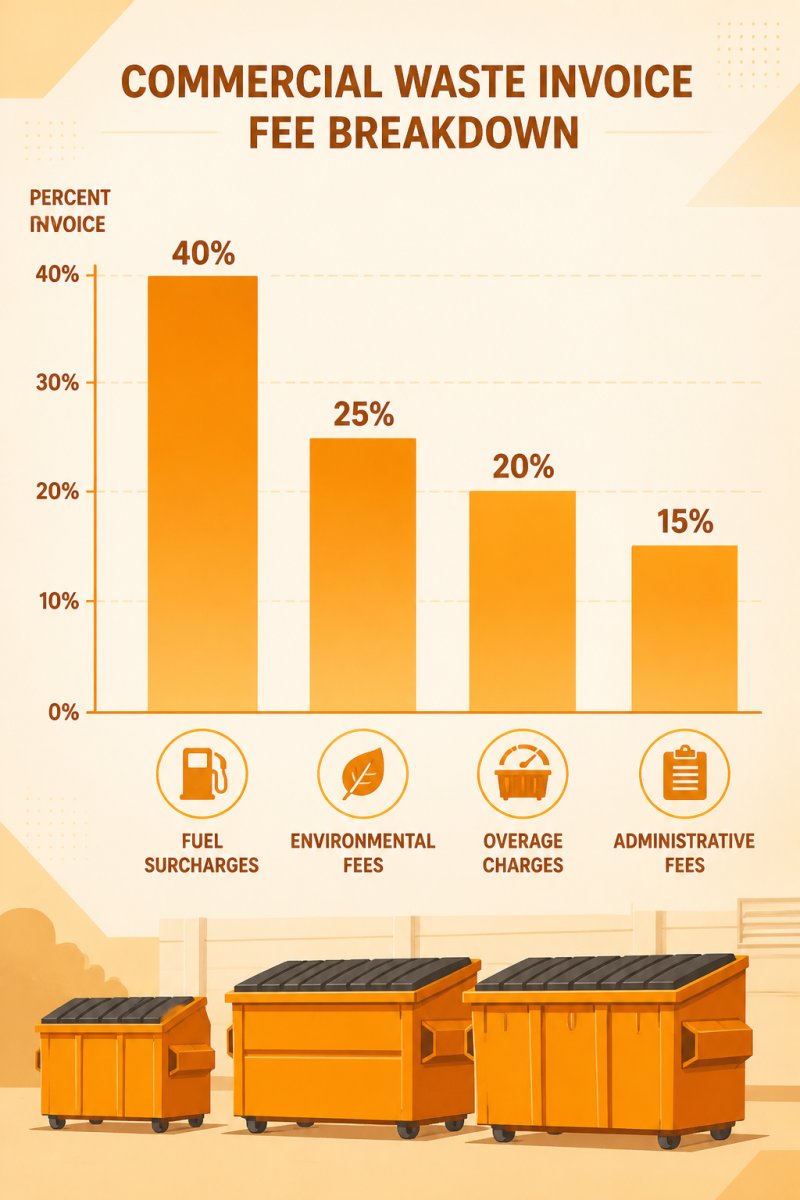
Fuel Surcharges, Environmental Fees, and Overage Charges
Fuel surcharges are meant to track diesel prices, but many contracts set them by formula the hauler controls. Ask for the index and the calculation.
| Fee Type | What Triggers It | How to Challenge It |
|---|---|---|
| Fuel surcharge | Diesel price index | Request the formula and index source |
| Environmental fee | Flat per-haul add-on | Ask for the stated basis in writing |
| Overage charge | Load above rail line | Compact waste to stay under capacity |
| Administrative fee | Account handling | Confirm it is in the signed contract |
Industrial Waste Compaction Benefits for High-Volume Sites
Industrial waste compaction benefits come down to one idea: you pay to move trucks, not trash. Crush the material on site and each container holds far more, so you need fewer hauls to move the same tonnage.
- More tonnage per container
- Fewer truck trips per month
- Less yard space tied up in containers
- Lower disposal fees because you are not paying to haul air
Right-Sizing Container Size and Collection Schedule
Container size and collection schedule should match your actual waste flow, not the default the sales rep proposed. Oversized containers on a fixed schedule are the most common source of wasted spend.
Run this check:
- Track fill level daily for two weeks
- Note which days the container overflows and which days it sits half empty
- Match container size to peak days, not average days
- Cut hauling frequency on the slow weeks
Comparing Pricing Models: Flat Rate vs Usage-Based
Flat rate and usage-based pricing behave very differently when your volume swings. Flat rate gives you a predictable bill. Usage-based pricing gives you a bill that tracks what you actually threw away. The right choice depends on how much your volume moves and how much visibility you need into the cost drivers.
| Model | Best For | Trade-Off |
|---|---|---|
| Flat rate | Steady, predictable volume | You overpay in slow months |
| Usage-based | Swinging volume | Bill varies month to month |
| Per-haul | Sites with compaction | Requires accurate tonnage data |
| Weight-based | Heavy, dense material | Needs reliable scale tickets |
How to Calculate the Break-Even Point
Before you switch models, run a simple comparison using 12 months of invoices.
- Add up your total annual waste spend under the current flat-rate contract.
- Estimate what the same volume would cost under usage-based pricing using the hauler's published per-haul or per-ton rate.
- Add the cost of any new equipment or process changes needed to make the switch work, such as compaction or a scale.
- Divide the difference by 12 to see the monthly impact.
The Hybrid Model Most Industrial Sites Use
For most industrial sites, a hybrid works best: a base service level agreement for scheduled pickups plus per-haul pricing on overflow. This gives you a predictable floor for routine service and a variable rate for the weeks when production spikes. Optimizing these operational variables often reveals broader efficiencies, much like the systematic approach required for reducing industrial energy costs.
Transitioning Without Triggering Penalties
Switching from flat rate to usage-based pricing mid-contract can trigger early termination fees or minimum volume commitments. Read the contract for a minimum tonnage or minimum haul clause before you propose the change.
How to Lower Commercial Waste Hauling Fees Long-Term
Long-term savings come from changing what leaves your site, not from haggling over the same volume year after year. The operators who win set waste reduction targets and track them like any other production metric.
Build a simple program:
- Run a waste audit to map every recycling stream
- Set a diversion rate goal and review it monthly
- Add on-site compaction to cut volume at the source
- Renegotiate with real tonnage and diversion rate data
- Review the contract every 12 months for evergreen clauses
Conclusion
The hard part is not reading your contract. It is accepting that the same container, picked up on the same schedule, will keep costing more every year no matter who hauls it. Volume is the variable you control.
Frequently Asked Questions
What are the most common hidden fees in waste hauling contracts?
Fuel surcharges, environmental fees, overage charges, and administrative fees are the most common add-ons. Fuel surcharges often fluctuate monthly based on diesel prices. Environmental fees may cover landfill compliance costs. Overage charges apply when your container exceeds weight limits. Audit every line item against your service level agreement and question anything not explicitly defined in your contract.
How do I negotiate better rates with my waste hauler?
Start by gathering 12 months of invoices and tonnage data. Request a usage-based pricing structure instead of flat rate. Ask for a service level agreement that locks in hauling frequency and container size. Use competitive bids as leverage, but focus on total cost rather than just the base rate. Avoid evergreen clauses that allow automatic price escalation without your approval.
Does on-site compaction actually reduce hauling frequency?
Yes. Mobile compaction can reduce dumpster volume by up to 70%, which means fewer hauls for the same amount of waste. For manufacturing plants and construction sites generating heavy debris, this directly lowers disposal fees and truck trips. Fewer hauls also reduce fuel surcharges and environmental fees tied to each pickup.
What factors influence commercial waste collection pricing?
Container size, hauling frequency, waste type, tonnage, and local disposal fees all affect your rate. Fuel surcharges and environmental fees add variability. Your contract structure, whether flat rate or usage-based, determines how much you pay for empty space. Right-sizing containers and scheduling based on actual fill levels prevents overpaying for unused capacity.
Ready to stop paying for empty space? Get started with Junk Crusher and turn your waste stream into a line item you can actually shrink.
