
7 Signs of Metal Fatigue in Commercial Dumpsters
Quick Summary
Signs of metal fatigue in commercial dumpsters include hairline cracks at welds, rust bleeding through paint, and a sagging floor. Bulging walls, loose or bent hinges, cracked lid seams, and deformed corners also signal stressed steel. Checking for these at every service visit catches fatigue before a panel splits or a hinge fails.
- Check for hairline cracks along seams and corners where panels meet.
- Watch for rust bleeding through paint, since rust often starts inside the metal.
- Inspect every service visit, not just once a year.
- Pull any container with a visible crack or structural problem out of service until repaired.
Table of Contents
- Why Metal Fatigue Shows Up in Dumpsters Before It Fails
- Seven Signs of Metal Fatigue to Check For
- Keeping Commercial Dumpsters Safe: Maintenance and Inspection Schedule
- Frequently Asked Questions
Why Metal Fatigue Shows Up in Dumpsters Before It Fails
Metal fatigue is the slow weakening of steel from repeated loading. Every time a dumpster is loaded, emptied, hauled, or compacted, the steel flexes a little. Over time, those small stresses add up and cracks start to form.
Most operators only notice a problem after a panel splits or a hinge gives way. If you spot cracks or compactor faults, a safe diagnostic guide walks through troubleshooting equipment errors. The warning signs of metal fatigue in commercial dumpsters usually show up much earlier. Catching them early keeps your containers safe and in service longer.
Seven Signs of Metal Fatigue to Check For
- Hairline cracks at welds. Look along seams and corners where panels meet.
- Rust bleeding through paint. Rust often starts inside the metal and pushes through.
- A sagging floor. A floor that dips under normal load points to stressed steel.
- Bulging walls. Side panels that bow outward have lost their strength.
- Loose or bent hinges. Hinges that wobble or sit out of line need immediate attention.
- Cracked lid seams. Lids that fail to close flush can signal fatigue in the frame.
- Deformed corners. Corners that look rounded, crushed, or misshapen have taken heavy stress.
Check these signs of metal fatigue in commercial dumpsters during every service visit, not just once a year. For broader guidance on keeping high-volume commercial waste handling cost-efficient, read best practices for high-volume commercial waste.
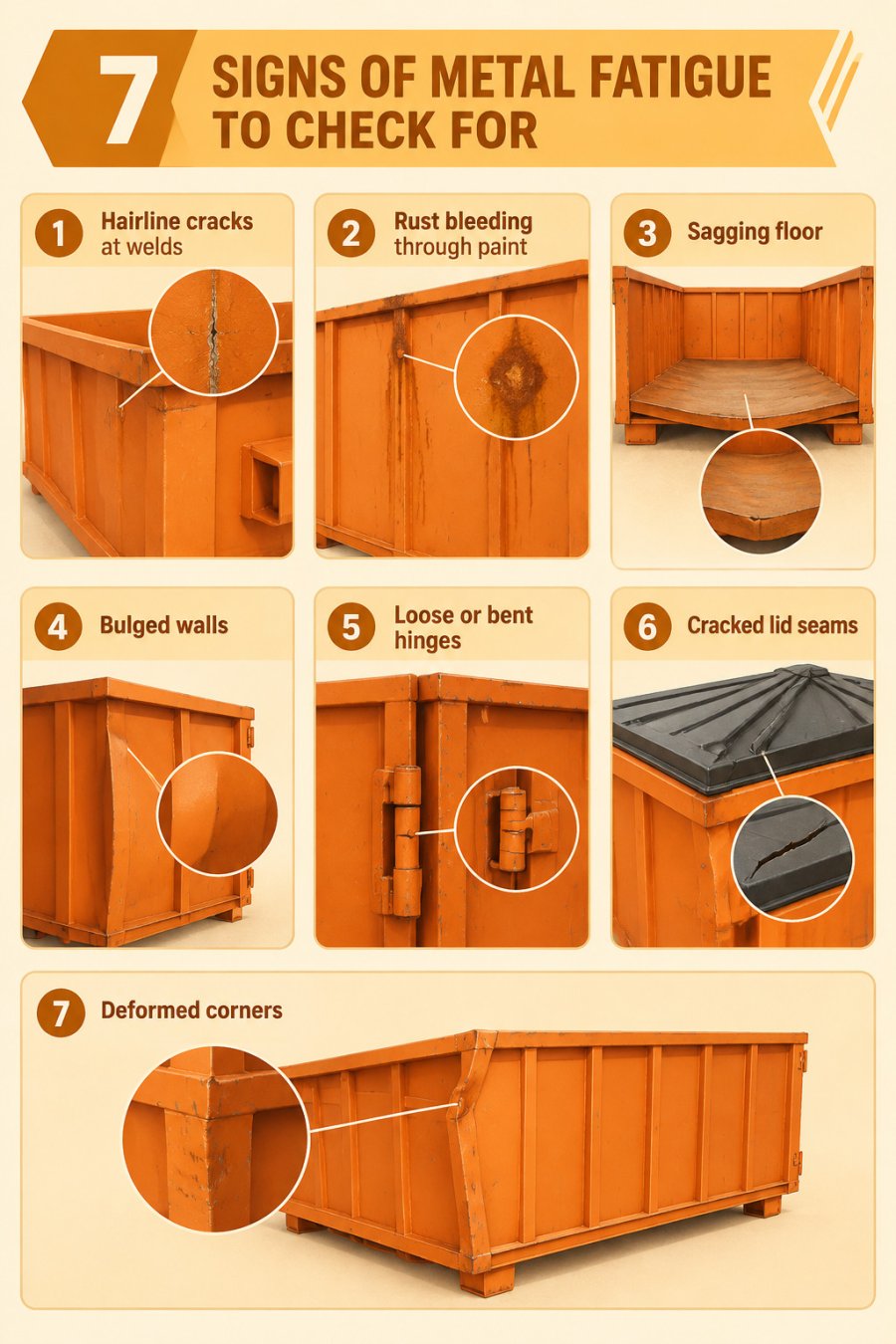
The seven warning signs below are worth checking at every service visit.
| Sign | Where to look | Why it matters |
|---|---|---|
| Hairline cracks at welds | Seams and corners where panels meet | Cracks start from repeated flexing |
| Rust bleeding through paint | Painted panels | Rust often starts inside the metal |
| Sagging floor | Container floor under normal load | Points to stressed steel |
| Bulging walls | Side panels | Panels have lost their strength |
| Loose or bent hinges | Hinge assemblies | Needs immediate attention |
| Cracked lid seams | Lid frame | Can signal fatigue in the frame |
| Deformed corners | Container corners | Shows heavy stress |
Keeping Commercial Dumpsters Safe: Maintenance and Inspection Schedule
A simple inspection routine catches fatigue early. Walk each container, check the seven signs above, and log what you find. To set up an inspection routine, see how often compaction equipment should be serviced. Pull any container with a visible crack or a structural problem out of service until it is repaired. If you are weighing whether to maintain your own containers or compare waste management options, that guide covers both approaches. If a container is beyond repair, a replacement unit can be arranged through our Dumpster Rental service.
Regular cleaning and rust treatment also slow metal fatigue. Keep debris out of hinges and corners, and touch up paint where bare metal shows.
Junk Crusher offers 20-yard and 25-yard dumpsters, and our mobile Dumpster Compaction service helps reduce how often containers need to be hauled.
Frequently Asked Questions
How often should commercial dumpsters be inspected for safety?
Inspect commercial dumpsters at least once a month, and after any heavy loading event or collision. Frequent haulers and sites that load dense debris such as roofing shingles or concrete should check weekly. Record each inspection with the date, the container ID, and any findings so you can spot a pattern, such as a corner that cracks every season. A simple checklist covering welds, floors, walls, hinges, and lid seams keeps the process consistent across crews.
Can metal fatigue lead to a dumpster collapsing?
Yes. Metal fatigue starts as microscopic cracks that grow each time the steel flexes under load, and eventually a floor, wall, or corner can give way while the container is being loaded or moved. The risk rises when a dumpster is overfilled, dragged, or repeatedly loaded with heavy material. Remove any container showing structural cracks or deformation from service instead of repairing it on site.
When should a commercial dumpster be taken out of service?
Take a dumpster out of service when you find through-cracks in the floor or walls, sagging that does not return to shape, bent or missing hinges, or corrosion that has thinned the steel at load-bearing points. Tag the unit so it is not loaded, and contact your provider for a replacement. Surface rust alone is usually a maintenance issue, but rust combined with cracking is a structural one.


