
EV Charging Infrastructure for Warehouses: Planning Guide
Quick Summary
Warehouse EV charging means installing AC Level 2 or DC fast chargers for fleets that sit on site for hours between uses, such as yard tractors, forklifts and delivery vans. Planning starts with grid capacity, since the utility's view of your peak demand decides whether a service upgrade is needed.
- Confirm the highest 15- or 30-minute demand from the last 12 months of utility bills before choosing hardware.
- Use AC Level 2 for depot charging with long downtime and DC fast charging where vehicles need minutes.
- Compare retrofitting the existing service against new infrastructure, using the 20% headroom rule of thumb.
- Request a utility load study early, since it can take 8 to 12 weeks.
- Use charge management to stagger sessions and avoid demand charges that spike monthly bills.
Table of Contents
- Why Warehouses Are Electrifying Their Delivery and Yard Fleets
- Types of EV Charging Stations for Warehouse Fleets
- Warehouse EV Charging Station Requirements: Grid Capacity, Power and Site Planning
- EV Charging Load Management and Demand Charge Control
- How Long It Takes to Install Warehouse EV Charging Stations
- Scheduling Your Warehouse Charging Site Assessment
- Frequently Asked Questions
EV Charging Infrastructure for Warehouses: Planning Guide
Last Updated: November 5, 2026
Why Warehouses Are Electrifying Their Delivery and Yard Fleets
Warehouse operators are electrifying yard tractors, forklifts and delivery vans because the fleet is already parked on site for hours at a time. That idle time is what makes charging practical. The same question tends to come up in planning conversations: how much power does the building need before the first charger goes in?
Readers weighing the broader business case can compare how other logistics sites are cutting their footprint, see how other logistics sites are reducing their carbon footprint.
Types of EV Charging Stations for Warehouse Fleets
Warehouse fleets generally rely on two charger families, and the right choice depends on how long each vehicle sits between shifts. DC fast chargers suit vehicles that must recharge during a short window.
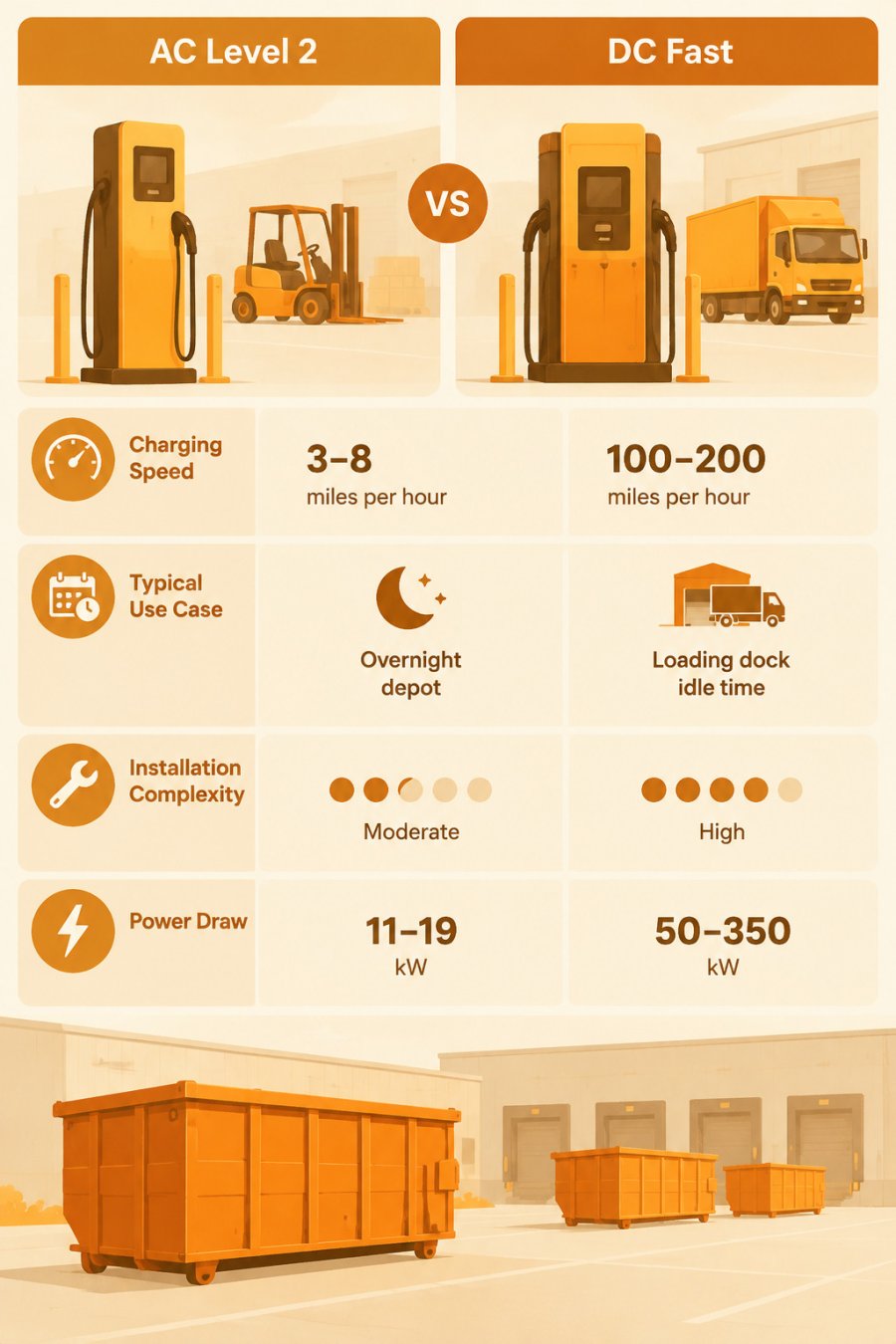
AC Level 2 versus DC fast charging
AC Level 2 chargers deliver power at lower rates and are typically the lower-cost option to install. They work well for depot charging, where a forklift or van returns at the end of a shift and has all night to reach full charge. DC fast chargers push far more power into the battery, which shortens charge time to under an hour for many vehicles, but they require substantially more electrical capacity and a larger upfront investment.
A practical rule: if the vehicle's downtime is measured in hours, AC is usually enough. If it is measured in minutes during loading or unloading, DC fast charging deserves a closer look. Most warehouses end up with a mix.
Warehouse EV Charging Station Requirements: Grid Capacity, Power and Site Planning
Grid capacity is the constraint that surprises most sites, and it is where warehouse projects stall. Before selecting hardware, confirm with the local utility how much additional load the service can support.
Start by pulling the site's utility bills for the last 12 months and identifying the highest recorded demand in kilowatts (kW). That peak, not the average, is what the utility will use to evaluate your request. Then calculate the connected load of the chargers you plan to install. If the combined charger load plus existing peak exceeds the transformer and service rating, you are looking at a service upgrade, and that is where timelines and costs escalate.
Retrofitting existing electrical infrastructure vs. building new
Most warehouse managers face a fork in the road: upgrade the existing electrical panel and service, or build new infrastructure dedicated to charging. The right choice depends on three factors: available capacity, physical space, and the urgency of the timeline.
Retrofitting works when the existing service has headroom, typically when the building was constructed with spare capacity or when the operation has downsized equipment since the original design.
New construction, a separate service, transformer, and distribution panel dedicated to EV charging, makes sense when the existing service is already near its limit, when you need DC fast charging for Class 8 trucks, or when you plan to scale to dozens of chargers over the next five years. It costs more upfront and takes longer, but it isolates charging load from building operations and gives you a clear path to expansion.
A practical decision rule: if the charger load you need in the next 24 months is less than 20% of your existing peak demand, retrofitting is usually viable. If it exceeds that, or if you anticipate doubling the fleet, plan for new infrastructure.
Site planning should also cover charger placement relative to truck routes, parking layout, and future expansion. Running conduit during initial construction is far cheaper than retrofitting once the lot is paved and in use.
EV Charging Load Management and Demand Charge Control
Load management is the difference between a charging project that pays for itself and one that quietly inflates the utility bill every month. Most warehouse managers focus on the cost of the chargers and forget that the utility rate structure can penalize uncoordinated charging far more than the hardware costs.
Many commercial and industrial utility rates include a demand charge, a fee based on the highest 15- or 30-minute average demand recorded during the billing period. That charge is not about total energy consumed; it is about the peak. A site that adds four DC fast chargers without coordination can spike its peak demand by hundreds of kilowatts, and that spike sets the demand charge for the entire month, even if the chargers run only a few hours.
Utility rate optimization strategies
The first step is to obtain the actual rate schedule from your utility, not a summary.
Once you understand the rate, you can design charging around it. A common pattern is to schedule charging sessions so that the combined load of all active chargers never exceeds a set threshold, often the existing peak demand before EV charging was added.
Another strategy is to shift as much charging as possible to off-peak periods. For overnight depot charging, this is straightforward: program the system to begin charging after the time-of-use rate drops.
Watch out: some utilities offer an EV-specific rate or rider that separates charging load from the main service, but eligibility often requires a separate meter and can come with its own demand charges.
Integrating with building energy management
Load management works best when it talks to the building. A charge management system that integrates with the building energy management system (BEMS) can read real-time load data from the meter and adjust charging accordingly, throttling back when the building approaches its demand threshold and resuming when load drops. Ask any prospective vendor whether their system supports open protocols such as OpenADR or Modbus, and whether it can accept a demand response signal from the utility. Without that integration, you are relying on manual scheduling, which breaks down as the fleet grows.
Finally, document your load management strategy for the utility. Some utilities offer rebates or favorable rates for sites that demonstrate managed charging, and having a written plan can strengthen your application for a service upgrade or incentive.
How Long It Takes to Install Warehouse EV Charging Stations
Installation timelines vary widely. Simple AC Level 2 projects on an existing service can be completed in a few weeks once permits are approved. Projects that require a utility service upgrade, transformer work or new trenching commonly take several months. Permitting and utility review are usually the longest steps, not the physical installation.
Waste handling often runs alongside construction on the same site. Demolition debris, packaging and construction waste can slow a crew if it accumulates on the yard, so many managers arrange disposal in advance. Dumpster rentals and on-site compaction can keep the work area clear; see our dumpster rental options for construction and warehouse sites and our dumpster compaction service. Permit requirements for on-site waste handling can also apply, and a reader planning those changes can check which permits apply to on-site waste processing.
Scheduling Your Warehouse Charging Site Assessment
Start with a site assessment that records your current electrical service, the number and type of vehicles, their daily hours of operation, and any planned expansion. That information lets a contractor size the service upgrade and choose between AC and DC hardware without guessing.
Once the assessment is done, you can compare realistic options and timelines with your utility and charger vendors. For current pricing on any dumpster or waste service that supports your project, contact Junk Crusher directly for a quote, since pricing depends on quantity, dates, and delivery. Book your site assessment early in the planning cycle so that grid upgrades, permits and waste logistics are sequenced rather than rushed.
Frequently Asked Questions
How do you plan EV charging infrastructure for a warehouse?
Start with a site assessment that maps your fleet's daily mileage, vehicle dwell times and shift schedules. Those figures determine how many charging ports you need and how much power each one draws. Next, review the existing electrical service, including panel capacity and transformer size, and identify where chargers can sit without blocking truck traffic or yard flow. Finally, decide on a charging management system so the site can scale without overloading the grid connection. Planning in this order keeps infrastructure costs tied to real operational needs rather than guesses.
What type of EV chargers are best for warehouse fleets?
Most warehouse fleets rely on Level 2 AC chargers for overnight depot charging, because vehicles typically sit for many hours and do not need rapid top-ups. DC fast chargers suit operations where vehicles have short idle windows, such as during loading and unloading, but they require significantly more power and utility upgrades. Many facilities combine both: Level 2 for the majority of ports and a smaller number of DC units placed where dwell time is short. The right mix depends on vehicle battery size, daily range and the power your utility can supply.
How long does it take to install warehouse EV charging stations?
Installation timelines vary widely. Simple Level 2 installations on an existing electrical service can take a few weeks, while projects requiring transformer upgrades, new service drops or switchgear replacement often run several months once utility interconnection review is included. Permitting and utility approval are frequently the longest steps, so start those conversations early. Scheduling installation around operations, such as during low-volume shifts or planned shutdowns, also affects total project duration.
How can warehouses manage charging for electric delivery fleets?
Load management software distributes available power across charging ports so the site never exceeds its contracted capacity or triggers high demand charges. Charging can be scheduled to run during off-peak utility hours and prioritized for vehicles that need the most range before their next shift. Monitoring dashboards let managers track uptime, session data and energy costs per vehicle. Combining scheduling with power caps usually allows a site to add more vehicles before needing costly grid upgrades.


