How Do Manufacturing Plants Start Industrial Recycling?
Quick Summary
Manufacturing plants start industrial recycling by walking the floor for a week to see which waste fills containers fastest, then separating materials that have a buyer at the point they are created. Cardboard, wood pallets, plastic film, and scrap metal are usual starting points because they are common, high in volume, and easy to sort.
- Walk the floor for a week and note which waste streams fill containers fastest.
- Place collection points where waste is created, not away from the production line.
- Flatten and keep cardboard dry, since a baler is usually the first equipment purchase.
- Separate ferrous from nonferrous scrap, because buyers pay different rates for each.
- Never mix hazardous or regulated waste with ordinary recyclables.
Table of Contents
- Industrial Recycling Programs for Manufacturing Plants: Where to Start
- Materials Your Plant Can Recycle, and How to Sort Them
- Reducing Manufacturing Waste Volume with On-Site Compaction
- Frequently Asked Questions
Industrial Recycling Programs for Manufacturing Plants: Where to Start
Last Updated: November 12, 2026
Manufacturing plants generate more waste than most managers expect, and hauling it away is one of the largest recurring costs on site. Junk Crusher works with plant teams in Western Pennsylvania on this exact problem: find out what you are throwing away, then sort it before it leaves the building. A cost reduction guide lays out where the savings typically come from.
A workable industrial recycling program starts small. Walk the floor for a week, note which waste streams fill containers fastest, and separate materials that have a buyer. Cardboard, wood pallets, plastic film, and scrap metal are the usual starting points because they are common, high in volume, and easy to sort at the point of creation.
The goal is to stop paying to haul recyclable material to a landfill; each stream you pull out of the general trash reduces disposal fees and frees container space.
Materials Your Plant Can Recycle, and How to Sort Them
Most plants can start with a short list, but the difference between a program that pays for itself and one rejected at the buyer's dock is in the handling details.
Cardboard and paper packaging. Flatten and keep dry. A baler is usually the first equipment purchase because loose cardboard fills containers with air. Store bales on a covered dock; moisture destroys fiber value. Keep food waste and oily parts out of the same container.
Wood pallets and crates. Separate reusable pallets from broken ones. Reusable pallets can often be returned to suppliers or sold; broken wood can be ground for mulch or biomass. Keep pallets out of general trash because they consume container volume quickly and are usually recoverable.
Scrap metal. Separate ferrous from nonferrous (aluminum, copper, brass) because buyers pay different rates. Keep metal free of oil, coolant, and attached plastic or rubber. A dedicated metal container near machining or fabrication reduces contamination and captures higher-value turnings and drops.
Plastic film and stretch wrap. Clean, dry film has a market; film contaminated with tape, labels, or grit often does not. Set up a separate film collection point at the dock where loads are unwrapped, and compact or bale film to reduce storage space.
Electronics and universal waste. Do not treat old computers, monitors, or fluorescent lamps as ordinary recyclables. Universal waste rules apply to these items, and documentation of proper destination is important. Store them separately and use a downstream partner that provides certificates of recycling.
Hazardous and regulated waste. Solvents, paints, aerosols, and oily rags require identification, labeling, and manifesting under federal and state rules. Never mix regulated waste with ordinary recyclables; a single contaminated load can cause a rejection and create liability.
Watch out: A recycling bin placed away from the production line rarely gets used. Put collection points where the waste is actually created, and label each container with accepted and rejected items so contamination stays low.
The handling details decide whether each recyclable stream pays off, so here is how the main materials are typically sorted.
| Material | Handling step | Key note |
|---|---|---|
| Cardboard and paper | Flatten and keep dry | Baler is usually the first purchase |
| Wood pallets | Separate reusable from broken | Reusable pallets can be returned or sold |
| Scrap metal | Split ferrous from nonferrous | Buyers pay different rates for each |
| Plastic film | Keep clean and dry | Tape, labels or grit can cause rejection |
| Electronics and universal waste | Store separately | Keep certificates of recycling |
| Hazardous waste | Label and manifest | Never mix with ordinary recyclables |
Reducing Manufacturing Waste Volume with On-Site Compaction
Hauling cost depends heavily on how much air is in the container. Loose cardboard, plastic, and packaging fill a dumpster long before they weigh much, so you pay for trips carrying mostly empty space.
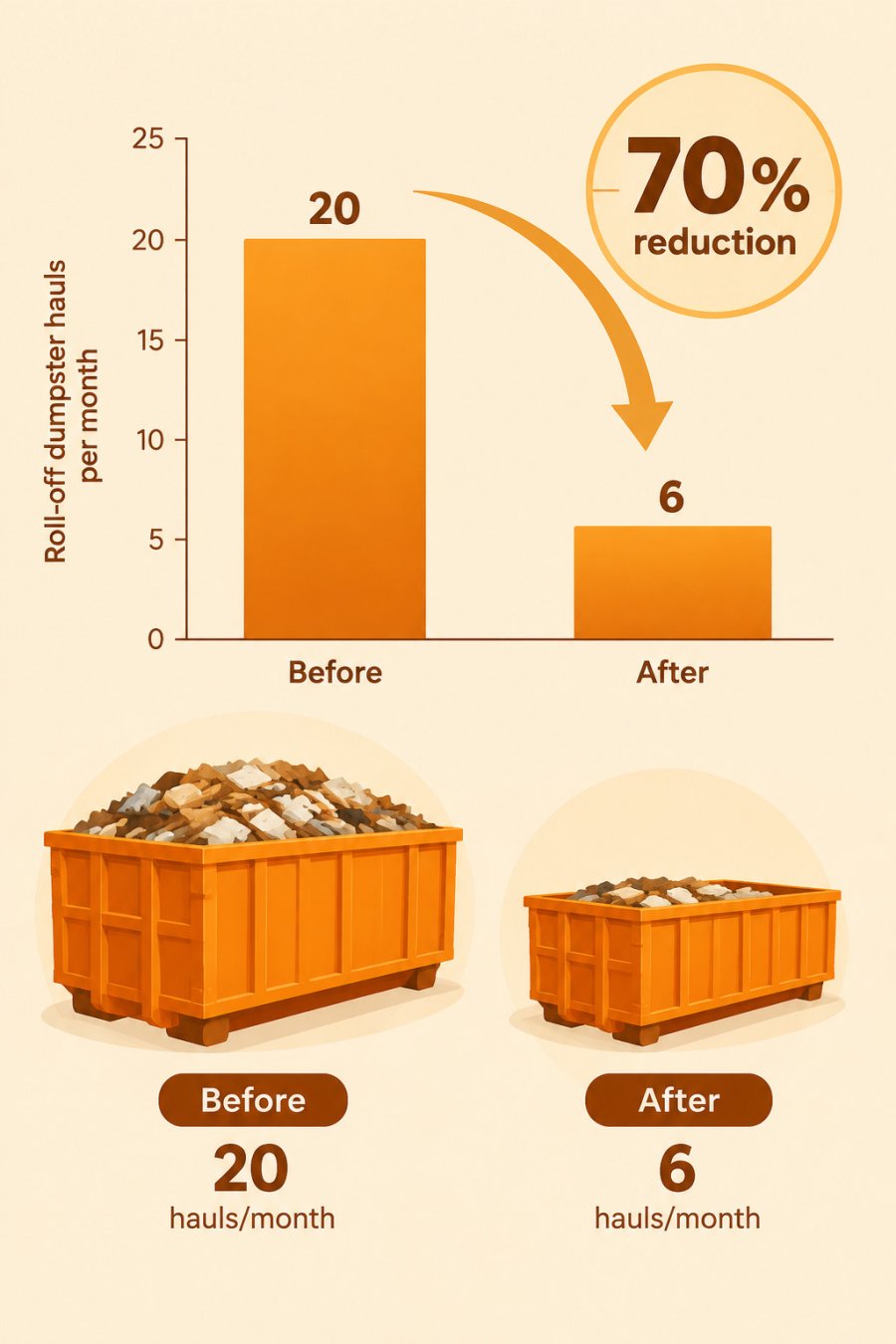
Junk Crusher provides mobile dumpster compaction for commercial sites. Our service crushes waste on site, which reduces hauling volume and the number of truck trips your facility needs. We also offer 20 and 25 yard dumpsters, so you can match container size to the volume your plant produces.
Compaction works best alongside sorting. Compacting mixed trash does not solve contamination, so keep recyclable streams separate and compact the materials destined for disposal or recovery.
To decide whether compaction is worth it, build a simple ROI estimate. For the pickup side of the math, see how to calculate waste hauling frequency. Start with your current hauling cost per month and the number of pickups per month, then estimate the volume reduction compaction can achieve for your material mix; light, bulky waste commonly compacts by a factor of two to four, while dense or wet material compacts less. Multiply your pickup count by the expected reduction to estimate avoided hauls, and subtract the service cost. Payback is shortest when hauling costs are high and the waste stream is mostly air-filled packaging.
Track pickup frequency before and after compaction to see whether fewer hauls are actually reducing your monthly bills. If the numbers do not move, revisit container placement and sorting first.
To see what compaction could mean for your plant's hauling schedule, visit our dumpster compaction service page or call 412-407-9100.
Frequently Asked Questions
How do you start a recycling program in a manufacturing plant?
Begin with a waste audit to find which streams your plant generates most, such as metal scrap, cardboard, plastics and pallets. Assign an owner for the program, place labeled collection bins at the points where waste is created, and train shift workers on sorting rules. Then choose a hauler or recycler that accepts your materials. Review hauling invoices and bin counts monthly to confirm the program is reducing disposal costs. Junk Crusher can also help you evaluate whether on-site compaction fits your waste volume; pricing depends on volume, schedule and site access, so request a quote for current figures.
What materials can manufacturing plants recycle?
Most plants can recycle metal scrap, cardboard, plastics, wood waste and pallets. Metal scrap is often the highest-value stream because recyclers pay for it, which can offset disposal costs. Cardboard and pallets are common in shipping areas. Plastics and wood vary by type and contamination level, so confirm acceptance with your recycler before setting up bins. Keeping streams separate at the source improves the chance a recycler will accept them.
How can manufacturers reduce industrial waste volume?
Source separation is the first step: keeping recyclables out of the general waste stream reduces what goes to landfill. On-site compaction is another option. Compacting roll-off dumpster waste can reduce its volume by up to 70 percent, which means fewer hauls and lower hauling frequency. Track bin fill rates and haul counts over several months to see where the largest gains are. Results depend on the waste mix at each site.


