
Dumpster Compaction vs Extra Rentals: Cost & Efficiency
Table of Contents
- Dumpster Compaction vs Extra Rentals: The Core Difference
- Understanding Dumpster Rental Costs and Fee Structure
- How Compaction Reduces Volume and Hauling Frequency
- Waste Management Efficiency: Compaction vs Traditional Hauling
- Total Cost of Ownership: Breaking Down the Numbers
- Operational Factors That Tip the Scale
- Which Approach Works for Your Operation?
- Frequently Asked Questions
Last Updated: September 27, 2026
Dumpster Compaction vs Extra Rentals: The Core Difference
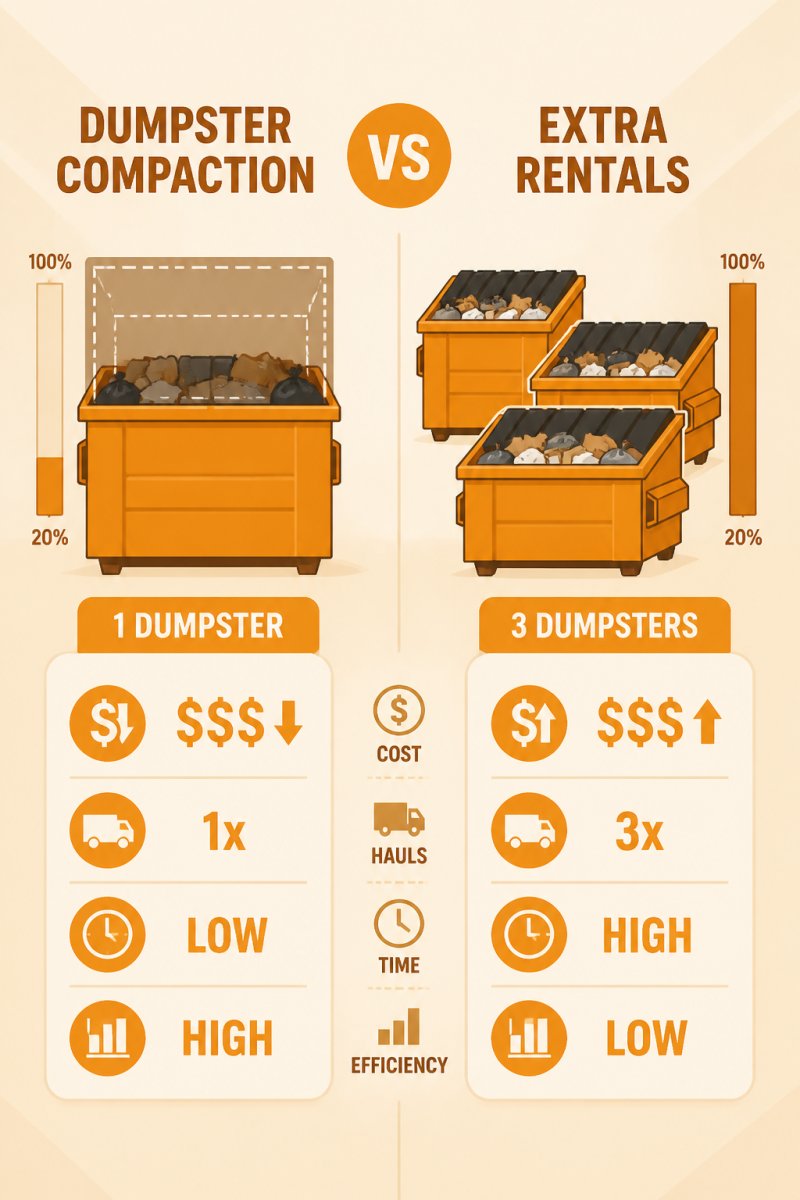
When your waste stream overflows, you face a choice between dumpster compaction vs extra rentals to manage your disposal needs. The real question isn't which option is "better" in theory, it's which one actually reduces your total disposal costs and operational headaches for your specific situation.
Extra rentals are straightforward: you pay a base rental rate, then per-pickup fees each time your dumpster fills. Compaction reduces waste volume in your existing container so you need fewer pickups overall. One approach spreads costs across multiple containers; the other concentrates waste and minimizes hauling frequency.
Understanding Dumpster Rental Costs and Fee Structure
Your dumpster rental invoice contains three primary line items: base rental, per-pickup hauling fees, and overage charges. Understanding each component is essential to comparing extra rentals against compaction fairly.
Base Rental Base rental covers the container itself and is your fixed monthly cost regardless of how full it becomes or how often it's picked up. Facilities with steady waste benefit from predictable budgeting; those with seasonal spikes may find the fixed cost inefficient during slow months.
Per-Pickup Hauling Fees Each per-pickup fee covers the truck, driver, fuel, and landfill tipping. Per-pickup fees compound rapidly with high waste density or frequent collection. A facility filling a single 40-yard container twice weekly pays 8-10 per-pickup fees monthly, often exceeding base rental. Over 12 months, per-pickup charges frequently represent 40-60% of total waste management cost, yet many managers focus only on base rental when evaluating options.
Overage and Excess-Weight Charges Most haulers impose weight limits per load. Overage fees apply when loads exceed this threshold. Construction debris, roofing materials, and metal scrap frequently trigger overage charges because they're denser than general waste. These charges are often buried in fine print and surprise facility managers during invoice review.
Contract Terms and Rate Locks Most rental agreements lock in rates for 12 months, but some include escalation clauses or fuel surcharges. Review your contract for these clauses before committing.
The Real Cost Pattern When you aggregate base rental, per-pickup fees, and overage charges across 12 months, the true cost emerges. Many facilities discover they're overpaying by 20-30% simply because they've never audited their waste stream or negotiated per-pickup rates based on actual collection frequency.
Extra rentals shift the per-pickup burden by spreading waste across multiple containers, but you pay multiple base rental fees. Compaction eliminates per-pickup fees by reducing collection frequency, but you pay per-visit compaction charges instead. The trade-off depends on which cost structure dominates your current spending.
How Compaction Reduces Volume and Hauling Frequency
Compaction crushes waste inside your existing dumpster, reducing volume by up to 70%, creating space for more material without requiring additional pickups.
A mobile compactor positions itself over your open-top dumpster and uses hydraulic pressure to compress waste. What previously required three pickups might fit into one or two, reducing landfill trips while using the same container footprint.
For facilities with consistent waste output, compaction becomes a predictable cost aligned with your operational rhythm, not container-fill rates.
Fewer truck trips mean fewer emissions, but the primary driver is operational efficiency: reduced collection frequency, minimized site downtime, and eliminated overflow risk.
Waste Management Efficiency: Compaction vs Traditional Hauling
Extra rentals optimize for simplicity: more containers mean fewer pickups per container. Compaction optimizes for volume reduction and site footprint.
With extra rentals, your yard becomes a multi-container operation. Each fills on its own schedule, and your hauler picks up whichever ones are full. This works well when your site has space and waste generation is unpredictable.
Extra rentals consume yard space. A dumpster occupies significant square footage with access and maneuvering room. For tight urban sites or facilities where every square foot has value, that footprint becomes a liability.
Compaction preserves yard space by maintaining one container. Your site stays cleaner, more organized, and safer, with more predictable equipment movements.
Construction sites with variable debris and seasonal spikes benefit from extra rentals' flexibility. Facilities with steady, predictable waste streams benefit from scheduled compaction.
Total Cost of Ownership: Breaking Down the Numbers
For extra rentals: (base rental × containers × 12) + (per-pickup fee × annual pickups) + overage charges. For compaction: (per-visit fee × monthly visits × 12) + (base rental × 12).
Pickup frequency and waste density move the needle. A facility generating 8-10 pickups monthly benefits significantly from compaction. One generating 2-3 pickups monthly may find extra rentals more cost-effective.
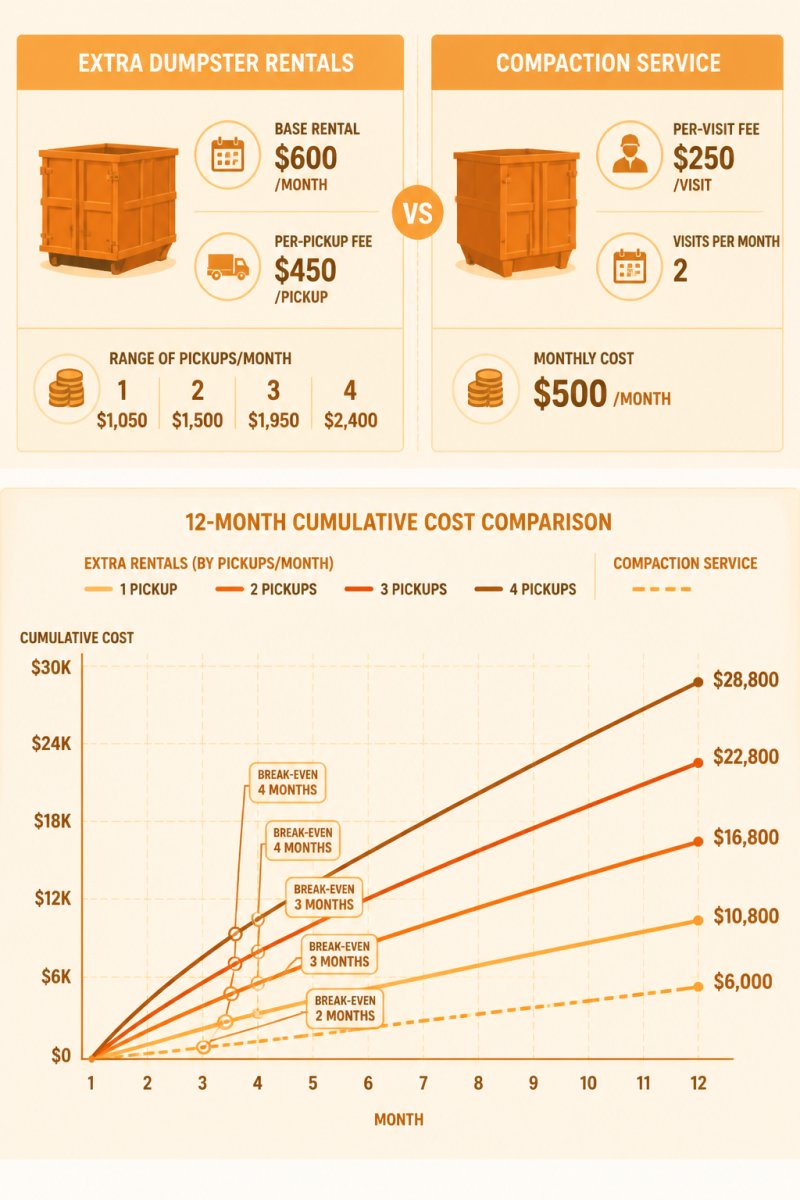
Most facilities compare per-visit compaction cost to a single month's hauling fees and conclude compaction is expensive. But compaction's value emerges over 12 months as you eliminate accumulated per-pickup fees. If compaction reduces pickups from 10-12 annually to 4-5, savings become substantial.
Site-specific factors shift the calculation. A roofing company with seasonal peaks might use extra rentals during slow months and compaction during peak season. A construction site with a short timeline might choose extra rentals because the project ends before compaction's savings materialize.
Operational Factors That Tip the Scale
Beyond cost, three operational factors determine which approach serves your facility better: space constraints, waste density, and the hidden costs of equipment maintenance and downtime.
Space Constraints and Site Access If your dock or yard has limited real estate, extra rentals become impractical. A dumpster occupies significant square footage with access and maneuvering room. For tight urban sites and distribution centers where every square foot has value, that footprint becomes a liability. Compaction preserves your footprint by maintaining a single container, freeing yard space for equipment staging or material storage.
Compaction requires the mobile compactor truck to position over your open-top dumpster, needing clear approach paths and overhead clearance. Sites with overhead power lines, narrow alleyways, or limited turning radius may find compactor access more difficult. Before committing, verify your site accommodates compactor equipment.
Waste Density and Compression Efficiency Heavy, dense materials (roofing debris, metal scrap, construction waste) compress efficiently and benefit from compaction. Light, bulky materials (cardboard, foam, plastic film) compress poorly and may favor extra rentals. Compaction's value scales directly with compression ratio. A roofing company can achieve 60-70% volume reduction; a distribution center processing cardboard may achieve only 20-30%.
Understand your waste stream composition before committing. Mixed waste operations may see lower savings than pure heavy-waste operations. Predominantly light waste may favor extra rentals because compaction visits deliver minimal volume reduction.
Equipment Maintenance, Downtime, and Reliability Risk Compaction introduces equipment dependency that extra rentals avoid.
Which Approach Works for Your Operation?
Use this framework to determine which strategy aligns with your actual needs.
Choose extra rentals if:
- Your waste generation is unpredictable or seasonal
- Your site has sufficient yard or dock space
- Your projects are short-term (under 6 months)
- Your waste is light and bulky (low density)
- You prefer simplicity and flexibility over cost optimization
- Your current pickup frequency is 2-3 times monthly or less
Choose compaction if:
- Your waste generation is consistent and predictable
- Your site has limited space for multiple containers
- Your operation is ongoing (12+ months)
- Your waste is heavy and dense (high compression ratio)
- You want to minimize hauling frequency and environmental impact
- Your current pickup frequency is 8+ times monthly
Frequently Asked Questions
What is the difference between dumpster compaction and renting extra dumpsters?
Dumpster compaction crushes waste on-site using mobile equipment, reducing volume by up to 70% so fewer hauls are needed. Extra dumpster rentals add containers to handle overflow but still require the same number of pickups per container. Compaction attacks the root problem, waste density, while extra rentals simply add capacity. For high-volume operations, compaction reduces commercial waste hauling frequency significantly, cutting total disposal costs.
How does on-site compaction reduce dumpster rental costs?
By compressing waste on-site, you fit more material into each container, extending the time between pickups. This cuts the number of hauling trips per month, directly lowering per-pickup fees and base rental charges. Waste stream optimization through compaction means you may need fewer dumpsters overall or can downsize container capacity. The reduction in collection frequency compounds savings over time, especially for construction sites and manufacturing plants with consistent waste output.
Is compaction worth it for small jobsites or facilities?
Compaction typically pays off when you generate enough waste to require multiple pickups per week or operate across several sites. Small projects with one dumpster and infrequent pickups may see minimal ROI. However, if your jobsite experiences overflow or overage charges, or if you're managing multiple locations, compaction becomes cost-effective faster. Calculate your current hauling frequency and fees, if you're paying for more than 3-4 pickups monthly, compaction usually justifies the investment.
What types of waste work best with dumpster compaction?
Compaction works well for dense, non-hazardous materials: construction debris, shingles, mixed demolition waste, cardboard, and general manufacturing scrap. Heavy, compressible items achieve the highest volume reduction. Wet or liquid waste, hazardous materials, and certain bulky items may not compress effectively. Before committing to compaction, confirm your waste stream composition with your service provider to ensure the equipment can handle your specific material types and achieve meaningful density gains.
