
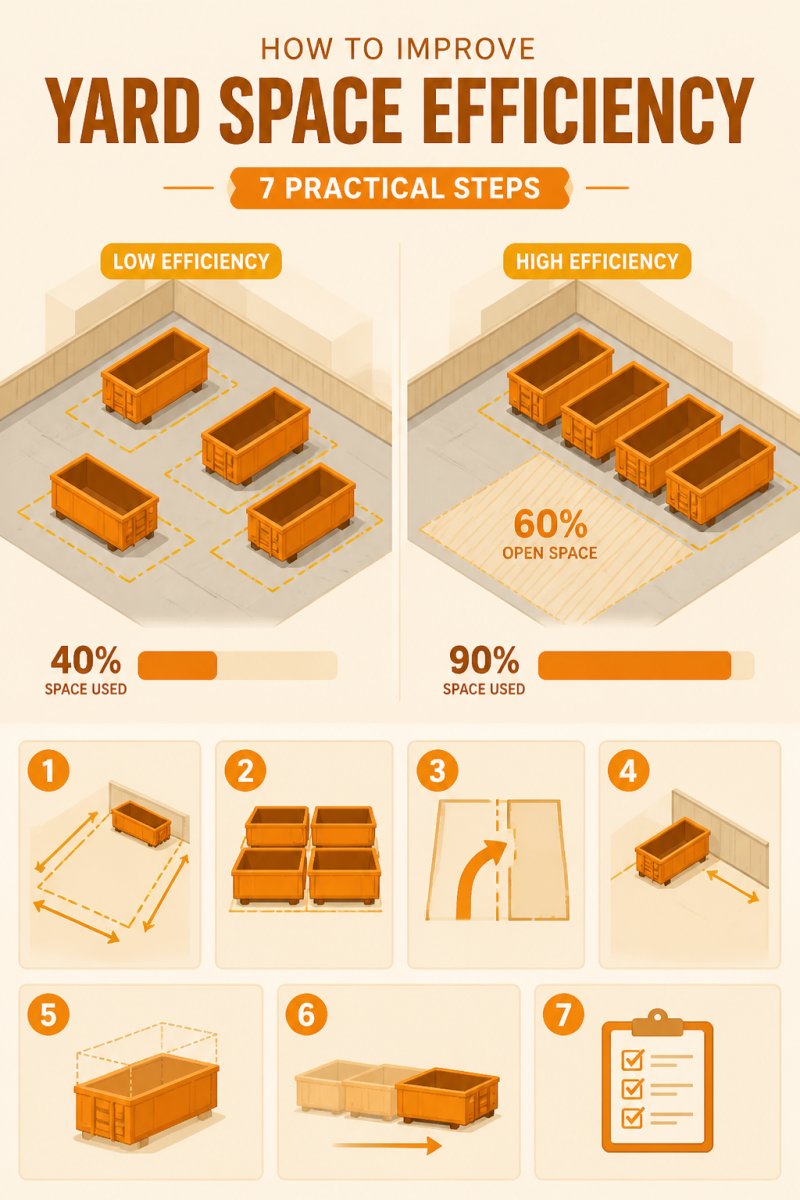
How to Improve Yard Space Efficiency: 7 Practical Steps
Table of Contents
- What You'll Need Before You Start
- Map Your Yard Space Efficiency: Zones, Traffic, and Storage
- Step 1: Fix Drainage Grading and Runoff Prevention
- Step 2: Build Soil Health to Stabilize the Root Zone
- Step 3: Reduce Waste Volume Through Industrial Waste Management
- Step 4: Choose Hardscape and Softscape Materials That Earn Their Space
- Step 5: Add Smart Irrigation and Ground Cover
- Common Mistakes That Waste Yard Space
- Frequently Asked Questions
Last Updated: September 23, 2026
What You'll Need Before You Start
Improving yard space efficiency starts with knowing what you have and what you need. At Junk Crusher, we work with plants, warehouses, and jobsites every week, and the yards that run best are mapped before anything moves.
Gather these basics first:
- A tape measure and a notebook, or a free layout app
- Your waste hauling schedule and dumpster sizes
- A list of every truck, trailer, and forklift that enters the yard
- Photos of problem spots: standing water, bare areas, clogged aisles
- A rough budget for materials and equipment rental
Map Your Yard Space Efficiency: Zones, Traffic, and Storage
Yard space efficiency means getting more useful work out of the same square footage by organizing zones, traffic flow, and storage so nothing sits idle or blocks something else. It moves trucks faster, stores more material, and hauls less air.
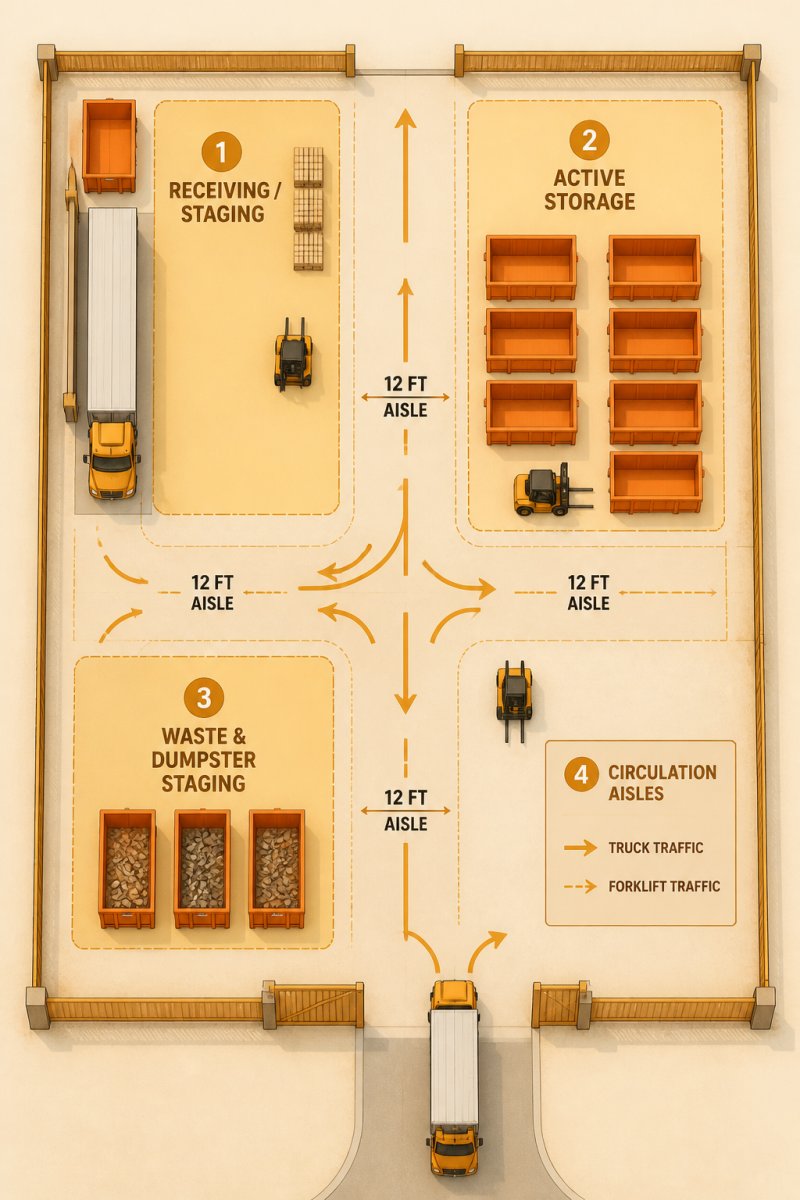
- Receiving and staging - where deliveries land and get checked
- Active storage - material that moves within days
- Waste and dumpster staging - bins, compactors, and debris
- Circulation aisles - the paths trucks and forklifts actually use
Multi-Functional Zone Planning
Multi-functional zone planning means designing one area to serve two or three jobs instead of one. A staging pad that doubles as overflow parking on slow days costs nothing extra to build.
Try these pairings:
- Receiving pad that becomes a wash-down area after hours
- Dumpster pad that also holds a spare trailer during peak season
- Aisle ends that store pallets of fast-moving material
Row Spacing and Industrial Yard Layout
Row spacing decides how much you can store and how fast you can move it. Too tight, and forklifts scrape racks. Too wide, and you pay for pavement you never use.
Step 1: Fix Drainage Grading and Runoff Prevention
Water is the quiet killer of yard efficiency: a low spot that holds water for three days shuts down that corner and softens the base under your pavement.
Fixes that work:
- Regrade low spots so they slope away from buildings and storage
- Clear debris from trench drains and catch basins
- Add permeable materials at the edges to soak up runoff
- Keep dumpster pads slightly raised so bins never sit in water
Step 2: Build Soil Health to Stabilize the Root Zone
If your yard has grass, gravel, or planted edges, the soil under it decides how well it holds up. Compacted soil sheds water, kills roots, and turns green space into mud. Soil health, the mix of structure, organic matter, and living organisms that lets ground absorb water and support plants, improves by loosening, feeding, and covering, not by adding chemicals.
Soil Aeration and Compost Amendment
Soil aeration punches small holes so air and water reach the root zone; compost amendment adds organic matter that feeds soil life and holds moisture. Together they are the highest-return soil work you can do on a yard.
A practical fall or early-spring sequence:
- Mow low and bag the clippings to open the canopy.
- Dethatch if the layer is thick.
- Core aerate the whole area, overlapping passes.
- Spread a thin layer of compost (about a quarter inch) and rake it into the holes.
- Overseed with quality grass seed suited to your region, match the species to your sun and traffic.
- Water lightly and often for two to three weeks until the new seed establishes.
Weed Control and Pest Management at the Soil Level
Most weed and pest problems start in the soil. Bare, compacted ground invites weeds because nothing else will grow there; a dense, healthy stand of grass shades the surface and outcompetes weed seeds before they sprout.
A few habits do most of the work:
- Mow high. Taller grass blades shade the soil and starve weed seedlings of light. Removing more than a third of the blade at once stresses the lawn.
- Water deeply and less often. Shallow daily watering trains roots to stay near the surface, where they dry out and invite weeds.
- Feed at the right time. Fertilize when the grass is growing, not when it is dormant.
- Spot-treat, don't blanket. Hand-pull or spot-spray individual weeds rather than treating the whole yard.
Step 3: Reduce Waste Volume Through Industrial Waste Management
Industrial waste management is the planning and handling of waste streams so they cost less to store, move, and haul. The biggest lever is volume: haulers charge for the space your waste takes up, not just its weight.
On-Site Compaction and Waste Hauling Cost Reduction
On-site compaction crushes waste inside the dumpster so more material fits in the same container, meaning fewer hauls, fewer truck trips, and lower fees.
Waste hauling cost reduction comes from three places:
- Fewer pickups because each bin holds more
- Less downtime waiting on trucks to arrive and swap bins
- Lower fuel use and emissions from fewer trips
Step 4: Choose Hardscape and Softscape Materials That Earn Their Space
Every square foot should do a job. Hardscape is the built surface, concrete, asphalt, pavers, gravel; softscape is the living layer, grass, ground cover, shrubs, trees. The trade-off decides how your yard functions.
| Surface | Best For | Watch Out For |
|---|---|---|
| Concrete | Heavy truck traffic, dumpster pads | Cost, runoff if unshaded |
| Asphalt | Large lots, fast install | Cracks, heat, resealing |
| Permeable pavers | Edges, drainage zones | Higher upfront cost |
| Gravel | Overflow storage, low traffic | Dust, migration into aisles |
| Ground cover | Slopes, bare areas | Slow to establish |
Vertical Gardening for Small Yards
Vertical gardening grows plants up walls, fences, and trellises instead of across the ground. On a tight commercial yard, it turns dead vertical space into screening, shade, and dust control without stealing a parking spot.
Good candidates:
- Vines on fence lines to hide storage and cut wind
- Planters on retaining walls for color and curb appeal
- Trellised ground cover on steep slopes to stop erosion
Step 5: Add Smart Irrigation and Ground Cover
Smart irrigation waters only when the ground needs it, using timers, soil sensors, or weather data. On a commercial site, that means less water waste, fewer puddles, and healthier plantings along your edges.
How Smart Irrigation Actually Works
A smart controller replaces the old clock timer. Instead of running on a fixed schedule, it adjusts based on one of three inputs:
- Weather-based (ET) controllers pull local evapotranspiration data, the rate at which water leaves soil and plants, and adjust run times to match. If a cool, cloudy week rolls in, the controller cuts back automatically.
- Soil-moisture sensor systems bury a probe in the root zone and water only when moisture drops below a set threshold. These are the most accurate for yards with mixed sun and shade.
- Rain sensors are the simplest add-on. They shut the system off after measurable rainfall and let it resume when the sensor dries out.
Watering Schedules That Match the Ground
A schedule is only as good as the soil under it. Sandy soil drains fast and needs shorter, more frequent cycles; clay holds water and needs longer, less frequent cycles to push moisture to the roots; loam is the easiest middle ground.
A few rules that hold across soil types:
- Water early in the morning. Midday watering loses a large share to evaporation; evening watering leaves blades wet overnight and invites disease.
- Water deeply, not daily. Deep cycles push roots down, where soil stays moist longer.
- Watch the edges. Slopes and compacted edges shed water fast, give them shorter cycles or convert them to ground cover.
- Adjust by season. Cut run times in fall and spring; most warm-season grasses need little to no supplemental water in winter.
Ground Cover and Mulch That Earn Their Space
Pair smart irrigation with the right ground cover to cut both water use and labor:
- Drought-tolerant grasses for wide open edges where mowing is easy.
- Low-growing covers on slopes to stop runoff and reduce mowing.
- Mulch rings around trees and shrubs to hold moisture and suppress weeds.
Common Mistakes That Waste Yard Space
- Storing air in dumpsters. Bulky debris fills bins loosely, so you pay to haul empty space. Compaction fixes this.
- Letting one low spot flood. A single puddle can shut down a whole corner and soften pavement.
- Over-paving. Concrete everywhere kills drainage and raises runoff costs. Keep softscape where it earns its keep.
- Ignoring row spacing. Aisles too tight slow every forklift turn; too wide wastes pavement.
- Skipping soil care. Compacted, bare ground turns to mud and dust that spread onto your working surfaces.
- Hauling on a fixed schedule. If bins are not full, you are paying for truck trips you do not need.
Fix the map, the water, and the waste volume, and the rest gets easier.
Frequently Asked Questions
What are the benefits of on-site waste compaction for yard efficiency?
Compacting waste inside the dumpster before it is hauled away frees up the ground space that extra containers would occupy. Fewer containers means shorter walking distances, clearer circulation aisles, and less time spent repositioning bins. Junk Crusher's mobile service crushes dumpster contents on site and can reduce roll-off volume by up to 70%, which allows a facility to keep the same footprint while handling more material between hauls.
How can businesses reduce waste hauling frequency to save space?
Start by separating recyclable cardboard and metal from general trash so each stream fills more slowly. Then increase the density of what stays in the dumpster. Compaction is the biggest lever here: crushed loads fit more material per container, so trucks arrive less often. Fewer hauls also mean fewer trucks queued at your gate, which keeps the yard entrance clear for deliveries. Pair this with a fixed pickup schedule and monitor fill levels between visits.
How does waste management impact overall site productivity?
Overflowing dumpsters spill debris into aisles, forcing forklifts and loaders to take longer routes or stop while someone clears the path. That downtime adds up across a shift. Keeping containers contained and right-sized means equipment moves without interruption, and crews spend their time on production rather than cleanup. Industrial waste management that includes on-site compaction also reduces the number of hauling trucks entering the yard, which lowers congestion at the gate and reduces the carbon footprint of your operation.
What are the best practices for organizing industrial yard layouts?
Assign every square foot a purpose before you move anything. Group high-turnover items near the point of use and push slow movers to the perimeter. Leave circulation aisles wide enough for your largest vehicle plus a safety margin, and keep dumpster staging away from main traffic lanes. Use row spacing that matches your equipment turning radius rather than filling every gap with storage. Review the layout each quarter, because storage needs shift with project mix and seasonal volume.
Most yards do not have a space problem. They have a volume and layout problem, and both are fixable without buying more land. Junk Crusher helps you crush that problem at the source with mobile on-site dumpster compaction, fewer required hauls, and a smaller carbon footprint from fewer truck trips. We also offer 20 and 25 yard dumpsters when you need extra capacity on site. Book a Crush with Junk Crusher and turn the space you already have into space that works.
