Mobile vs Stationary Waste Compaction for Manufacturing
Table of Contents
- Mobile vs Stationary Waste Compaction: How the Two Systems Work
- Self-Contained Compactor vs Stationary Compactor: Which Fits Your Waste Stream?
- Manufacturing Waste Management: Matching Equipment to Dry, Wet, and Mixed Waste
- Compaction Performance and Volume Reduction: How to Measure What You Get
- Space, Installation, and Site Planning for Each Option
- Manufacturing Waste Hauling Frequency: How Compaction Changes Your Pickup Schedule
- Waste Compactor Safety and Compliance on a Manufacturing Site
- Which Waste Compaction Option Fits Your Facility? A Decision Framework
- Step 1: Map Your Waste Streams by Material and Moisture
- Step 2: Estimate Volume Reduction and Haul Frequency
- Step 3: Model Total Cost of Ownership
- Step 4: Factor in Safety, Compliance, and Site Logistics
- Step 5: Consider Recycling and Material Recovery
- Step 6: Plan for Implementation and Service Continuity
- Frequently Asked Questions
Last Updated: October 20, 2026
Mobile vs Stationary Waste Compaction: How the Two Systems Work
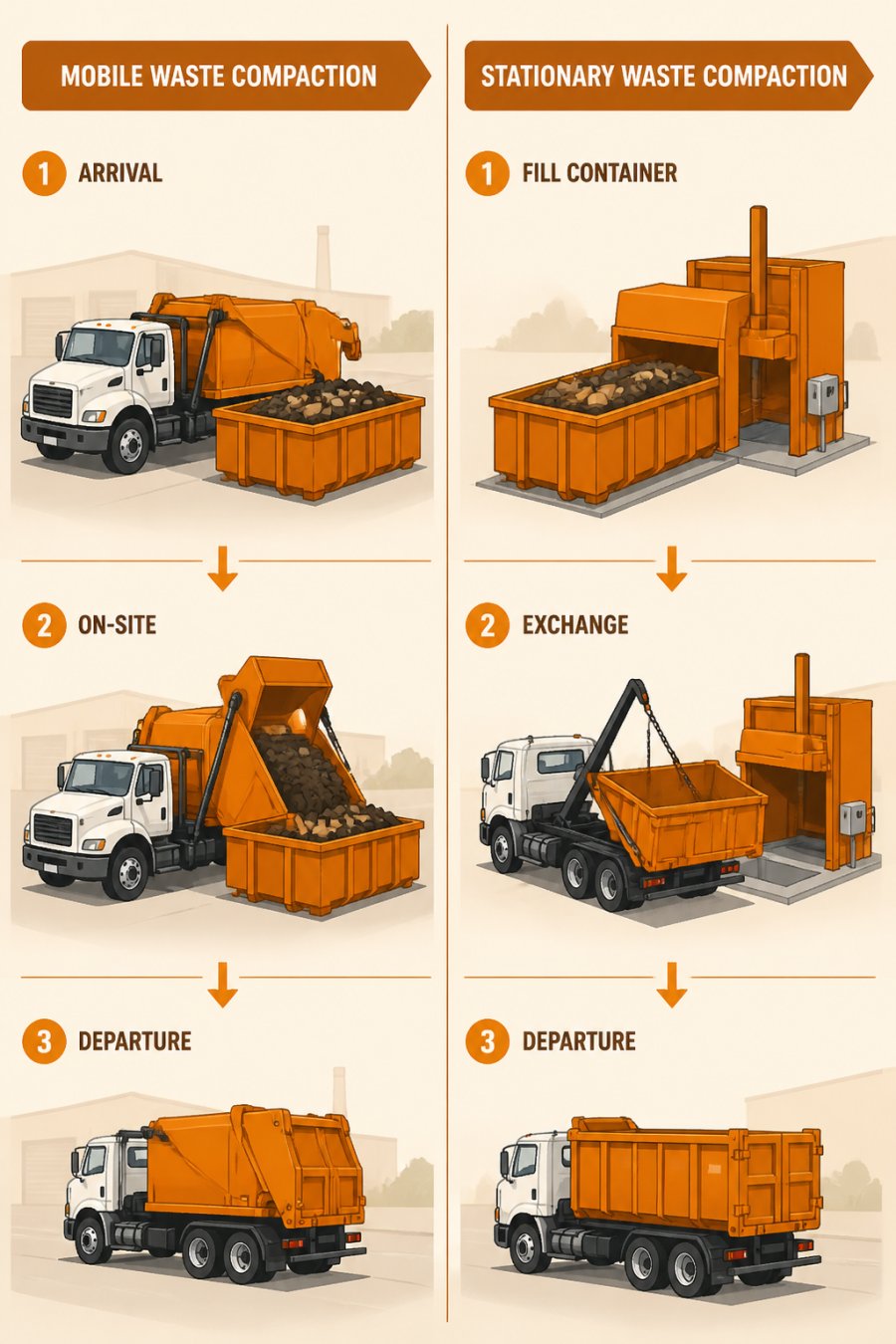
Mobile vs stationary waste compaction comes down to one question: does the compactor travel to your waste, or does your waste travel to the compactor? Mobile compaction brings a crushing unit to the roll-off dumpster already in your yard; stationary compaction parks a permanent ram unit at a fixed point and feeds it from the plant floor.
What Mobile Waste Compaction Looks Like on a Plant Floor
Mobile waste compaction is an on-site service in which a compaction truck pulls up to your existing roll-off dumpster, crushes the contents in place, and leaves the container behind.
A mobile visit takes minutes, not hours: your crew keeps working, and the dumpster simply holds more before it needs to go out.
How a Stationary Compactor Fits Into a Fixed Waste Lane
A stationary compactor is a permanently installed machine, typically anchored at a loading dock or in a dedicated waste lane, that receives material and rams it into a detachable container. Staff load it by hand or cart tipper, the ram cycles, and a hauling truck swaps the full container for an empty one.
Self-Contained Compactor vs Stationary Compactor: Which Fits Your Waste Stream?
The self-contained compactor vs stationary compactor decision usually hinges on moisture. A self-contained compactor is a single sealed unit combining the compaction chamber and container, so liquid stays inside the box. A stationary compactor is an open system that pushes material into a separate container; wet loads can leak at the connection point.
Manufacturing Waste Management: Matching Equipment to Dry, Wet, and Mixed Waste
Manufacturing waste management succeeds or fails on whether the equipment matches the material. Dry waste compacts predictably in either system; wet and mixed waste need containment, which favors sealed designs. The practical sorting rule we give plant teams:
- Dry, uniform waste: either system works; choose on space and volume
- Wet or food-adjacent waste: self-contained only
- Mixed waste with unknown moisture: self-contained, or separate the streams first
That last point matters. Compaction is not always the right answer for a clean, single-material stream.
Compaction Performance and Volume Reduction: How to Measure What You Get
Compaction performance is measured by compaction ratio: the volume of loose waste divided by the volume after compaction. A ratio of 3:1 means three loose cubic yards fit into one compacted yard. Track three numbers before and after: container capacity filled per pickup, haul frequency per month, and total disposal cost per ton.
| What to track | Before compaction | After compaction | What it tells you |
|---|---|---|---|
| Hauls per month | Baseline count | Lower count | Direct haul savings |
| Weight per haul | Baseline tons | Higher tons | Whether densification is real |
| Container fill rate | Days to full | Longer interval | Labor and scheduling relief |
| Disposal cost per ton | Baseline rate | Same or lower | True operating cost |
Space, Installation, and Site Planning for Each Option
Space requirements split the two systems cleanly. A stationary compactor needs a permanent footprint, a concrete pad, often power or hydraulic connections, and clearance for the hauling truck to swap containers. A mobile service needs only the space your roll-off dumpster already occupies. For a facility with a tight yard, that difference decides the question; stationary installation also means site work, permitting, and downtime, while mobile compaction requires none of it.
Manufacturing Waste Hauling Frequency: How Compaction Changes Your Pickup Schedule
Hauling frequency is where compaction pays off, or fails to. The goal is fewer pickups without overweight containers, missed service, or production backups. Here is how to calculate the change and negotiate it with your hauler.
Calculate Your Baseline and Projected Hauls
Start with two months of data: container size (cubic yards), days to full, and hauls per month. Then estimate your compaction ratio per waste stream. Use this formula:
Projected hauls per month = (monthly loose volume ÷ compaction ratio) ÷ container capacity
For example, if you generate 40 loose cubic yards per week of cardboard, your compactor achieves a 4:1 ratio, and you use a 30-yard container: (40 ÷ 4) ÷ 30 = 0.33 containers per week, or about 1.4 hauls per month. Compare that to your current hauls to see the reduction.
Understand Your Hauler's Rate Structure
Hauling contracts vary: some charge per haul plus disposal tonnage, others a fixed monthly fee for a set number of hauls. If you are on a fixed schedule, compaction alone will not reduce cost, you must renegotiate frequency. Ask for a rate review once you have two months of compacted data showing higher weight per haul and fewer hauls, and bring container weight tickets.
Watch Container Weight Limits
Compaction increases weight per haul, and every container has a rated weight limit; exceeding it can damage the container, void the hauler's ability to lift it, or trigger overweight fines. Confirm the ceiling with your hauler before compacting heavy materials like metal or wet waste. For cardboard, weight is rarely an issue; for dense waste, reduce load size or switch to a heavier-duty container.
Optimize Container Utilization
Fewer hauls only save money if containers are actually fuller. Monitor fill levels and adjust service frequency to match generation: start conservative and tighten as you gather data. If the container is consistently full before pickup, increase frequency; if half full, decrease it.
Factor in Transportation and Disposal Costs
Each haul carries transportation cost and disposal tonnage charges. Compaction cuts transportation cost by reducing trips, but disposal cost per ton may stay flat or rise slightly as weight per haul increases. Net savings come from fewer trips and lower container rental fees if you can downsize container count. Model both line items.
Plan for Production Peaks and Seasonality
Manufacturing volume fluctuates. Mobile compaction service can often adjust frequency with a phone call, while stationary compactor hauling may be locked into a contract. If your plant has seasonal peaks, build flexibility into your hauler agreement or choose a service model that accommodates swings.
If you need containers to pair with mobile compaction, we offer dumpster rental in 20 and 25 yard sizes.
Waste Compactor Safety and Compliance on a Manufacturing Site
Waste compactor safety comes down to lockout procedures, guarding, and training. Stationary units carry the heavier burden: pinch points at the ram, the need for lockout/tagout during service, and restricted access for untrained staff. On the compliance side, check your state and local environmental rules for waste handling and container labeling, and follow OSHA machine guarding standards for any permanently installed equipment.
Which Waste Compaction Option Fits Your Facility? A Decision Framework
For a manufacturing plant, the decision should start with your waste stream, not your equipment preferences. Use this framework to compare mobile versus stationary compaction on the factors that drive cost and uptime.
Step 1: Map Your Waste Streams by Material and Moisture
Walk the plant floor and list every waste stream by material type, generation rate, and moisture content. Common factory streams:
- Cardboard and paper packaging: dry, uniform, high volume. Either system works, but a dedicated baler may produce a higher-value recyclable if you have clean, single-material cardboard.
- Plastic film and stretch wrap: lightweight and bulky. Compaction helps, but check whether your recycler accepts compacted film or prefers bales.
- Production offcuts (metal, wood, composite): often heavy and abrasive. Confirm container weight limits and ram durability before choosing a stationary unit.
Plants with three or more distinct streams often benefit from separating dry recyclables from wet waste before compaction: a stationary or self-contained unit for the wet stream, and a baler or separate container for dry recyclables.
Step 2: Estimate Volume Reduction and Haul Frequency
Before comparing equipment, establish a baseline: loose cubic yards generated per week, current container size, and hauls per month. Then estimate compaction ratio for your material:
- Cardboard and paper: typically 3:1 to 6:1 depending on compaction force and moisture.
- Plastic film: often 2:1 to 4:1.
- Mixed light waste: 2:1 to 3:1.
Use this formula: Estimated hauls per month = (weekly loose volume ÷ compaction ratio) ÷ container capacity × 4.33. Compare that to your current hauls to see the potential reduction. If your hauler charges per haul, the savings can be significant; if you are on a fixed schedule, you will need to renegotiate.
Step 3: Model Total Cost of Ownership
Compare mobile and stationary on total cost over three to five years. Include:
- Equipment: stationary compactor purchase or lease, plus installation.
- Site work: concrete pad, power or hydraulic connections, permitting, and downtime for installation.
- Service and maintenance: scheduled maintenance, repair parts, and downtime risk for stationary units; mobile service is typically bundled into the per-visit fee.
A transparent model often shows mobile service has lower upfront cost and more predictable monthly expense, while stationary can pay back in high-volume, steady-stream operations where labor and hauling savings accumulate.
Step 4: Factor in Safety, Compliance, and Site Logistics
Stationary compactors introduce machine-guarding, lockout/tagout, and training obligations for your staff; mobile compaction shifts those risks to the service crew. Check traffic flow: can a hauling truck access the container without blocking loading docks or production traffic? For stationary units, confirm clearance for container swaps and ram service access, and review local rules for container labeling and recordkeeping.
Step 5: Consider Recycling and Material Recovery
Compaction choices affect recyclable quality. Source-separated cardboard compacted in a self-contained unit may be rejected if too wet or contaminated, and baling clean cardboard often yields higher recovery value than compacting it with mixed waste. If recycling revenue or sustainability goals matter, separate dry recyclables before compaction and choose equipment that preserves material quality.
Step 6: Plan for Implementation and Service Continuity
Stationary installation can take weeks to months depending on permitting and site work; mobile service can typically start within days. Ask providers about maintenance response times, backup equipment, and peak-volume handling. For multi-site operations, mobile service scales across locations without duplicating capital equipment.
For most manufacturing plants with variable volume, limited yard space, or multiple locations, mobile compaction offers flexibility and cost certainty. If you also need containers, we offer dumpster rental in 20 and 25 yard sizes to pair with the service.
Frequently Asked Questions
What is the difference between mobile and stationary waste compaction?
Mobile waste compaction brings a compaction truck to your existing roll-off dumpster and crushes the contents on site, so the container stays in place and you keep your current hauler. Stationary compaction installs a fixed ram unit at your facility that pushes waste into a detachable container, which requires dedicated space, power, and a container exchange schedule. Mobile fits facilities that want volume reduction without construction; stationary fits high-volume plants with a steady, single waste stream and room for permanent equipment.
Is mobile dumpster compaction a good fit for manufacturing facilities?
It fits plants that generate dry waste such as cardboard, paper, plastic, and packaging materials and want to cut hauling frequency without installing permanent equipment. Because the compaction truck comes to your loading dock or yard, you avoid the space requirements and infrastructure work a stationary compactor needs. Facilities with wet or mixed waste, or very high daily volumes, often need a different setup. A site walkthrough is the fastest way to confirm whether mobile compaction matches your waste stream.
How do mobile and stationary compactors affect waste hauling frequency?
Both reduce hauling frequency by increasing container capacity through volume reduction, but they do it differently. Mobile compaction crushes the contents of your existing roll-off dumpster on a scheduled visit, so you can go longer between hauls without adding containers. Stationary compaction continuously compacts into a detachable container, and hauling happens when the container reaches capacity or your exchange schedule triggers. Track your current haul frequency and container fill levels to estimate the change before choosing.
What safety considerations apply to waste compaction at a manufacturing facility?
Lockout/tagout procedures, guarded access points, and clear signage matter for stationary units because the ram creates a serious crush hazard. Mobile compaction shifts the hazard to the service visit, so your team must keep clear of the dumpster during crushing and follow site traffic rules. Train employees on what can and cannot go into the container, keep the area free of obstructions, and confirm your service provider follows your facility's safety plan. Review requirements with your safety lead before changing equipment or schedules.
If your plant is paying to haul empty space every week, that is the cost to attack. Junk Crusher brings mobile on-site compaction to your existing dumpster, reducing volume by up to 70% and cutting haul frequency without new equipment or installation. We serve manufacturing facilities, distribution centers, and construction sites across the region, and we can schedule service across multiple locations. Book a Crush and see what your waste stream looks like compacted.


