
Optimizing Dumpster Space for Manufacturing Plants
Table of Contents
- Why Dumpster Space Is a Profit Center, Not a Cost
- Step 1: Audit Your Waste Stream and Measure Cubic Yard Usage
- Step 2: Apply Industrial Waste Management Best Practices on the Floor
- Step 3: Break Down Rigid Materials and Pallet Debris Before It Hits the Bin
- Step 4: Use On-Site Waste Compaction Services to Cut Volume at the Source
- Step 5: Reducing Waste Hauling Frequency Without Overflow
- Build a Simple ROI Framework for Dumpster Space Optimization
- Conclusion
- Frequently Asked Questions
Last Updated: October 2, 2026
Why Dumpster Space Is a Profit Center, Not a Cost
Most plant managers treat the dumpster as a fixed expense.
Optimizing dumpster space for manufacturing plants starts with one reframe: you are not paying for a container. You are paying to haul air.
At Junk Crusher, we work with manufacturers and distribution centers across Western Pennsylvania, and the pattern repeats.
The Real Cost of Empty Air in Your Dumpster
Think about what a haul actually costs. You pay for the truck, the driver, the fuel, the landfill tipping fee, and the container.
So when a bin leaves at 40% capacity, you paid full price for 60% nothing. Do that twice a month and you have funded a whole extra haul without getting anything for it.
The fix is not a bigger dumpster. It is denser waste.
Step 1: Audit Your Waste Stream and Measure Cubic Yard Usage
Start by measuring what actually leaves your facility. Not what you think leaves. What leaves.
For two weeks, track three things:
- How many containers get pulled
- What each container weighs at the scale
- How full each container looks before pickup
That third number is the one most plants never record. Walk out and look before the truck arrives. Take a photo. You will quickly see which bins leave half empty.
How to Read a Hauler Invoice Like an Operator
Most invoices bury the useful data. Pull one month of statements and separate the charges into four buckets:
- Container rental: a fixed line item per bin, regardless of use
- Haul or pull charge: billed per trip, not per ton
- Tipping or disposal fee: billed per ton at the landfill or transfer station
- Fuel and environmental surcharges: usually a percentage of the haul charge
When you sort the invoice this way, the pattern jumps out. If the haul charge is the biggest line and the tipping fee is small, you are paying to move air. If the tipping fee dominates, you have a weight problem, not a volume problem. Those two problems have different fixes.
Tonnage vs. Volume: Which Metric Actually Drives Your Bill?
This is where most waste programs go wrong. Haulers bill on volume, but landfills charge on weight.
A bin full of cardboard weighs almost nothing.
Track both. The gap between them is where your savings hide.
A simple way to see the gap: divide the tipping fee by the container's cubic yardage.
Build a One-Page Waste Stream Map
Before you change anything, draw the flow. Walk the plant and mark every point where waste is generated: machining cells, packaging lines, weld booths, paint areas, maintenance shops, break rooms.
Most plants find that two or three generation points produce the majority of the volume. Those points deserve the right container, the right location, and the right pickup cadence.
A Note on Lean Integration
If your plant runs 5S or Kaizen events, fold the waste audit into them. The Sort and Shine steps already force a walk through the floor. Add a waste observation to the checklist: what material is in the wrong bin, what bin is overflowing, what bin is empty. That turns a one-time audit into a recurring habit owned by the floor team, not by you.
Step 2: Apply Industrial Waste Management Best Practices on the Floor
Good industrial waste management best practices only work if the floor actually follows them. That means making the right choice easier than the wrong one.
Put the right container where the waste is created. A cardboard baler next to the packaging line beats a sign telling people to walk it across the plant. Scrap metal bins at the machining cell beat a shared bin by the loading dock.
Label everything clearly. Train new hires on day one. Then check the bins weekly, because habits slip.
Waste Segregation That Holds Up on a Busy Shift
Segregation fails when it slows people down. A line worker on a tight takt time will not sort if it costs them seconds.
So design for speed:
- Color-code bins by material type
- Place bins within arm's reach of the work cell
- Keep lids open and openings wide
- Empty bins before they overflow, never after
When sorting is faster than not sorting, it sticks. When it is slower, it fails within a month.
Step 3: Break Down Rigid Materials and Pallet Debris Before It Hits the Bin
Rigid materials are the biggest space thieves in any plant. Wooden pallets, crates, drums, and long scrap all create voids that trap air and block other waste from filling the bin.
A common mistake is tossing pallets whole. A single intact pallet can eat several cubic yards of a container on its own.
Break them down first:
- Cut pallets into flat sections with a pry bar and saw
- Crush drums and pails flat
- Cut long scrap into shorter lengths
- Stack flat material in layers, not piles
Flatter waste packs tighter. Tighter waste means fewer pulls.
Step 4: Use On-Site Waste Compaction Services to Cut Volume at the Source
Manual breakdown only goes so far. Cardboard, foam, shrink wrap, and mixed debris still leave huge air pockets no matter how neatly you stack them.
That is where on-site waste compaction services change the math. A mobile compactor crushes the waste inside your container, driving material down and eliminating the voids between items.
Junk Crusher brings the equipment to your yard and compacts the waste on site. No extra dumpsters, no hauling air. The same container holds far more material, which directly cuts how often it needs to leave. If you would rather start with the right container for the job, we also offer dumpster rental in 20 and 25 yard sizes.
The result is fewer truck trips, lower disposal fees, and a smaller carbon footprint from hauling.
Safety Protocols for Manual Crushing
If your team crushes material by hand, set rules and enforce them.
- Never enter a container to stomp or shift waste
- Wear cut-resistant gloves and eye protection
- Use a pole or tamper from outside the bin, never your body weight
- Keep a spotter when working near the container edge
- Stop immediately if the load shifts
Manual crushing is a stopgap. It is slow, it is risky, and it will not get you close to the density a machine reaches. Treat it as a temporary measure, not a strategy.
Step 5: Reducing Waste Hauling Frequency Without Overflow
Reducing waste hauling frequency sounds simple until the bin overflows on a Friday and someone calls an emergency pull.
The trick is to match pickup schedules to real fill rates, not to habit.
Compaction changes the fill rate. Once waste is crushed, the same container lasts longer, so you can stretch the schedule safely.
Build a Simple ROI Framework for Dumpster Space Optimization
You do not need a spreadsheet model. You need six numbers.
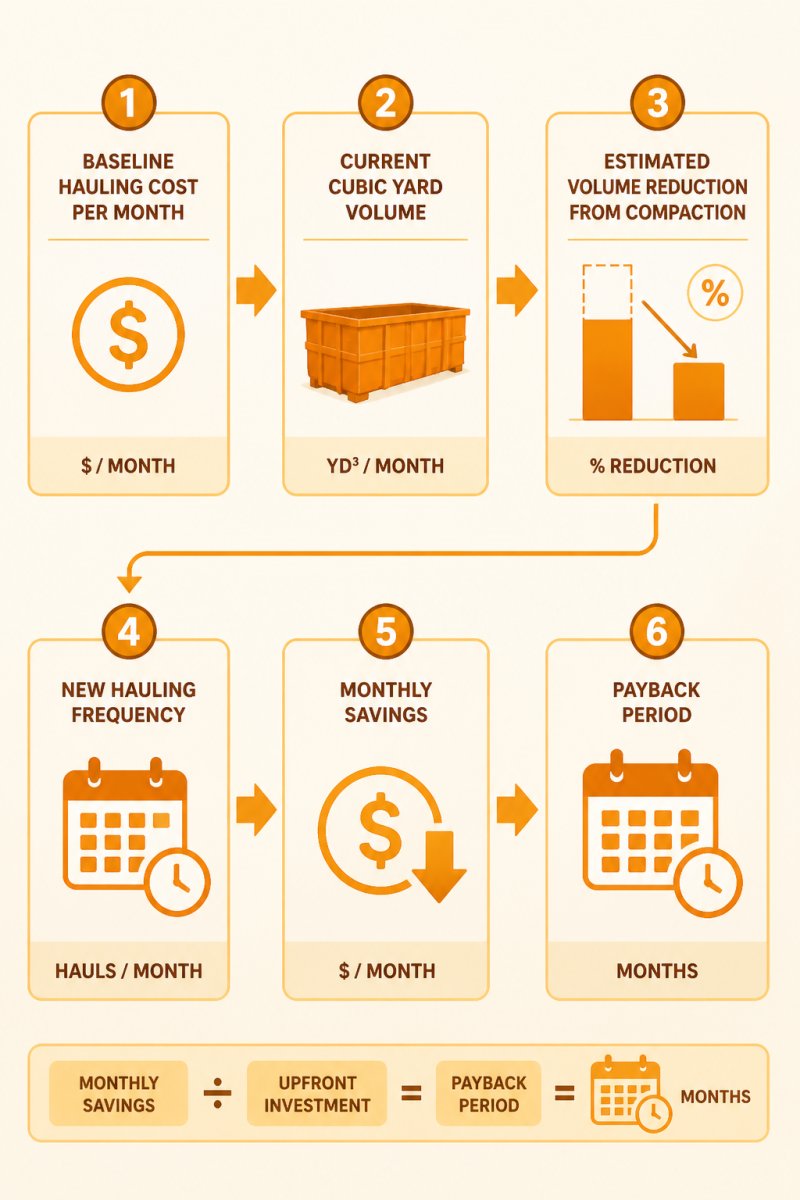
Work through them in order:
- Baseline hauling cost per month: total invoice, all containers
- Current cubic yard volume: container size times number of pulls
- Estimated volume reduction: how much compaction shrinks the load
- New hauling frequency: pulls per month after compaction
- Monthly savings: old cost minus new cost
- Payback period: upfront cost divided by monthly savings
That is the whole framework. It also gives you the answer to the question every plant manager asks: how do I know this actually works for our waste? Run your own numbers on your own bins.
Estimating Volume Reduction Without a Trial
You will not know the exact reduction until you run a trial, but you can bracket it. Loose cardboard, foam, and shrink wrap typically compact to a fraction of their original volume because the material is mostly air.
A practical approach: run one container for one month with compaction and compare the fill level at pickup to the same container the month before.
The Weight-Limited Bin Problem
Some bins hit the hauler's weight limit before they look full. Compaction does not help those bins, it makes the problem worse by packing more weight into the same space.
Check your hauler's weight limit per container before you assume compaction is the answer. A bin that leaves at 70% fill but at the weight limit is not a compaction candidate.
Compaction vs. Adding Another Dumpster
The simplest alternative to compaction is adding a second container. Run the numbers both ways:
- Adding a dumpster: adds a fixed monthly rental plus additional haul charges. It solves overflow but does not reduce cost per ton.
- Compaction: adds equipment cost but reduces the number of pulls. It lowers cost per ton because the same truck trip carries more material.
If your waste is light and bulky, compaction usually wins because the haul charge is the dominant cost. If your waste is heavy and dense, a second container may be cheaper because compaction will not reduce volume enough to matter. The decision hinges on which line item dominates your invoice.
A Worked Example Structure
You do not need real numbers to see the shape of the math. Set up your own sheet with these rows:
- Current pulls per month
- Current cost per pull
- Current monthly haul cost
- Estimated pulls per month after compaction
- New monthly haul cost
- Monthly savings
- Equipment cost or service cost
- Months to payback
Fill in rows 1 through 3 from your invoice. Fill in row 4 from your one-month trial. Rows 5 through 8 fall out of the arithmetic. If payback lands inside your capital or operating threshold, the decision is easy. If it does not, you have saved yourself a bad purchase.
Where Compaction Fits in a Lean Program
If your plant runs Kaizen events, the ROI framework is a natural fit. A Kaizen event is already a structured improvement cycle with a before-and-after measurement. Use the same discipline: measure the baseline, run the change for a defined period, measure again, and standardize what worked. That turns waste optimization from a one-time project into a repeatable process the plant already knows how to run.
Conclusion
The hard part is not understanding the math.
Junk Crusher makes that switch simple. Our mobile service compacts waste on site, cuts container volume, and reduces how often your bins need to leave the yard.
Book a Crush with Junk Crusher and turn your dumpster from a fixed cost into a measurable saving.
Frequently Asked Questions
How can manufacturing plants reduce waste hauling frequency?
The most effective way is to compact waste on-site before it reaches the dumpster. Mobile compaction services can reduce dumpster volume by up to 70%, meaning fewer pulls per month. Pair that with consistent waste segregation and pre-breaking rigid items like pallets and crates. Most plants that combine these steps move from multiple hauls per week to one or two, depending on production volume and material mix.
What are the benefits of using a mobile dumpster compactor?
A mobile compactor crushes waste directly inside your existing dumpster, so you are not paying to haul empty air. The main benefits include fewer hauls, lower disposal fees, reduced truck traffic on your yard, and a smaller carbon footprint from fewer hauling trips. For manufacturing plants with steady scrap and packaging waste, compaction also means less time spent managing overflow and fewer calls to your hauler.
How do you properly break down industrial waste for disposal?
Start by separating recyclable metals, cardboard, and hazardous waste from general trash. Break down pallets, crates, and large rigid containers so they lay flat. Never place hazardous waste, liquids, or pressurized containers in a compactor. For heavy or bulky items, use a mobile compaction service that can crush material safely on-site. Proper breakdown improves cubic yard efficiency and keeps your team safe.
How does on-site compaction impact waste management costs?
On-site compaction reduces the number of hauls required because each dumpster holds more material by weight and volume. Fewer hauls mean lower disposal fees, less fuel surcharge, and reduced labor for yard management. While exact savings depend on your waste stream and current contract, compaction can significantly reduce dumpster-related fees. Request a quote from a compaction provider to model your specific numbers.


