Hazardous Roofing Material Disposal: A Safe Jobsite Workflow
Last Updated: November 1, 2026
Quick Summary
Hazardous roofing disposal means identifying, containing, labeling, and legally disposing of roof debris that carries health or environmental risks, such as asbestos-containing shingles, lead-bearing flashings, and solvent-based tars. Stop work when suspect material crumbles, sheds fibers, or paperwork mentions asbestos or lead, then call a licensed abatement contractor. Contain, label, store, and transport each hazardous stream separately from general debris.
- Test suspect shingles, mastic, and flashing before disturbing them; age alone does not settle the question.
- Build a written waste management plan covering material survey, hazard screening, containers, labeling, and disposal routes.
- Double-bag friable suspect material, tape closures, and label containers at the point of generation.
- Only licensed haulers may move hazardous waste to a licensed facility, and you keep the manifest.
- Segregate waste into a general debris dumpster, sealed hazardous containers, and a separate metal bin.
Table of Contents
- Hazardous Roofing Disposal: What Counts as Hazardous on a Tear-Off
- Asbestos Roofing Removal and Disposal: Stop-Work Criteria and Qualified Help
- Building Your Roofing Waste Management Plan Before the First Shingle Comes Off
- Hazardous Waste Disposal Procedures: Contain, Label, Store, and Transport
- Construction Dumpster Waste Segregation on the Jobsite
- Book a Crush: Right-Sizing Dumpster Capacity for Roofing Debris
- Frequently Asked Questions
Hazardous Roofing Disposal: What Counts as Hazardous on a Tear-Off
Managing hazardous roofing material disposal safely starts with one hard truth: not everything you pull off a roof is ordinary trash. Some of it can harm your crew, your neighbors, and the environment if you handle it wrong.
Hazardous roofing disposal is the process of identifying, containing, labeling, and legally disposing of roof debris that carries health or environmental risks. That includes asbestos-containing shingles, lead-bearing flashings, and solvent-based tars.
Asbestos in shingles, mastic, and flashing
Older asphalt shingles, roofing mastic, and some flashing sealants can contain asbestos. The fibers stay locked in place until someone cuts, grinds, or breaks the material. Then they go airborne.
A common mistake is assuming age alone settles the question. It does not. The only reliable answer comes from lab testing or a qualified inspector.
Lead-bearing components and tar products
Lead shows up in older flashing, roof vents, and pipe boots. Roofing tar and solvent-based adhesives bring their own risks: fumes, flammability, and skin irritation.
Treat any suspect component as hazardous until proven otherwise. The EPA guide to asbestos and demolition explains why this caution matters on tear-offs.
| Material | Likely Hazard | First Move |
|---|---|---|
| Older asphalt shingles | Asbestos fibers | Test before disturbing |
| Roofing mastic | Asbestos, solvents | Keep intact, test, label |
| Lead flashing and vents | Lead dust | Bag separately, no cutting |
| Coal tar and adhesives | Fumes, flammability | Ventilate, keep from ignition |
| Treated wood decking | Chemical residue | Segregate from general debris |
Asbestos Roofing Removal and Disposal: Stop-Work Criteria and Qualified Help
Asbestos roofing removal and disposal is not a do-it-yourself job. When suspect material is found, the safe move is to stop work and bring in qualified help.
Here are the stop-work triggers we tell every crew to watch for:
- Material crumbles, powders, or sheds fibers when touched
- Labels or paperwork mention asbestos or lead
- A building was constructed before the 1980s and records are missing
- A worker reports breathing trouble or skin reaction after handling debris
- Packaging breaks open during removal
If any trigger fires, halt the task. Isolate the area. Call a licensed asbestos abatement contractor or your state environmental agency. The OSHA asbestos standards for construction spell out worker protections that apply once suspect material is disturbed.
Building Your Roofing Waste Management Plan Before the First Shingle Comes Off
A roofing waste management plan is a written outline of how debris gets sorted, contained, stored, and hauled away. Build it before demolition starts, not after the first load hits the ground. The unique angle here is sequence: most guides list plan elements, but a roofing plan works best as a job-site workflow that runs from assessment through final documentation, with stop-work decision points built in.
A workable plan covers five things, in this order:
- Material survey - list every debris type expected on the job, including shingles, mastic, flashing, vents, and decking
- Hazard screening - flag suspect asbestos, lead, and tar products, and note which need lab testing before disturbance
- Container plan - match dumpster size and placement to the waste volume, and designate separate containers for hazardous streams
- Labeling and storage - define where each waste stream sits on site and how it is labeled at the point of generation
- Disposal routes - name the licensed facility and permitted hauler for each stream, and the records you will keep
The roofing job-site workflow, step by step
A sequenced checklist keeps the plan actionable:
- Assess: survey the roof and records before tear-off; flag suspect material
- Test or presume: if records are missing and the building predates the 1980s, test or treat as hazardous
- Contain: bag and label suspect material at the point of generation
- Stage: move hazardous containers to a marked area away from traffic and drains
- Transport: use a permitted hauler and keep the manifest
- Document: file the survey, lab results, and disposal records together
For the broader workflow, our guide on construction site waste management solutions walks through the full project structure. Pair the plan with a dumpster that fits the debris load so you are not stuck mid-job.
Hazardous Waste Disposal Procedures: Contain, Label, Store, and Transport
Hazardous waste disposal procedures follow one sequence: contain, label, store, and transport.
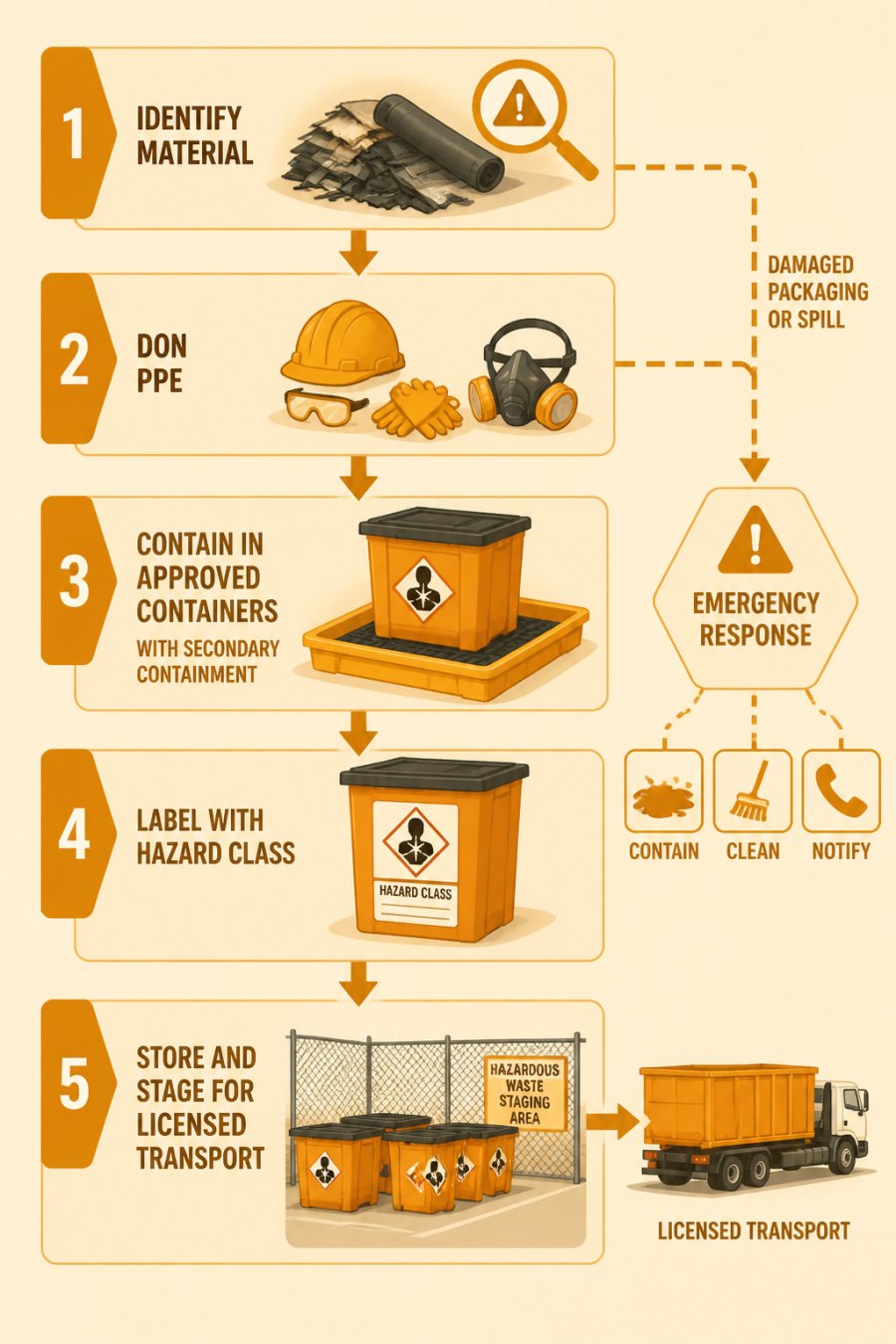
Contain. Use approved containers that seal, sized to the material and closed before they leave the work area.
Label. Every container should carry a hazard label that matches the material, with its contents and date.
Store. Keep hazardous waste away from traffic, heat, and storm drains. Cover it.
Transport. Only licensed haulers move hazardous waste to a licensed disposal facility. Keep the paperwork.
Packaging, vehicle loading, and documentation for roofing loads
Packaging and loading are where roofing jobs most often go wrong. A common pattern is a crew that contains suspect material correctly on the roof, then undoes the work by tossing the bag into a general debris dumpster at ground level.
- Packaging: double-bag friable suspect material, tape closures, and use rigid containers for sharp or heavy lead components. Keep packaging dry; wet paper or torn poly fails on the haul.
- Vehicle loading: load hazardous containers last and separate them from general debris, brace them so they cannot shift, and tarp the load. Do not stack heavy debris on top of hazardous containers.
- Documentation: keep the waste manifest or disposal receipt, the material survey, and any lab results together in the job file. This is your proof of lawful disposal if a question comes up later.
Emergency response for damaged packaging and spills
A spill plan saves the job. When packaging fails or a spill happens:
- Stop work and clear the area
- Don personal protective equipment before approaching
- Contain the spill with absorbent material or a berm
- Block any path to storm drains
- Report the spill to your supervisor and, where required, to the state environmental agency
Keep a spill kit on every roofing site. Restock it after each use.
Construction Dumpster Waste Segregation on the Jobsite
Construction dumpster waste segregation means keeping waste types apart in separate containers or marked zones. It cuts disposal costs and keeps hazardous material out of general debris.
Set up your site like this:
- One dumpster for general C&D debris (shingles, wood, packaging)
- Sealed containers for hazardous waste
- A separate bin for metal flashing and recyclables
- Clear signage on every container
Segregation also improves dumpster efficiency. Our guide on optimizing dumpster capacity on construction sites shows how smart loading and segregation reduce trips. Before loading anything, check what can go in a dumpster rental so you do not mix banned material into a general load.
Book a Crush: Right-Sizing Dumpster Capacity for Roofing Debris
Right-sizing dumpster capacity comes down to matching container volume to the debris your roof produces. Too small and you pay for extra hauls.
Roofing debris is bulky and heavy. Shingles stack fast and fill a dumpster long before it hits its weight limit.
Before delivery, prep the drop spot. Our driveway preparation guide covers access and placement so the container sits where crews can load it safely.
For roofing contractors working through hazardous tear-off debris, our guide on efficient waste disposal for roofing contractors connects this workflow to daily job planning.
Frequently Asked Questions
Which roofing materials may contain hazardous substances?
Asphalt and fiberglass shingles made before the 1980s can contain asbestos, and asbestos also shows up in roof mastic, flashing cement, and some underlayments. Lead appears in older flashing, roof vents, and painted metal components. Coal tar pitch roofs and roofing tar carry polycyclic aromatic hydrocarbons. Treat any pre-1980 roof, and any roof of unknown age, as suspect until a sample confirms otherwise. A lab test is the only reliable way to know what you are tearing off.
Can hazardous roofing materials go in a construction dumpster?
Not in a standard construction dumpster. Asbestos-containing material, lead-bearing components, and liquid tar products need approved containers, labeling, and a route to a licensed disposal facility. Mixing them into general C&D debris can make the whole load regulated waste. Keep a separate, labeled container for suspect material and confirm acceptance with the receiving facility before anything leaves the site.
When should a contractor hire a licensed hazardous-waste professional?
Bring in a qualified professional when sampling confirms asbestos or lead above applicable thresholds, when the material is friable or already damaged, or when the scope exceeds what your trained crew can legally handle. Stop work in that area until the material is assessed. A licensed abatement contractor handles removal, packaging, and manifesting, and gives you documentation that protects the company if the disposal is ever questioned.
What should a roofing waste management plan include?
A workable plan names the materials expected on the tear-off, the testing done before removal, the PPE and containment required, the separation scheme for the dumpster, the licensed disposal route for each waste type, and the records you will keep. It also sets stop-work triggers and a spill response step. Write it before mobilization, review it with the crew, and update it when the roof surprises you, which older roofs usually do.
Roofing debris piles up fast, and paying to haul air is money you never get back. Junk Crusher brings mobile on-site dumpster compaction to your jobsite, reducing roll-off volume and cutting the number of hauls you need. We serve construction, demolition, and manufacturing crews who want simpler cleanup and lower waste costs. Get started with Junk Crusher and book a crush to shrink your debris load before the next haul.


