
Optimizing Dumpster Capacity on Construction Sites
Table of Contents
- Why Dumpster Capacity Matters for Project Timelines
- Dumpster Rental Size Guide for Contractors
- How to Load a Roll-Off Dumpster Efficiently
- Calculating Debris Density by Material Type
- Strategic Dumpster Placement for Site Logistics
- On-Site Waste Compaction Benefits for Capacity
- Waste Segregation, Recycling, and Disposal Regulations
- Common Loading Mistakes That Waste Cubic Yardage
- Frequently Asked Questions
Last Updated: September 8, 2026
Construction project managers often discover too late that their dumpster capacity is the silent bottleneck in their workflow. When a roll-off container fills up mid-week, crews stop working and the project timeline slips. Optimizing dumpster capacity is less about ordering the biggest box and more about matching container size, loading technique, and waste stream composition to the specific phase.
Most contractors treat the dumpster as an afterthought. Dumpster capacity is the total usable volume and weight allowance of a roll-off container, and it determines how many trips your hauler makes. Below, we walk through the loading strategies, density calculations, and site logistics that keep projects moving.
Why Dumpster Capacity Matters for Project Timelines
Every unscheduled hauler visit interrupts the workflow. When a container hits its weight limit before it is visually full, you are paying for wasted space. When it overflows visually but is under the weight cap, you risk unsafe loading conditions.
A common mistake is ordering one large container for the entire project. That approach fails because different phases generate different waste streams: demolition produces heavy material like concrete, framing produces bulky but light wood scrap, and drywall creates volume without much weight. Matching container size and swap-out timing to each phase keeps the workflow moving.
Dumpster Rental Size Guide for Contractors
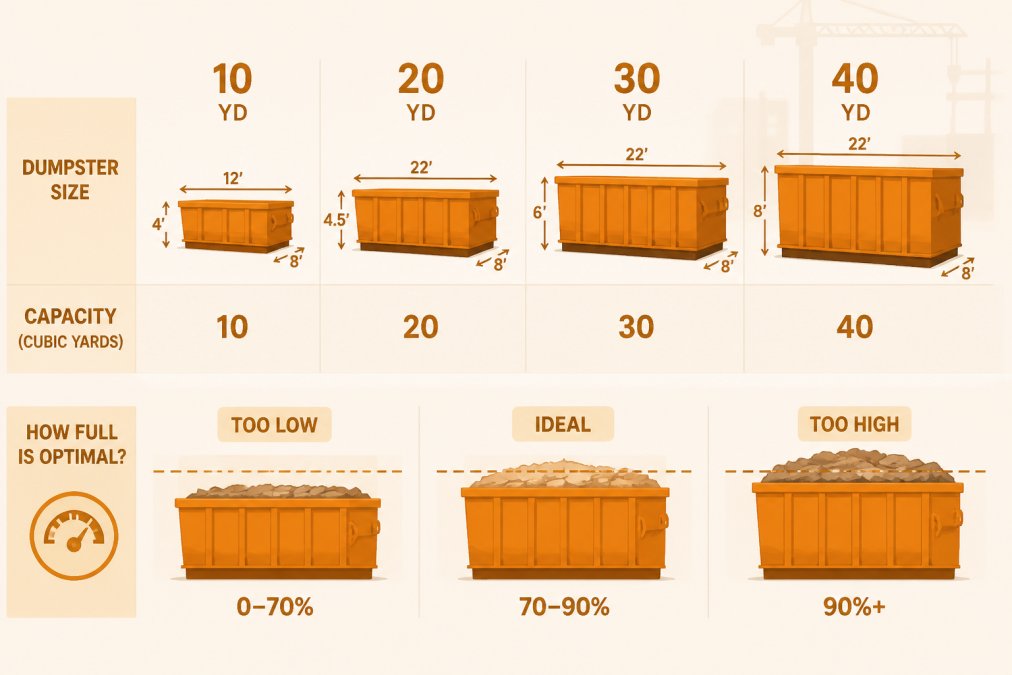
Choosing the right container starts with understanding the cubic yardage you actually need. A 20-yard dumpster suits mid-size renovation projects and roofing tear-offs. A 30-yard unit handles larger commercial builds, while 40-yard containers fit major demolition work. We also offer 20 and 25 yard dumpsters for construction sites that need a dependable mid-range option.
The calculation is straightforward: estimate the volume of debris your project will generate, then add a buffer for unexpected material. For a roof tear-off on a 3,000 square foot home, expect roughly 20 to 25 cubic yards of shingles and underlayment. A full interior demolition of a commercial space typically produces 30 to 40 cubic yards. When in doubt, construction waste estimation guidelines from the EPA suggest breaking the project into phases and sizing containers per phase rather than for the whole job.
How to Load a Roll-Off Dumpster Efficiently
Loading technique determines how much usable space you extract from every container. The goal is to eliminate air pockets and distribute weight evenly across the floor.
Concrete chunks, brick, and asphalt form a stable base layer. Lighter materials like wood framing and drywall go on top, where they can be compressed by subsequent loads. Break down anything that traps air: crush boxes, remove doors from cabinets, and cut long lumber into manageable sections. A 2x4 thrown in whole occupies the same space as one cut into three pieces, but the cut pieces stack flat and leave room for more debris.
Load evenly from front to back and side to side. An uneven load shifts during transport, creating a safety hazard and potentially damaging the truck. Fill the container level to the top rails, never mounding above them, because overfilled dumpsters cannot be legally transported on public roads.
Calculating Debris Density by Material Type
Weight limits often hit before volume limits do, and the only way to predict which limit you will reach first is to understand debris density. Dumpster capacity is governed by both cubic yardage and the load capacity of the hauler's truck, typically 10 tons.
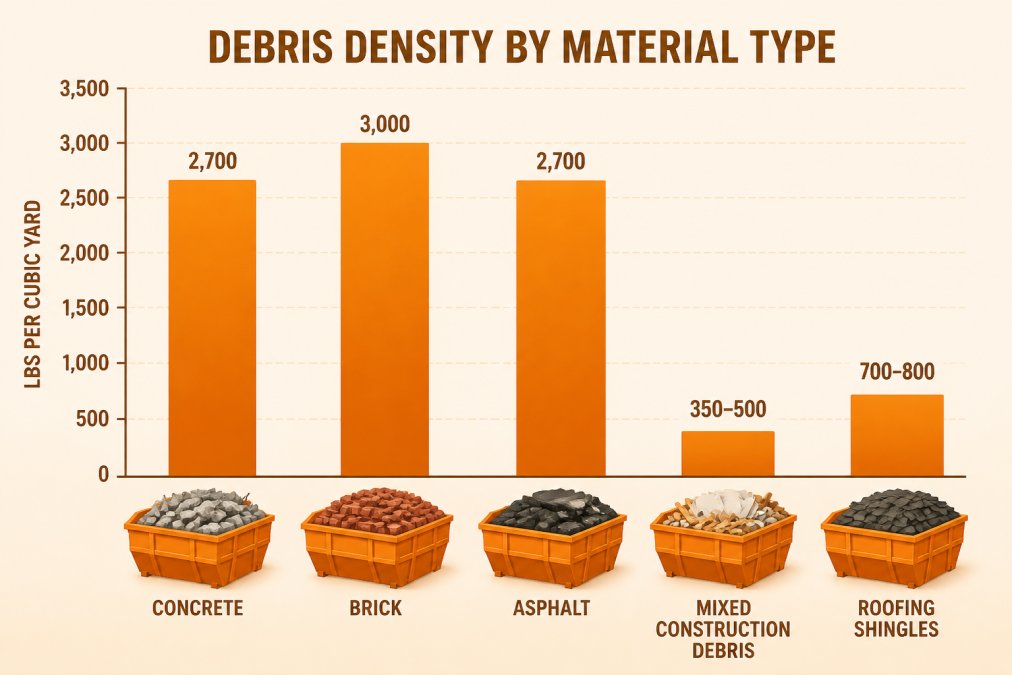
Concrete weighs roughly 2,700 pounds per cubic yard. Brick is heavier at about 3,000 pounds, while asphalt matches concrete at around 2,700 pounds. Roofing shingles are deceptive: a cubic yard weighs between 700 and 800 pounds, but they compact poorly and trap air. Mixed construction debris runs 350 to 500 pounds per cubic yard, which is why general cleanup fills containers slowly by weight.
Weight vs. Volume: Which Limit Hits First?
For heavy demolition work, weight is almost always the binding constraint. A 30-yard dumpster filled with concrete reaches its 10-ton weight limit at roughly seven cubic yards, meaning you pay for 30 yards of space but can only use about a quarter of it. For light renovation debris, volume is the constraint.
This distinction drives container selection. Heavy demolition jobs often justify smaller containers swapped out more frequently, because you are paying for weight, not space. Light framing and packaging jobs benefit from larger containers that maximize the space between weight limits. The Occupational Safety and Health Administration guidance on material handling emphasizes that proper load distribution prevents tipping hazards, which reinforces the need to know your waste density before loading begins.
Strategic Dumpster Placement for Site Logistics
Where the dumpster sits determines how efficiently crews can load it. Place the container within reach of the work zone but clear of material delivery paths, equipment staging areas, and emergency access routes. A dumpster that blocks a crane path wastes hours every day.
For urban and constrained sites, placement gets more complicated. Narrow access points, low overhead wires, and weight limits on driveways all restrict where a roll-off truck can set the container. Check local permit requirements before placement; many municipalities require a permit when a dumpster occupies a public right-of-way. The National Association of Home Builders guide to jobsite logistics recommends mapping the site before the container arrives, identifying the drop zone, the debris accumulation point, and the path between them.
The Unique Challenges of Tight-Access and Urban Sites
Most capacity guides assume an open suburban lot with a straight driveway. Real-world construction, especially renovation work in dense urban corridors, rarely offers that luxury. Consider the physical constraints that dictate where a roll-off truck can even maneuver:
- Turning radius: A standard roll-off truck needs roughly 45 to 50 feet of clearance to make a 90-degree turn. If your site entrance sits at the end of a narrow alley, the truck may not be able to angle in for a drop-off without blocking traffic or risking damage to adjacent structures.
- Overhead obstructions: Low-hanging utility lines, tree canopies, and building overhangs can prevent the truck's lifting arm from raising the container to the vertical position required for placement. Always measure clearance to at least 25 feet above the drop zone.
- Surface load ratings: A fully loaded 30-yard dumpster can weigh upwards of 10 tons. Asphalt driveways and grass medians may not support that weight without cracking or rutting. Plywood spread under the container's rails distributes the load and protects the surface below.
- Street occupancy permits: When the container must sit in a public right-of-way, most municipalities require a street occupancy permit. In many cities, this process takes 5 to 10 business days, so filing early is critical.
Mapping the Debris Flow Path
Beyond physical placement, the internal logistics of moving debris from the work face to the container deserve the same planning as material deliveries. A common pattern on efficient sites is a designated debris accumulation point near the work zone, paired with a clear, unobstructed path to the dumpster. Crews should never carry material through an active work area.
A debris chute routed from an upper floor directly into the dumpster eliminates the need for crews to carry material down stairwells. When a chute is not feasible, staging a smaller collection point on each floor and consolidating during scheduled breaks keeps walkways clear.
Placement Timing and Phase-Based Relocation
A single placement rarely serves an entire project. As the work zone moves, from demolition on one side of the structure to framing on the other, the optimal dumpster location shifts with it. Contractors who schedule a mid-project relocation often recover the cost in reduced carry distances within days.
When planning placement, also consider how the container will be swapped out. The hauler needs clear access to lift the full container and set an empty one. If you stage materials around the dumpster, you may need to clear that area before the swap truck arrives.
On-Site Waste Compaction Benefits for Capacity
The fastest way to multiply dumpster capacity is to reduce the volume of waste before it enters the container. On-site compaction crushes loose debris, eliminating the air that occupies as much as 70 percent of an uncompacted load. For sites generating bulky waste like drywall and insulation, compaction can cut the number of required hauls dramatically.
Instead of paying to haul air, our service brings a crusher to your site and compacts the waste directly in the dumpster. The result is fewer truck trips, less jobsite downtime, and a smaller carbon footprint from reduced hauling miles.
Waste Segregation, Recycling, and Disposal Regulations
Sorting waste on site serves two purposes: it keeps hazardous materials out of standard disposal streams, and it maximizes recycling diversion that can qualify for LEED certification points. Clean wood, metal, cardboard, and concrete are all recyclable when kept separate from mixed debris.
Hazardous waste requires separate handling under federal regulations. Materials like asbestos, lead-based paint, solvents, and certain adhesives cannot go in a standard roll-off dumpster. The Resource Conservation and Recovery Act regulations on hazardous waste define which materials require special disposal and the documentation needed for proper handling. Contractors who mix hazardous materials into general debris face significant fines and potential project delays.
When materials are segregated properly, recycling diversion rates rise. Concrete and brick can be crushed and reused as aggregate. Clean wood becomes mulch or fuel. Metals are almost entirely recyclable.
Building a Diversion Tracking Framework for LEED and ESG Reporting
Commercial contractors increasingly face contractual requirements to report waste diversion rates, not just for LEED certification, but for corporate environmental, social, and governance (ESG) commitments. The LEED v4.1 Building Design and Construction framework offers up to two points for construction and demolition waste management, requiring projects to divert at least 50 percent of waste from landfill. Achieving 75 percent diversion earns the full two points.
The framework that works on large commercial projects follows a simple discipline:
- Establish baseline categories before demolition begins. Identify the major material streams you expect: concrete and masonry, metals, clean wood, gypsum board, cardboard, mixed recyclables, and landfill-bound waste. Assign each a color-coded container or a clearly labeled section of the dumpster.
- Weigh every load. The hauler's scale ticket provides the documentation you need. Insist on itemized weight tickets that break down each stream rather than a single mixed-weight ticket.
- Track against the project's waste management plan. The U.S. Green Building Council LEED credit library provides templates for the construction and demolition waste management plan that many projects adapt for internal tracking.
- Audit monthly. Compare actual diversion rates against the 50 or 75 percent target. If the project is falling short, the monthly audit reveals which stream is being contaminated or under-sorted.
The Economics of Segregation vs. Mixed Debris
Segregation is not free. It costs labor hours, floor space for separate containers, and coordination effort. The offsetting benefit is that recycling disposal fees are often lower than landfill tipping fees, and some scrap metal buyers will pay for clean loads. The decision of how aggressively to segregate should be driven by the local tipping fee differential.
In markets with abundant landfill capacity and low fees, the cost of extra containers and labor may exceed the disposal savings. The calculation changes when LEED points or client ESG requirements are at stake, in those cases, segregation is not optional.
Managing Hazardous Material Discovery
Hazardous materials often surface mid-project, particularly in renovations of buildings constructed before 1980. Asbestos-containing materials, common in floor tiles, pipe insulation, and drywall joint compound, require abatement by licensed professionals before demolition proceeds. Lead-based paint creates similar complications.
Do not attempt to sort hazardous material into a recycling stream. Federal law under RCRA requires proper labeling, manifesting, and disposal at permitted facilities. Mixing even small quantities into a standard dumpster can trigger substantial penalties.
Common Loading Mistakes That Waste Cubic Yardage
Several recurring mistakes reduce usable dumpster capacity and inflate hauling costs. The first is throwing materials in randomly rather than layering by density. The second is failing to break down bulky items, allowing air pockets to consume valuable space. The third is underestimating how quickly heavy materials hit weight limits, resulting in a half-empty container that cannot be hauled.
A container sized for demolition debris will be oversized for the framing phase and undersized for the drywall phase. Planning container swap-outs around project phases prevents both wasted space and premature fills. Finally, many contractors skip compaction entirely, paying for multiple hauls when one compacted load would have handled the same volume. For projects generating significant bulky waste, on-site compaction is the single most effective way to stretch dumpster capacity.
Frequently Asked Questions
How do I know if my dumpster will hit the weight limit or the volume limit first?
Check the density of your dominant material. Heavy materials like concrete, brick, and asphalt typically hit the weight limit before the container is visually full. A 20-yard dumpster holds roughly 10 tons for concrete but only 2-3 tons for mixed debris. Light materials like lumber, drywall, and packaging fill the volume first. Track your hauler's stated weight limit and compare it against the material weights you are loading to predict which limit applies to your project.
How does on-site waste compaction improve dumpster utilization?
On-site compaction reduces loose debris volume by up to 70%, meaning each dumpster holds significantly more material before needing a haul. This cuts the number of truck trips required, reduces disposal fees, and minimizes jobsite downtime waiting for container swap-outs. For projects generating bulky but compressible waste like cardboard, drywall, or packaging, compaction can reduce total hauls by half or more. Mobile compaction services bring the equipment to your site, so no extra handling is needed.
What is the best way to load a roll-off dumpster for maximum capacity?
Start with flat, heavy materials like broken concrete or brick at the bottom to create a stable base. Place bulky items like lumber or drywall next, then fill gaps with smaller debris. Break down larger pieces before tossing them in, and do not stack items above the fill line because haulers will refuse overloaded containers. Keep lighter materials on top and distribute weight evenly to avoid shifting during transport. This layering technique maximizes usable space in every cubic yard.
What are the most common mistakes contractors make with construction dumpsters?
The biggest mistakes are filling the container unevenly, tossing in prohibited items like hazardous waste, and exceeding weight limits. Contractors also waste capacity by failing to break down bulky materials and by mixing recyclables with landfill waste, which increases disposal fees. Another frequent error is poor placement, forcing workers to carry debris long distances or requiring a second container. Plan your dumpster size, placement, and loading strategy before the project starts to avoid these costly problems.
Managing construction waste is a constant balance between volume, weight, and project pace. The contractors who stay on schedule treat dumpster capacity as a planning variable, not an afterthought. Junk Crusher helps Western Pennsylvania construction firms compress their waste stream with mobile on-site compaction, reducing hauling frequency and dumpster fees while keeping jobsites cleaner and safer. Book a Crush to see how fewer, denser hauls can keep your next project on budget and on time.
