
Managing Bulky Cardboard Waste: 7 Ways
Table of Contents
- Why Bulky Cardboard Waste Drains Distribution Center Budgets
- 1. Cardboard Recycling for Businesses: Build a Sorting System That Works
- 2. Flatten Boxes at the Dock to Reduce Storage Volume
- 3. Choose the Right Cardboard Baler for Distribution Centers
- 4. How to Reduce Packaging Waste in Warehouses at the Source
- 5. Commercial Cardboard Waste Collection: Evaluating Haulers and Schedules
- 6. On-Site Compaction: Crush Cardboard Before It Leaves the Dock
- 7. Measure Diversion Rate and Cost per Ton to Prove Results
- Frequently Asked Questions
Last Updated: October 14, 2026
Why Bulky Cardboard Waste Drains Distribution Center Budgets
Bulky cardboard waste is loose, unflattened corrugated material that piles up at receiving docks and packing stations faster than most facilities can move it out. At Junk Crusher, we see the same pattern across distribution centers: cardboard fills roll-off containers within days, haulers charge for air space, and yard capacity disappears.
Cardboard arrives on every inbound truck, a single trailer of packaged goods can generate hundreds of pounds of corrugated material before a single order ships out. Loose material consumes container volume that should belong to actual waste, and compaction changes the math entirely.
Below, we break down seven ways to manage bulky cardboard waste in distribution centers, from dock-level sorting to measuring your savings.
1. Cardboard Recycling for Businesses: Build a Sorting System That Works
Cardboard recycling for businesses starts with one rule: keep corrugated cardboard separate from everything else. Mixed streams destroy recovery value and often get rejected at the recycling center.
Separate Corrugated Cardboard from Other Waste Streams
Corrugated cardboard, the fluted material used in shipping boxes, has real recovery value. Stretch wrap, polystyrene foam, and packing peanuts do not belong in the same container. When they mix, the whole load can be downgraded or landfilled.
A workable sorting system at a distribution center usually includes:
- Dedicated corrugated-only containers at each dock door
- Separate bins for stretch wrap and plastic film
- Clearly labeled stations so temporary labor sorts correctly
Sorting discipline matters more than equipment: a facility with three well-placed, clearly marked containers will outperform one with expensive equipment and no process.
Keep Cardboard Clean and Dry to Protect Recovery Value
Wet or contaminated cardboard loses recovery value immediately. Moisture weakens fiber strength, and food residue or oil creates problems at the mill. A simple roof over your outdoor cardboard container prevents most of this, but small issues, a leaking dock seal, a container without a lid, a bin under a roof drain, can ruin a week of sorting effort. Inspect storage points monthly and fix leaks before they cost you a load.
U.S. EPA guidance on recycling and waste management
2. Flatten Boxes at the Dock to Reduce Storage Volume
Flattening boxes at the dock is the cheapest volume reduction step available. A flattened box takes up a fraction of the space of an assembled one, and the labor cost is minimal.
The workflow is straightforward. As boxes are emptied at receiving or packing, workers break them down immediately rather than stacking them whole. RoadRunner Recycling's guidance on breaking down cardboard recommends flattening boxes to make better use of recycling container space, and that principle applies at any scale.
Where facilities go wrong is timing. If boxes pile up whole and get flattened later, you need double the floor space and double the handling. Flatten at the point of generation, not at the end of the shift.
3. Choose the Right Cardboard Baler for Distribution Centers
A cardboard baler for distribution centers turns loose corrugated material into dense, stackable bales, changing storage, transport, and the price your material commands. Baler selection comes down to four variables: throughput, floor space, labor, and bale handling. Vertical balers suit lower-volume facilities and take up less room. Horizontal balers handle continuous, high-volume streams and produce denser bales, but need more space and automation.
Matching Baler Throughput to Your Shipping Volume
Throughput is measured in pounds per hour, and mismatching it is the most common and expensive mistake: an undersized baler bottlenecks the dock, while an oversized one sits idle and ties up capital. To size a baler, weigh the corrugated from one representative shift, multiply by shifts per day, then by your peak season multiplier. Most vertical balers process roughly 100 to 300 pounds per hour depending on model and operator; horizontal balers can exceed 1,000 pounds per hour but require a conveyor or feed system.
| Facility Profile | Typical Baler Type | Handling Approach | Best For |
|---|---|---|---|
| Low volume, limited floor space | Vertical baler | Manual feed, batch cycles | Small warehouses, seasonal peaks |
| Moderate, steady volume | Vertical or small horizontal | Scheduled baling shifts | Regional distribution centers |
| High, continuous volume | Horizontal baler | Automated feed, conveyor integration | Large-scale logistics operations |
Safety and Ergonomics Around Baling Equipment
Baling equipment introduces hazards general waste guides ignore. Operators need training on lockout/tagout, safe feed techniques, and wire tie handling. Blocked egress is a common violation, a baler too close to a fire exit or electrical panel creates a citation risk, and loose cardboard should not accumulate near ignition sources.
A practical safety checklist for baler areas:
- Keep at least 36 inches of clearance around the baler and all exits
- Train every operator on emergency stop locations and lockout/tagout
- Store bales away from sprinkler heads and electrical panels
Bale Handling and Storage
Once baled, material must move, a bale sitting on the dock blocks shipping lanes. Plan a staging area that holds at least one full trailer load of bales, and coordinate bale pickup separately from loose cardboard collection.
Orwak's discussion of compacting sorted corrugated cardboard notes that compacted material is easier and more cost-effective to transport than loose cardboard, which is the core argument for baling at the source rather than shipping air.
4. How to Reduce Packaging Waste in Warehouses at the Source
Knowing how to reduce packaging waste in warehouses means working upstream with suppliers, not just downstream with your hauler. Start with a packaging audit: track what arrives, how it's packed, and how much void fill you're throwing away.
Practical source reduction steps:
- Ask suppliers to ship in right-sized cartons instead of oversized boxes with filler
- Request minimal adhesives and tape so boxes break down faster
- Consolidate inbound shipments to reduce the number of cartons per order
Every carton you never receive is a carton you never handle, store, bale, or haul. Source reduction is the only method on this list that eliminates cost instead of shifting it.
5. Commercial Cardboard Waste Collection: Evaluating Haulers and Schedules
Commercial cardboard waste collection works best when the schedule matches your actual generation rate, not a default contract term. Most facilities overpay because pickup frequency was set once and never revisited. Evaluating a hauler requires a framework connecting service levels to your operational reality.
Build a Vendor Scorecard
Before you sign or renew, score each hauler on five criteria. This turns a subjective choice into a comparable decision.
- Service frequency flexibility, Can pickup frequency adjust seasonally without a contract change? A hauler who locks you into a fixed schedule will either miss pickups or charge overage fees.
- Container size and supply, What container sizes are available, and who supplies and maintains them? For bulky cardboard, 20 and 25 yard roll-off containers are common starting points.
- Accepted grades and contamination rules, What exactly do they accept? Clean corrugated only, or mixed recyclables? Ask for their contamination penalty schedule in writing.
- Reporting and weight tickets, Will you receive weight tickets for every haul? Without this data, you cannot calculate cost per ton or prove program results.
- Service reliability and response time, What is the guaranteed response time for missed pickups or container swaps? A hauler who takes three days to replace a full container costs you dock space and labor.
Questions to Ask Before Signing
- Can pickup frequency adjust seasonally without a contract change?
- What container sizes are available, and who supplies them?
- How are contaminated loads handled and billed?
- Will you provide weight tickets and diversion reports?
- What is the process for adding locations to the account?
- What is the notice period for canceling or renegotiating?
Aligning Pickup Schedules with Dock Operations
A pickup schedule that conflicts with receiving hours creates friction, if the hauler arrives during your busiest dock window, your team stops shipping to move containers. Schedule pickups during low-activity periods, or designate a staging area where full containers can wait without blocking traffic.
For multi-site operations, standardizing container sizes and pickup windows across locations simplifies training and gives you more leverage in contract negotiations. Waste Harmonics on multi-site cardboard recycling programs highlights that standardized programs across locations help control service costs and provide consistent reporting, which matters if you operate more than one facility.
When to Renegotiate
Review your hauler agreement every six months. If diversion is climbing and containers fill slower, you may be paying for pickups you no longer need; if volume has grown, you may need more containers or service. The goal is a schedule matching actual generation.
6. On-Site Compaction: Crush Cardboard Before It Leaves the Dock
On-site compaction crushes cardboard and mixed waste inside the container before it leaves your yard, so you haul dense, compacted loads instead of loose material and empty space. A mobile compaction service arrives on-site, crushes the contents of your roll-off container, and leaves. The container holds far more material, so it fills slower and gets hauled less often. Junk Crusher's mobile service reduces roll-off dumpster volume by up to 70%, which directly cuts the number of hauls required.
How Mobile Dumpster Compacting Fits a Distribution Center Workflow
The process is designed around your dock schedule: a compaction visit takes a fraction of a shift and doesn't require your team to stop receiving or shipping. For facilities already running a baler for clean corrugated, compaction handles the mixed and bulky material that baling can't process. Baling maximizes recovery value on clean cardboard; compaction reduces hauling frequency on everything else.
If you need additional container capacity while you sort out your compaction schedule, our dumpster rental service covers 20 and 25 yard roll-off containers.
7. Measure Diversion Rate and Cost per Ton to Prove Results
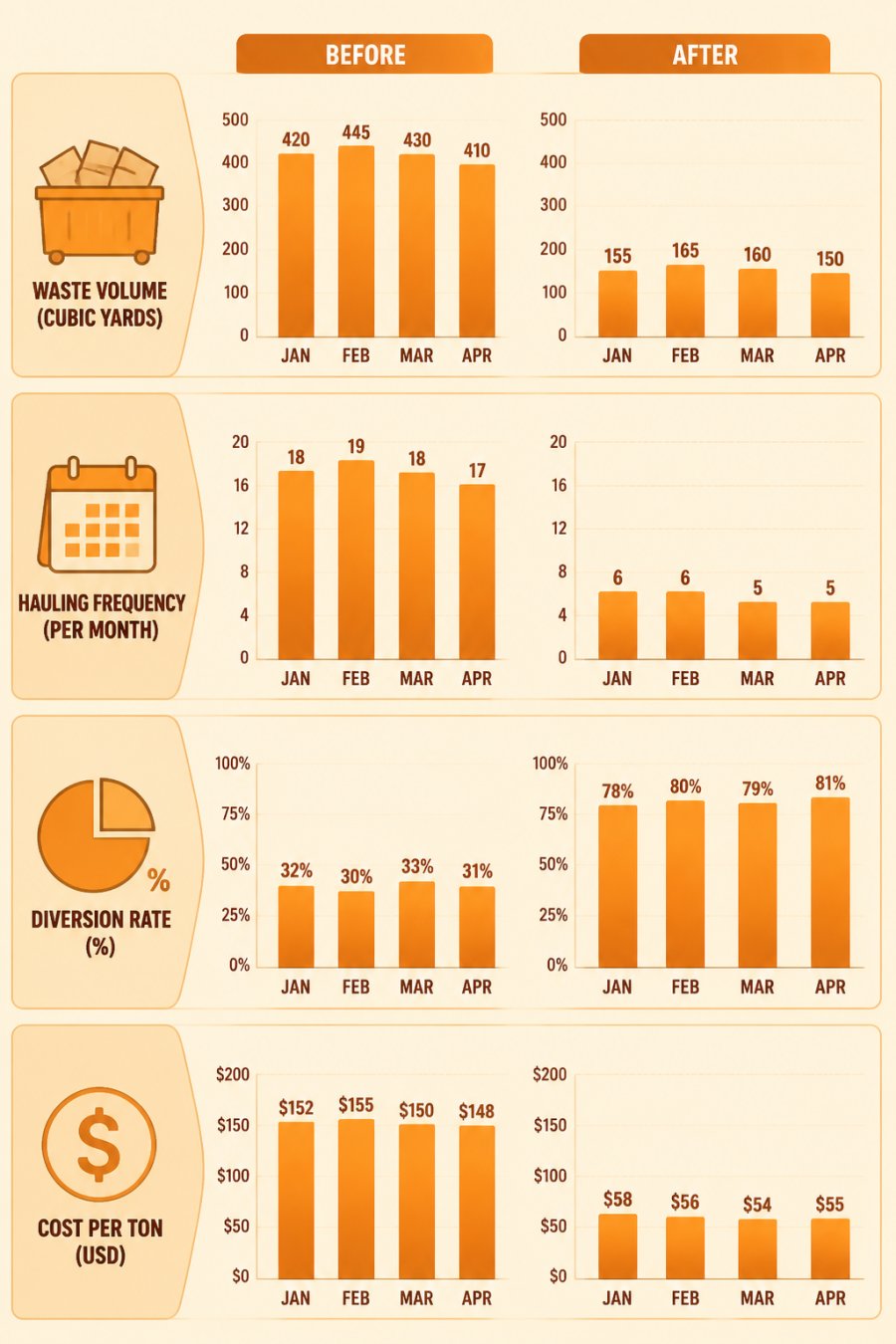
(https://dyrt.co/posts/7-proven-strategies-to-reduce-waste-disposal-costs-in-2026) recommends weighing and photographing waste during a representative week and comparing cost per ton across locations, which gives you a defensible baseline before you change anything.Cardboard volume at a distribution center never stops arriving, but the cost of handling it is a choice. Junk Crusher provides mobile dumpster compacting built for distribution centers, with on-site crushing that reduces roll-off volume by up to 70% and cuts dumpster fees by up to 56%.
Frequently Asked Questions
How can a distribution center get rid of large amounts of cardboard?
Start by flattening boxes at the dock and separating corrugated cardboard from other waste streams. For high volumes, a baler or on-site dumpster compaction service reduces the space cardboard occupies before hauling. Many facilities combine a baler for clean corrugated with a compactor for mixed bulky waste. Then schedule bulk collection based on your actual generation rate, not a fixed calendar. The goal is to stop paying to haul empty space.
When should a distribution center use a cardboard baler or dumpster compactor?
A baler makes sense when you generate consistent volumes of clean, dry corrugated cardboard and want to sell or recycle it as bales. A dumpster compactor works better for mixed bulky waste, including cardboard that is contaminated or combined with other materials. If your yard space is tight and you need to reduce hauling frequency across multiple waste types, on-site compaction can cut roll-off volume significantly. Match the equipment to your material condition and throughput.
Should cardboard be flattened before recycling?
Yes. Flattening boxes maximizes the capacity of every recycling container and reduces the number of pickups you need. It also keeps cardboard from jamming baler feed mechanisms and makes bales denser. The simplest approach is to assign a flattening station near the receiving dock where boxes are opened. A box cutter handles most corrugated quickly. RoadRunner Recycling demonstrates this method as a basic step for optimizing container space.
How can distribution centers keep cardboard waste from creating safety hazards?
Loose cardboard stacks block aisles, hide spills, and create fire load. Keep collection bins near high-traffic receiving areas so cardboard does not pile up on the floor. Empty bins on a fixed schedule rather than when they overflow. If you store bales or bulky cardboard before pickup, designate a marked staging zone away from forklift paths and emergency exits.


