Sustainable Waste Management Alternatives for Businesses
Table of Contents
- Why Sustainable Waste Management Alternatives Pay Off
- Start With Waste Audits for Businesses
- Commercial Waste Reduction Strategies That Cut Volume First
- Building Business Recycling Programs That Survive Contamination
- Waste Compaction for Businesses: The Volume Lever
- Comparing Waste Management Alternatives by Business Type
- Implementation Roadmap: From Audit to Measurable Results
- Frequently Asked Questions
Last Updated: October 18, 2026
Why Sustainable Waste Management Alternatives Pay Off
Sustainable waste management is the practice of reducing, reusing, recycling, and compacting business waste so fewer materials reach a landfill. Every trip a truck makes to carry air and empty space costs the same as a trip carrying a full load.
Most operations managers treat waste as a fixed cost. It isn't. The volume in your roll-off dumpster is a variable you can control, and controlling it changes what you pay each month.
That is the throughline of this guide: the cheapest ton of waste is the one you never pay to haul. Below, we walk through the alternatives that actually move that number, from waste audits to on-site compaction, and how to choose among them by business type.
Start With Waste Audits for Businesses
A waste audit is a structured review of what your operation throws away, in what quantity, and where it comes from. Waste audits for businesses turn guesswork into a baseline you can measure against later.
Here is how a waste audit is typically run:
- Pick a representative week, not a slow one.
- Separate waste by stream: general refuse, cardboard and paper, metal, organics, hazardous waste.
- Weigh or estimate volume per stream, per shift or per production line.
- Note where each stream is generated and who handles it.
- Photograph the dumpster at pickup so you know how full it actually is.
That last step surprises people. Many facilities pay for hauls on a fixed schedule while their dumpster sits half empty. You cannot fix a cost you have never measured.
Commercial Waste Reduction Strategies That Cut Volume First
Commercial waste reduction strategies attack volume at the source, before anything reaches a dumpster. Prevention is cheaper than handling, and it is the first tier of any credible waste plan.
Start with disposable packaging and single-use items. Ask suppliers to ship in returnable containers or to reduce overboxing. In offices, paperless operations cut a surprising share of the general waste stream.
Then look at process scrap. Manufacturing plants often generate offcuts and reject parts that can be reworked or sold rather than landfilled. Construction firms can order materials to dimension where the supplier allows it.
Reuse and repurposing come next. Pallets, crates, and drums frequently have a second life internally or with a local buyer. A common mistake is skipping this tier and jumping straight to recycling, which captures less value.
Building Business Recycling Programs That Survive Contamination
Business recycling programs fail for one reason: contamination. When the wrong items land in a recycling container, whole loads get rejected, and your program quietly costs more than it saves.
Contamination rate is the share of material in a recycling stream that does not belong there. Keep it low with three habits:
- Label containers clearly and in the languages your crew reads.
- Place recycling points where the material is generated, not in a distant corner.
- Train new hires during onboarding, not once a year.
Waste sorting at the source beats sorting at the end of the line. If your team separates cardboard, metal, and general refuse at the point of disposal, recyclable materials stay clean and actually get recycled.
Check with your hauler about which materials they accept. Local rules vary, and a stream your hauler cannot process is not recycling, it is contamination waiting to happen.
Waste Compaction for Businesses: The Volume Lever
Waste compaction for businesses is the practice of crushing waste on site so more material fits in each container. It is the highest-use alternative on this list because it cuts haul frequency without changing what your team throws away.
Traditional compaction means a stationary compactor bolted to a pad. Mobile on-site dumpster compaction works differently: a truck-mounted crusher compacts the contents of your existing roll-off dumpster in place. Our mobile service reduces roll-off dumpster volume by up to 70%, which means fewer hauls for the same amount of material.
The operational benefits stack up:
- Fewer truck trips, which lowers fuel use and carbon emissions.
- Less jobsite downtime waiting on swaps.
- More usable yard space at distribution centers.
- Lower dumpster fees because you stop paying to haul empty space.
U.S. EPA guidance on reducing commercial waste reinforces the same principle: source reduction and volume reduction come before disposal in any waste hierarchy.
Comparing Waste Management Alternatives by Business Type
The right alternative depends on your waste stream, not on what worked for someone else. This decision matrix compares the main alternatives across the criteria that actually drive a purchase decision: relative cost, diversion potential, contamination risk, implementation effort, and best-fit business types. Use it to shortlist two or three options before you run a pilot.
| Alternative | Relative cost | Diversion potential | Contamination risk | Implementation effort | Best-fit business types |
|---|---|---|---|---|---|
| Waste audit | Low (staff time) | Enables all others | None | Low | All |
| Source reduction (packaging, paperless) | Low to moderate | High | Low | Moderate | Offices, manufacturing, distribution |
| Reuse and repurposing | Low | High | Low | Moderate | Construction, distribution, manufacturing |
| Recycling program | Moderate | Moderate to high | High if unsorted | Moderate | Distribution, offices, manufacturing |
| Composting | Moderate | Moderate | Moderate (organics) | Moderate | Offices, food service |
| On-site compaction | Moderate to high (equipment) | Low (volume only) | Low if screened | Low to moderate | Construction, roofing, distribution, manufacturing |
| Smart waste technology | Moderate to high | Indirect | Low | Moderate to high | Large multi-site operations |
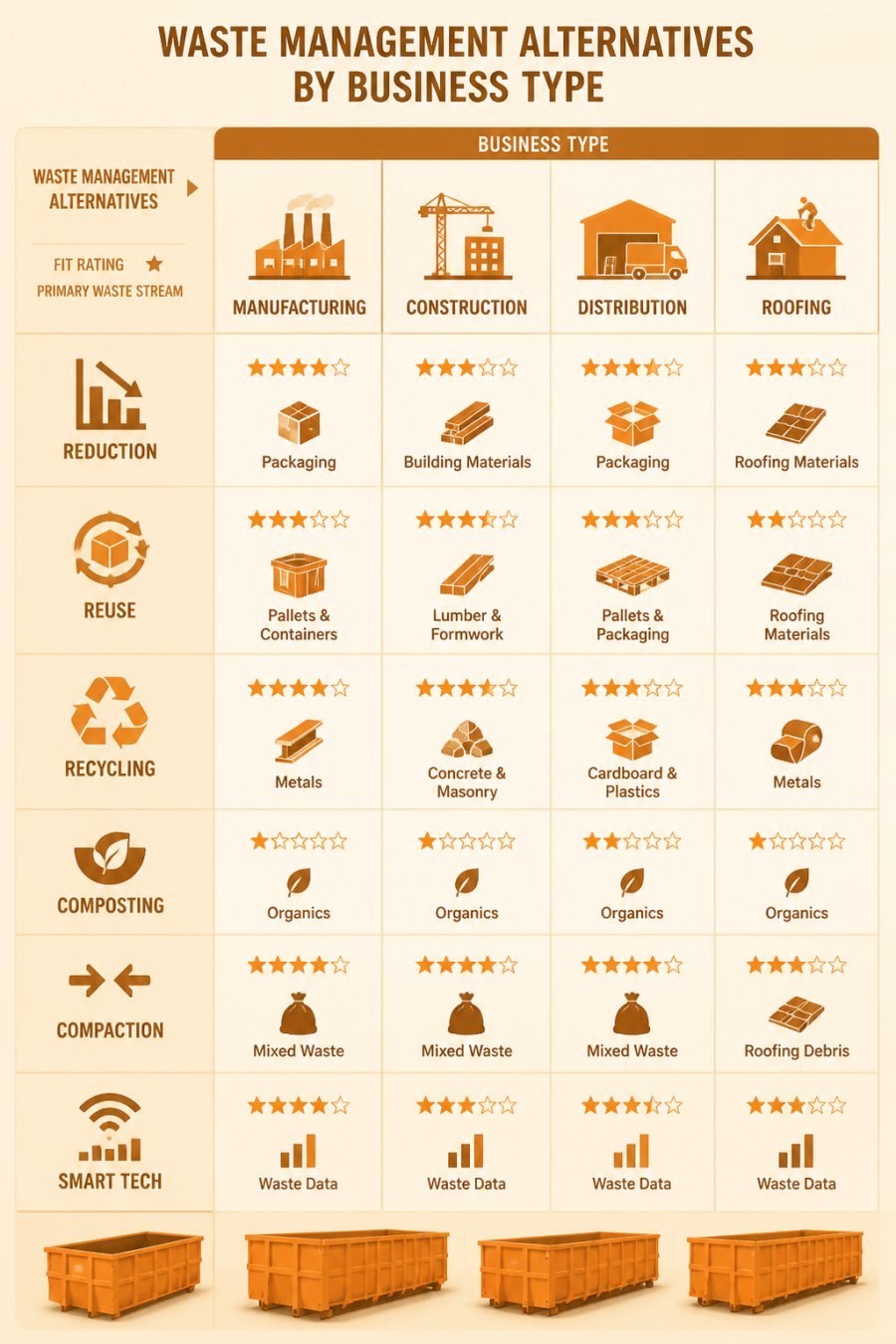
How to read the matrix. Cost is relative, not a quote, equipment, hauling, and labor vary by market and contract. Diversion potential reflects how much material can realistically leave the landfill. Contamination risk is the chance a stream gets rejected. Implementation effort covers setup, training, and ongoing management.
Manufacturing plants generate process scrap, packaging, and general refuse. A waste audit followed by source reduction and on-site compaction usually delivers the fastest return because heavy debris compacts well and haul frequency drops quickly.
Construction sites produce debris, shingles, and dimensional lumber. Compaction and reuse work well here; recycling depends on local processing capacity for mixed debris.
Distribution centers are dominated by cardboard, pallets, and shrink wrap. A clean recycling program plus compaction handles the volume, and pallet reuse often pays for itself.
Roofing contractors deal with shingles and tear-off debris. Compaction is the primary lever; recycling shingles requires a local processor that accepts them.
Offices and professional services generate paper, food waste, and general refuse. Paperless operations and composting do more of the work than compaction, which has less volume to crush.
For high-volume, heavy-debris operations, compaction usually delivers the fastest return. For offices, prevention and composting do more of the work. Most facilities benefit from combining two or three alternatives rather than picking one. A common pattern is to pair a waste audit with compaction first, then layer in recycling once sorting habits are stable.
Implementation Roadmap: From Audit to Measurable Results
A waste program succeeds or fails on sequencing and ownership. Here is a roadmap often recommended, with clear checkpoints, piloting guidance, and change-management steps at each stage.
- Audit (weeks 1-2). Establish your baseline volume and cost per stream. Pick a representative week, separate by stream, weigh or estimate volume, and photograph the dumpster at pickup. Output: a baseline table of volume, haul frequency, and cost per stream.
- Reduce (weeks 3-6). Cut disposable packaging, single-use items, and process scrap at the source. Ask suppliers about returnable containers and reduced overboxing. Output: a short list of source-reduction changes with owners and dates.
- Sort (weeks 4-8). Set up labeled stations where material is generated, not in a distant corner. Train staff during onboarding and at shift huddles. Output: station map and a one-page sorting guide in the languages your crew reads.
- Compact (weeks 6-10). Add on-site compaction to stretch each dumpster load. Screen loads for hazardous waste and liquids before crushing. Output: a compaction schedule tied to pickup days.
- Measure (ongoing). Track haul frequency, contamination rate, and diversion rate monthly. Share results with the crew. Output: a one-page monthly scorecard.
Pilot before you scale. Run the new sorting or compaction routine on one shift, one production line, or one jobsite for two to four weeks. Compare haul frequency and contamination against your baseline. If the pilot holds, expand to the next area. Piloting limits risk and gives you real numbers to justify equipment spend.
Change management matters as much as equipment. Name one person accountable for the program, not a committee. Give that person authority to adjust collection points and schedules. Train supervisors first so they can reinforce habits on the floor. Post results where the crew can see them; visible progress sustains participation better than memos.
Ownership and reporting. Assign a program owner, a backup, and a monthly review meeting. Keep a simple log of hauls, contamination incidents, and cost changes. OSHA guidance on workplace safety for waste handling is worth reviewing before you reconfigure collection points, especially where compactors or new stations change traffic flow.
Benchmarks to watch. Haul frequency per month, contamination rate, diversion rate, and cost per ton. If hauls drop while diversion holds steady, the program is working. If contamination rises, pause expansion and retrain before adding volume.
Frequently Asked Questions
How can a business reduce the amount of waste it sends to a landfill?
Work through the hierarchy in order: prevent waste through procurement changes, reuse what you can, recycle clean sorted streams, then compact what remains so fewer hauls leave the site. A waste audit tells you which stream is largest. On construction and manufacturing sites, compaction often delivers the fastest volume reduction because it shrinks what is already going to landfill while recycling and reduction programs mature.
How can businesses reduce waste hauling frequency?
Hauling frequency tracks volume, so cut volume before negotiating schedules. Waste compaction for businesses reduces roll-off dumpster volume by up to 70 percent, which means fewer pickups for the same amount of material. Pair compaction with waste sorting so recyclables stay out of the landfill container. Then ask your hauler to right-size service to actual measured volume rather than historical estimates.
What waste management practices work best for manufacturing facilities?
Manufacturing sites usually benefit from a waste audit first, then separation of scrap, cardboard, and packaging at the point of generation. Compaction handles bulky packaging and mixed debris efficiently. Track contamination rate in recycling containers monthly, because one greasy cardboard load can spoil a whole stream. Set collection frequency from measured volume, not habit, and review haul invoices against actual container fill levels.
How can a business decide whether to compact, recycle, or reuse its waste?
Match the method to the material and the cost driver. Reuse wins when items have remaining value, like pallets or crates. Recycling works when material is clean, sorted, and accepted locally. Compaction wins when waste is bulky, mixed, and destined for landfill, because it cuts haul count without sorting labor. Many facilities run all three: reuse first, recycle clean streams, compact the remainder.


