
Reduce Dumpster Rental Overhead: Small Sites Guide
Table of Contents
- Why Dumpster Rental Overhead Drains Small Construction Budgets
- Calculating Dumpster Rental Frequency for Your Project Timeline
- Construction Waste Management Best Practices That Lower Haul Counts
- On-Site Waste Compaction Benefits for Small Construction Sites
- Avoiding Overweight Fees and Contamination Fees at the Disposal Facility
- Negotiating Hauling Services and Rental Agreements With Your Hauler
- Tracking Disposal Costs as a Line Item in Your Project Budget
- Conclusion: Building a Repeatable Waste Strategy
- Frequently Asked Questions
Last Updated: October 4, 2026
Why Dumpster Rental Overhead Drains Small Construction Budgets
Dumpster rental overhead is the total cost of hauling, tipping, and renting waste containers on a jobsite, including the fees you pay for air space. On small construction sites, that overhead eats profit fast because every roll-off dumpster you rent gets picked up whether it is full or not.
Here is the part most crews miss: you are often billed for the empty space inside the container. A 20-yard dumpster filled with loose shingles and drywall might only hold a few tons of material before it hits its weight limit.
At Junk Crusher, we see this on roofing and renovation jobs across Western Pennsylvania every week. The fix is not renting more dumpsters. It is getting more material into each one.
Below, we break down how to reduce dumpster rental overhead for small construction sites using better volume estimation, smarter loading, and on-site compaction.
Calculating Dumpster Rental Frequency for Your Project Timeline
Dumpster rental frequency is the number of times a container is swapped or hauled away over the life of a project. Get this number wrong and you either pay for extra hauls or stall your crew waiting on an empty can.
Start with your project timeline, then work backward. A two-week roofing job needs a different pickup schedule than a three-month renovation.
Use this simple formula:
Total waste volume ÷ usable dumpster capacity = number of hauls needed
The catch is "usable capacity." A roll-off dumpster has both a volume limit (cubic yards) and a weight limit (tons). You hit whichever comes first. Heavy debris like shingles and concrete fills by weight long before it fills by volume.
Waste Volume Estimation by Trade and Phase
Waste volume estimation means predicting how much debris each trade will generate before the job starts. Most small-site overruns come from guessing instead of estimating.
Break your project into phases and assign waste to each:
- Demolition: heaviest volume, fastest fill rate
- Framing: long lumber offcuts, bulky but light
- Drywall: dusty, compacts well, moderate weight
- Roofing: dense shingles, hits weight limits fast
- Finishing: packaging, cardboard, small offcuts
A common mistake is treating all debris the same. Shingles and cardboard behave nothing alike in a dumpster. Plan separate containers or separate pickups for each.
EPA guidance on construction and demolition debris management
Construction Waste Management Best Practices That Lower Haul Counts
Construction waste management best practices are the daily habits that keep containers from filling too fast. They cost nothing and cut hauls immediately.
The biggest win is keeping material loose and level. Debris piled in a mound leaves huge gaps of air. Spread flat and you fit far more per load.
Try these habits on your next job:
- Break down cardboard boxes before tossing them
- Stack lumber offcuts flat, not in a heap
- Keep heavy material at the bottom, light on top
- Assign one person to manage the dumpster each day
- Never let trash bags fill the can when loose debris could go in first
Waste Segregation and Material Recycling on Tight Sites
Waste segregation means sorting debris into separate streams, like metal, wood, and cardboard, instead of dumping everything together. On a tight site, this feels impossible. It is not.
Set up a small sorting zone near the dumpster. Use three or four labeled bins or a divided area. Metal and cardboard have recycling value, and separating them keeps your main container free for true waste.
Material recycling also cuts weight. Pull the heavy metal out and your dumpster holds more before hitting its limit.
On-Site Waste Compaction Benefits for Small Construction Sites
On-site waste compaction benefits small sites most because it attacks the root problem: air. Compaction crushes the empty space out of debris so each dumpster holds far more material.
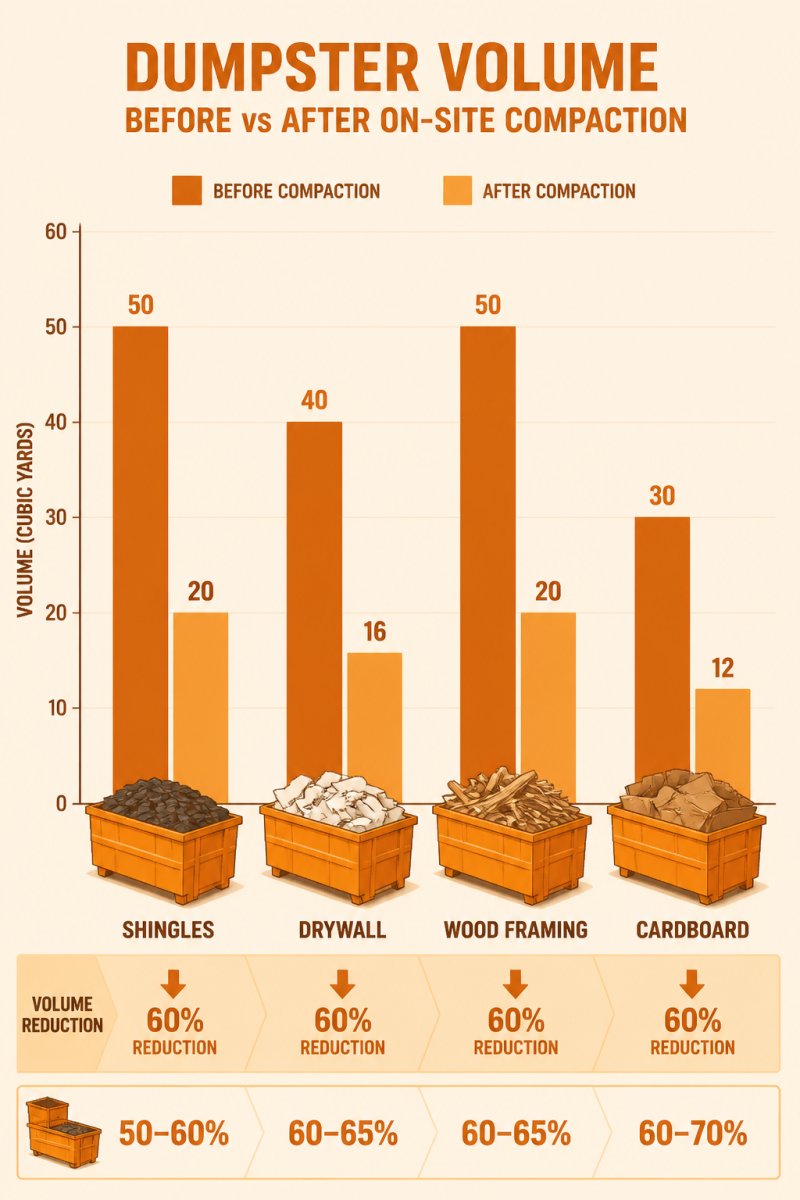
That means fewer hauls, fewer pickups, and less money spent on hauling air.
For a small site with limited space, compaction also reduces the number of containers you need on the ground. One compacted dumpster can replace two or three loose ones.
How Compaction Changes Load Capacity and Haul Frequency
Compaction changes load capacity by letting you pack more material into the same container volume. When capacity goes up, haul frequency goes down.
Here is the math in plain terms:
- A loose dumpster fills in a few days
- The same dumpster, compacted, lasts much longer
- Fewer swaps mean fewer hauling charges
- Fewer hauls mean less crew downtime waiting on cans
The trade-off is weight. Compacting heavy debris like shingles can push you toward the weight limit faster, so watch the tonnage, not just the volume.
Junk Crusher's mobile compaction service crushes dumpster waste on site, which can cut roll-off volume by up to 70% and reduce the number of required hauls. That is how you stop paying to ship empty space.
Avoiding Overweight Fees and Contamination Fees at the Disposal Facility
Overweight fees are charges added when your dumpster exceeds its weight limit. Contamination fees hit when non-approved material ends up in the load. Both are avoidable.
Overweight fees usually cost more than the base haul. A single overloaded shingle container can wipe out your savings for the week.
To avoid them:
- Know your container's weight limit before you fill it
- Weigh heavy loads when you can
- Keep concrete and dirt in their own container
- Never mix hazardous material with general debris
Contamination fees come from mixing the wrong items. Paint cans, solvents, and treated wood can turn a cheap load into an expensive one. Keep hazardous and non-hazardous material strictly separate.
OSHA construction industry resources on jobsite safety and waste handling
Negotiating Hauling Services and Rental Agreements With Your Hauler
Hauling services and rental agreements are where small sites quietly overspend. Most crews sign the first contract, then never revisit it. The gap competitors miss is that haulers price on route density and asset turns, not on your project size.
Start by understanding what you are actually paying for. A roll-off invoice usually bundles four things: the container rental, the haul, the tipping fee at the disposal facility, and surcharges. Surcharges are the soft spot.
Levers worth pulling, in order of impact:
- Route density. If you have multiple small jobs in the same area, ask to have them serviced on the same day. Haulers save on drive time and fuel, and that savings is the easiest discount to justify.
- Scheduled service instead of on-call. A standing weekly or biweekly pickup lets the hauler plan capacity. Ask for a per-haul rate that is locked for the contract term rather than a spot rate that floats.
- Flat fuel surcharge. Ask for a fixed surcharge or a capped percentage tied to a published index, not an open-ended pass-through. An uncapped fuel clause is the single most common way a small site loses its disposal budget.
- Delivery and pickup fees. On repeat rentals, ask for these to be waived or bundled into the haul rate. They are often pure margin on the hauler's side.
- Overweight definition. Get the tonnage allowance per container in writing, plus the per-ton overage rate. "Overweight" means nothing if the contract does not state the included tonnage.
- Contamination terms. Ask what triggers a contamination fee and whether you get a chance to remove the offending material before the load is rejected. Some haulers will let you pull a rejected load and re-haul it; others charge full freight both ways.
A common pattern is to ask for a short trial term, such as 60 or 90 days, with a locked rate and a defined scope.
Get everything in writing, including the surcharge schedule and the overweight definition. A verbal "we'll work with you" means nothing when the invoice arrives.
Tracking Disposal Costs as a Line Item in Your Project Budget
Disposal costs belong in your project budget as their own line, not buried in "general conditions." If you cannot see the number, you cannot cut it.
Track these separately on every job:
- Rental fees per container
- Hauling charges per pickup
- Tipping fees at the disposal facility
- Overweight and contamination penalties
- Any surcharges that appear on the invoice
Then convert the total into a unit rate. The two most useful are cost per cubic yard of debris removed and cost per ton disposed.
A simple tracking routine that works on a small site:
- Log every pickup the day it happens, with the container size, the material type, and the invoice number.
- Note the weight ticket if the hauler provides one. Many do, and it is the only way to know your real cost per ton.
- Update a running total weekly, not monthly. Weekly keeps the number close enough to act on.
- Compare the running total to your original estimate at each phase change, such as demo to framing to finish.
Digital waste tracking tools make this easier than a paper log.
One more angle worth checking: some disposal and recycling costs carry tax implications. Talk to your accountant about how to categorize waste disposal as a deductible overhead expense and whether any recycling revenue needs to be reported.
IRS resources on business expense deductions
Conclusion: Building a Repeatable Waste Strategy
Every small site runs into the same wall: waste costs creep up because nobody owns the number. The crews that win treat dumpster rental overhead as a managed line item, not a surprise invoice.
You do not need a bigger budget. You need fewer hauls, tighter sorting, and a container that actually holds what you put in it.
That is where Junk Crusher comes in. Our mobile on-site compaction crushes dumpster waste where it sits, cutting roll-off volume by up to 70% and trimming the number of hauls you pay for. We also offer 20 and 25 yard dumpsters for jobs that need the right container from day one.
Book a Crush with Junk Crusher and turn your waste line from a leak into a saving.
Frequently Asked Questions
How can contractors accurately estimate dumpster volume needs for a small construction site?
Start with a per-trade estimate: framing generates roughly 1 cubic yard per 1,000 square feet, drywall adds another 0.5 to 1 cubic yard, and roofing shingles fill a 20-yard container fast because of weight. Walk the site before each phase, note the heaviest debris streams, and match container size to the densest material rather than total volume. Track actual fill levels for two or three jobs to calibrate future estimates.
What are the benefits of on-site waste compaction for small projects?
On-site compaction crushes bulky debris like shingles, cardboard, and wood framing inside the container, reducing roll-off dumpster volume by up to 70 percent. Fewer hauls mean lower disposal costs, less site disruption, and fewer truck trips. For small sites with limited staging space, compaction also extends the time between swaps, which cuts rental duration and keeps the crew focused on production instead of coordinating pickups.
How does waste segregation impact dumpster rental frequency?
Separating recyclable material like clean cardboard, metal, and concrete from mixed debris lets you send each stream to the right disposal facility. Recycling-heavy loads often avoid contamination fees and can reduce the number of mixed-waste hauls. On small sites, even two containers (one for recyclables, one for trash) can meaningfully cut the total number of roll-offs per project and lower tipping fees at the disposal facility.
Is it more cost-effective to use multiple small dumpsters or one large container?
One large container usually wins when debris is bulky but light, because you pay for the haul, not the air. Multiple small dumpsters make sense when materials are heavy, like concrete or shingles, since you avoid overweight fees. Many contractors combine both: a 20 or 25 yard dumpster for mixed debris plus a separate container for heavy material, then use on-site compaction to stretch capacity on the bulky stream.


