

How Can Construction Teams Improve Labor Efficiency?
Quick Summary
Construction teams can improve labor efficiency by measuring productivity weekly against installed quantities, keeping schedules reliable with look-ahead plans, organizing the site to cut wasted movement, and planning debris handling into the crew plan. Each change should be tracked against the team's own historical benchmarks.
- Track labor hours against installed quantities every week, by trade and work package.
- Calculate unit labor hours to compare performance across projects and crews.
- Review a two-to-four week look-ahead plan with foremen to confirm materials and access.
- Place dumpsters so haulers can reach them without blocking active work areas.
- Assign debris handling to helpers and laborers so skilled crews stay on installation.
Table of Contents
- Why Construction Labor Efficiency Stalls on Jobsites
- How to Measure Construction Labor Productivity
- Strategy 1: Build a Reliable Construction Project Scheduling Process
- Strategy 2: Organize the Construction Site to Cut Wasted Movement
- Strategy 3: Track Construction Productivity Against Real Benchmarks
- Strategy 4: Allocate Crews and Train for Trade-Specific Tasks
- Putting These Labor Efficiency Gains Into Practice on Your Next Project
- Frequently Asked Questions
Why Construction Labor Efficiency Stalls on Jobsites
Crews lose hours every day to things that have nothing to do with building. They wait for materials, walk back and forth across the site, and stand around while debris blocks the next task. Labor efficiency is the share of paid hours that go into productive work, and most jobsites lose a meaningful slice of it before anyone notices.
The causes are usually ordinary. A crew arrives before the materials do. A dumpster is full, so the carpenters stop to clear space. The electricians cannot start because the drywall crew has not finished the previous room. Each delay looks small, but together they stretch schedules and erode margins.
Watch out: A dumpster that fills mid-task can cost more in idle crew time than the rental itself. Plan container swaps before they become emergencies.
How to Measure Construction Labor Productivity
You cannot improve what you do not measure, and most contractors measure labor efficiency the wrong way. They look at total labor cost against budget at the end of the month, by which point the overrun is already baked in.
The core formula is simple: Productivity Ratio = Planned Labor Hours ÷ Actual Labor Hours. A ratio of 1.0 means the crew hit its plan. Below 1.0 means the work took longer than expected. Above 1.0 means the crew beat its plan, which is worth investigating too, because it may signal that the original estimate was padded.
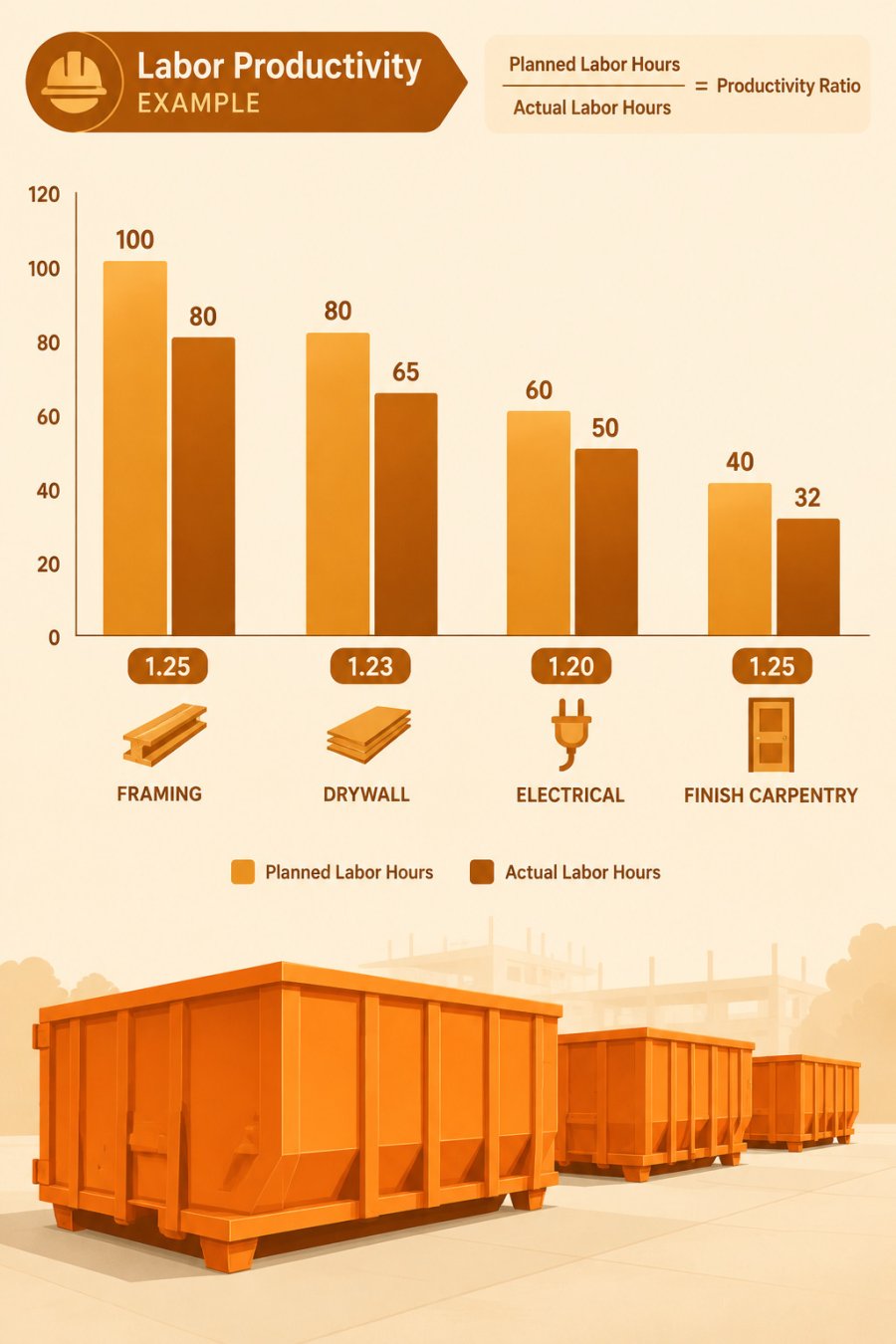
Track Units in Place, Not Just Hours
Hours alone tell you how much labor you spent. They do not tell you what you got for it. Pair every labor hour entry with the quantity installed: square feet of drywall hung, linear feet of pipe run, cubic yards of concrete placed, or units set. Then calculate Unit Labor Hours = Actual Labor Hours ÷ Quantity Installed for each work package.
This unit-rate view is what lets you compare across projects and across crews. A drywall crew that hangs 1,200 square feet in 40 hours is running at 0.033 hours per square foot. If the same crew ran 0.045 on the previous floor, something changed, and the unit rate makes that visible in a way that a project-level cost report never will.
Set a Weekly Cadence
Daily reporting sounds rigorous but usually collapses into noise and paperwork. A weekly cadence is more durable. Every Friday, the superintendent and each foreman review the week's installed quantities against the planned hours for each work package, calculate the ratio and the unit rate, and flag any package below the crew's own recent baseline.
Keep the review short and specific. Three questions per work package: Did we hit the planned hours? If not, what consumed the extra time? What changes next week? The answers become the input for the look-ahead plan, which is where measurement turns into action.
Interpret Variance Before You React
A ratio below 1.0 is a signal, not a verdict. Before changing anything, separate the cause into one of four buckets:
- Quantity variance: the crew installed less than planned because the work was not ready, materials were late, or the prior trade slipped.
- Rate variance: the crew installed the planned quantity but took more hours per unit, usually from rework, poor sequencing, or an inexperienced crew mix.
- Scope variance: the work package changed after the plan was set, so the original hours no longer apply.
- Estimate variance: the original planned hours were wrong, and the crew is actually performing to a realistic rate.
Each bucket calls for a different response. Quantity variance is a scheduling and logistics problem. Rate variance is a training, quality, or supervision problem. Scope variance is a change-order problem. Estimate variance is a preconstruction problem. Treating all four the same way, usually by pushing the crew harder, fixes none of them.
Use Your Own History as the Benchmark
Published industry productivity figures are useful for sanity checks, but they rarely match your crews, your region, or your building type. The most reliable benchmark is your own trailing performance: the unit labor rate each trade achieved on the last three comparable projects. Compare this week's rate against that trailing average, not against a generic number from a manual.
A common pattern is for a trade to run slightly above its trailing average early in a project and then drift below it as the work moves into less familiar areas. Catching that drift in week three is far cheaper than catching it in the final cost report.
Watch out: A productivity ratio that looks healthy at the project level can hide a trade that is badly behind, because overperformance elsewhere offsets it. Always review by trade and by work package before drawing conclusions.
Strategy 1: Build a Reliable Construction Project Scheduling Process
Schedule reliability is the foundation of construction labor efficiency. When tasks start on time, crews stay busy, and when they slip, the whole sequence stalls.
Build the schedule around the work each trade needs to finish before the next trade can begin. Note the dependencies between tasks, and build in a small buffer at the points where delays are most likely.
Using Look-Ahead Plans to Protect Crew Time
A look-ahead plan covers the next two to four weeks in detail. Review it with the foremen every week and confirm that materials, equipment, permits, and dumpster space are ready for each task.
- Confirm material deliveries for the next two weeks
- Check that the prior trade will finish on schedule
- Reserve dumpster capacity before demolition or cleanup phases
- Flag any task that depends on an inspection or approval
Look-ahead plans catch problems early, when fixing them still costs little. Match container pickups to each trade's sequence so crews are not waiting on hauling. Plan how long a dumpster rental should run to match the work sequence.
Strategy 2: Organize the Construction Site to Cut Wasted Movement
Every extra trip across a jobsite is paid time spent walking. Organizing staging areas, material storage, and debris containers close to the work reduces that movement.
Place the dumpster where haulers can reach it without blocking the work area. Junk Crusher offers 20 and 25 yard dumpsters for remodeling projects. Junk Crusher offers 20 and 25 yard dumpsters.
Keep tools and materials staged by the phase that needs them. When a crew can reach what it needs within a few steps, more of the shift goes into actual building.
Strategy 3: Track Construction Productivity Against Real Benchmarks
Benchmarks give you a target. Compare each trade's productivity ratio against its own history on earlier projects, not against a general industry number that may not match your work.
Review the numbers on a fixed schedule, such as every Friday. When a trade drops below its usual ratio, ask what changed: a material delay, a crew change, weather, or a rework issue. Fix the cause, not the symptom.
Consistent tracking also makes it easier to spot patterns. If the same trade falls behind on every project, the problem may be scheduling or training rather than effort.
Strategy 4: Allocate Crews and Train for Trade-Specific Tasks
Crew allocation matters as much as crew size, and the right allocation looks different by trade and by project phase. Generic advice to "match skills to tasks" does not help a superintendent decide who goes where on Monday morning. The guidance below is organized by trade and phase so it can be applied directly to a staffing plan.
Allocate by Trade and Phase
Structural and framing phases. These phases reward crew continuity. Keep the same core framing crew together across floors or building sections, because familiarity with the layout and the sequence reduces setup time on every repeat.
Mechanical, electrical, and plumbing rough-in. These trades are sequence-sensitive. The most common allocation error is starting rough-in before the preceding trade has finished enough of the area to allow uninterrupted work.
Drywall and finishes. Finishes are where rework costs the most, because defects surface late and repairs disrupt the trades that follow.
Closeout and punch work. Punch work is often assigned to whoever is available, which is why it drags. Assign a dedicated closeout crew with the authority to sign off on completed areas, and keep that crew out of the general labor pool.
Size Crews to the Work, Not to the Headcount
Crew size should follow the installed quantity and the unit rate, not the other way around. If a work package needs 400 linear feet of pipe at a known unit rate, the required hours are a calculation, not a guess. Use the unit rates from the measurement section to size each crew for the coming week, then compare the planned crew size against the available headcount. When the two do not match, the answer is usually to resequence work rather than to overstaff a zone.
A common pattern on mid-size projects is a crew that is correctly sized for the middle of a phase but too large for the start and too small for the finish. Staging crew size across the phase, rather than holding it constant, keeps labor hours aligned with the work actually available.
Train for the Sequence, Not Just the Task
Trade-specific training pays off most when it teaches workers how their task affects the next trade. A drywall hanger who understands how the electrician needs to access a wall makes fewer blocking errors. A plumber who understands the inspection sequence leaves test ports accessible the first time. This kind of training is usually delivered in short toolbox talks tied to the current phase rather than in a classroom.
Cross-training helps when one trade is waiting on another, but it has limits. A carpenter who can handle basic material moves or a laborer trained in safe debris handling keeps the site moving during gaps. Cross-training into skilled trade work, however, usually produces slower work and more rework than it saves, so keep cross-training focused on support tasks and material handling rather than on skilled installation.
Plan Debris Handling Into the Crew Plan
Debris handling is the task most often pulled from productive crews at the worst moment. When a dumpster fills mid-task, the nearest crew stops to clear space, and the labor cost of that interruption usually exceeds the container cost.
Junk Crusher offers 20 and 25 yard dumpsters for remodeling and gut-and-rebuild work. Junk Crusher offers 20 and 25 yard dumpsters, and a 25 yard unit is usually the better fit for full gut-and-rebuild work where debris volume is high and continuous.
Watch out: Pulling skilled workers off installation to handle cleanup feels free because it avoids a separate labor line, but it usually costs more in lost installation hours than a dedicated laborer would cost.
The article's guidance on crew allocation and debris handling by trade and phase can be scanned quickly in this table.
| Trade or task | Allocation guidance | Key reason |
|---|---|---|
| Structural and framing | Keep core crew together across floors | Familiarity cuts setup time |
| Mechanical, electrical, plumbing rough-in | Assign to fully released zones only | Avoids stop-start work around other trades |
| Drywall and finishes | Put most experienced finishers in first rooms | Defects surface late and cost the most |
| Closeout and punch work | Use a dedicated closeout crew | Dedicated crews clear lists faster |
| Debris handling | Assign to helpers and laborers | Pulling skilled workers costs more hours |
Putting These Labor Efficiency Gains Into Practice on Your Next Project
Start with one change rather than all four strategies at once. Measure the productivity ratio for two weeks, then add a look-ahead meeting and a debris plan. Compare the numbers after each change to see what works on your sites.
Plan dumpster capacity as part of the schedule, not as an afterthought. Junk Crusher offers 20 and 25 yard dumpsters for construction projects. For current pricing and availability, visit Junk Crusher's dumpster rental page.
Frequently Asked Questions
What are some effective strategies for improving labor productivity?
The most effective strategies combine planning, site organization and tracking. Use look-ahead schedules so crews always have ready work, stage materials close to where they will be installed, and assign clear daily targets by trade. Measure output against labor hours each week so problems surface early. Pair these steps with consistent crew communication and training on the specific tasks each trade performs, since most idle time comes from waiting for materials, information or access rather than from slow work.
How does better scheduling improve construction labor efficiency?
Better construction project scheduling reduces idle time by making sure each crew has the materials, access and predecessor work it needs before it arrives. A look-ahead schedule covering the next three to six weeks lets superintendents remove constraints in advance, such as missing inspections or late deliveries. Sequencing trades so they do not interfere with one another also cuts rework and standby hours, which are among the largest sources of lost labor productivity on commercial jobs.
What tools help track construction labor productivity?
Construction productivity tracking typically relies on daily timecards tied to cost codes, foreman reports of quantities installed, and a simple dashboard that compares planned and actual labor hours per unit of work. Many firms use project management software with mobile time entry, while smaller contractors often start with spreadsheets. The key is consistency: tracking the same cost codes and units every day makes trends in crew output visible and comparable across projects.
How can job-site organization reduce wasted labor time?
Construction site organization reduces wasted labor time by cutting the distance crews travel to get tools, materials and debris removed. Designate laydown areas near each work zone, keep clear access routes for material handling, and schedule regular debris removal so walkways stay open. Keeping waste containers close to active work, rather than at the far edge of the site, helps crews avoid repeated trips. Clean, well-marked sites also reduce the time spent searching for equipment and the hazards that slow work down.


