
7 Ways to Minimize Commercial Waste in 2026
Table of Contents
- 1. Run a Commercial Waste Audit Before You Change Anything
- 2. Set Waste Reduction Strategies for Businesses That Actually Stick
- 3. Build a Business Recycling Program Your Crew Will Use
- 4. Prevent Waste at the Source With Smarter Purchasing
- 5. Use Dumpster Compaction for Businesses to Cut Hauls and Fees
- 6. Divert Food Waste and Organics Through Composting
- 7. Train Employees and Track Progress Every Month
- Conclusion: Start With One Waste Stream, Then Scale
- Frequently Asked Questions
Last Updated: October 15, 2026
1. Run a Commercial Waste Audit Before You Change Anything
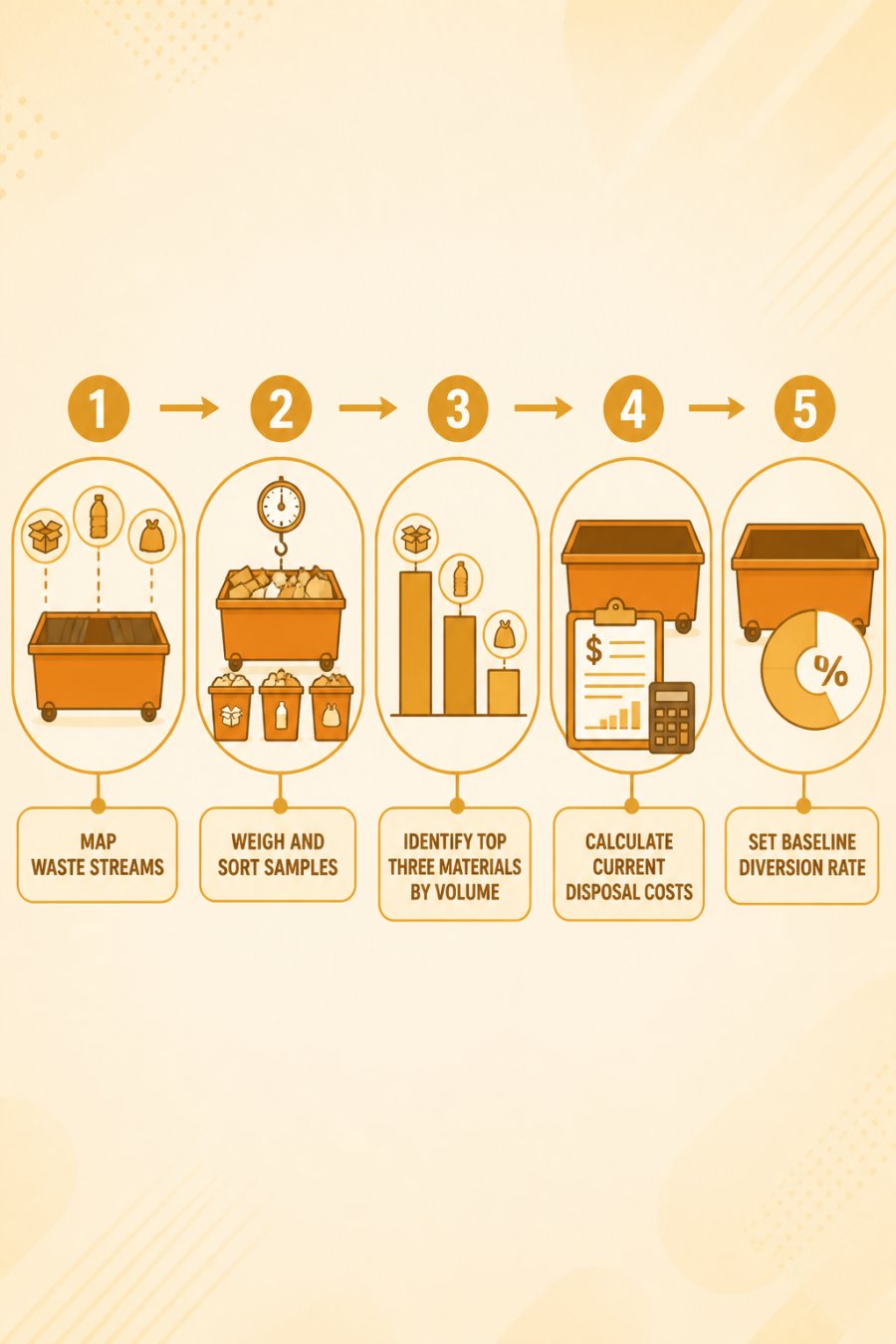
A commercial waste audit is a structured study of what your business throws away, how much of it, and where it goes. It turns guesswork into a baseline you can measure against. At Junk Crusher, we tell every client the same thing: you cannot cut what you have not counted.
Most teams skip this step. They buy new bins, print recycling posters, and hope for the best. Three months later, nothing has changed.
What to Measure in a Two-Week Audit
Two weeks gives you a fair sample without dragging the project out. Here is what to track:
- Waste stream: trash, recycling, cardboard, organics, metal, pallets
- Volume by weight or bin fill level, per stream, per day
- Where each stream comes from: production line, break room, shipping dock, office
- Current haul frequency and bin size for every container
- Disposal cost per haul and per month
Write it all down in one place. A simple spreadsheet works fine.
Once you have two weeks of data, you know your top three materials by volume. That is your starting point for everything that follows.
2. Set Waste Reduction Strategies for Businesses That Actually Stick
Waste reduction strategies for businesses fail for one reason: they are too broad. "Reduce waste by 20%" means nothing to the person sorting cardboard on a Tuesday afternoon.
Pick one stream. Set one target. Give it a deadline.
Good targets look like this:
- Cut cardboard volume from shipping by 15% in 90 days
- Move food waste out of the trash bin by the end of the quarter
- Reduce trash hauls from four per month to three
KPIs That Tie Waste to Cost and Carbon
Track a small set of numbers every month. More than five and nobody looks at them.
| KPI | What It Shows | How to Measure |
|---|---|---|
| Diversion rate | Share of waste kept out of landfill | Recycled or composted tons ÷ total tons |
| Disposal cost per ton | True cost of waste handling | Monthly hauler spend ÷ tons removed |
| Hauls per month | Pickup frequency and bin efficiency | Count from hauler invoices |
| Contamination rate | How clean your recycling stream is | Visual audit of recycling bins |
| Waste per unit produced | Waste tied to output, not headcount | Total waste ÷ units shipped |
Review these numbers in a monthly meeting. Fifteen minutes is enough.
3. Build a Business Recycling Program Your Crew Will Use
A business recycling program only works when the bins are closer than the trash can. Convenience beats good intentions every time.
Start with placement. Walk your floor and ask one question at each station: would a busy employee use this bin without thinking?
- Put recycling bins beside every trash bin, never across the room
- Label bins with pictures, not just words
- Use one color per stream and keep it consistent across the whole site
- Empty bins before they overflow, because full bins get contaminated
Contamination is the quiet killer. One greasy pizza box in a cardboard bin can send the whole load to landfill. Your hauler may charge a fee for it too.
Train the crew on what goes where during a shift meeting, not a mandatory hour-long session. Show real examples from your own bins.
4. Prevent Waste at the Source With Smarter Purchasing
Source reduction beats every downstream fix. The cheapest waste to handle is the waste you never create.
Look at your purchasing practices first. Small changes add up fast:
- Buy in bulk to cut packaging waste per unit
- Ask suppliers for reusable totes instead of single-use cardboard
- Choose products with minimal packaging and recyclable materials
- Set printers to double-sided and move invoices to digital workflows
- Return pallets and crates to vendors instead of trashing them
Sustainable sourcing matters here too. Vendors that take back packaging or ship in returnable containers save you disposal costs and bin space.
A common mistake is chasing the perfect green supplier while ignoring the pallet pile behind the dock. Fix the obvious waste first.
5. Use Dumpster Compaction for Businesses to Cut Hauls and Fees
Dumpster compaction for businesses solves a simple problem: you are paying to haul air. Most roll-off dumpsters fill to the brim with bulky, low-density material long before they hit their weight limit.
Compacting crushes that material on site. Junk Crusher brings mobile compaction equipment to your location and reduces roll-off dumpster volume by up to 70%. Fewer hauls means lower fees, less truck traffic, and more yard space.
That matters most for:
- Construction and demolition sites with shingles, drywall, and framing scrap
- Distribution centers buried in cardboard and stretch wrap
- Manufacturing plants with bulky packaging and production scrap
U.S. Environmental Protection Agency guidance on waste reduction and diversion notes that source reduction and recycling sit at the top of the waste management hierarchy for good reason. Cutting volume before it leaves your site is the highest-value move available.
Our clients typically see up to a 56% reduction in dumpster fees. The exact savings depend on your material mix, your hauler rates, and how often you were pulling bins before. We will run the numbers with you before you commit to anything.
6. Divert Food Waste and Organics Through Composting
Food waste is heavy, wet, and expensive to haul. It also breaks down into methane in a landfill, which makes it one of the worst streams to ignore.
Composting or organics diversion pulls that material out of your trash entirely. Options include:
- A commercial composting service that picks up organics separately
- On-site composting for landscaped campuses with yard space
- Donation programs for surplus food that is still safe to eat
Start with the break room and any cafeteria. Add back-of-house prep waste next if you run food service.
Keep organics bins lined, lidded, and emptied daily. Odor complaints kill these programs faster than budget cuts.
7. Train Employees and Track Progress Every Month
Employee engagement decides whether any of this works. A program nobody understands becomes a program nobody follows.
Build a small Green Team with one person from each shift or department. Give them three jobs:
- Teach new hires where each stream goes
- Spot contamination and fix it on the spot
- Bring one improvement idea to the monthly meeting
Post your KPIs where the crew can see them. People sort better when they can watch the diversion rate climb.
U.S. Occupational Safety and Health Administration guidance on workplace safety and health programs offers a useful model here: strong programs rely on worker participation, clear roles, and regular review. Waste programs follow the same pattern.
Conclusion: Start With One Waste Stream, Then Scale
The hardest part of cutting commercial waste is starting. Pick your heaviest stream from the audit, set one target, and give it 90 days. Add the next stream only after the first one holds steady.
If hauling bulky waste is your biggest cost, on-site compaction changes the math fastest. Junk Crusher brings mobile dumpster compaction to your site, cuts roll-off volume by up to 70%, and reduces the number of hauls you pay for. We also offer dumpster rental for sites that need both.
Book a Crush with Junk Crusher and see how much of your waste spend is really just paying to haul empty space.
Frequently Asked Questions
How can a business reduce commercial waste without spending a lot upfront?
Start with a two-week waste audit using a clipboard and a scale. Map every waste stream, weigh samples from each dumpster, and identify the top three materials by volume. Most facilities find cardboard, pallets, and food waste dominate. Fixing sorting and adding a baler or compactor typically pays back within a few months. Junk Crusher's mobile compaction service reduces roll-off volume by up to 70%, cutting haul frequency without a capital purchase.
What is a commercial waste audit, and how often should we run one?
A commercial waste audit is a structured review of what your operation throws away, where it comes from, and what it costs to dispose of. It covers waste streams, weights, disposal costs, and contamination rates. Run a full audit annually, and a lighter monthly check on your top two streams. That cadence catches drift before it shows up on a hauler invoice.
How can businesses reduce dumpster pickups?
Two levers work best. First, separate recyclables and organics so general waste fills slower. Second, compact what remains. On-site dumpster compaction for businesses crushes cardboard, wood, and mixed debris so a roll-off holds far more material per load. Junk Crusher reports up to a 56% reduction in dumpster fees and fewer hauls, which also lowers truck trips and emissions.
How do we get employees to actually use the recycling program?
Make sorting obvious and low-effort. Put color-coded bins at the point of generation, label them with pictures of what goes in, and keep them within ten steps of the work area. Recruit a Green Team from each shift, run a five-minute training at every monthly safety meeting, and post the diversion rate where everyone sees it. Tie a small recognition to the team that hits the target.


