
Zero Waste Manufacturing: Benefits Explained
Table of Contents
- What Zero Waste Manufacturing Actually Means
- Conducting a Manufacturing Waste Audit
- Cost Savings and Financial Impact
- Manufacturing Waste Reduction Strategies
- Lean Manufacturing Waste Reduction Methods
- Industrial Recycling Programs and Material Recovery
- Environmental and Operational Gains
- Overcoming Implementation Barriers
- Frequently Asked Questions
Last Updated: October 10, 2026
What Zero Waste Manufacturing Actually Means
Zero waste manufacturing is the practice of designing production processes to eliminate or dramatically minimize waste sent to landfills.
At Junk Crusher, we've worked with manufacturing plants across Western Pennsylvania to understand what zero waste actually requires. It's not about stopping production or accepting lower output. It's about rethinking how you handle what comes off the line.
The core principle is straightforward: prevent waste before it happens, then recover value from what remains. This means examining every step of your manufacturing process, from raw material intake to final product packaging, and asking where material is lost, damaged, or discarded unnecessarily.
Conducting a Manufacturing Waste Audit
Before you can reduce waste, you need to see exactly where it's happening. A manufacturing waste audit is a systematic review of your facility's waste streams, volumes, and disposal methods. This becomes your baseline for measuring improvement.
Start by mapping every waste stream in your operation. Document what's being thrown away, how much, how often, and where it goes. Many facilities discover they're paying to haul material that could be recovered or sold. The audit reveals these hidden costs immediately.
Common waste categories in manufacturing include scrap material from cutting or stamping operations, defective products, packaging waste, and process by-products. Each stream has different recovery potential. A waste audit typically uncovers opportunities to reduce disposal costs while recapturing material value.
Cost Savings and Financial Impact
The financial case for zero waste manufacturing is direct and measurable, but only if you quantify it correctly. Most manufacturers underestimate their true waste cost because they count only disposal fees, not the hidden expenses embedded in scrap, rework, and inefficiency.
Building a transparent ROI calculation requires tracking four cost categories:
-
Disposal and hauling costs, The direct fees you pay per ton or per haul. Document your current frequency and per-unit cost. A facility hauling waste twice weekly at $150 per haul spends roughly $15,600 annually just on removal.
-
Material recovery value, What you can sell scrap for, net of collection and processing labor. Aluminum scrap typically fetches $0.30-$0.50 per pound; steel scrap $0.08-$0.15 per pound. A facility generating 500 pounds of aluminum scrap monthly could recover $1,800-$3,000 annually if properly segregated and sold.
-
Rework and defect labor, The hours spent fixing or remaking defective parts. If your facility produces 10,000 units monthly with a 3 percent defect rate, that's 300 units requiring rework. At $25 per hour labor cost and 1 hour per unit rework, you're spending $7,500 monthly ($90,000 annually) on fixing mistakes. A 1 percent defect reduction saves $30,000 per year.
-
Raw material efficiency, The cost of material purchased but not sold in finished goods. If your material cost is 40 percent of revenue and your scrap rate is 8 percent, you're losing 8 percent of that 40 percent to waste. On $5 million in annual revenue, that's $16,000 in material cost sent to landfill each year. A 2 percent scrap reduction saves $4,000 annually.
A worked example: A mid-sized metal stamping facility processes 50,000 parts monthly. Current state: 4 percent scrap rate, twice-weekly waste hauling at $150 per haul, 2 percent defect rate requiring rework.
- Annual disposal cost: $15,600
- Annual rework labor (2 percent defect × 50,000 parts × 12 months × $25/hour × 0.5 hours per unit): $75,000
- Annual material waste (4 percent scrap × $8 material cost per part × 50,000 × 12): $192,000
- Total annual waste cost: $282,600
If zero waste initiatives reduce scrap to 2 percent, defects to 1 percent, and consolidate hauling to once weekly:
- Disposal savings: $7,800
- Rework labor savings: $37,500
- Material waste reduction: $96,000
- Material recovery revenue (selling segregated scrap): $8,000
- Total annual benefit: $149,300
Payback period on a $20,000 audit and process redesign investment: 1.6 months.
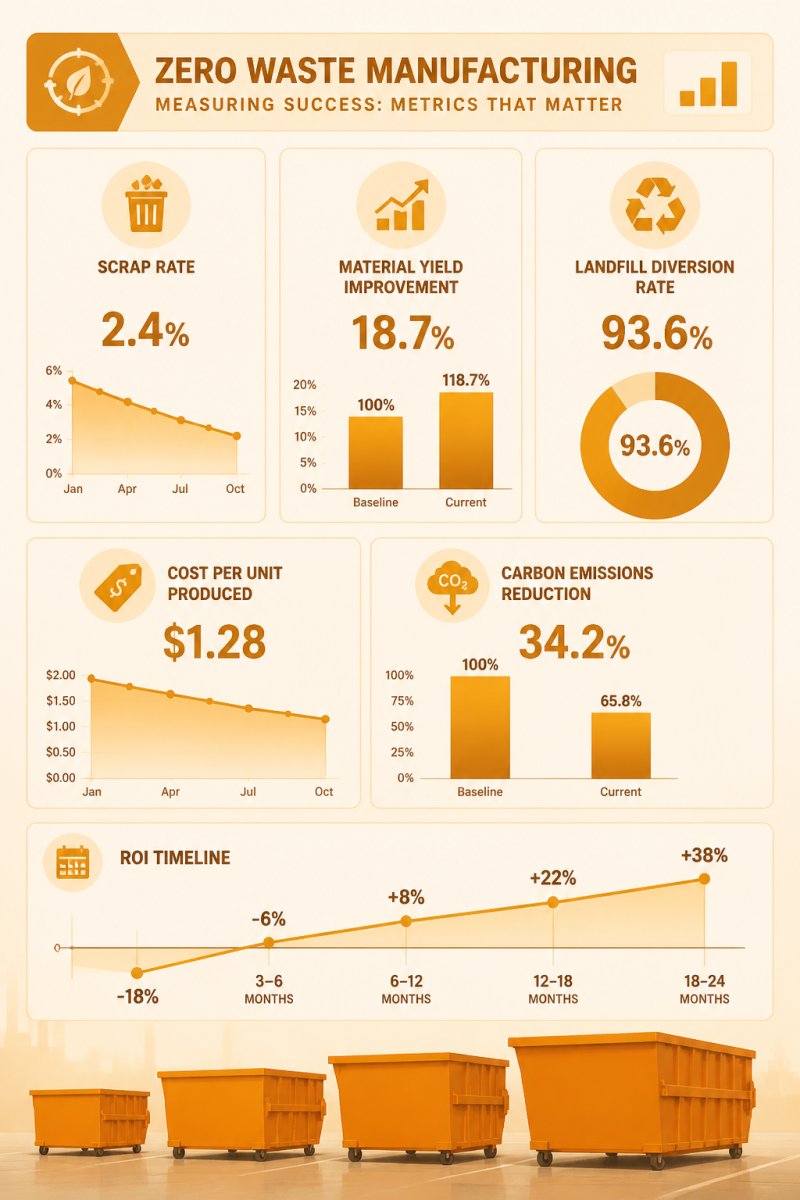
The key is documenting your baseline accurately. Many facilities discover that waste costs 5-15 percent of their total manufacturing cost once all categories are included. That's why even modest improvements generate substantial returns.
Manufacturing Waste Reduction Strategies
Effective manufacturing waste reduction requires a structured roadmap, not a one-time checklist.
Step 1: Audit and Prioritize Waste Streams
Not all waste is equal.
Common high-priority streams in metal fabrication include cutting scrap, stamping trim, and defective castings.
Step 2: Diagnose Root Cause by Process Stage
Waste doesn't appear randomly, it signals a process problem. Categorize your waste by where it occurs:
- Input waste, Damaged or oversized raw material, poor supplier quality, or over-ordering. Solution: tighter supplier specifications, smaller batch orders, or material pre-inspection.
- In-process waste, Scrap from cutting, stamping, molding, or assembly. Solution: design optimization, tooling improvement, or process parameter tuning.
- Quality waste, Defects caught in-house or returned by customers. Solution: statistical process control, operator training, or equipment maintenance.
- Packaging and logistics waste, Damaged goods, excess packaging, or obsolete inventory. Solution: protective packaging redesign, inventory management, or vendor consolidation.
Each category requires different interventions. Cutting scrap from a stamping die is solved by die redesign or material nesting optimization.
Step 3: Pilot One High-Impact Stream
Choose your highest-priority waste stream and run a 4-8 week pilot. Document baseline metrics: volume, cost, and current disposal method.
A successful pilot proves the concept works in your facility and builds internal buy-in.
Step 4: Implement Segregation and Recovery Infrastructure
Once you've reduced waste at the source, recover value from what remains. This requires:
- Dedicated collection bins for each material type (aluminum, steel, plastic, cardboard). Mixed waste is nearly worthless; separated waste has market value.
- Clear labeling and operator training so material goes to the right bin. Contamination (mixing materials or including non-recyclable items) destroys recovery value.
- Vendor relationships with scrap buyers or recyclers. Get quotes from multiple buyers, prices vary significantly. Some buyers offer on-site collection; others require you to deliver.
- Tracking and documentation of what you sell, to whom, and for how much. This data proves ROI and identifies trends.
A facility generating 500 pounds of aluminum scrap monthly can sell it for roughly $150-$250 per month if properly segregated.
Step 5: Scale Successful Interventions
Once your pilot stream shows results, apply the same approach to your next-highest-priority stream.
Common scaling barriers include:
- Operator resistance, People are comfortable with current processes. Address this through training, incentives, and clear communication about why change matters.
- Capital constraints, New equipment or tooling costs money upfront. Prioritize interventions with payback periods under 12 months.
- Supply chain dependencies, Some waste reduction strategies require supplier changes (material specifications, delivery formats, packaging). Build these partnerships early.
- Recycling market volatility, Scrap prices fluctuate. Lock in contracts with buyers when prices are favorable, or diversify recovery channels.
Lean Manufacturing Waste Reduction Methods
Lean manufacturing waste reduction focuses on eliminating inefficiencies in your production process itself. The lean framework identifies eight types of waste: defects, overproduction, waiting, non-used talent, transportation, inventory, motion, and extra processing. Each one represents material, time, or resources being wasted.
Lean methodologies work well alongside zero waste goals because they both target the same root issue: unnecessary loss. When you reduce overproduction, you automatically reduce the scrap from products that nobody needs.
Many manufacturing teams use lean tools like value stream mapping to visualize where waste occurs. Once you see it clearly, you can design it out. The combination of lean thinking and zero waste principles creates a powerful framework for continuous improvement.
Industrial Recycling Programs and Material Recovery
Industrial recycling programs and material recovery systems turn waste streams into revenue streams. Rather than paying to dispose of scrap, you can sell it to recyclers or material recovery facilities. This works for metals, plastics, paper, wood, and many other materials.
The key is finding the right buyer for your specific material streams. A scrap metal recycler pays differently for aluminum than for steel. A plastic recycler has different requirements for contamination and color consistency.
Some facilities establish partnerships with material recovery companies that handle collection and processing. Others manage recovery in-house when volumes are large enough. Either way, the principle is the same: material that leaves your facility should have value, not cost.
Environmental and Operational Gains
The environmental benefits of zero waste manufacturing are significant. Sending less material to landfills reduces your facility's environmental footprint. Manufacturing operations that minimize waste also typically reduce energy consumption and emissions, since less material handling and transportation mean lower energy use.
From an operational perspective, cleaner facilities run more efficiently. When waste is controlled and organized, your team spends less time managing it. Space that was dedicated to waste storage or sorting can be repurposed for production or inventory. Operational flow improves when material moves through your facility with less disruption.
These gains compound over time. A facility that reduces waste by 30 percent sees immediate disposal savings, but also benefits from improved efficiency, better space use, and lower overall operational friction.
Overcoming Implementation Barriers
The biggest barrier to zero waste adoption is inertia. Your current waste disposal process works, it's familiar, established, and somebody already handles it. Changing that system requires effort, planning, and buy-in from multiple departments.
Start small. Pick one waste stream and optimize it completely before expanding to others. This builds confidence and proves the concept works in your facility. Many teams find that early wins create momentum for broader adoption.
Budget and resource constraints are real. A comprehensive waste audit costs time and money upfront.
The most successful implementations treat zero waste as an ongoing process, not a one-time project. Assign clear ownership, measure progress regularly, and celebrate wins.
Reducing manufacturing waste requires a structured approach, but the financial and operational payoff is substantial. Junk Crusher helps manufacturing facilities across Western Pennsylvania optimize their waste management through on-site compaction services that reduce hauling volume and frequency, cutting disposal costs while minimizing your environmental impact. For facilities with larger waste volumes, Dumpster Rental provides flexible containment solutions that work alongside your waste reduction strategy. The EPA's waste prevention guidance for manufacturers outlines best practices for identifying and eliminating waste at the source.
Frequently Asked Questions
What is zero-waste manufacturing and how does it differ from standard waste reduction?
Zero waste manufacturing aims to eliminate waste at every stage of production by redesigning processes, reusing materials, and recovering by-products rather than sending them to landfills. Unlike standard waste reduction, which focuses on minimizing disposal costs, zero waste manufacturing treats waste as a design flaw and a resource loss. It requires systematic changes to material selection, production methods, and supply-chain practices to achieve a closed-loop system where nearly all material becomes productive input.
How can a manufacturing waste audit help identify cost-saving opportunities?
A manufacturing waste audit traces every material stream through your production process to quantify what's being discarded, where it's lost, and why. This reveals hidden costs: disposal fees, material handling, rework, and lost raw material value. By documenting scrap rates, defect patterns, and by-product volumes, you create a baseline to target high-impact improvements. Audits often uncover that 10-30% of material costs are lost to waste, making the audit itself a roadmap to quick wins that improve margins before major process redesign.
Can zero waste manufacturing actually reduce operating costs, or is it just an environmental goal?
Zero waste manufacturing directly reduces operating costs by cutting material waste, disposal fees, energy use, and rework. Every pound of scrap eliminated saves raw material cost and hauling expense. Reduced defect rates lower warranty claims and warranty costs. Closed-loop systems recover by-products as sellable material or process input, creating revenue or eliminating purchase costs. Operational efficiency gains, faster production cycles, less downtime for waste handling, add further savings. The financial case is strong enough that many manufacturers adopt zero waste strategies primarily for profit, with environmental benefits as a secondary gain.
What role do industrial recycling programs play in zero waste manufacturing?
Industrial recycling programs are a core pillar of zero waste manufacturing. They divert scrap metal, plastics, paper, and other by-products from landfills into material recovery streams, either for resale or reuse within your own process. Many manufacturers recover 40-60% of waste stream material through structured recycling. This reduces disposal costs, generates scrap material revenue, and decreases reliance on virgin materials, lowering input costs. Effective programs require vendor partnerships, material segregation systems, and tracking to ensure accountability and measure landfill diversion rates.


