
Smash My Trash vs Roll Right: Mobile Compaction Compared
Table of Contents
- Mobile Compaction Services Compared: Smash My Trash vs Roll Right
- How Each Service Works
- How Mobile Dumpster Compaction Works
- Compaction vs Traditional Hauling: Volume Reduction and Hauling Frequency
- How Mobile Compaction Affects Dumpster Rental Costs
- Commercial Waste Management Efficiency: Yard Space, Truck Traffic, and Carbon Emissions
- What to Check Before Choosing a Mobile Compaction Provider
- Conclusion
- Frequently Asked Questions
Last Updated: September 14, 2026
Mobile Compaction Services Compared: Smash My Trash vs Roll Right
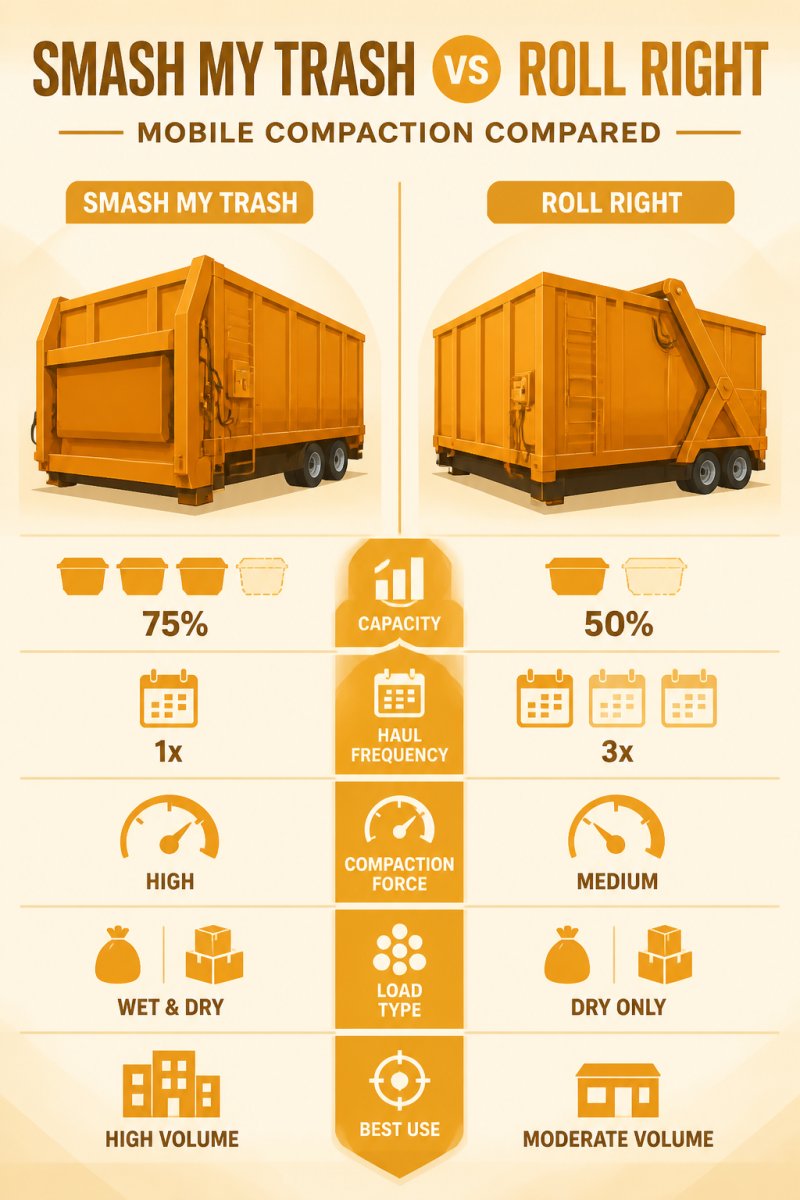
Mobile compaction crushes waste inside a roll-off dumpster on site, so each container holds far more material before hauling. This comparison from Junk Crusher examines how mobile compaction services operate.
The pitch behind both companies is simple: you are paying to haul air. A dumpster filled with loose cardboard, shingles, or pallet wrap is mostly void space, and every haul bills you for that emptiness (the EPA). Crushing on site shrinks the volume, meaning fewer trips, fewer tipping fees, and less truck traffic.
Below, we break down how each service runs, what the compaction process looks like step by step, and the math that decides whether mobile compaction beats traditional hauling. The two providers differ less in concept than in execution: equipment, service radius, and scheduling.
How Each Service Works
Both providers send a truck-mounted compactor to your site, lower a heavy steel plate into the dumpster, and press the contents down. Differences show up in scheduling, service area, and equipment configuration rather than the basic idea.
Smash My Trash built its model around a franchise network, so quality and responsiveness depend heavily on the local operator who owns your territory. That structure scaled the brand quickly, but scheduling flexibility, equipment age, and crew experience vary from one franchise to the next. Pricing is set locally, so two facilities in different regions can see materially different quotes.
Roll Right approaches the same problem with a similar on-site model and its own footprint of service areas. Neither company publishes a national flat rate, because pricing depends on dumpster size, waste stream, haul frequency, and travel distance.
What matters for a facility manager is not the logo on the truck, but whether the provider can reach your site on a predictable schedule, handle your waste stream without equipment failures, and prove volume reduction in writing.
Equipment and Compaction Technology
Mobile compaction units are not all built the same. Most truck-mounted systems use a hydraulic boom or crane to position a heavy steel plate over the open top of a roll-off dumpster, then lower it to compress the waste (osha.gov). The key variables are plate weight, hydraulic pressure, and cycle time.
A heavier plate with higher hydraulic pressure can crush denser materials, roofing shingles, pallet wood, compacted cardboard, in fewer passes. Lighter-duty units may need multiple cycles and still achieve less volume reduction on dense loads. Some systems add a rotating or vibrating mechanism to help material settle evenly.
No provider publishes detailed equipment specs, so the practical way to compare is to ask for a demonstration on your actual waste stream. A confident provider will run a test cycle and show you the before-and-after volume.
Franchise vs. Corporate Operations
Some providers operate with a franchise model, which ties your service experience to the local owner. That can be an advantage, a local operator may be more responsive and familiar with regional waste regulations, or a disadvantage if the franchisee is undercapitalized or runs older equipment. Other providers operate with a similar on-site model, though their footprint and structure may differ by region.
For a facility manager, the practical takeaway is to evaluate the local operator, not just the national brand. Ask about equipment age, maintenance schedules, and whether the same crew will service your site consistently.
Scheduling and Service Radius
Both providers schedule repeat visits based on your waste generation rate. A high-volume facility may need weekly or twice-weekly compaction, while a lower-volume site might schedule monthly. Service radius matters because a distant provider may struggle to maintain a fixed schedule, especially during peak periods or bad weather.
Ask each provider for their typical response time on an unscheduled compaction visit. A provider with a tight local footprint can often accommodate same-week requests; a provider relying on a distant franchisee may not.
How Mobile Dumpster Compaction Works
Mobile dumpster compaction compresses waste inside a roll-off container while it sits on your property, using a truck-mounted hydraulic press rather than a stationary baler or compactor. The container never leaves your site until it is genuinely full.
That separates this service from a traditional compactor, which requires dedicated floor space, power, and permanent installation. A mobile unit arrives, works in minutes, and leaves.
The Compaction Process, Step by Step
- Site assessment. The provider confirms dumpster placement, access lanes, and overhead clearance for the truck and boom.
- Waste stream check. Crews verify the load is compactable material, not prohibited items like tires, liquids, or hazardous waste.
- Compactor positioning. The truck backs into place and the compaction head is aligned over the open container.
- The crush cycle. The hydraulic plate descends, compressing the load. Most cycles run a few minutes per container.
- Repeat passes. For heavy debris like shingles, crews may run multiple cycles as material settles and more waste is added.
- Documentation. A reputable provider logs the volume reduction so you can track hauling savings over time.
A common mistake is assuming every waste stream compacts equally well. Loose cardboard and pallet wrap compress dramatically; dense, already-packed material compresses far less, and wet or mixed loads behave unpredictably. Ask any provider to demonstrate on your actual waste before committing to a schedule.
Compaction vs Traditional Hauling: Volume Reduction and Hauling Frequency
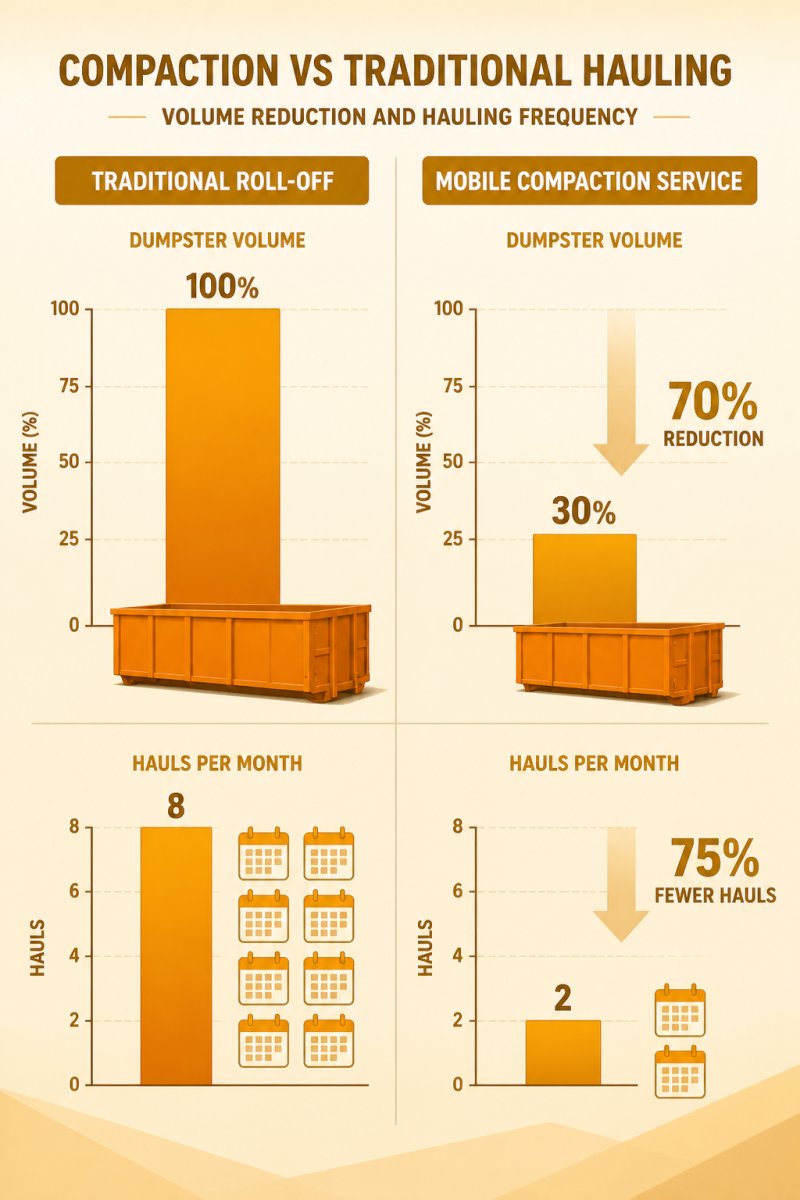
Traditional hauling picks up a dumpster whenever it is nominally full, which for light, bulky waste means hauling a container that is 60 to 70 percent air. Mobile compaction attacks that waste directly.
Because material is crushed in place, a single roll-off container can absorb multiple rounds of waste before hitting weight or volume limits. The result is fewer hauls per month for the same material generated, and fewer hauls is where the money is saved.
How Mobile Compaction Affects Dumpster Rental Costs
Dumpster rental costs are driven by three variables: the container itself, the haul charge each time it is emptied, and the tipping fee at the disposal facility. Compaction only touches the second and third, but it touches them hard.
Cutting hauls cuts per-trip charges and the tipping fees that ride along with each load. For sites generating bulky, low-density waste, that trip reduction is the single largest line item you can influence without changing what you throw away.
The U.S. Environmental Protection Agency's guidance on waste reduction and recycling frames the broader principle well: reducing the volume of material that moves through the waste system lowers both cost and environmental burden. Compaction is one of the few tools that does both at once.
A Simple ROI Framework for Mobile Compaction
Most providers quote volume reduction percentages, but those numbers do not tell you whether the service pays for itself. To decide, compare your current hauling cost against the cost of compaction service plus reduced hauling.
Start by gathering three data points from your waste invoices:
- Average cost per haul (including tipping fees).
- Number of hauls per month for the dumpster you are considering.
- Monthly rental fee for the container, if separate.
Next, estimate your volume reduction. A claim of up to 70% volume reduction does not mean 70% fewer hauls, actual reduction depends on your waste stream. Loose cardboard might yield 50-70% fewer hauls; dense materials like shingles, 20-40%. Use a conservative estimate for your first calculation.
Then, calculate your break-even point:
- Current monthly hauling cost = (cost per haul) × (hauls per month).
- Projected hauls after compaction = (current hauls) × (1 - reduction rate).
- Projected hauling cost = (cost per haul) × (projected hauls).
- Monthly savings = current hauling cost - projected hauling cost.
- Compaction service cost = quoted monthly fee (or per-visit fee × visits per month).
- Net monthly savings = monthly savings - compaction service cost.
If net monthly savings is positive, the service pays for itself. If it is negative, you either need a higher waste volume, a better reduction rate, or a lower service cost.
What Drives the Break-Even Point
The break-even point is most sensitive to two factors: your current haul frequency and the actual volume reduction achieved on your waste. A site hauling a 20-yard dumpster three times a week has more to gain than one hauling monthly, and a waste stream that compacts well, loose cardboard, pallet wrap, mixed packaging, delivers more savings than dense, already-compacted material.
Another factor is the cost of the compaction service itself. Because pricing is local and depends on service radius, waste type, and contract length, get quotes from providers and compare them against your calculated savings. Ask for a demonstration on your actual waste and a written estimate of haul reduction.
Beyond Hauling: Other Cost Impacts
Compaction can also reduce indirect costs. Fewer hauls mean less truck traffic, lowering site congestion and the risk of damage to pavement or equipment. Some facilities also spend less labor managing waste areas. These savings are harder to quantify but can be significant in high-traffic operations.
Finally, consider the dumpster itself. If compaction lets you fill a smaller container more densely, you may save on rental fees. Mobile compaction works with standard roll-off dumpsters, so no specialized equipment purchase is needed.
Pricing for any of these services depends on quantity, dumpster size, waste type, and delivery logistics, so no single figure applies across sites. Get a written quote based on your actual haul history rather than a generic rate card.
Commercial Waste Management Efficiency: Yard Space, Truck Traffic, and Carbon Emissions
Commercial waste management efficiency is measured in more than dollars. It shows up in how much yard space your containers consume, how often heavy trucks roll through your site, and how much fuel those trips burn.
Fewer hauls means fewer truck movements, which matters where a hauling truck blocking the scale house or loading dock costs real production time. It also reduces diesel burned per ton of waste removed, an environmental win that sustainability reporting increasingly rewards.
For distribution centers and manufacturing plants, the compounding effect is the real story: you free up yard space, cut downtime tied to hauling logistics, and lower your waste operation's carbon footprint at once, the combination most operations managers are chasing.
What to Check Before Choosing a Mobile Compaction Provider
Service area is the first filter. A national brand with a franchise network may lack a local operator who can reach your site weekly, and a regional provider may cover your primary facility but not satellite locations.
Ask each provider four questions before signing anything:
- Can you service every site we operate on a fixed schedule?
- What is your documented volume reduction on our specific waste stream?
- How long does each compaction cycle take, and will it interrupt our operations?
- What references can you provide from facilities similar to ours?
Get the volume reduction claim in writing, tied to your own dumpster and material. A provider confident in its equipment will demonstrate on your waste before asking for a contract and give you contacts at comparable sites who can speak to the savings.
| Evaluation Factor | What to Ask | Why It Matters |
|---|---|---|
| Service area | Can you cover all our sites weekly? | Missed schedules erase savings |
| Waste compatibility | Have you tested our material? | Crush performance varies by stream |
| Cycle time | How long per container? | Downtime eats into gains |
| Documentation | Will you log volume reduction? | Proof drives budget decisions |
| References | Facilities like ours? | Real results beat sales claims |
Conclusion
The gap between mobile compaction and traditional hauling comes down to one number: how many trips you eliminate. Providers differ in service area, equipment, and scheduling reliability, but the underlying math is the same for every site.
Junk Crusher provides mobile on-site dumpster compaction built specifically for commercial operations, reducing roll-off dumpster volume by up to 70% and cutting required hauls. With up to a 56% reduction in dumpster fees, less jobsite downtime, and fewer truck trips lowering your carbon footprint, the service turns waste management from a recurring cost into a controlled one.
Get started with Junk Crusher and see how much of your current waste spend is going toward hauling empty space. Book a Crush.
Frequently Asked Questions
What does Smash My Trash do?
Smash My Trash sends a truck-mounted compactor to commercial sites and crushes the contents of a roll-off dumpster on location. The process flattens bulky items like cardboard, wood, and construction debris so the same container holds more material. That reduces dumpster volume, which means fewer hauls, lower tipping fees, and less truck traffic. It is a service-based alternative to renting extra containers or scheduling more pickups. Mobile compaction works best for sites that generate steady, crushable waste and want to cut disposal costs without changing haulers.
How does mobile dumpster compaction work?
A compaction truck arrives at your site and positions a heavy steel plate or roller over the open dumpster. The equipment presses down repeatedly, crushing furniture, pallets, cardboard, and similar debris. The operator typically works from controls on the truck, so the process takes minutes per container rather than hours. Once compacted, the dumpster holds significantly more material by weight and volume. You keep your existing roll-off container and hauler; the compaction service simply reduces how often that container needs to be pulled and dumped.
Can mobile compaction reduce the number of dumpster hauls per month?
Yes. Because compaction increases how much waste fits in each container, most sites need fewer pulls per month. A facility that scheduled four hauls might drop to two or three, depending on waste type and generation rate. Fewer hauls mean lower tipping fees, less fuel burned by hauling trucks, and fewer disruptions in your yard. The exact reduction depends on your waste stream, container size, and how full containers get before pickup. Tracking your haul log before and after switching gives you a clear before-and-after comparison.
What types of waste are suitable for mobile compaction?
Mobile compaction handles dry, crushable waste: cardboard, wood, pallets, construction and demolition debris, roofing shingles, furniture, and general commercial trash. It is not suitable for liquids, hazardous materials, food waste, or anything that could damage the compaction equipment. Roofing and renovation crews often see strong results because shingles and bulky debris compact well. Manufacturing and distribution centers benefit too, especially when cardboard and packaging dominate the waste stream. Check with your provider about your specific materials before scheduling service.
How do I determine if my business needs a compaction service?
Start by reviewing your haul log. If you schedule frequent pickups, pay high tipping fees, or regularly rent extra dumpsters during busy periods, compaction likely saves money. Sites with limited yard space or heavy truck traffic also benefit because fewer hauls free up room and reduce congestion. If your waste is mostly crushable and you generate it consistently, the math usually favors compaction. If your waste is wet, hazardous, or mostly non-compactable, traditional hauling remains the better fit.
