

Save Big on Jobsite Downtime: General Contracting Guide
Table of Contents
- Understanding Jobsite Downtime in General Contracting
- The True Cost of Construction Jobsite Downtime
- A Downtime Cost Calculator for General Contractors
- Common Causes of Equipment Downtime and Project Delays
- Construction Site Debris Management: A Key Downtime Killer
- Construction Cleanup Scheduling to Prevent Delays
- How On-Site Dumpster Compaction Reduces Downtime and Costs
- Building a Downtime Response Protocol and Contingency Plan
- Frequently Asked Questions
Last Updated: October 12, 2026
Understanding Jobsite Downtime in General Contracting
Jobsite downtime is any period when a crew, trade, or piece of equipment sits idle instead of moving the project forward. For general contractors, it is the quietest line item on the budget and often the largest.
Idle time rarely announces itself. A concrete pour pushed two hours because a pump truck is late looks minor. Multiply it across a crew, a subcontractor, and a rented machine, and the number grows fast. Proactive scheduling remains the most effective way to minimize truck idling and keep the entire project timeline from unraveling.
Planned, Unplanned, and Avoidable Downtime
Not all downtime is a failure. Some of it is scheduled, and some of it is entirely preventable:
- Planned downtime: Scheduled maintenance, crane inspections, or a deliberate weather day. Expected and budgeted.
- Unplanned downtime: A broken excavator, a late material delivery, or a failed inspection. Sudden and expensive.
- Avoidable downtime: Crews waiting on a debris-filled work area or a full dumpster. Nobody scheduled this, and nobody has to accept it.
The third category is where general contractors find the fastest wins. It hides inside ordinary days.
The True Cost of Construction Jobsite Downtime
The real cost of construction jobsite downtime is the sum of every idle input: labor, equipment rental, supervision, and schedule impact.
Labor is the biggest. A crew standing around still gets paid. So does the foreman watching them.
Equipment keeps billing whether it runs or not. A rented lift costs the same on an idle Tuesday as a busy one.
Then come the downstream hits. Project delays push other trades back. Schedule slippage can trigger contract penalties and budget overruns.
Most contractors track material and labor to the penny. Very few track idle hours at all. That blind spot is where project profitability quietly leaks away.
A Downtime Cost Calculator for General Contractors
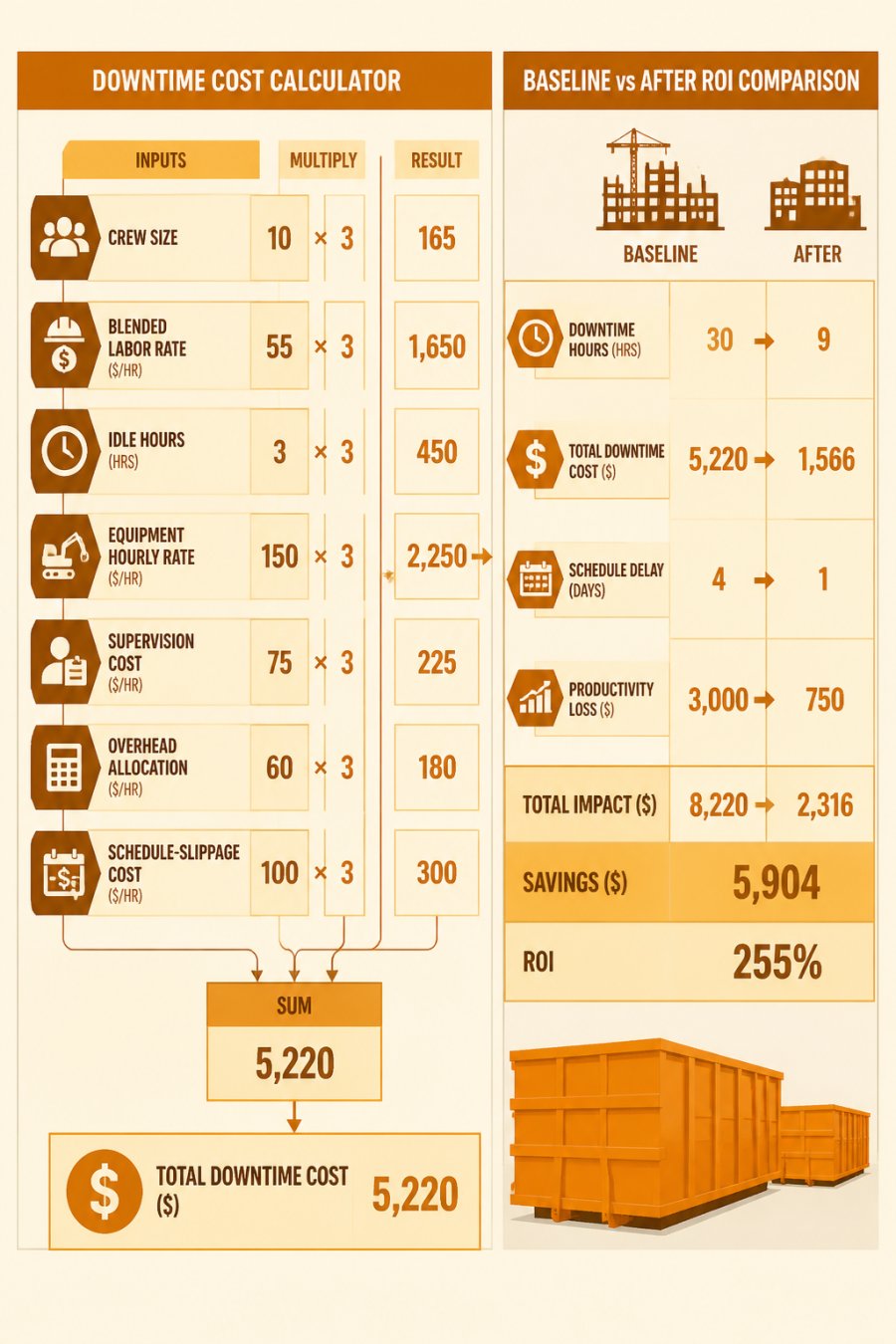
You do not need software to size the problem. A simple formula turns idle hours into a dollar figure you can act on, and it is the same formula you will reuse later to prove the savings.
Downtime Cost = (Crew Size x Blended Labor Rate x Idle Hours) + (Equipment Hourly Rate x Idle Hours) + Supervision Cost + Overhead Allocation + Schedule-Slippage Cost
Most contractors stop at the first three terms. The last two are where the real money hides.
- Blended labor rate: your loaded rate, including benefits, payroll taxes, and workers' compensation. Use the real number, not the base wage.
- Equipment hourly rate: any machine on rent bills whether it runs or not. Include the idle-hour rate from your rental agreement.
- Supervision cost: foremen and supers cost money while they wait too.
- Overhead allocation: your fixed monthly overhead divided by expected working hours. Every idle hour absorbs a slice of it.
- Schedule-slippage cost: the daily cost of a delayed completion, including extended general conditions, liquidated damages if your contract has them, and lost early-completion incentive.
Worked Example: One Stalled Morning
Say a six-person crew is idle for three hours because a rented lift is down and the work area is blocked by debris. Blended labor runs $65 per hour. The lift rents at $40 per hour. A foreman at $85 per hour is also waiting. Overhead allocation is $30 per idle hour. The schedule absorbs a half-day slip at a general-conditions cost of $500.
- Labor: 6 x $65 x 3 = $1,170
- Equipment: $40 x 3 = $120
- Supervision: $85 x 3 = $255
- Overhead: $30 x 3 = $90
- Slippage: $500
- Total: $2,135 for one morning
Run that same math across a month of recurring stalls and the business case for fixing the cause writes itself.
How to Prove the Savings
The calculator is also your ROI tool. Follow this baseline-versus-after method:
- Baseline: log idle hours by cause for one full month before you change anything. Record crew size, equipment on rent, and slippage days alongside them.
- Intervene: fix one cause at a time so you can attribute the change.
- After: log the same metrics for the next month.
- Compare: subtract after-cost from baseline-cost. Divide the savings by what you spent on the fix. That ratio is your return.
Track idle hours, hauls per month, dumpster fill rate, and on-time completion side by side. When hauls drop and idle hours fall, the savings show up in project profitability, not just in a spreadsheet.
Common Causes of Equipment Downtime and Project Delays
Equipment failure and coordination breakdowns cause most of the lost hours on a jobsite. They look unrelated. In practice, they feed each other.
Equipment Failures and Maintenance Gaps
A machine that misses its routine inspections fails at the worst moment. Preventive maintenance is cheaper than a repair in the middle of a pour.
- Skipped service intervals on heavy equipment
- Worn parts that fail under load
- No spare replacement parts on hand
- Slow repair response from a distant dealer
A common mistake is treating maintenance as optional when the schedule tightens. That is exactly when a breakdown hurts most.
Trade Coordination and Handoff Delays
Trade-by-trade coordination is where schedules quietly slip. If the electrician cannot start until the framer clears out, both crews lose.
- Work sequencing that overlaps trades in the same space
- Subcontractor coordination gaps with no single owner
- Material availability that stalls a crew mid-task
- Task readiness checks that happen too late
The fix is a daily handoff check. Confirm the next trade has a clear, ready space before they arrive.
Construction Site Debris Management: A Key Downtime Killer
Construction site debris management is the practice of controlling waste flow so it never blocks the work. When debris piles up, crews slow down or stop.
Debris is downtime in disguise. A full roll-off dumpster means someone has to stop and wait for a haul. Scattered material creates trip hazards and safety incidents.
Many contractors treat waste as a cleanup chore. It is really a scheduling input. If the dumpster is full, the next task cannot start.
Good debris management keeps the work area clear and the container ready. That single habit removes a whole category of avoidable delays.
Construction Cleanup Scheduling to Prevent Delays
Construction cleanup scheduling means planning debris removal around the work sequence, not after it. Cleanup should follow the trades, not interrupt them.
Build cleanup into the schedule the same way you build in inspections:
- Daily: Clear active work zones at the end of each shift.
- Per phase: Schedule a full debris sweep before the next trade moves in.
- Weekly: Confirm dumpster capacity matches the upcoming workload.
- Before inspections: Clean early so a failed walk-through does not cost a day.
The mistake is treating cleanup as reactive. When it is reactive, crews stop work to deal with waste. When it is scheduled, waste never becomes the bottleneck.
Pair cleanup timing with your hauling plan. Fewer, fuller hauls beat frequent partial ones, and they cut both cost and truck traffic. If you would rather not manage the hauling side yourself, Dumpster Rental keeps a container on site so crews are never waiting on a swap.
How On-Site Dumpster Compaction Reduces Downtime and Costs
On-site dumpster compaction crushes waste inside the container so it holds far more before a haul is needed.
Here is the mechanism. Loose debris, especially shingles, cardboard, and packaging, is mostly air. Crushing it on site packs the same material into a much smaller volume.
The downtime effect is direct. A dumpster that fills in two days now lasts much longer.
The cost effect follows. Fewer hauls mean lower dumpster fees. Fewer truck trips also cut the site's carbon footprint.
For general contractors running tight schedules, this is one of the simplest levers available. You are not changing how crews work.
Building a Downtime Response Protocol and Contingency Plan
A downtime response protocol is a written plan for what happens the moment work stops. Without one, every delay becomes a fresh argument. The strongest version pairs a short set of rules with a decision tree for each common trigger.
The Five Rules
- Name the triggers. List what counts as downtime: equipment failure, late delivery, full dumpster, failed inspection, weather, unavailable crew.
- Assign an owner. One person decides and communicates. No group huddles.
- Set the first response. For a full dumpster, that might be calling for compaction or a swap. For a breakdown, it is the repair contact.
- Plan the backup work. Keep a task ready that crews can do while the main path is blocked.
- Review weekly. Track idle hours by cause and fix the top one each week.
Decision Trees for the Four Most Common Triggers
Equipment breakdown. Is the machine on the critical path? If yes, call the repair contact and the rental swap line at the same time.
Weather. Is the work weather-sensitive? If yes, shift crews to interior or covered tasks and protect the schedule. If no, continue and document the conditions.
Material shortage. Is a substitute approved? If yes, use it and document the substitution.
Unavailable crew. Is the absence covered by another crew? If yes, reassign and confirm the handoff. If no, pull forward the next ready task and check task readiness before the crew arrives.
Contingency Planning Turns a Crisis into a Checklist
Write the trees down, post them, and rehearse them once a quarter. The goal is not to eliminate downtime. It is to make the first thirty minutes automatic so the crew is never standing around deciding what to do.
Track a few key performance indicators: idle hours, hauls per month, dumpster fill rate, and on-time completion. Compare them quarter over quarter. When hauls drop and idle hours fall, the savings show up in project profitability and customer satisfaction.
Frequently Asked Questions
What is construction jobsite downtime?
Construction jobsite downtime refers to any period when work stops or slows due to equipment breakdowns, material shortages, poor coordination, or safety incidents. It includes both unplanned stops and planned pauses like maintenance. For general contractors, downtime directly impacts labor costs, project schedules, and profitability. Tracking downtime helps identify patterns and implement fixes.
How do I calculate downtime on a construction site?
To calculate downtime, track idle hours per crew and multiply by the crew's hourly labor cost. Add equipment rental costs for idle machinery and any penalties from missed deadlines. Include indirect costs like extended supervision and site overhead.
What are common causes of downtime on a construction site?
Common causes include equipment failures, late material deliveries, trade coordination issues, and debris accumulation that blocks work areas. Unplanned downtime often stems from skipped preventive maintenance or poor jobsite planning. Weather and safety incidents also contribute. Addressing debris and cleanup scheduling can significantly reduce idle time caused by clutter and access issues.
How does on-site dumpster compaction affect waste-hauling frequency?
On-site dumpster compaction crushes waste inside the dumpster, increasing its capacity by up to 70%. This means fewer hauls are needed because each dumpster holds more material. For general contractors, fewer hauls translate to lower disposal costs and less downtime waiting for dumpster swaps. It also reduces truck traffic on site, improving safety and efficiency.
Downtime is not a mystery. It is a set of causes you can measure, price, and remove. Junk Crusher helps general contractors cut one of the most stubborn causes with mobile on-site dumpster compaction, which reduces roll-off volume by up to 70%, fewer required hauls, and a smaller carbon footprint. If idle crews waiting on full dumpsters are eating your schedule, book a crush with Junk Crusher and turn those lost hours back into billable work.


