
Mashed Co Alternative for Construction Waste
Table of Contents
- Why Contractors Are Searching for a Mashed Co Alternative
- How On-Site Compaction Works: A Direct Comparison of Technologies
- Construction Site Debris Management: What Changes When You Compact
- Construction Waste Hauling Frequency: The Math Behind Fewer Truck Trips
- ROI Calculator: How to Estimate Your Waste Compaction Savings
- Regulatory Compliance Checklist for On-Site Waste Processing
- The Junk Crusher Alternative: Mobile Compaction for Construction Sites
- Conclusion
- Frequently Asked Questions
Last Updated: September 12, 2026
Why Contractors Are Searching for a Mashed Co Alternative
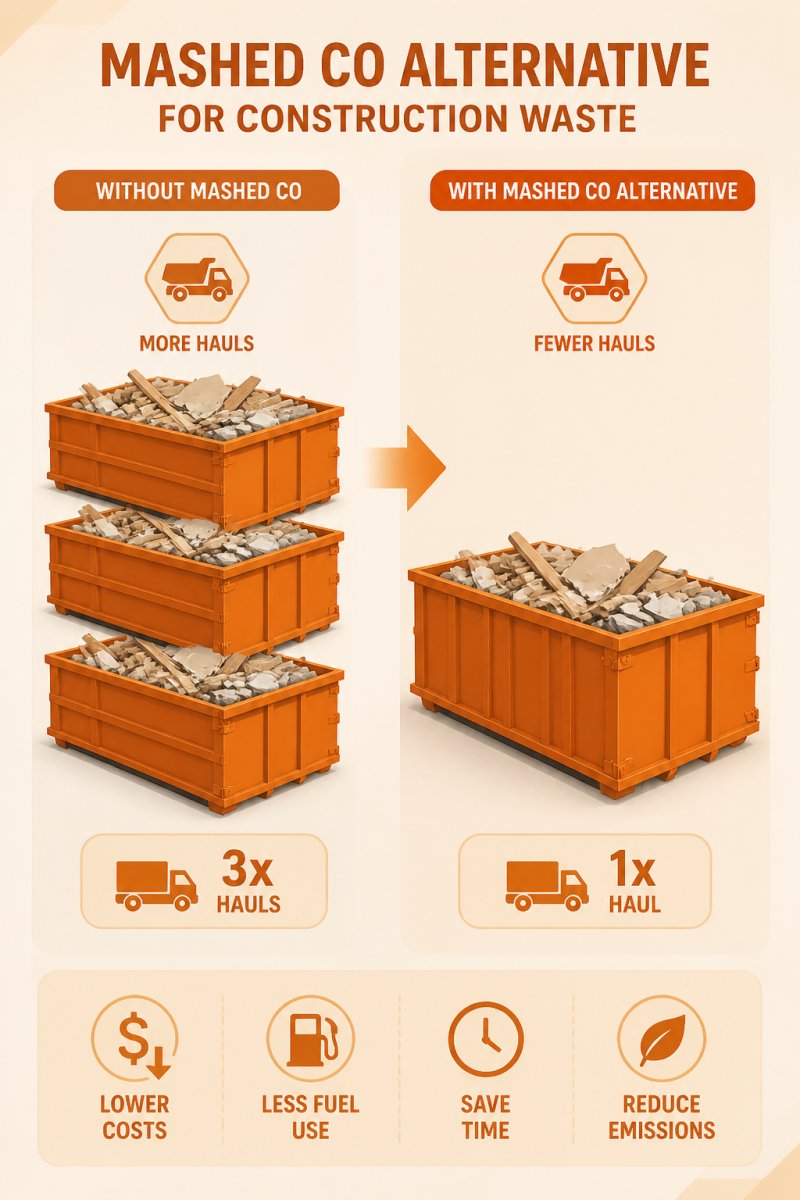
Contractors want a mashed co alternative for construction because traditional waste hauling charges them to move air. Junk Crusher built its business around that problem: mobile, on-site dumpster compaction that crushes debris before it ever leaves the jobsite. This guide breaks down how compaction technologies compare, what the hauling math looks like, and how to estimate your own savings.
Here's the core tension. A roll-off dumpster fills up long before it reaches its weight limit when you're loading shingles, drywall, and mixed C&D debris. You're paying hauling fees on empty space. A mashed co alternative for construction solves that by compacting material in place, so each container holds more and each truck trip does more work.
The EPA's Construction and Demolition Debris Management guidance frames the problem clearly: C&D debris is one of the heaviest and most voluminous waste streams in the country, and diversion rates remain low relative to the material generated. Volume, not weight, is what drives your hauling frequency.
Below, we'll show you exactly how on-site compaction changes the economics of a working jobsite.
How On-Site Compaction Works: A Direct Comparison of Technologies
On-site compaction falls into three broad technology families, and most contractors searching for a mashed co alternative for construction never stop to compare them directly.
Rotational crushers use a rotating drum or shaft with hardened teeth to break debris down through shear force. They handle mixed material well and tolerate contamination better than press-based systems.
Hydraulic press plates apply direct downward force to flatten material in the container. They excel on flat, uniform debris like shingles and drywall but struggle with irregular, bulky items.
Auger systems feed material through a rotating screw mechanism that crushes and compacts continuously. They work best in fixed installations with a consistent waste stream, not on a jobsite that changes daily.
The practical difference comes down to mobility and material tolerance.
Construction Site Debris Management: What Changes When You Compact
Construction site debris management changes fundamentally once you compact in place. The container stops being a passive box and becomes an active processing point.
Shingles, Drywall, and Mixed C&D: What Actually Compacts
Shingles compact exceptionally well. They're flat, dense, and stack predictably under pressure. Roofing crews see some of the biggest volume reductions because shingle loads are almost pure air until compressed.
Drywall compacts well too, though it generates dust. Mixed C&D is messier. Wood, metal, and cardboard respond differently to force, so a rotational system that handles variance outperforms a press plate on mixed loads.
Compaction doesn't reduce weight. Your hauler still charges by weight on the back end. What you're eliminating is the volume-driven haul, the truck that shows up to move a half-empty container.
Construction Waste Hauling Frequency: The Math Behind Fewer Truck Trips
Construction waste hauling frequency is the lever that moves your cost line. If a container holds twice the material, you schedule half the hauls.
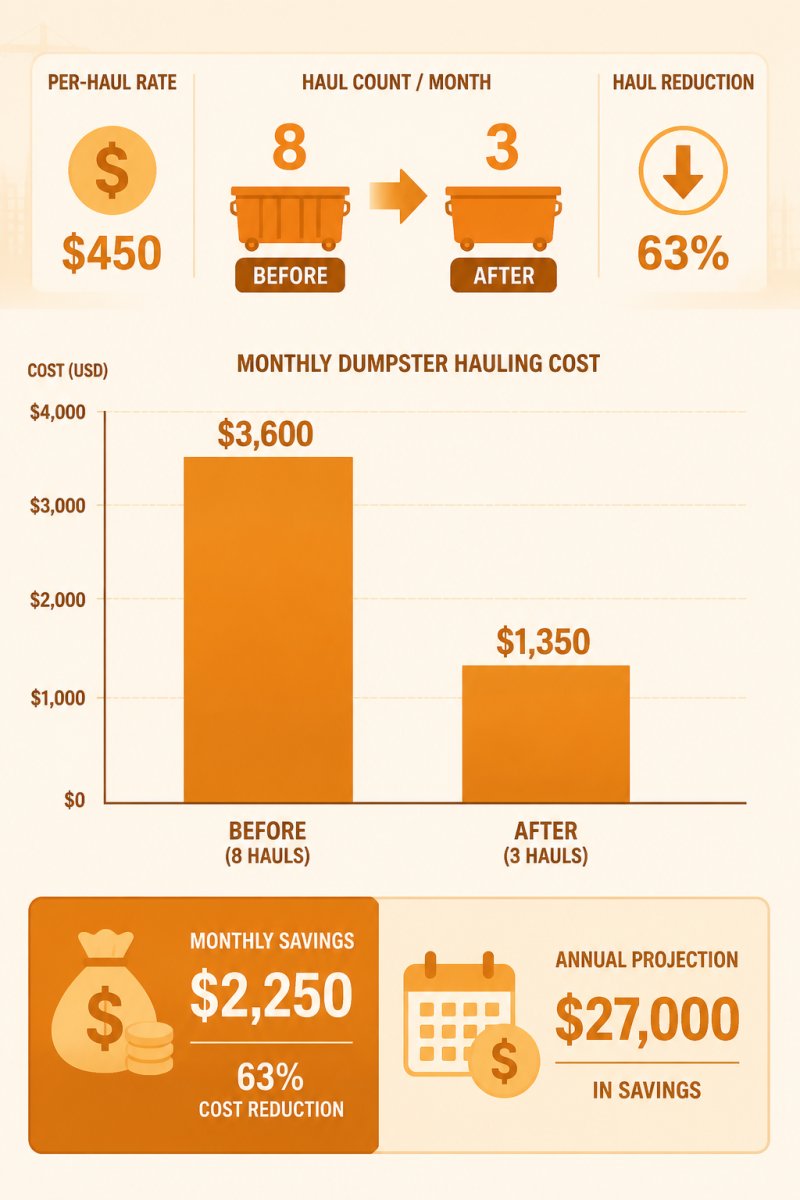
Picture a mid-size commercial site running eight hauls a month. Compact in place and that same debris volume might fit in three. Fewer trucks means fewer hauling fees, less gate traffic, and less downtime waiting on pickup.
The secondary benefit is jobsite logistics. Every haul is a truck entering your site, staging, and leaving. Cutting haul frequency frees up your yard space and reduces the coordination load on your site supervisor.
ROI Calculator: How to Estimate Your Waste Compaction Savings
Most contractors searching for a mashed co alternative for construction want one thing: a number. Not a pitch, not a percentage claim, a framework they can run against their own jobsite and see whether compaction pays. Here's that framework.
The Four Inputs You Need
You can build a working ROI model with four numbers pulled from your own hauling invoices and site logs:
- Current monthly haul count. Count every roll-off pickup, including overflow pulls. Most mid-size commercial sites run between six and twelve per month depending on phase.
- Per-haul cost. This is your hauler's flat pull fee plus any fuel, environmental, or overweight surcharges. Pull it straight from an invoice, don't estimate.
- Container size and fill pattern. Note whether containers are hitting weight limits or volume limits first. If they're volume-limited (typical for shingles, drywall, and mixed C&D), compaction has room to work. If they're weight-limited, compaction won't help much.
- Expected volume reduction. Ask the service provider for a site-specific estimate rather than assuming a number.
The Formula, Worked
Monthly savings = (Current hauls − Reduced hauls) × Per-haul cost
Say a site runs eight hauls a month. If compaction cuts that to three, you've eliminated five hauls. Multiply five by your per-haul rate and you have monthly savings. Multiply by twelve for the annual figure.
But the formula alone undersells the model. Add these secondary lines:
- Labor recovered. Every haul is a truck entering the site, staging, and leaving. If your superintendent spends 30 minutes per haul coordinating gate access and staging, five fewer hauls per month is roughly 2.5 hours of supervisory time back.
- Container rental avoided. If you're currently renting an overflow container to absorb volume between hauls, that line disappears once compaction is in place.
- Site footprint. Fewer containers on site means more laydown space, which matters on tight urban lots.
What Breaks the Model
Three things kill compaction ROI:
- Weight-limited loads. If your hauler charges by weight and your containers are already hitting the weight cap, volume reduction won't reduce hauls. Check your tickets before you build the case.
- Low haul frequency. If you're running two hauls a month, the absolute savings are small even at a high reduction rate.
- Contamination. A single load rejected for prohibited material wipes out months of savings. Sort discipline is a prerequisite, not an add-on.
Pricing for a compaction service depends on volume, site access, and service frequency, so request a quote rather than guessing at a rate. The OSHA standards for construction site housekeeping also matter here: keeping debris contained and walkways clear is a compliance issue, not just a cost one.
Regulatory Compliance Checklist for On-Site Waste Processing
On-site waste processing sits at the intersection of environmental regulation, workplace safety, and local disposal rules. Here's what to verify before you compact a single load.
Environmental and Disposal Compliance
- Classify your debris stream before compaction. C&D material is regulated differently from municipal solid waste in most jurisdictions. Confirm which category your loads fall under with your hauler and your state environmental agency.
- Separate hazardous and prohibited material first. Asbestos-containing material, lead-painted components from pre-1978 structures, solvents, and pressurized containers cannot be compacted. Sort at the point of generation, not at the container.
- Confirm local diversion requirements. Many states and municipalities set C&D diversion targets or disposal bans on specific materials. Compaction doesn't change your diversion obligations, it changes the logistics of meeting them.
- Document every load. Retain haul manifests, weight tickets, and disposal facility receipts. If your jurisdiction requires diversion reporting, your manifests are the evidence.
- Verify your hauler's permits cover compacted loads. Some disposal facilities have density or composition restrictions. Confirm before your first compacted pull.
Workplace Safety Compliance
- Keep egress paths clear. OSHA's housekeeping requirements for construction sites address accumulated debris and means of egress. Compactor placement must not block exits, stairways, or fire lanes.
- Establish a exclusion zone around the compaction point. Rotational crushers and press plates generate flying debris and pinch points. Only trained operators should be inside the zone during a cycle.
- Train operators on the specific equipment. Lockout/tagout procedures, emergency stops, and material limits vary by system. Generic training isn't sufficient.
- Confirm container weight limits are not exceeded. Compaction increases density. A container that was volume-limited before may become weight-limited after, and overweight loads trigger penalties and rejected pulls.
- Check fall protection and access requirements. If operators access the container or compactor platform, fall protection rules apply.
Documentation to Keep on Site
- Haul manifests for every load leaving the site
- Weight tickets matching each manifest
- Operator training records for the specific equipment in use
- Equipment inspection and maintenance logs
- Hazardous material separation records
What to Ask Your Service Provider
Before you sign with any on-site compaction service, ask three questions:
- Who handles manifest documentation, you or them?
- What happens if a load is rejected at the disposal facility for contamination or weight?
- How do they verify that prohibited material hasn't entered the container?
A provider who can answer these clearly is one who's been through an inspection. One who can't is a liability.
Compliance isn't the exciting part of a mashed co alternative for construction, but it's the part that keeps you operating.
The Junk Crusher Alternative: Mobile Compaction for Construction Sites
Junk Crusher is a mobile on-site dumpster compacting service built for commercial clients, and it's the alternative we'd point contractors toward. The service crushes dumpster waste in place, reducing roll-off container volume by up to 70% and cutting the number of required hauls (the EPA).
What separates it from a generic hauling arrangement: the compacting happens on your site, on your schedule, without you renting extra containers to absorb overflow. That translates to up to a 56% reduction in dumpster fees for clients, along with fewer truck trips and a smaller carbon footprint from hauling.
It serves construction, demolition, and manufacturing operations, and it pairs naturally with Junk Crusher's dumpster rental options if you need 20 or 25 yard containers on site.
Junk Crusher works across multiple sites on a regular schedule, which matters if you're running crews in more than one location.
Conclusion
The real challenge with construction waste isn't finding somewhere to put debris. It's stopping the bleed from hauling fees on containers that are mostly air. A mashed co alternative for construction only pays off if it reduces your haul count without disrupting your crew.
Junk Crusher handles that with mobile on-site compaction, up to 70% volume reduction, and up to 56% lower dumpster fees. Book a Crush and see what your hauling line looks like after compaction.
Frequently Asked Questions
What are the benefits of on-site waste compaction for construction sites?
On-site compaction reduces debris volume by up to 70%, which means fewer roll-off dumpster hauls and lower disposal fees. For a busy jobsite, that translates to less downtime waiting for swaps, more usable yard space, and fewer truck trips through the neighborhood. It also helps with waste diversion goals because compacted loads are easier to sort and route to recycling facilities rather than straight to landfill.
How does mobile dumpster compaction compare to traditional hauling?
Traditional hauling picks up whatever is in the dumpster, even if it is mostly air. Mobile compaction crushes the debris in place first, so each container holds significantly more material. The result is fewer pickups for the same amount of waste.
Can on-site compaction reduce the number of dumpster hauls required?
Yes. Volume reduction of 60-70% typically cuts haul frequency by half or more. If your site was scheduling eight hauls per month, compaction could bring that down to three or four. The exact number depends on your material mix, dumpster size, and how tightly the debris packs. Heavier materials like shingles and drywall compact differently than framing lumber or cardboard.
How do I calculate the cost-efficiency of waste compaction services?
Start with your current monthly haul count and the per-haul cost from your waste hauler. Multiply those to get your baseline. Then estimate your compacted haul count, usually 40-60% of the original, and multiply by the same per-haul rate. Add the compaction service fee to the new total. If the combined cost is lower than your baseline, compaction is worth pursuing. Ask your provider for a site-specific quote since pricing depends on volume, schedule, and location.
What factors should contractors consider when choosing a waste management service?
Look at service area coverage, equipment capability for your specific debris types, scheduling flexibility, and whether the provider can handle multiple sites. Ask for references from similar projects. Also check how the service integrates with your existing dumpster rental setup, because you may not need to change haulers at all.
