
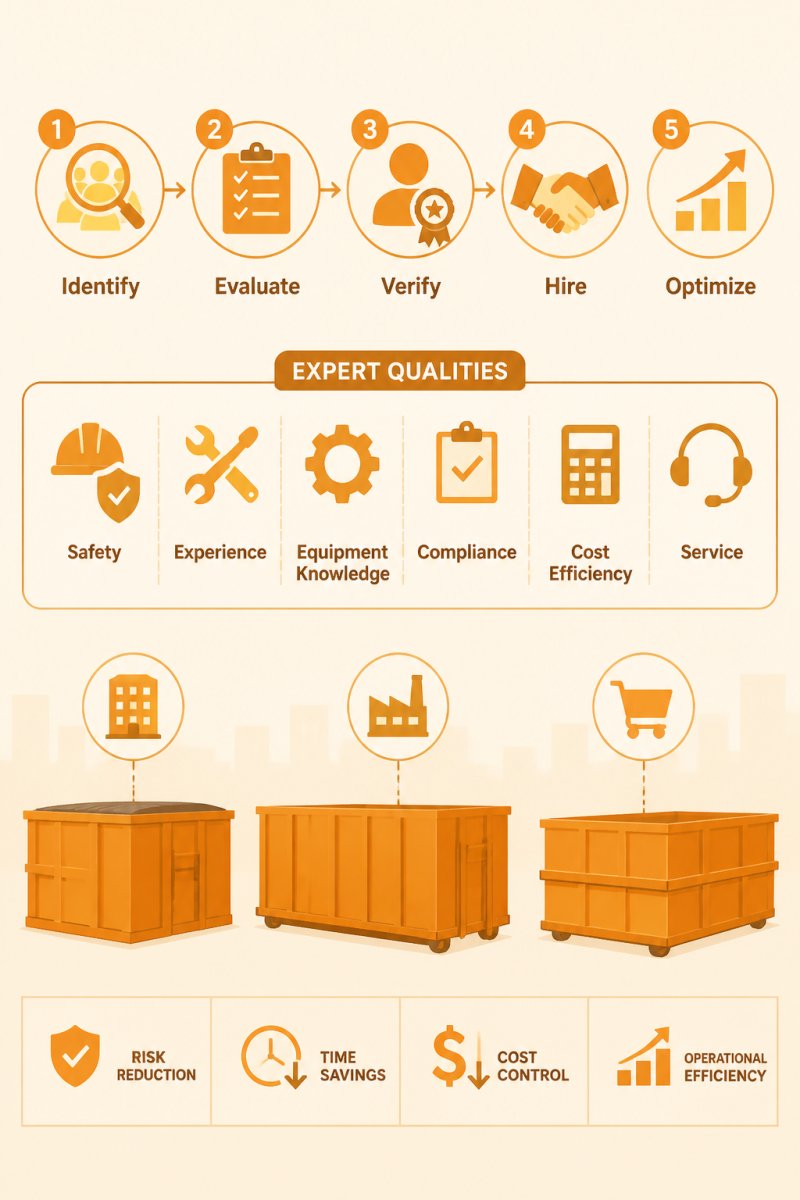
How to Hire Local Waste Compaction Experts
Table of Contents
- What You'll Need Before Hiring Waste Compaction Experts
- Step 1: Audit Your Current Waste Streams and Hauling Frequency
- Step 2: Evaluate Commercial Dumpster Compaction Benefits
- Step 3: Compare Best Smash My Trash Alternatives
- Step 4: Calculate Mobile Waste Compaction Cost Savings
- Step 5: Verify Compliance and Preventative Maintenance Plans
- Step 6: Service Contracts and Multi-Site Scheduling
- Common Mistakes to Avoid When Hiring Waste Compaction Experts
- Frequently Asked Questions
Last Updated: September 17, 2026
What You'll Need Before Hiring Waste Compaction Experts
Hiring local waste compaction experts starts with three things: a written record of your current waste volumes, a copy of your hauler agreement, and a rough map of your site's dumpster placement. Without those, every vendor conversation becomes guesswork.
Gather this before you make a single call:
- Twelve months of haul invoices, including overage and fuel surcharges
- Your current dumpster sizes and pickup frequency
- A site sketch showing dumpster locations, truck access, and turning radius
- Any internal sustainability or waste diversion targets
- Contact details for whoever signs off on vendor contracts
Step 1: Audit Your Current Waste Streams and Hauling Frequency
A waste audit tells you how much you're actually throwing away versus how much you're paying to haul. Most facilities overestimate their volume and underestimate their empty-space cost.
How to Calculate Your Baseline Costs
Add every line on your haul invoices for a full year, not just the base rate. Divide by twelve for a monthly baseline. Then divide that monthly figure by the number of hauls to get your true cost per pickup.
Step 2: Evaluate Commercial Dumpster Compaction Benefits
Commercial dumpster compaction benefits come down to one mechanism: crushing air and void space out of the waste stream so each container holds more material. That changes your cost structure without changing your operation.
Two gains show up immediately.
Step 3: Compare Best Smash My Trash Alternatives
When facility managers search for the best Smash My Trash alternatives, they're usually comparing mobile on-site compaction services against each other. The differences are in coverage, equipment, and how the provider handles your specific waste type.
| Provider Type | How It Works | Best For | Watch Out For |
|---|---|---|---|
| Mobile on-site compaction | Truck-mounted crusher compacts your dumpster in place | Multi-site industrial and construction operations | Limited service radius; confirm your sites are covered |
| Stationary compactor rental | Permanent hydraulic unit installed at your dock | High-volume single-site facilities | Capital cost, footprint, and maintenance burden |
| Traditional hauling | Standard pickup on a fixed schedule | Low-volume or irregular waste streams | You pay for empty space on every haul |
| Self-contained compactor | Combined container and compactor unit | Wet or high-liquid waste streams | Heavier, harder to relocate |
What to Look for in a Mobile Compaction Provider
Ask four questions before you sign anything.
- Can you service every one of my sites on a set schedule?
- What happens if the crusher goes down mid-service?
- Do you handle shingles, heavy debris, and mixed construction waste?
- Who owns the equipment, and who pays for repairs?
A provider that can't answer all four cleanly isn't ready for a multi-site industrial account.
Step 4: Calculate Mobile Waste Compaction Cost Savings
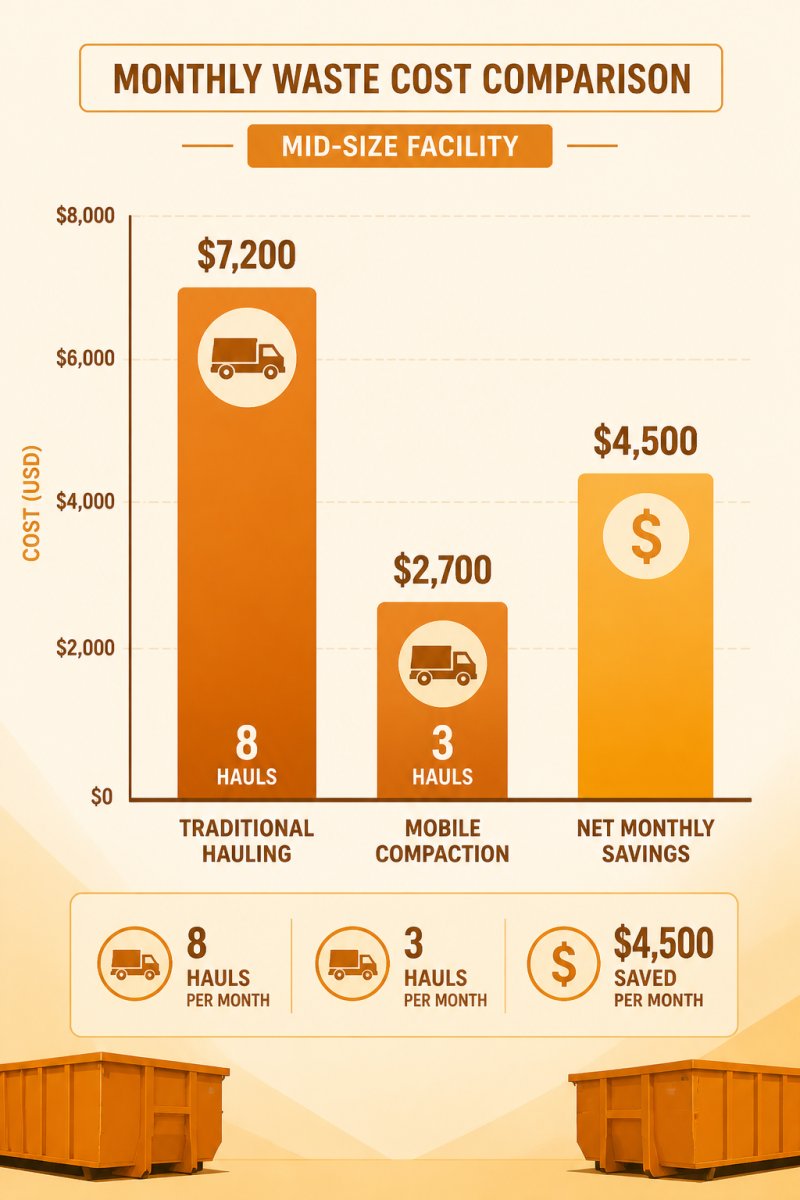
Mobile waste compaction cost savings come from two levers: fewer hauls and more material per haul. Model both before you commit, and model them on your own invoices, not on a vendor's rule of thumb.
Build the Model in Four Inputs
Every credible savings estimate reduces to four numbers you already have.
- Current hauls per month. Pull this from your hauler invoices, not your memory. Count every pickup, including extra pulls for overflow.
- Your all-in cost per haul. Base rate plus fuel surcharge plus environmental fee plus overage. This is the number compaction actually attacks.
- Compaction ratio for your waste stream. Cardboard and dry mixed debris compact differently than shingles or wet waste. Ask the provider what ratio they expect for your specific material, and ask them to show it on a test pull.
- Service fee per visit. What the compaction provider charges each time the crusher comes out. This is the cost you're adding to the equation.
The Formula
Net monthly savings = (hauls avoided × cost per haul) − (compaction service fees)
ROI Factors: Hauling Frequency, Capacity, and Logistics
- Hauling frequency. Count your current monthly pickups. If compaction cuts that count, multiply the reduction by your cost per haul.
- Capacity. Confirm how much additional material each container holds after compaction. A provider who won't put a number on this is guessing.
- Logistics. Factor in reduced truck traffic, less yard congestion, and fewer scheduling conflicts with deliveries. These don't show up on the invoice but they show up in labor hours.
Where the Model Breaks Down
Three inputs routinely get overstated.
- Compaction ratio. Vendors quote the best-case ratio for ideal material. Real waste streams are mixed. Discount the quoted ratio unless you've seen it on your own container.
- Haul count reduction. If your hauler bills a minimum monthly pickup regardless of volume, fewer hauls may not reduce your bill. Read the contract.
- Service fee creep. Per-visit pricing can rise with fuel or equipment costs. Ask whether the rate is locked for the contract term.
A Sanity Check Before You Sign
Ask the provider to run one paid test service on your highest-volume container. Compare the haul interval before and after. If the interval doesn't stretch enough to cover the service fee, the model fails on your site regardless of what the spreadsheet says. That single test is worth more than any savings estimate a sales rep hands you.
Step 5: Verify Compliance and Preventative Maintenance Plans
Compliance and maintenance are where cheap providers cut corners. Most competitors skip this section entirely, which is exactly why it's worth slowing down here, a compactor that fails an inspection or injures an operator costs far more than the service fee you saved.
The Compliance Questions to Ask in Writing
Ask the provider to document, in the contract, how they handle each of the following. Vague answers are a red flag.
- OSHA machine guarding and lockout/tagout. Compactors and crushers are powered equipment with moving parts. Operators and maintenance staff need guarding in place and a lockout/tagout procedure before any service or jam-clearing. Ask who trains your staff and who owns the procedure.
- Powered industrial truck safety. If your team uses forklifts to stage waste near the compactor, OSHA's powered industrial truck standard applies. Confirm the provider's site plan keeps pedestrian and truck traffic separated.
- RCRA waste stream documentation. The federal baseline for handling and tracking waste is set by RCRA. If any of your streams are regulated, the provider needs to feed you documentation you can hand to a regulator.
- Local zoning and permit requirements. Compactor placement, noise, and enclosure rules are set locally, not federally. Confirm with your municipality whether a stationary unit needs a permit or a screening enclosure before you install one.
- Diversion and sustainability reporting. If your facility tracks diversion rates, the provider must deliver data in a format you can actually use, weight tickets, stream breakdowns, and service dates.
OSHA standards for machine guarding and lockout/tagout
RCRA hazardous and non-hazardous waste requirements
Preventative Maintenance: What Belongs in the Contract
A hydraulic failure mid-service means your container sits full until it's repaired. The maintenance clause is what determines how long that takes.
A service contract should spell out:
- Response time when equipment fails, in hours, not "promptly"
- Who performs repairs and at what cost
- Whether a backup unit is available and how fast it arrives
- The preventative maintenance schedule, hydraulic fluid, hoses, seals, and inspection intervals
- Documentation you receive after each service visit
A Troubleshooting Shortcut
Before you call a technician, most operators can rule out the common causes themselves. If the crusher won't cycle, check the emergency stop, the hydraulic fluid level, and whether a jam is blocking the cycle. If it cycles weakly, suspect hydraulic pressure or a worn seal. If it won't start at all, check the disconnect and any interlock on the guard door.
Step 6: Service Contracts and Multi-Site Scheduling
Multi-site operators need a schedule, not a promise. Map every location, its waste type, and its current pickup cadence before you finalize terms.
Common Mistakes to Avoid When Hiring Waste Compaction Experts
The most expensive mistake is signing a contract without a baseline audit. You can't verify savings against a number you never measured.
Four others come up repeatedly:
- Choosing on price alone. The lowest per-service rate often comes with the slowest response time and no backup equipment.
- Ignoring site access. A crusher truck needs room to maneuver. Confirm access before you commit.
- Skipping the maintenance clause. Equipment downtime is your problem unless the contract says otherwise.
- Assuming one schedule fits all sites. A construction jobsite and a distribution center have different cadences.
Frequently Asked Questions
What are the benefits of mobile dumpster compaction?
Mobile dumpster compaction reduces waste volume by up to 70%, which cuts hauling frequency and lowers disposal costs. It also frees up yard space, reduces truck trips, and supports sustainability goals by lowering your carbon footprint. For construction, manufacturing, and distribution sites, this means fewer roll-off containers needed and less downtime waiting for hauls.
How does on-site waste compaction reduce hauling costs?
On-site compaction crushes waste inside your dumpster, so each container holds more material before it is full. That means fewer hauls per month because you are not paying to transport empty space. For example, if you currently schedule four hauls per month, compaction could cut that to two or three, directly reducing your waste management expenses.
How do I choose between a permanent compactor and mobile compaction services?
Permanent compactors require a large upfront investment, dedicated space, and ongoing maintenance. Mobile compaction services bring the equipment to your site on a schedule, so you avoid capital costs and can service multiple locations without installing equipment at each one. If your waste volume fluctuates or you operate several sites, mobile service is often more flexible and cost-effective.
Is mobile waste compaction safe for all dumpster types?
Mobile compaction works with most standard roll-off dumpsters, including 20 and 25 yard sizes. Providers assess your container type and waste stream before compacting. Heavy debris like shingles or industrial waste may require a site assessment to confirm compatibility. Always ask the provider about their safety protocols and equipment capabilities for your specific materials.
Waste costs climb quietly, one surcharge and one unnecessary pickup at a time. Junk Crusher compacts dumpster waste on site, reducing roll-off volume and cutting the number of hauls your facility pays for. With mobile on-site compaction, multi-site scheduling across Western Pennsylvania, and support for construction, demolition, and manufacturing waste streams, we make the switch straightforward. Book a Crush and see what your waste budget looks like when you stop paying to haul empty space.
