

Are Hidden Fees Sneaking Into Your Waste Contract?
Last Updated: October 25, 2026
Quick Summary
Common hidden fees in waste management contracts include environmental and regulatory fees, fuel and energy surcharges, administrative and account fees, container rental and equipment charges, contamination fees, overage and overweight charges, and early termination penalties. Ask for the full fee schedule before signing and confirm which lines are fixed versus adjustable.
- Environmental fees are often calculated as a percentage of invoice charges, so they rise as your bill rises.
- Fuel surcharges should be tied to a named, published index that can decrease as well as increase.
- Administrative fees are usually flat dollar amounts and are among the most negotiable lines in a waste contract.
- Overweight charges are typically billed per ton above the allowance using the disposal facility's weight ticket.
- Automatic renewal with a long notice window is the most common cancellation trap in waste agreements.
Table of Contents
- Why Hidden Fees Thrive in Waste Management Contracts
- How to Read Waste Management Invoice Charges Line by Line
- 1. Environmental and Regulatory Fees
- 2. Fuel and Energy Surcharges
- 3. Administrative and Account Fees
- 4. Container Rental and Equipment Charges
- 5. Contamination and Improper Sorting Fees
- 6. Overage, Overweight, and Extra Pickup Charges
- 7. Waste Disposal Contract Cancellation Fees and Early Termination Penalties
- What a Waste Management Contract Review Checklist Should Cover
- Frequently Asked Questions
Why Hidden Fees Thrive in Waste Management Contracts
Most waste haulers make their margin on the line items you never negotiated. That is the core problem with common hidden fees in waste management contracts: the base service rate looks reasonable, then the invoice arrives with surcharges stacked on top of it. At Junk Crusher, we see this constantly across Western Pennsylvania job sites. A contract quotes a monthly rate, but the attached fee schedule lets the hauler adjust charges as costs shift.
The Fee Escalation Problem
Escalation clauses let haulers raise fees on a schedule or at their discretion. A contract may permit automatic annual increases, plus separate adjustments to environmental and fuel lines. Over a multi-year term, those adjustments compound. National Waste's guide to reviewing vendor contracts flags fuel surcharges, environmental fees, and administrative charges as the most common add-ons. The fix is simple: ask for the full fee schedule before signing, and confirm which lines are fixed versus adjustable.
How to Read Waste Management Invoice Charges Line by Line
Waste management invoice charges fall into two groups: the base service rate you agreed to and the variable fees underneath it. Read every invoice against your contract's fee schedule, not last month's bill.
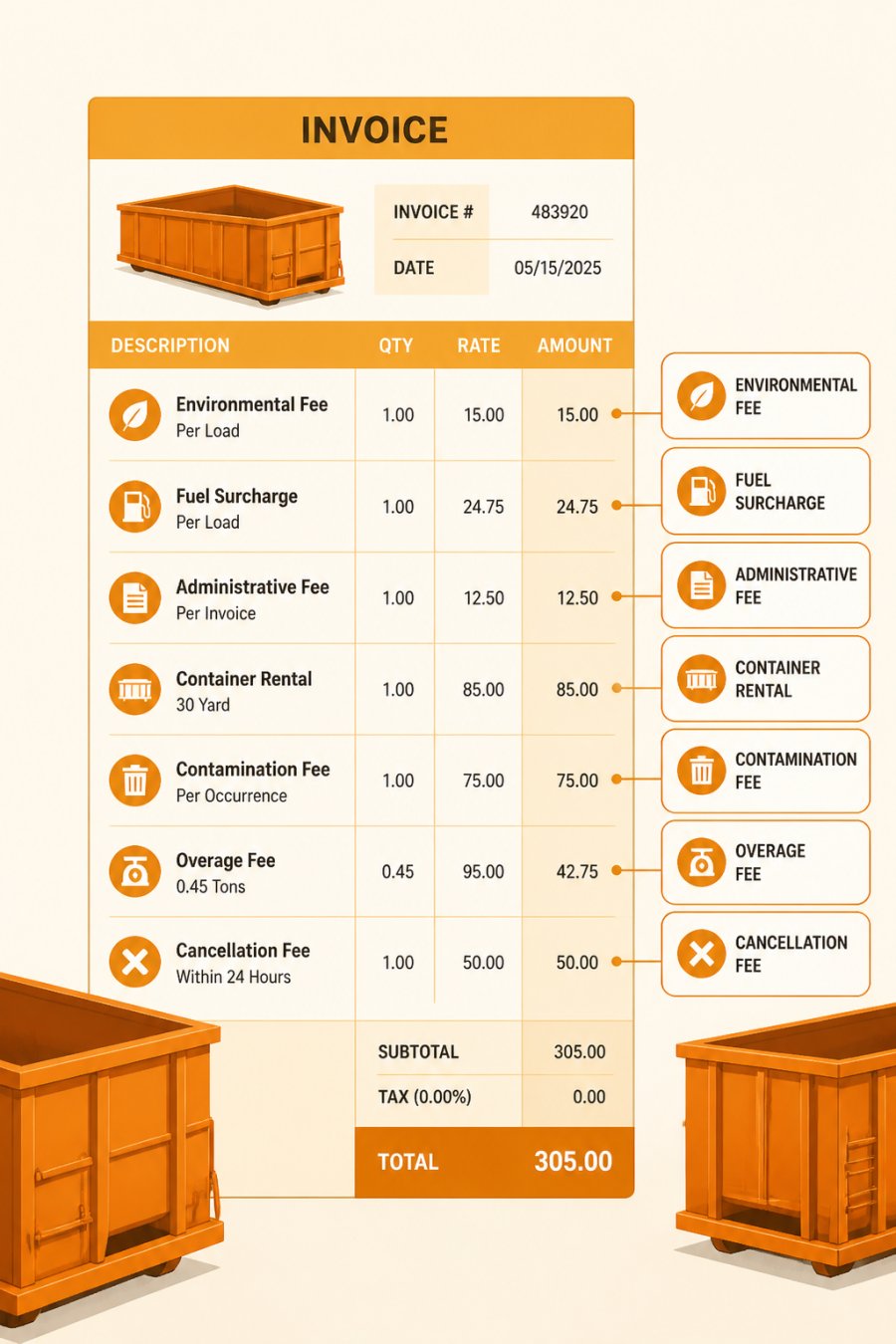
A practical review sequence:
- Match the base rate to the contract.
- Confirm each surcharge line appears in the fee schedule.
- Check the calculation basis for each variable fee.
- Flag any line you cannot trace to the agreement.
- Keep a dated copy of every invoice for disputes.
That last step matters: without service records and invoice history, disputing a charge becomes your word against the hauler's.
Here is the review sequence the article recommends for checking every invoice against your contract.
| Step | What to do |
|---|---|
| 1 | Match the base rate to the contract |
| 2 | Confirm each surcharge line appears in the fee schedule |
| 3 | Check the calculation basis for each variable fee |
| 4 | Flag any line you cannot trace to the agreement |
| 5 | Keep a dated copy of every invoice for disputes |
1. Environmental and Regulatory Fees
Environmental fees are recurring invoice charges that haulers apply to cover disposal-related costs, and they are rarely a fixed dollar amount. Waste Management's invoice charges FAQ describes its Environmental Charge as a recurring line item typically calculated as a fixed percentage of invoice charges, with the percentage subject to change. That structure is the issue. A percentage-based charge rises automatically as the rest of your bill rises.
How Environmental Fees Are Calculated
Most environmental fees use one of three methods: a flat per-pickup amount, a percentage of the subtotal, or a pass-through tied to disposal costs. Ask your hauler which applies and get it in writing. A percentage-based fee on a high-volume account can quietly outgrow the base service rate, so separate this line from disposal when benchmarking costs.
EXTERNAL_LINK: Warehouse waste cost benchmarks | junkcrusher.com
2. Fuel and Energy Surcharges
Fuel surcharges are variable fees tied to diesel prices or a published index, and they are the most frequently adjusted line on a waste invoice. Waste Consultants on hauler contract charges identifies fuel and environmental fees as items to examine closely in hauler agreements. The legitimate version of a fuel surcharge moves with a stated index. The problematic version is a flat percentage that only ever goes up.
What to Check on Your Fuel Surcharge Line
- Is the surcharge tied to a named, published index?
- Does the contract allow it to decrease as well as increase?
- How often can it be recalculated?
If the answer to any of those is "not specified," you have an open-ended charge. Fewer hauls means fewer surcharge events, which is one reason facilities weigh EXTERNAL_LINK: traditional hauling against on-site compacting | junkcrusher.com.
3. Administrative and Account Fees
Administrative fees cover billing, account management, and paperwork, and they are the fee category most likely to appear after signing rather than in the original quote. Because they are usually defined in the fee schedule rather than the service rate, they can be added or adjusted without renegotiating the base price.
Common Administrative Fee Types
Most administrative charges fall into a few recognizable patterns:
- Per-invoice or statement fees. A flat charge applied each billing cycle, sometimes labeled "invoice processing" or "statement fee." These are small individually but compound across multiple sites and billing frequencies.
- Account setup or onboarding charges. One-time fees applied when service begins, often buried in the first invoice rather than quoted upfront.
- Account management or "customer service" line items. Recurring charges tied to having an assigned representative or portal access, which may be presented as optional but appear by default.
How These Fees Are Calculated
Administrative fees are almost always flat dollar amounts rather than percentage-based, which makes them predictable but easy to overlook. A per-invoice fee applied monthly across five locations differs from the same fee applied weekly. Ask three questions before signing:
- Is the fee per invoice, per site, per container, or per account?
- Is it one-time or recurring?
- Does it change if billing frequency or service level changes?
Administrative fees are often quoted as a single proposal line but itemized into several charges on the first invoice. Compare the proposal's fee summary against the first two invoices line by line; flag any charge missing from the proposal in writing before you pay it.
Negotiation Language to Request
Administrative fees are among the most negotiable lines in a waste contract because they are not tied to disposal costs. Practical requests include:
- A written cap on total administrative charges per billing cycle.
- Waiver of setup fees as a condition of signing.
- A clause stating that no new administrative fee category may be added without written notice and your approval.
Administrative fees rarely dominate a waste bill, but they are the clearest signal of how a hauler treats fee disclosure. A contract that lists every administrative charge in writing usually handles the larger surcharges the same way.
4. Container Rental and Equipment Charges
Container rental charges apply when you lease rather than own the equipment, and equipment charges cover delivery, removal, and swap-outs. The trap is the removal fee: many contracts include free delivery but charge for pickup when service ends, and some bill separately for each container swap. If you would rather sidestep rental lines altogether, Dumpster Rental with our 20- and 25-yard dumpsters is a straightforward alternative to leased equipment.
5. Contamination and Improper Sorting Fees
Contamination fees apply when recyclable loads contain material the hauler will not accept, and improper sorting fees apply when waste streams are mixed. Waste Optimize on hidden trash costs lists contamination fees for improper sorting alongside overfill and special pickup charges. These fees are avoidable, which makes them the easiest line to attack. Signage at the dumpster, a short sorting briefing for crews, and a weekly spot check will prevent most of them.
6. Overage, Overweight, and Extra Pickup Charges
Overage charges apply when a container exceeds its rated capacity, and overweight charges apply when the load exceeds the weight allowance. Both trigger extra pickup fees, and all three are where hauling costs escalate fastest. RoadRunner on waste management costs identifies contamination fines, overage charges, extra-trip fees, and fuel surcharges as the costs businesses most often miss.
How Overweight Charges Are Calculated
Overweight charges are typically billed per ton above the allowance, using the disposal facility's weight ticket. Because you pay for the air inside the container as much as the material, an overflowing bin can bill twice: once for the overage and once for the extra trip. Learn how empty space in industrial dumpsters drives extra pickups and cost. Reducing volume before pickup is the direct fix.
EXTERNAL_LINK: Cutting waste removal costs through capacity | junkcrusher.com
7. Waste Disposal Contract Cancellation Fees and Early Termination Penalties
A waste disposal contract cancellation fee is the charge applied when you end service before the term expires, and it is frequently the largest single line in the agreement. Early termination penalties may be a flat amount, the remaining months of service, or a percentage of contract value. Check the notice period required to cancel, whether the contract auto-renews, and whether the penalty applies on renewal as well as early exit.
What a Waste Management Contract Review Checklist Should Cover
Most guides stop at naming fee categories. The practical gap is what to do with that list before you sign and after a charge appears. Use this checklist as a negotiation tool, pairing each item with the contract language you should request.
Pre-Signing Checklist With Requested Contract Language
- Full fee schedule attached as an exhibit. Request: "All fees, surcharges, and charges applicable to this agreement are listed in Exhibit A and incorporated by reference." A fee schedule referenced only in the proposal is not enforceable in the same way.
- Every surcharge tied to a named index or fixed amount. Request: "Fuel surcharge shall be calculated per the [named published index] and may decrease as well as increase." An uncapped percentage with no index is an open-ended charge.
- Escalation clause with a stated cap and frequency. Request: "Annual increases shall not exceed [X]% and shall occur no more than once per contract year." Without a cap, escalation compounds across a multi-year term.
How to Dispute a Charge Step by Step
When a fee appears that you cannot trace to the contract, a documented process matters more than a phone call:
- Pull the contract and fee schedule. Identify the exact clause the charge is supposed to rely on, or confirm that no clause exists.
- Gather service records. Collect the invoice, the pickup tickets, weight tickets if applicable, and any photos of the container at the time of service.
- Compare against prior invoices. A charge that appears for the first time without a contract change is the strongest dispute position.
- Submit a written dispute within the invoice terms. Reference the contract clause, the invoice line, and the amount in question. Keep it factual and dated.
- Request correction and a written response timeline. Ask the hauler to confirm in writing whether the charge will be removed, adjusted, or upheld, and on what basis.
- Escalate if unresolved. Most contracts include a dispute or cure period; use it before the next billing cycle so the charge does not repeat.
Questions to Ask Before You Sign
- Which fees are fixed for the full term, and which can change?
- What triggers each variable fee, and who documents the trigger?
- How much notice is required before a fee change takes effect?
If a hauler will not put a fee in writing, treat it as a fee that will appear later. The checklist only helps if it changes the contract before you sign and gives you a paper trail when a charge appears.
Frequently Asked Questions
What are common hidden fees in waste management contracts?
The most common hidden fees include environmental and regulatory charges, fuel and energy surcharges, administrative and account fees, container rental or equipment charges, contamination fees for improper sorting, overage and overweight charges, extra pickup or special trip fees, and early termination penalties. Many of these are buried in the fine print of waste management contracts and only appear as line items on your invoice after the first billing cycle. Reviewing your fee schedule before signing is the best defense.
How can I avoid a waste disposal contract cancellation fee?
Read the termination clause before signing and note the required notice period, typically 30 to 90 days. Calendar that deadline so you can cancel or renegotiate on time. Ask for the cancellation fee formula in writing, confirm whether it is a flat charge or a percentage of remaining contract value, and negotiate a cap. If you must exit early, document your reason and request a waiver in writing. Keeping service records helps if you dispute the charge later.
What should I check for on a waste management invoice?
Compare every line item to your signed fee schedule. Look for new or changed environmental charges, fuel surcharges that exceed the stated percentage, administrative fees not in the contract, container rental charges after the rental period ends, and contamination or overage fees you did not expect. Flag any charge without a corresponding service record. Request a written explanation and a copy of the contract clause authorizing the charge before paying it.
Can a waste hauler add fees that are not listed in the contract?
A hauler should only bill fees authorized by the service agreement. If a charge appears that is not in your contract, ask for the specific clause and the calculation method in writing. Some contracts include broad language allowing pass-through environmental or regulatory costs, which can open the door to new fees. If the charge has no contractual basis, dispute it formally and keep copies of all correspondence. A contract review checklist helps you spot these open-ended clauses before they become invoice surprises.


