Alternatives to Frequent Dumpster Hauling for Manufacturing
Table of Contents
- Why Frequent Dumpster Hauling Drains Manufacturing Profits
- On-Site Dumpster Compaction: Crush Waste, Not Your Budget
- Waste Segregation for Manufacturing Facilities: Sort First, Save More
- Manufacturing Recycling Best Practices That Pay Off
- Stationary Compactors and Balers: When Fixed Equipment Makes Sense
- Commercial Dumpster Rental: Sizing and Scheduling for Fewer Pickups
- How to Choose the Right Dumpster Hauling Alternative
- Conclusion
- Frequently Asked Questions
Last Updated: October 21, 2026
Why Frequent Dumpster Hauling Drains Manufacturing Profits
Frequent dumpster hauling is a silent cost center in most manufacturing plants: you pay for the container, the truck, and the empty space the truck ships. At Junk Crusher, we built our service around that last part.
A hauler charges per pull, not per ton, so a dumpster that fills to a third of its capacity costs the same as one packed to the top. Plants on steady production schedules often get a pickup every few days, meaning dozens of paid trips a year where most of the volume was never used.
Below, we walk through the practical dumpster hauling alternatives for manufacturing facilities, ranked by what they actually change about your waste operation, plus a decision framework for choosing between them.
On-Site Dumpster Compaction: Crush Waste, Not Your Budget
On-site dumpster compaction means crushing waste inside your existing container before it is hauled, so each pickup carries more material in the same footprint. It is the fastest working alternative to frequent dumpster hauling for manufacturing facilities because it changes nothing about your hauler relationship, container, or yard layout.
Here is how a mobile compaction visit typically runs:
- A compaction unit arrives at your site on a scheduled day
- Loose material in the container is crushed down in place
- The container is left with more usable volume for the next load
- Production continues while the work happens
The benefit: fewer pickups for the same amount of waste, and no new equipment to buy. Junk Crusher's mobile service is designed to reduce roll-off dumpster volume by up to 70% and cut dumpster fees by up to 56%, without replacing your existing waste setup.
The trade-off worth knowing: compaction works best on dry, crushable material. Heavy steel, sealed drums, and wet loads need different handling.
Waste Segregation for Manufacturing Facilities: Sort First, Save More
Waste segregation for manufacturing facilities means separating material streams at the point of generation so each is handled in the cheapest appropriate way. A plant that mixes cardboard, scrap metal, and general refuse in one container pays landfill rates for material that could be recovered or sold.
A practical segregation setup for a plant floor looks like this:
| Stream | Where it belongs | Why it matters |
|---|---|---|
| Cardboard and paper | Dedicated baler or recycling container | Reduces general waste volume |
| Scrap metal | Separate roll-off or scrap vendor container | Often recoverable value |
| Wooden pallets | Pallet return or grinding program | Bulky and crushable |
| General refuse | Standard dumpster | Lowest recovery value |
Segregation reduces the volume going into your general container, which directly lowers pickup frequency. It also makes compaction more effective, because the material left in the general dumpster is usually the crushable kind.
The common mistake is starting with too many streams. Begin with two or three, get the signage and container placement right, and add streams once the first ones are clean.
Manufacturing Recycling Best Practices That Pay Off
Manufacturing recycling best practices come down to three things: put containers where the material is generated, keep contamination low, and measure what leaves the building. Programs fail not because employees resist them but because the container is forty feet from the workstation.
What works in practice:
- Place collection points at the machine or line, not at the end of the aisle
- Label containers with pictures of what belongs in them, not just words
- Assign one person per shift to check contamination
- Track recovered volume monthly and post it where the team can see it
Material recovery also changes your hauling profile: baled cardboard and returned or ground pallets never enter the general dumpster, reducing the number of trips your hauler makes.
For facilities that generate consistent volumes of a single material, a dedicated recycling vendor for that stream often costs less than the equivalent dumpster capacity.
Stationary Compactors and Balers: When Fixed Equipment Makes Sense
Stationary compactors and balers make sense when a facility generates high-volume, consistent waste and has the space and power for fixed equipment. These are capital installations: a compactor mounts permanently, ties into a specific container, and needs a concrete pad, power, and a service contract.
Consider fixed equipment when:
- Waste generation is steady enough to justify the installation
- You have dedicated yard space and three-phase power available
- Your volume supports a larger container that fills predictably
- You can absorb the upfront capital cost
Skip it when your waste profile changes month to month, your yard is tight, or you lease the building and cannot commit to a permanent pad. In those cases, mobile on-site compaction delivers much of the volume reduction without the installation.
Commercial Dumpster Rental: Sizing and Scheduling for Fewer Pickups
Commercial dumpster rental remains the backbone of most plant waste programs, but most facilities size the container and set the pickup schedule once, then let both run unchanged for years while production volumes and shift patterns drift. The result is a contract that pays for air.
Two levers matter: container size and pickup frequency. A hauler charges per pull, not per ton, so a 20-yard container that is consistently half full costs the same per trip as one packed to the top.
Manufacturing facilities should review these questions at least annually, and again whenever production volume changes by more than roughly 15 percent:
- Is the container consistently full at pickup, or consistently half empty by volume?
- Does the pickup schedule match production peaks, or a legacy calendar inherited from a previous tenant?
- Could a larger container on a slower schedule reduce total trips without creating overflow risk?
- Are there seasonal swings the current contract ignores, such as annual shutdowns or peak shipping seasons?
- Is the container placed where waste is generated, or at the far end of the yard where employees consolidate loads by hand?
A common pattern is a 20-yard roll-off that fills to roughly a third of its rated volume before the scheduled pull, because bulky but light material, stretch wrap, cardboard, foam packaging, bridges and leaves air pockets, yet the hauler charges for the pull regardless. Junk Crusher offers dumpster rental in 20- and 25-yard sizes for projects that need container capacity alongside compaction, so sizing and volume reduction can be handled together.
Scheduling deserves the same scrutiny. Many plants inherit a Monday-Thursday pickup calendar that made sense when the facility ran three shifts and now runs two.
How to Choose the Right Dumpster Hauling Alternative
Choosing among dumpster hauling alternatives starts with two questions: what material are you throwing away, and how predictable is the volume? Manufacturing facilities need a third: what does each option require of your building, your people, and your capital budget?
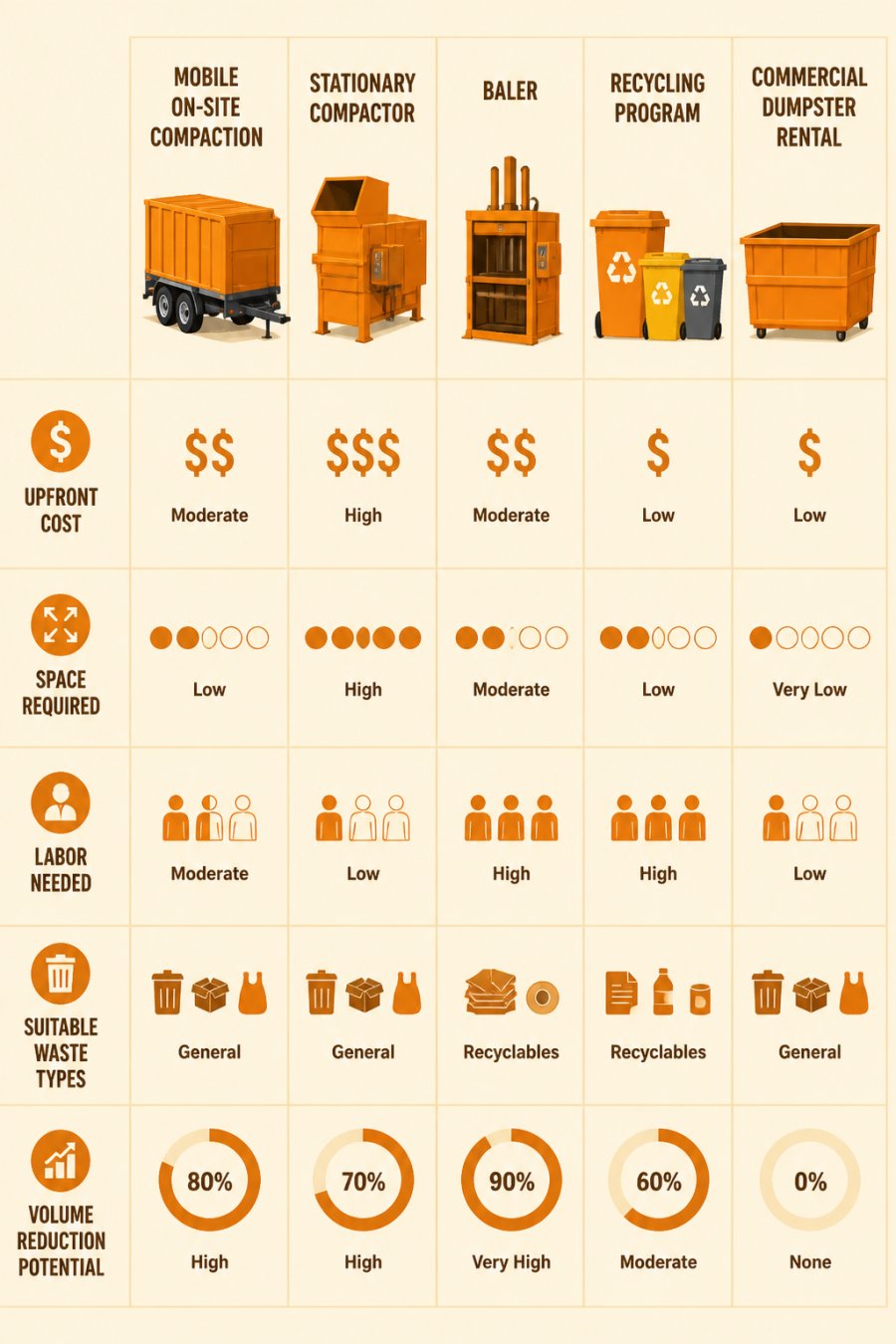
Work through this framework by waste stream first, then by operating constraint:
- Mixed, crushable waste with an existing container → mobile on-site compaction. Lowest upfront commitment of any option that meaningfully reduces volume, no permanent yard changes, no new hauler relationship.
- High, steady volume of a single crushable stream with dedicated yard space and three-phase power → stationary compactor. Capital installation with a concrete pad and service contract; justify only when volume is predictable enough to keep the machine loaded.
- One dominant material like cardboard or film plastic → baler plus a recycling vendor for that stream. Baled material often has recoverable value and never enters the general container.
- Multiple recoverable streams (scrap metal, pallets, cardboard, general refuse) → segregation program first, then reassess compaction and sizing once the general stream is clean.
- Short-term, seasonal, or fluctuating volume → right-sized commercial dumpster rental, reviewed at least annually.
Now layer in the implementation constraints that decide whether an option is actually viable at your facility:
- Footprint. A stationary compactor needs a concrete pad and clearance for the container to be swapped; a baler needs floor space near the material source. Mobile compaction needs only your existing container and a scheduled visit.
- Power and utilities. Stationary compactors and balers typically require three-phase power. If your yard or dock does not have it, the installation cost climbs quickly.
- Loading access. Can a hauling truck reach the container without blocking dock doors or forklift lanes? A container that is hard to access gets pulled less often, which defeats the purpose.
- Throughput and staffing. Balers and compactors need an operator and a maintenance routine. Mobile compaction needs neither; the work happens during a scheduled visit.
- Integration with production. Segregation and recycling programs succeed when containers sit at the machine or line, not at the end of the aisle. Plan placement around workflow, not around available floor space.
On total cost of ownership, model the full picture: equipment purchase or rental, installation, service fees, hauling cost per pull, labor to operate and maintain, and the avoided pickups each option delivers.
The decision matrix above scores each option on the criteria that drive cost and feasibility.
Conclusion
The pressure to cut waste costs rarely comes with budget for new equipment, the real constraint most operations managers face, and why the order of operations matters more than any single purchase.
Start by measuring what your containers actually carry, then reduce volume before you renegotiate hauling. Junk Crusher's mobile on-site compaction service is built for exactly that step: we crush waste in your existing roll-off dumpster, reduce volume by up to 70%, cut dumpster fees by up to 56%, and cut the number of truck trips your site generates.
Get started with Junk Crusher and find out how many of your scheduled pickups you can eliminate. Book a Crush and we will walk your site and size the schedule around your actual waste volume.
Frequently Asked Questions
Can on-site dumpster compaction reduce hauling frequency?
Yes. On-site compaction crushes waste inside your existing roll-off dumpster, so each container holds more material before it hits the weight limit. Junk Crusher reports volume reductions of up to 70%, which means fewer trips to the landfill and lower hauling costs. For manufacturing facilities generating consistent waste, this can cut pickups significantly without changing your waste hauler or adding equipment.
What types of manufacturing waste can be compacted?
Most non-hazardous solid waste can be compacted, including wooden pallets, cardboard, packaging, construction debris, and general industrial debris. Avoid compacting hazardous materials, liquids, or pressurized containers. If your facility generates metal scrap, a dedicated baler or container service may be better. Always check with your compaction provider about your specific waste stream before scheduling service.
How should manufacturers choose between compaction, recycling, and more frequent pickups?
Start by analyzing your waste stream: volume, material types, and current pickup frequency. If recyclables make up a large share, invest in segregation and recycling first. For mixed waste that's mostly air space, on-site compaction delivers immediate volume reduction. More frequent pickups are usually the most expensive long-term option. A combination of segregation, recycling, and compaction often yields the best return.
What should a facility assess before changing its waste-hauling schedule?
Review current hauling costs, dumpster sizes, pickup frequency, and waste volume trends. Check available yard space for equipment, labor requirements, and any contractual obligations with your hauler. Also consider your waste segregation practices and recycling goals. A brief waste audit can reveal how much volume you can eliminate through compaction or recycling before you renegotiate your service schedule.
When should a manufacturing facility add another dumpster instead of compacting waste?
Add another dumpster when your waste stream includes materials that cannot be compacted, when you need separate containers for recycling or hazardous waste, or when space allows and hauling costs are not the primary concern. If your current dumpster fills quickly with compactable waste, on-site compaction is usually more cost-effective than renting additional containers and paying for more pickups.


