
Dumpster Fees vs Jobsite Downtime: 56% Reduction
Table of Contents
- Dumpster Fees vs Jobsite Downtime: The Real Comparison
- Side-by-Side Comparison: Fee Savings and Downtime Savings
- How On-Site Dumpster Compaction Cuts Both Costs
- Construction Dumpster Rental: Sizing and Service Fees
- Jobsite Cleanup: Turning Cleanup Time Into Production Time
- Construction Waste Hauling: Frequency, Reliability, and Cost Control
- A Transparent Methodology for Calculating Your Savings
- Frequently Asked Questions
Last Updated: October 19, 2026
Dumpster Fees vs Jobsite Downtime: The Real Comparison
Most contractors treat dumpster fees and jobsite downtime as two separate line items. They are not. They are the same cost, arriving from different directions. At Junk Crusher, we built our service around one finding: reducing dumpster fees by up to 56% matters far less than the downtime you eliminate when a full container forces a crew to stop working. This comparison breaks down both levers, shows how they interact, and gives you a method for calculating your own numbers.
The core problem is simple. A roll-off dumpster fills faster than the pickup schedule anticipates. Your crew keeps working, debris piles up, and someone eventually has to stop production to deal with it. That is where the real money goes.
Side-by-Side Comparison: Fee Savings and Downtime Savings
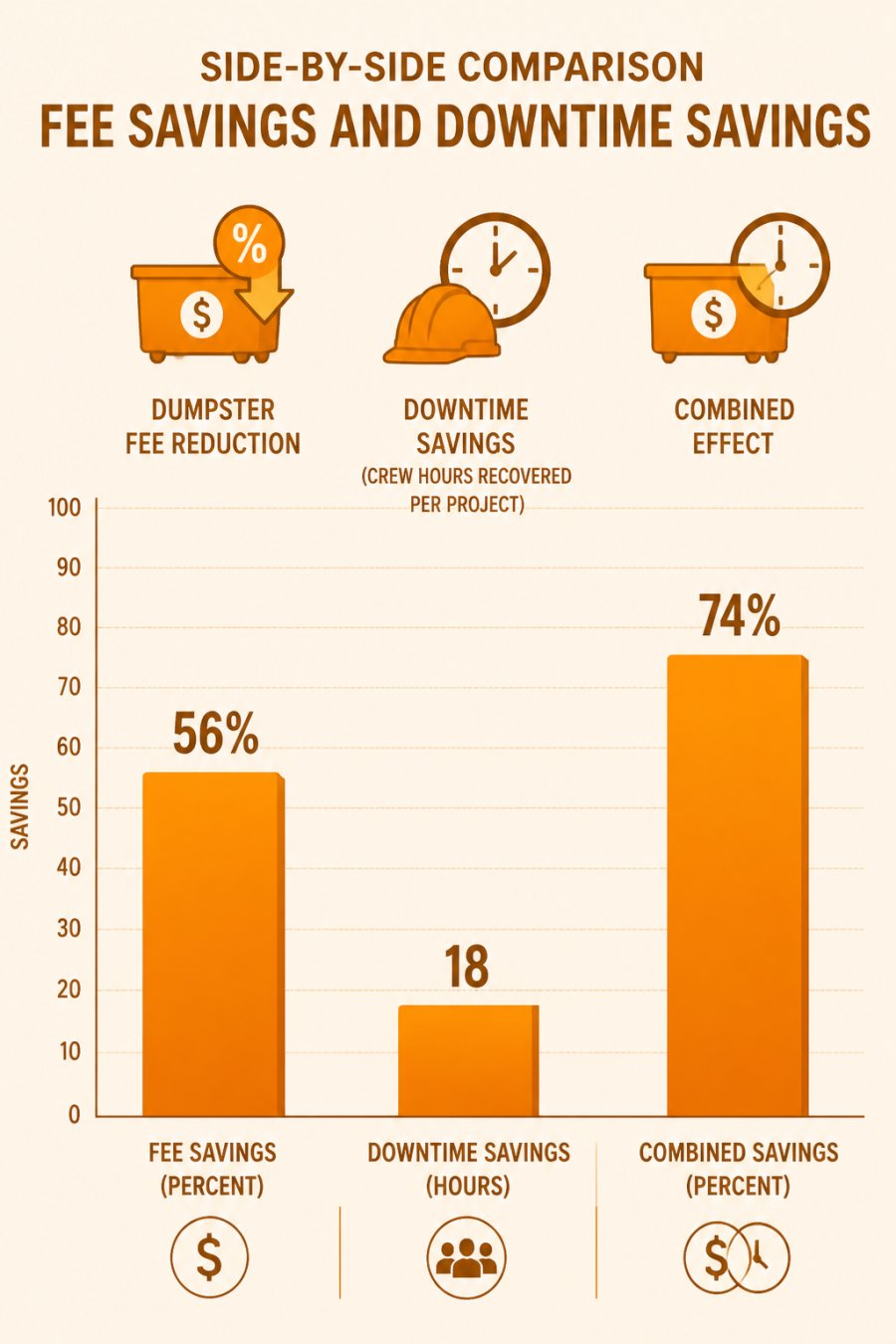
Fee savings and downtime savings differ in how they appear, how fast they materialize, and how easy they are to measure. Fee savings are visible and immediate: fewer hauls, lower overage charges, less rental time. Downtime savings are invisible until you look for them, but they compound across a project.
Consider a typical mid-size roofing project: a crew of four, tear-off debris filling a 20-yard container in two days. The hauler charges a base rental plus per-ton disposal, with overage when weight exceeds the allowance. If the container fills early, the crew stops production, waits for a swap, and loses billable hours. That lost time is downtime cost. Compaction reduces the number of hauls and the frequency of swaps, attacking both levers simultaneously.
Here is how the two levers compare across the factors that decide your total cost.
| Factor | Dumpster Fee Savings | Jobsite Downtime Savings |
|---|---|---|
| Where it appears | Hauling invoice, rental charges | Labor hours, schedule variance |
| How fast it shows | Next billing cycle | Same week, if measured |
| Ease of measurement | Straightforward | Requires tracking crew hours |
| Typical driver | Fewer hauls, less volume | Fewer work stoppages |
| Risk if ignored | Predictable overspend | Compounding schedule slip |
| Who owns it | Operations or accounting | Project manager |
| Example impact | Up to 56% reduction in dumpster fees | Recovered crew hours per project |
What Each Lever Actually Saves
Fee savings reduce what you pay the hauler: fewer pulls, fewer overage charges, shorter rental periods. Downtime savings reduce what you pay your own crew to stand around waiting for a container swap or a debris pile to clear.
The second number is the one most operations managers miss. A crew of four losing two hours to a container problem costs more than most people assume once you add burdened labor rates. Multiply that across a project and it dwarfs the invoice difference. For example, if the burdened labor rate is $50 per hour per worker, a two-hour stoppage for a four-person crew costs $400. If that happens twice a week on a month-long project, the downtime cost reaches $3,200, often exceeding the entire dumpster rental fee for that period.
Compaction changes the equation by reducing the frequency of these stoppages. Fewer hauls mean fewer opportunities for downtime, and the savings compound: you pay less in fees and lose less production time. The key is to measure both, not just the invoice.
How On-Site Dumpster Compaction Cuts Both Costs
On-site dumpster compaction is the process of crushing waste inside a roll-off container at the jobsite so more material fits per haul. It attacks both levers at once. Fewer hauls mean lower dumpster fees. Fewer container swaps mean less time your crew spends waiting.
Junk Crusher's mobile compaction service reduces roll-off dumpster volume by up to 70%, which is where the up-to-56% reduction in dumpster fees comes from. The same reduction in hauls means your crew is not stopping to manage a full container mid-task.
For roofing crews dealing with shingles and heavy debris, this matters more than for most trades. Shingle waste is bulky and fills a container fast. Compaction lets a single container absorb far more tear-off material before it needs to go.
Construction Dumpster Rental: Sizing and Service Fees
Construction dumpster rental pricing depends on container size, rental duration, haul distance, and material weight. Most haulers charge a base rental plus a per-ton disposal fee, with overage charges when you exceed the included weight allowance. Sizing too small drives overage charges and extra pulls. Sizing too large ties up capital and yard space.
The practical approach is to size for compacted volume, not loose volume. A container that looks undersized for loose debris may be correctly sized once compaction is in the picture. Our dumpster rental options pair with compaction so the container you rent does more work per pull.
Jobsite Cleanup: Turning Cleanup Time Into Production Time
Jobsite cleanup is where downtime savings become visible. Every hour a crew spends reorganizing debris, waiting on a swap, or working around a full container is an hour not spent producing. Cleanup time is not optional, but the amount of it is.
The difference between a well-run site and a poorly run one is usually not effort. It is container capacity. When the container has room, cleanup is a quick sweep at the end of a task. When it does not, cleanup becomes a scheduled event that stops everything.
Track it for one project. Note every time work pauses because of a container issue and how long the pause lasts. That log is your downtime baseline.
Construction Waste Hauling: Frequency, Reliability, and Cost Control
Construction waste hauling costs scale with frequency. More pulls mean more service fees, more coordination, and more chances for a missed pickup to disrupt your schedule. Service reliability matters as much as price: a hauler who shows up late creates the same downtime as a container that fills early.
Cost control comes from reducing the number of hauls without reducing capacity. Compaction does exactly that. It also cuts the number of truck trips, which supports sustainability goals for teams tracking their environmental footprint.
A Transparent Methodology for Calculating Your Savings
Here is how we would calculate savings on your own site. No guesswork, just your numbers. This methodology is designed for construction professionals who need to justify waste-management changes to project owners or accounting. It addresses a gap in most guides: a clear, step-by-step process for quantifying both fee and downtime savings, with construction-specific considerations.
Step 1: Baseline your hauls. Count pulls per month and the fee per pull. Include base rental, per-ton disposal, and any overage charges. For a typical 20-yard container on a roofing project, you might have four pulls per month at $450 each, totaling $1,800. Record the container size and waste type, as these affect compaction potential.
Step 2: Baseline your downtime. Log every container-related work stoppage: duration, crew size, and burdened hourly rate. Use a simple log sheet or mobile app. For example, if a crew of four stops for 1.5 hours twice a week, that's 12 hours per month. At a burdened rate of $55 per hour per worker, downtime cost is $660 per week, or $2,640 per month. This step is critical because downtime is often hidden in change orders or schedule extensions.
Step 3: Apply the volume reduction. Compaction reduces volume by up to 70%. Estimate your new haul count by dividing current volume by the compaction factor. If your current monthly volume is 40 cubic yards and compaction achieves 70% reduction, effective volume becomes 12 cubic yards, potentially reducing hauls from four to two per month. Adjust for waste type: bulky items like shingles compact well, while heavy debris may have different density.
Step 4: Compare total cost of ownership. Add hauling cost, rental cost, and downtime cost before and after. Using the examples above, before compaction: $1,800 hauling + $2,640 downtime = $4,440 per month. After compaction: $900 hauling (two pulls) + $1,320 downtime (half the stoppages) = $2,220 per month. The difference is $2,220 in savings, a 50% reduction, aligning with the up-to-56% fee reduction claim when downtime is included.
Step 5: Verify after 90 days. Compare actual hauls and logged downtime against your baseline. Adjust the model with real data. Track key performance indicators (KPIs) such as pulls per month, downtime hours, and cost per ton. Use this verification to refine container sizing and pickup schedules.
| Calculation Step | What You Measure | Why It Matters |
|---|---|---|
| Baseline hauls | Pulls per month, fee per pull, overage charges | Sets your fee baseline |
| Baseline downtime | Stoppage hours, crew size, burdened rate | Reveals hidden labor cost |
| Volume reduction | Current volume divided by compaction factor | Estimates new haul count |
| Total cost of ownership | Hauling plus rental plus downtime | Shows the full picture |
| 90-day verification | Actual versus baseline KPIs | Confirms the model and informs adjustments |
We are direct about the limits of the up-to-56% figure: it is a maximum, not a guarantee. Your result depends on waste type, container size, and how consistently your team uses the service. The methodology above is how you find out what your number actually is. For construction-specific logistics, consider how project phases affect waste volume: demolition generates more debris than finish work, so container sizing and pickup frequency should adapt. Coordinate with your hauler to schedule pickups around critical path activities to minimize downtime. Our dumpster rental options include 20 and 25 yard containers that pair with compaction for optimal results.
Frequently Asked Questions
How can construction contractors reduce dumpster fees?
Contractors reduce dumpster fees by increasing how much waste fits in each container before a haul. On-site compaction can cut roll-off volume by up to 70%, which the company says can translate to up to a 56% reduction in dumpster fees. Pair that with a waste audit to identify recyclable streams, right-size your construction dumpster rental, and set a pickup schedule based on fill level rather than a fixed calendar. Fewer hauls and fewer overage charges are where the savings concentrate.
How does on-site dumpster compaction reduce waste hauling?
On-site dumpster compaction crushes bulky debris inside the roll-off so the container holds more material by weight and volume. Because haulers charge per pull, fitting more waste into each container means fewer pulls for the same amount of debris. Junk Crusher reports volume reductions up to 70% and fee reductions up to 56%. The practical result is fewer construction waste hauling trips, less truck traffic on site, and a lower carbon footprint from fewer diesel runs.
How can better waste management reduce jobsite downtime?
Downtime creeps in when crews wait on a full dumpster, clear debris before they can work, or lose time to missed pickups. A structured waste plan keeps container capacity ahead of debris generation, so crews keep working. Compaction extends the time between hauls, which means fewer service disruptions during peak production. Add a clear jobsite cleanup routine and a named contact for customer coordination, and the labor hours spent managing waste drop noticeably.
How should contractors compare waste hauling savings with labor productivity?
Put both on the same annual basis. Add up dumpster fees, overage charges, and service fees for the year, then add the labor cost of cleanup hours and idle time caused by full containers. Compare that total against a compacted scenario with fewer hauls and less downtime. Junk Crusher reports up to 56% in dumpster fee reduction and significant downtime savings, but the honest comparison is your own numbers. Track fill levels and cleanup hours for a month before you decide.
Dumpster fees and jobsite downtime both drain profit, and most teams only track the first one. Junk Crusher's mobile on-site compaction service reduces roll-off volume by up to 70%, cuts haul frequency, and gives your crew the container capacity to keep working. We serve construction, demolition, manufacturing, and distribution sites across Western Pennsylvania. Book a Crush and measure your own savings with the methodology above.


