

Best Practices for Asphalt Shingle Recycling
Last Updated: October 28, 2026
Quick Summary
Asphalt shingle recycling follows three stages: confirm a local facility accepts post-consumer shingles before you tear off, separate shingles from underlayment, nails, metal, and packaging at the job site, then haul the load within weight limits and ask for documentation of the drop-off. Clean source separation is what makes a load acceptable.
- Call the facility before the tear-off and get acceptance criteria in writing if possible.
- Position a dedicated shingle container within easy throwing distance of the tear-off face.
- Keep underlayment, nails, drip edge, flashing, and packaging out of the shingle stream.
- Ask the facility for documentation showing the weight and material type at drop-off.
- Mobile on-site compaction reduces roll-off volume by up to 70% and cuts required hauls.
Table of Contents
- Why Asphalt Shingle Recycling Matters for Roofing Contractors
- How to Recycle Asphalt Shingles: A Step-by-Step Process
- Asphalt Shingle Recycling Requirements: What Facilities Expect
- Roofing Tear-Off Waste Sorting: Keeping Shingles Clean
- Recycled Asphalt Shingles Uses: Where the Material Goes
- Shingle Eligibility: Which Materials Can Be Recycled
- Common Mistakes That Get Shingle Loads Rejected
- How Dumpster Compaction Fits Into a Shingle Recycling Plan
- Book a Crush and Build Recycling Into Your Next Tear-Off
- Frequently Asked Questions
Why Asphalt Shingle Recycling Matters for Roofing Contractors
Asphalt shingle recycling is the practice of separating used roofing shingles from general tear-off debris so the material can be processed and reused instead of buried. For roofing contractors, it turns the heaviest part of a tear-off into a manageable, documented material stream rather than a disposal problem.
The economics are straightforward. Shingles are dense, they fill a roll-off fast, and every haul you pay for carries mostly empty space above the load line. When you separate shingles cleanly, you gain options: a recycler may take the material, and your remaining debris stream gets simpler to handle. The Asphalt Roofing Manufacturers Association guidance on shingle recycling makes the core point plainly: keep shingles apart from wood, metal, and other discarded materials, and recycling becomes more viable and often less expensive.
That is the whole argument in one sentence. Separation is not a chore bolted onto the tear-off. It is the decision that determines whether recycling is even possible.
Contractors who plan for it treat shingle recovery as part of the job sequence, the same way they plan dumpster placement. For a broader look at disposal workflows across trades, see our guide to efficient waste disposal for roofing contractors in 2026.
How to Recycle Asphalt Shingles: A Step-by-Step Process
Recycling shingles follows three stages: verify that a facility will take your material, separate shingles from the rest of the debris at the job site, and haul the load with documentation that proves where it went.
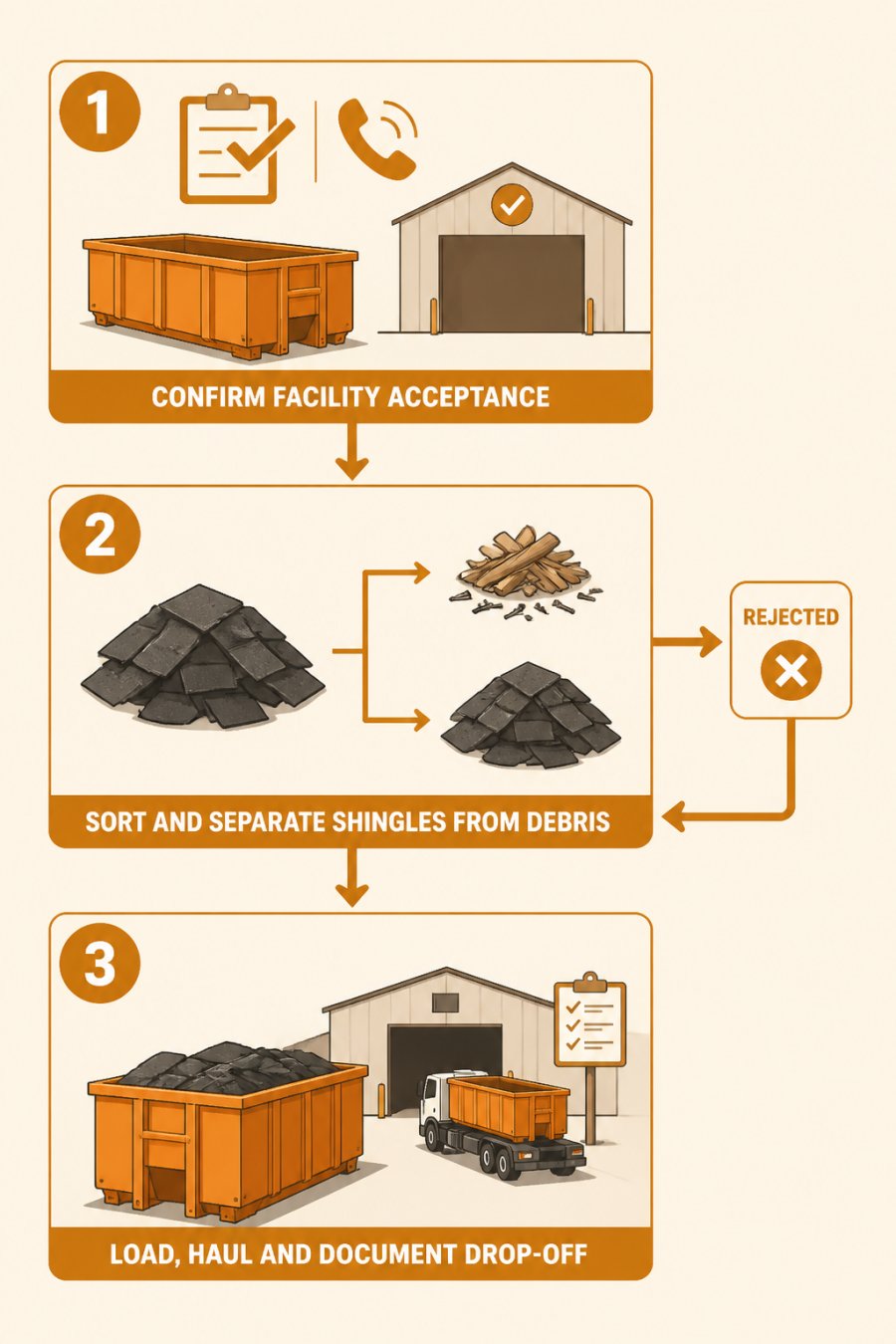
Step 1: Confirm Your Local Recycling Facility Accepts Shingles
Call before you tear off, not after. Ask three questions: do you accept post-consumer asphalt shingles, what contaminants cause rejection, and what are your hours and load limits. Facility rules vary widely by operator, and a verbal confirmation saves you a wasted trip with a heavy load.
Get the answers in writing if you can, even as a text or email. The person answering the phone at the facility can provide information on acceptance criteria.
Step 2: Sort and Separate Shingles at the Job Site
Source separation means keeping shingles in their own container from the moment they come off the roof. In practice, that means a dedicated drop zone or a second dumpster positioned near the tear-off face, not a shared pile where everything lands together.
The sort is simple but unforgiving. Shingles go in one stream. Underlayment, nails, drip edge, ridge vent, and packaging go somewhere else. Once shingles and trash mix in the same container, the load is contaminated.
Step 3: Load, Haul, and Document the Drop-Off
Load shingles so the container stays within its weight rating, and keep the load free of the items your facility named as automatic rejections. At the facility, ask whether documentation is available showing the weight and material type.
Documentation can have a customer-facing use too. Industry guidance recommends giving homeowners a written record of how much material was recycled, and some processors report the percentage recovered. If you are planning a tear-off and want to understand how shingle weight and layers affect container sizing before you book, read our breakdown of roofing dumpster rental and why weight comes before yardage.
Here is the three-stage process the article lays out for recycling tear-off shingles.
| Step | What to do | Key detail |
|---|---|---|
| Step 1 | Confirm a local facility accepts shingles | Call before you tear off; get answers in writing |
| Step 2 | Sort and separate shingles at the job site | Dedicated drop zone or second dumpster near tear-off face |
| Step 3 | Load, haul, and document the drop-off | Stay within weight rating; ask for weight and material documentation |
Asphalt Shingle Recycling Requirements: What Facilities Expect
Facility requirements differ from one processor to the next, so treat any single list as a starting point and confirm the specifics locally. That said, acceptance criteria across the industry tend to converge on a few themes: clean material, no prohibited items, and loads that fit the facility's handling equipment. The details below go beyond the typical one-line list to show what those themes mean at the scale house.
Contamination Thresholds and Prohibited Items
Facility acceptance criteria vary. Ask the facility which materials it prohibits.
- Wood, including sheathing, framing, and pallets
- Metal, such as nails, drip edge, flashing, and fasteners
- Plastic and paper packaging, banding, and wrap
- Underlayment, felt, and house wrap
- General construction debris, trash, and food waste
Ask the facility whether it accepts your shingle type and whether it requires post-manufacture scrap to be kept separate from post-consumer tear-off material.
Load Preparation Standards
Ask the facility how it expects loads to be prepared. That may include:
- Shingles should be loose or in bundles that can be easily inspected and unloaded.
- Loads must not exceed the facility's weight limits or the vehicle's rated capacity.
- Material should be free of excessive moisture, which adds weight and can affect processing.
- Loads should be secured and covered during transport to prevent debris from blowing out.
Ask the facility whether it accepts loads containing mixed shingles, underlayment, and nails.
Documentation and Traceability
Ask the facility whether it requires documentation showing the material source and weight, or a statement about asbestos or other hazardous materials.
Verification Checklist Before You Haul
Use this checklist to ask about acceptance before you commit a load:
- Call the facility and confirm they accept post-consumer asphalt shingles.
- Ask for the current contamination limit and list of prohibited items.
- Confirm weight limits and acceptable vehicle types.
- Ask whether post-manufacture scrap is accepted separately.
- Request any required documentation (manifest, asbestos statement).
- Get the facility's hours and any load-size restrictions.
- Verify the destination address and directions for large vehicles.
A quick phone call and a written confirmation can save a wasted trip and a rejected load. For a broader look at disposal workflows across trades, see our guide to efficient waste disposal for roofing contractors in 2026.
Roofing Tear-Off Waste Sorting: Keeping Shingles Clean
Clean shingles are the entire game. Every item you keep out of the shingle stream raises the odds your load gets accepted, and every item you let in raises the odds it gets rejected.
Here is how we would set up a tear-off for separation:
- Position a dedicated shingle container within easy throwing distance of the tear-off face
- Brief the crew before the first shingle comes off on what goes where
- Strip underlayment into a separate stream, not the shingle container
- Bag or bin nails, staples, and fasteners as they are removed
- Keep drip edge, flashing, and metal accessories out of the shingle load
- Remove plastic wrap, banding, and packaging from the work area before loading
- Spot-check the container at midday and again before the haul
A midday check can catch sorting problems while they are still fixable. A bundle of underlayment in the shingle container can contaminate an otherwise clean load. For a deeper walkthrough of handling shingle debris across a roofing site, our guide to managing shingle debris at roofing sites covers the workflow in more detail.
Recycled Asphalt Shingles Uses: Where the Material Goes
Recycled asphalt shingles do not disappear into a vague "recycling" void. They become feedstock, and the largest destination is asphalt pavement.
Processors grind and screen shingles into a material often called recycled asphalt shingles, or RAS. That material can be used as an additive in hot-mix asphalt, and it also shows up in cold patch products for road cracks and potholes, according to General Kinematics' overview of the shingle recycling process. The shingle's composition is one reason it can be used in pavement products; processing handles the fiberglass or organic mat.
The Construction & Demolition Recycling Association's shingle recycling coverage notes growing use of recycled asphalt shingles in hot-mix asphalt in recent years, which tells you the end market is not theoretical. Paving companies gain a lower-cost input and reduced demand for virgin material, according to ShingleRecycling.org's summary of end markets for recycled asphalt shingles.
Shingle Eligibility: Which Materials Can Be Recycled
Not every roof covering belongs in a shingle recycling stream. The material has to match what the processor is set up to handle, and the biggest split is between asphalt shingles and everything else. But eligibility goes beyond the basic material type, age, attached components, and potential hazards all play a role in whether a load will be accepted.
Accepted Shingle Types
Asphalt shingles, both fiberglass-mat and organic-mat types, are the standard feedstock. Post-consumer shingles come off an existing roof, while post-manufacture or factory scrap comes from production. Some facilities accept one and not the other, so ask which your processor wants. A state environmental agency resource on post-consumer reclaimed asphalt shingles frames best-practice guidance specifically around the post-consumer stream, which is the material a tear-off produces.
Materials That Do Not Belong
Ask the processor which roofing materials and other items it accepts in a shingle load.
How Age and Attached Materials Affect Acceptance
Ask the facility whether it has requirements concerning asbestos or attached materials before proceeding.
Suspected Hazardous Materials
Ask the facility whether it has requirements concerning hazardous or contaminated materials before loading.
Pre-Screening Questions for Your Facility
Before you tear off, ask:
- Do you accept both fiberglass and organic asphalt shingles?
- Is there an age limit or asbestos documentation requirement?
- How should attached underlayment or sealant be handled?
- Do you accept post-manufacture scrap separately?
- Are there any restrictions on shingles from fire-damaged or chemically contaminated roofs?
Getting clear answers up front can help you plan for facility acceptance and the destination of the material.
Common Mistakes That Get Shingle Loads Rejected
A load may be rejected for contamination, facility acceptance requirements, or exceeding a container's rating. Confirm requirements before hauling.
Ask the facility whether underlayment and plastic packaging are accepted in a shingle load.
Confirm that the facility accepts shingles and ask about weight limits before hauling.
How Dumpster Compaction Fits Into a Shingle Recycling Plan
Compaction and recycling address different parts of waste management. Recycling addresses where the material goes. Compaction reduces roll-off volume.
Mobile on-site compaction crushes dumpster waste, reducing roll-off volume by up to 70% and reducing the number of required hauls.
Keep your clean shingle stream separate. If you are weighing how to get more out of each container across a busy site, our article on optimizing dumpster capacity on construction sites walks through the trade-offs.
Book a Crush and Build Recycling Into Your Next Tear-Off
The contractors who recycle successfully are not the ones with the most elaborate setup. They are the ones who decided before the tear-off started: which container holds shingles, which holds everything else, and who is hauling what.
Junk Crusher supports that plan with mobile on-site dumpster compaction that reduces roll-off volume by up to 70% and cuts the number of required hauls. We serve construction, demolition, and manufacturing sites. Compaction does not replace your recycling stream.
Before you call, work through our dumpster rental call checklist so you have your address, debris types, container size, and schedule ready.
Recycling shingles well comes down to a decision you make before the first bundle comes off the roof, not a scramble at the end of the job. Junk Crusher helps roofing and construction crews in Western Pennsylvania with on-site compaction that reduces roll-off volume by up to 70% and reduces the number of required hauls. Get started with Junk Crusher and build a tear-off plan where the shingles get recovered.
Frequently Asked Questions
Can asphalt shingles be recycled?
Yes. Asphalt shingles can be recycled into recycled asphalt shingles, or RAS, which is used in hot-mix asphalt and other paving products. The catch is that not every facility accepts them, and most processors require the shingles to be separated from wood, metal and other roofing debris before drop-off. Call the facility first to confirm it takes post-consumer shingles and ask what its load requirements are.
How should asphalt shingles be prepared for recycling?
Keep shingles in their own container or pile, apart from underlayment, roofing felt, nails and plastic packaging. Remove metal drip edge and large fasteners where you can, and avoid mixing in wood sheathing or general construction and demolition waste. The Asphalt Roofing Manufacturers Association notes that recycling costs may be lower when materials are separated properly.
What contaminants prevent asphalt shingles from being recycled?
Ask the facility which materials it prohibits in a shingle load. Keep a dedicated container for shingles only, and brief your crew on what stays out of it before the tear-off starts.
Can shingles with nails be recycled?
Ask the facility whether it accepts shingles with nails still in them and whether it requires fasteners to be removed before hauling.
Where can contractors take old asphalt shingles?
Call shingle processors and construction and demolition recycling facilities in your area to ask whether they accept post-consumer shingles. Ask about accepted materials, load requirements and hours before you dispatch a truck. For jobs where recycling is not available nearby, a [dumpster rental](https://www.junkcrusher.com/dumpster-rentals) keeps debris contained, and [on-site compaction](https://www.junkcrusher.com/dumpster-compaction) reduces the number of required hauls.
How can roofing crews keep shingle waste separate on a job site?
Set up two containers before tear-off begins: one for shingles and one for everything else. Position them close to the work area so the crew does not have to walk far to sort, and label each clearly. At the end of each day, check the shingle container for wood, metal and packaging. Source separation at the point of generation can help keep a recycling load clean.


