Which Industrial Waste Streams Are Best for Compaction?
Last Updated: October 24, 2026
Quick Summary
The best industrial waste streams for compaction are dry, uniform, and bulky: cardboard, plastic film, mixed packaging, pallets, and construction debris all crush down predictably. Food waste, liquids, and hazardous material do not compact well and should be separated out.
- Compaction removes air rather than shrinking waste, so air-filled streams respond best.
- Assembly lines often achieve 50-65% volume reduction when dry packaging stays free of oil-soaked rags.
- Even 10-15% moisture by weight can cause smearing, leachate, and odor in a container.
- Junk Crusher's mobile service reduces dumpster volume by up to 70%.
- Run a one-week trial with separate containers for your top three streams before committing.
Table of Contents
- Why Waste Stream Choice Decides Your Compaction Results
- Materials Suitable for Compaction: A Ranked Guide
- Waste Streams in Manufacturing: What Actually Compacts Well
- Compaction Versus Baling: Which Processing Method Fits Your Stream?
- Dumpster Compactor Benefits: Volume, Hauling Frequency, and Cost
- Materials That Should Not Be Compacted
- A Decision Framework Based on Material Properties
- Book a Crush and Test Your Streams On-Site
- Frequently Asked Questions
Why Waste Stream Choice Decides Your Compaction Results
The best industrial waste streams for compaction are dry, uniform, and bulky: cardboard, plastic film, mixed packaging, pallets, and construction debris all crush down predictably, while food waste, liquids, and hazardous material do not. Get that match wrong and a compactor turns into an expensive way to smear grease across a container floor. At Junk Crusher, we see this play out across Western Pennsylvania plants and jobsites every week: the equipment is fine, the stream is wrong.
Here is the part most guides skip. Compaction does not shrink waste so much as it removes air. A stream that is mostly air, like corrugated boxes or stretch-wrapped pallet loads, responds well. A stream that is mostly water or dense mass barely moves at all. That single distinction explains almost every disappointing result we hear about.
Below, we rank streams by how well they actually compress, flag what should stay out of the container, and show how to test your own mix before you commit. The U.S. Environmental Protection Agency's waste management guidance is a useful starting point for classifying what you generate.
Materials Suitable for Compaction: A Ranked Guide
Materials suitable for compaction fall into three practical tiers based on how much dead space they carry. Tier 1 streams compress dramatically, Tier 2 streams compress moderately with some prep, and Tier 3 streams need special handling or should be diverted entirely.
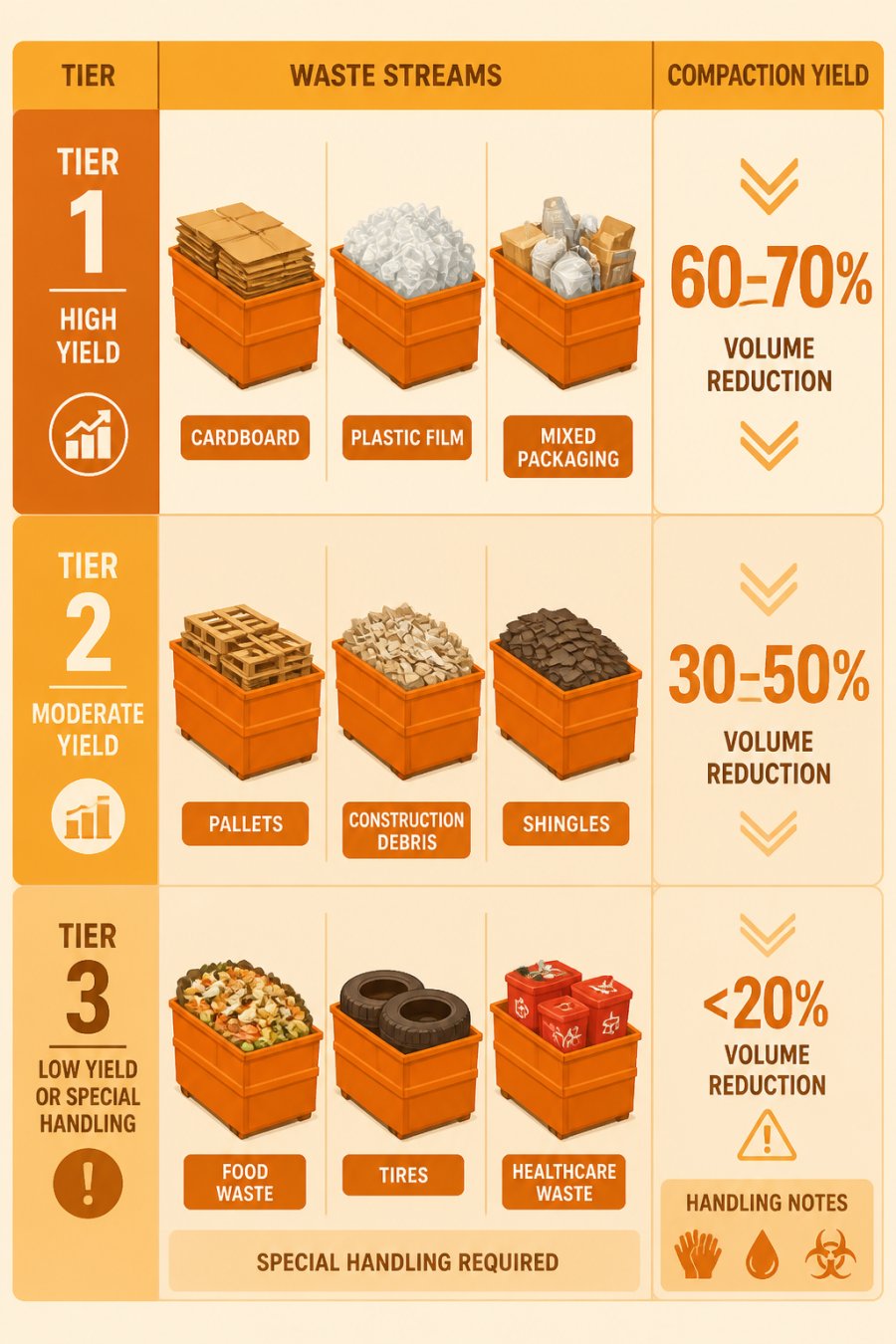
Tier 1: High-Yield Streams (Cardboard, Plastic Film, Mixed Packaging)
Corrugated cardboard is the single best candidate for any dumpster compactor. It arrives full of air, stacks in rigid layers, and collapses into dense bales under pressure. Plastic film and shrink wrap behave similarly, though they rebound slightly once the ram retracts. Mixed packaging, the retail and shipping mix of boxes, bags, and lightweight containers, compacts well as long as it stays dry.
Distribution centers and warehouses generate these streams in volume every day, which is why they see the fastest payback.
Tier 2: Moderate-Yield Streams (Pallets, Construction Debris, Shingles)
Wood pallets compress well once broken down, but whole pallets can bridge inside a container and leave voids. Construction debris is a mixed bag: drywall offcuts and framing lumber crush nicely, while rebar and concrete chunks resist. Shingles are heavy and dense, so they compress less by volume but still pack tighter than loose tear-off piles.
Roofing crews dealing with shingle volume should read our guide to managing shingle debris at roofing sites before setting up a container.
Tier 3: Low-Yield or Special-Handling Streams
Food waste, tires, and healthcare waste belong here. Food waste is wet and heavy, tires are engineered to resist deformation, and healthcare waste carries regulatory handling requirements that rule out casual crushing. These streams can still enter a compaction program, but they need separation and, in some cases, a different process entirely.
Waste Streams in Manufacturing: What Actually Compacts Well
Waste streams in manufacturing split cleanly along one line: dry process waste compacts, wet process waste does not. But within that split, the differences matter. Stamping and fabrication operations generate metal offcuts and packaging that crush predictably, steel banding and wire may resist, but cardboard and foam dunnage from parts shipments compact well. Assembly lines produce cardboard, film, and foam dunnage in steady daily volumes, often achieving 50-65% volume reduction when kept dry and free of oil-soaked rags. Food and beverage plants generate wet waste that turns a container into a leaking problem; even a small percentage of liquid waste can contaminate an entire load and trigger special-handling fees.
A common mistake is treating every plant stream as one waste stream. Segregate first, then compact. A container that receives cardboard, film, and pallets together will outperform one receiving the same materials plus cafeteria waste, because moisture ruins the whole load. In practice, plants that set up separate containers for dry packaging, wet organics, and metal scrap see the highest compaction yields and the fewest hauling surprises.
Material Properties That Drive Manufacturing Compaction Results
Three properties determine whether a manufacturing stream is a good compaction candidate:
- Compressibility: How much air the material holds. Corrugated boxes and foam dunnage are highly compressible; solid metal chunks and full drums are not.
- Moisture content: Even 10-15% moisture by weight can cause smearing, leachate, and odor. Keep wet streams out of dry compaction containers.
- Contamination: Oil, coolant, and chemical residue can render a load unrecyclable and may classify it as regulated waste. Clean segregation protects both the compactor and your compliance status.
Segregation Tactics for Manufacturing Facilities
Start with a waste audit: observe what each production line discards over a typical week, then map streams to containers. Place containers at the point of generation, near assembly cells, packaging lines, and shipping docks, to reduce cross-contamination. Label containers clearly and train staff on what stays out. For plants with multiple shifts, a simple color-code system for dry packaging, wet waste, and metal scrap prevents the end-of-shift dumping that ruins segregation.
Compaction Versus Other Processing for Manufacturing Streams
Not every dry stream should be compacted. Sorted cardboard bound for a mill may be better baled to preserve resale value. Metal offcuts are usually recycled as-is rather than compacted. Foam dunnage compacts well but may rebound; test a load before committing. For mixed dry waste with no recovery path, compaction is often the most practical option because it reduces haul frequency without requiring sorted output.
Compaction Versus Baling: Which Processing Method Fits Your Stream?
Compaction versus baling comes down to volume and destination. Compaction wins when you generate high-volume, low-value waste and pay by the haul. Baling wins when you have a buyer for sorted material and want clean, stackable units.
| Method | Best For | Space Needed | Handling After Processing |
|---|---|---|---|
| On-site compaction | Mixed dry waste, high haul frequency | Container footprint only | Hauled as-is |
| Vertical baler | Sorted cardboard, retail backrooms | Small floor area | Stacked, sold or hauled |
| Horizontal baler | High-volume sorted fiber | Large floor area | Sold to mills |
| Shredding | Sensitive documents, size reduction | Moderate | Often paired with compaction |
For a deeper comparison of processing methods, our breakdown of traditional versus on-site waste compacting covers the trade-offs in detail.
Dumpster Compactor Benefits: Volume, Hauling Frequency, and Cost
Dumpster compactor benefits show up in three places: fewer cubic yards leaving your site, fewer truck trips, and lower disposal spend. Because you stop paying to haul air, the same container holds more material and the hauler visits less often.
Junk Crusher's mobile service crushes waste in the roll-off on your site, reducing dumpster volume by up to 70%. Fewer hauls also mean fewer truck trips and a smaller carbon footprint, a point that matters to logistics managers tracking emissions. If you want the numbers behind those claims, our guide to how much dumpster compaction saves walks through the math.
Materials That Should Not Be Compacted
Some materials should never enter a compactor. Liquids and wet sludges leak under pressure and can violate container and disposal rules. Pressurized cylinders, aerosol cans, and anything reactive pose a genuine safety risk. Batteries, electronics, and items bound for recycling as whole units get destroyed rather than recovered.
Watch out: mixing one liquid-filled container into an otherwise dry load can contaminate the entire batch, turning a cheap haul into a special-handling charge. Our guide on whether waste compaction is safe for dumpsters covers the material limits in more depth.
A Decision Framework Based on Material Properties
Use four questions to decide whether a stream belongs in a compaction program. Answer them honestly and the decision usually makes itself.
- Is it dry? Moisture above a light dampness rules the stream out.
- Is it bulky rather than dense? Air-filled material compacts; solid mass does not.
- Is it uniform enough to feed without bridging? Mixed loads need pre-sorting.
- Does it have a recovery path? If material is sold or recycled whole, compacting may destroy its value.
If a stream passes all four, it is a strong candidate. If it fails one, separate it. If it fails two or more, divert it.
Book a Crush and Test Your Streams On-Site
The only way to know how your streams perform is to run them through a crusher on your own site. A trial shows you the real volume reduction, the handling quirks, and the haul savings before you change anything permanent.
That is exactly what Junk Crusher offers: mobile on-site compaction for construction sites, distribution centers, and manufacturing facilities across Western Pennsylvania. We bring the equipment to your roll-off, crush the load, and let the results make the case. You can book an on-site dumpster compaction trial and see your own numbers. If you need a container to get started, we also offer dumpster rental in 20- and 25-yard sizes.
Frequently Asked Questions
Which industrial waste materials can be compacted?
The highest-yield materials suitable for compaction are cardboard, plastic film, mixed packaging, wood pallets, construction debris, and asphalt shingles. These streams compress well because they contain significant void space. Manufacturing plants also compact metal scrap, plastic totes, and paper waste. Avoid compacting liquids, hazardous materials, and anything that could create a safety hazard under pressure. A quick on-site test with a mobile compactor shows exactly how much volume reduction your specific waste streams deliver.
What materials should not be compacted?
Do not compact liquids, hazardous waste, pressurized containers, or materials that can leak and contaminate groundwater. Healthcare waste and food waste require special handling because of odor and hygiene risks. Tires need dedicated processing equipment rather than standard compaction. Batteries, electronics, and anything containing chemicals should be segregated. When in doubt, check with your waste hauler before adding a new material to a compaction program.
How does compaction reduce industrial waste hauling frequency?
Compaction increases the density of waste inside a roll-off dumpster, so each container holds more material before it fills. A dumpster that fills in a day with loose cardboard might last three or four days after compaction. Fewer full containers mean fewer hauling trips, which lowers transportation costs and reduces truck traffic on site. For high-volume operations, this can cut hauling frequency by half or more depending on the material mix.
How should a facility decide whether to compact or bale its waste?
Choose compaction when your priority is reducing hauling volume and frequency for mixed or high-volume waste streams. Choose baling when you need clean, stackable bales for recycling markets, especially for cardboard or plastic film. Baling requires more space and labor to sort and tie bales, while compaction handles mixed loads with less sorting. Many facilities use both: baling for clean recyclables and compaction for general waste. The right mix depends on your stream composition and recycling contracts.
Your waste stream is either an asset or a cost, and the difference is how well it compacts. Junk Crusher helps you find out fast, with mobile on-site compaction that reduces roll-off volume by up to 70%, cuts dumpster fees by as much as 56%, and trims truck trips from your operation. Get started with Junk Crusher and turn your dumpster space into real savings.


