
Benefits of Mobile Waste Compaction for Retail
Table of Contents
- How Mobile Waste Compaction Works on a Retail Site
- Commercial Trash Compactor Benefits for Retail Operations
- Waste Hauling Cost Reduction Strategies That Work for Retail
- Sustainability Goals, Scope 3 Emissions, and Retail Waste Diversion
- Best Smash My Trash Alternatives and What Sets Them Apart
- Integrating Compaction With Your Existing Waste Management Contracts
- Safety and Liability Protocols for On-Site Compaction
- Frequently Asked Questions
Last Updated: September 30, 2026
How Mobile Waste Compaction Works on a Retail Site
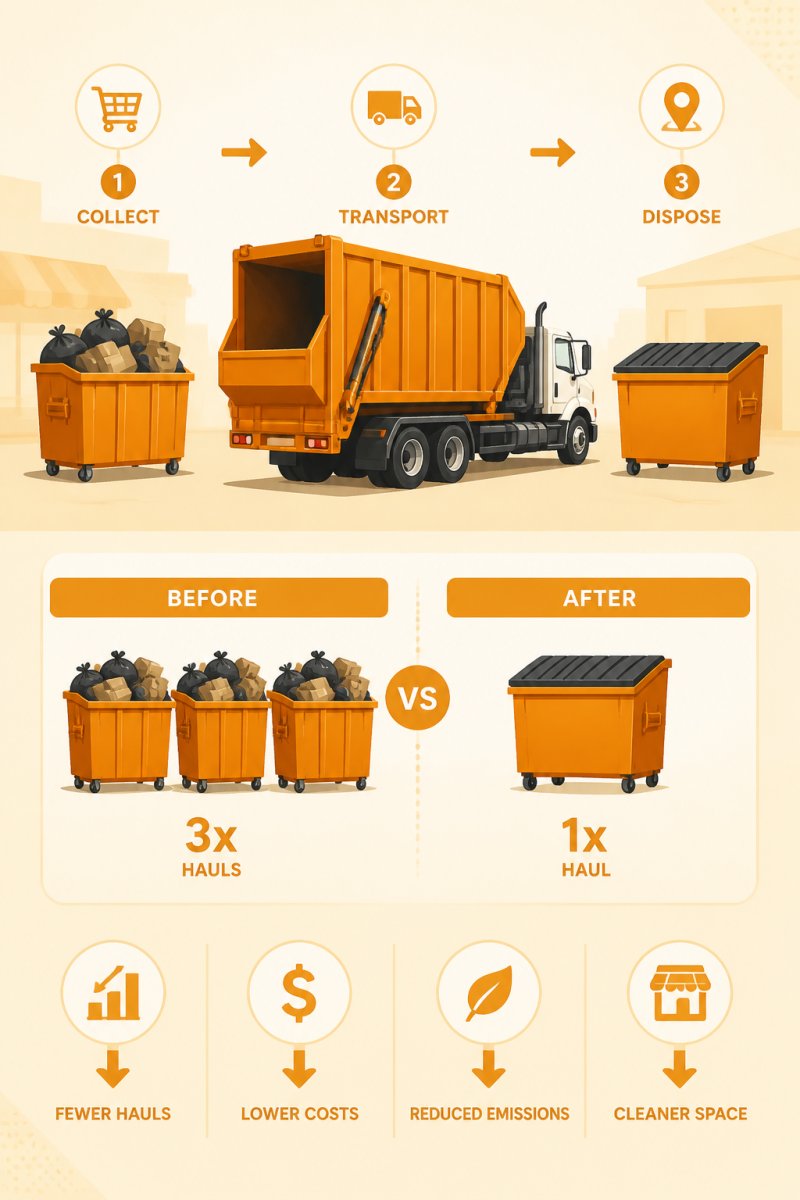
Mobile waste compaction is an on-site service that crushes a roll-off dumpster's contents in place, cutting retail waste volume before it leaves your loading dock. This guide from Junk Crusher covers what that means for store operations, budgets, and sustainability targets.
Commercial Trash Compactor Benefits for Retail Operations
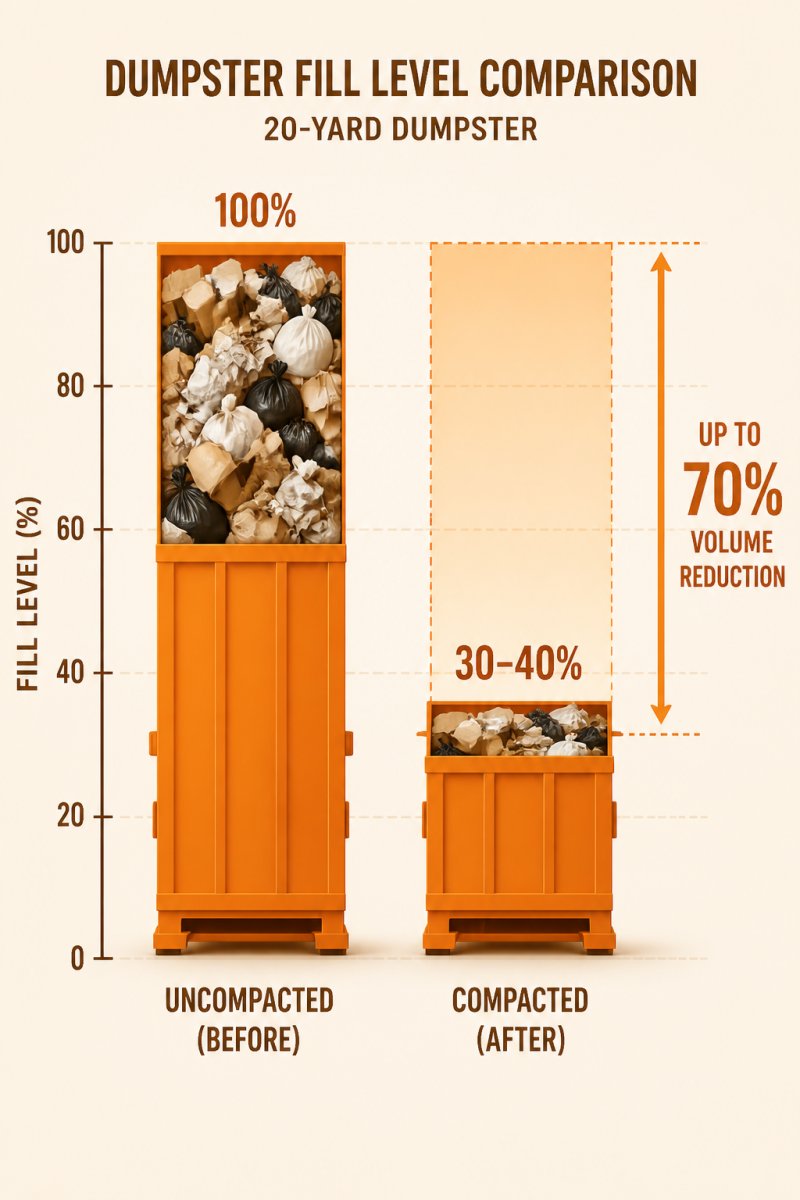
The core benefit of a commercial trash compactor run on a mobile basis is straightforward: more waste per container, fewer pulls, and lower disposal spend. Volume reduction is the biggest lever on total waste cost, because hauling fees are driven by container count and pickup frequency, not weight alone.
Volume Reduction and Dumpster Capacity Gains
Retail waste is bulky and light. Cardboard boxes, display packaging, and plastic film fill a container fast while weighing relatively little. Compaction addresses exactly that mismatch.
- Dumpster capacity: Same container, far more material
- Collection frequency: Fewer scheduled pulls per month
- Waste container management: Less staff time spent monitoring fill levels
Fewer Truck Trips and Less Site Congestion
Every haul requires a truck to enter your lot, maneuver to the dumpster pad, and leave. For retail parks and shopping centers, those movements compete with customer traffic, delivery vehicles, and pedestrian routes.
Waste Hauling Cost Reduction Strategies That Work for Retail
The most reliable waste hauling cost reduction strategy for retail is reducing pull count, not negotiating a lower per-pull rate. Haulers price on logistics, and every trip carries fixed costs regardless of how full the container is.
A practical sequence for retail operators:
- Audit your current waste stream. Separate cardboard, mixed refuse, and recyclables by volume, not just weight.
- Measure actual fill rates. Track how full each container is on pickup day for four weeks.
- Identify the bulkiest, lightest fraction. That is your compaction candidate.
- Right-size container count. Fewer, fuller containers usually beat more, half-empty ones.
- Re-bid or renegotiate with real data. Haulers respond to documented volume, not requests.
Calculating Your ROI Before You Commit
Build the case on pull count, not a vague percentage:
| Input | Where to Get It | Why It Matters |
|---|---|---|
| Current pulls per month | Hauler invoices | Baseline for savings math |
| Cost per pull | Hauler invoices | Converts pull reduction into dollars |
| Container size | Your dumpster label | Determines compaction fit |
| Fill rate on pickup day | Four-week manual check | Shows how much waste is air |
| Labor hours on waste handling | Staff logs | Captures the hidden cost |
Sustainability Goals, Scope 3 Emissions, and Retail Waste Diversion
Sustainability reporting is now routine in retail operations, and waste hauling sits inside it. Scope 3 emissions cover indirect emissions in your value chain, including waste disposal and the transportation that moves it, so fewer truck trips means fewer diesel miles attributed to your operation.
Best Smash My Trash Alternatives and What Sets Them Apart
Retail managers shopping this category usually compare a handful of national mobile compaction providers. The differences that matter are service coverage, equipment fit for your waste type, and scheduling across multiple sites.
- Best for multi-site retail: A provider that will commit to a recurring route across all your locations
- Best for heavy debris: Equipment rated for dense material, not just cardboard
- Best for tight sites: Fast service calls that do not block your dock for hours
Integrating Compaction With Your Existing Waste Management Contracts
You do not have to fire your hauler to start compacting. Mobile on-site compaction is structurally separate from hauling: compaction changes how full your containers are when the hauler arrives, not who owns or hauls them. That separation makes a phased transition possible.
Why the Two Services Can Coexist
A hauling agreement governs container placement, pickup frequency, and disposal; a mobile compaction service governs what happens inside the container between pickups. Because those are different scopes of work, most retail sites can add compaction as a standalone service without amending the hauling contract, at least initially.
Contract Clauses to Read Before You Start
Pull your hauler agreement and look for four things:
- Minimum pull requirements. Some agreements guarantee the hauler a set number of pulls per month. If you compact and cut pulls below that floor, you may still be billed for the minimum. Know the number before you change anything.
- Exclusivity or right-of-first-refusal clauses. These may require you to offer the hauler any new waste-related service before bringing in an outside vendor. Compaction is usually outside the scope, but the clause language varies.
- Automatic renewal terms. Many hauling contracts auto-renew for 12 months unless you give 60 or 90 days' notice. If you want to renegotiate pickup frequency at renewal, calendar the notice window now.
- Fuel and environmental surcharges. These are often calculated per pull. Fewer pulls means lower surcharges, which is a savings line most retail managers miss when they model ROI.
A Phased Transition Sequence
A common pattern that avoids penalty clauses:
- Add compaction without changing the hauling schedule. Run it for 60 to 90 days at your current pickup frequency. This builds a documented fill-rate baseline.
- Notify the hauler in writing that you are evaluating a frequency change, and request the contract's amendment process.
- Present the data. Show fill levels on pickup day before and after compaction. Haulers respond to documented volume, not to requests.
- Amend at renewal, not mid-term. Mid-term amendments often trigger re-pricing. Renewal windows are when you have the most leverage.
- Confirm the new schedule in writing and track fill levels for the first two months to make sure the reduced frequency holds.
Retail-Specific Scenarios
- Single-store operator on a month-to-month agreement: You have maximum flexibility. Add compaction, reduce pulls at the next billing cycle, and re-bid the hauling contract annually with your new volume data.
- Multi-site retail chain with a national hauler contract: The master agreement usually sets pricing and terms, but pickup frequency is often set at the site level. Work with your facilities or procurement team to amend frequency site by site rather than renegotiating the master contract.
- Shopping center with shared containers: Compaction changes the math for every tenant. Coordinate with property management before you compact a shared container, because the hauler's pull schedule serves all tenants, not just yours.
Safety and Liability Protocols for On-Site Compaction
Compaction involves heavy equipment operating near your staff, customers, and property, so safety planning is not optional. The OSHA standards for powered industrial trucks and general industry safety provide the baseline framework most operators apply to equipment operating in commercial spaces. But OSHA compliance is the floor, not the ceiling. Retail sites have specific conditions, customer foot traffic, shared loading docks, tight parking lots, that require protocols beyond the general industry standard.
Retail-Specific Safety Scenarios
Generic safety lists miss what actually happens at retail locations:
- Customer vehicles in the dumpster approach path. A compaction truck needs a clear approach and departure lane. In a busy parking lot, that lane may cross customer traffic. The service provider should establish a temporary exclusion zone, and your team should cone or sign it before the truck arrives.
- Shared loading docks. In multi-tenant retail parks, one dock may serve several stores. Schedule compaction service during low-delivery windows so you are not blocking another tenant's freight.
- Pedestrian routes near the dumpster pad. If customers or employees walk past the dumpster pad to reach a break area or back entrance, the exclusion zone needs to cover that path, not just the container itself.
- Container condition after repeated compaction. Compaction stresses container walls, rails, and hinges. Inspect after each service call for cracks, bent rails, or damaged hinges. A compromised container is a liability during both compaction and hauling.
Hazard Screening: What Must Never Enter the Container
Compaction multiplies the consequences of prohibited materials, a sealed container of aerosol cans that would sit inert in an uncompacted dumpster can rupture under compaction force. Screen for these before every service call:
- Propane cylinders and other pressurized gas containers
- Lithium-ion batteries, including those in discarded electronics
- Aerosol cans that are not fully empty
- Unknown liquids in unlabeled containers
- Flammable solvents, paints, and thinners
- Medical waste or sharps
How Liability Is Actually Allocated
Liability sits with clear roles, and the service agreement should state them explicitly:
- The service provider operates the compaction equipment and is responsible for equipment-related injury or property damage during the service call.
- Your site controls the waste stream and the site conditions. If prohibited materials are in the container, or if a customer enters the exclusion zone because it was not properly marked, that exposure sits with the site.
- The hauler is responsible for container condition and safe transport once the container leaves your property.
Insurance Questions to Ask Before You Sign
Ask these before committing:
- Does the service provider carry general liability and commercial auto coverage, and at what limits?
- Will the provider name your business as an additional insured on their policy for the duration of the service?
- Does your own commercial property policy exclude damage caused by third-party equipment operating on your premises? Many standard policies do, and a rider may be needed.
- If a customer is injured during a service call, whose policy responds first?
Get certificates of insurance from the provider before the first service call, and keep them on file with your other vendor documentation.
Documentation That Protects You
- Service log: Date, time, provider, container serviced, and any observed damage.
- Pre-service inspection record: Who checked the container and what they found.
- Incident report: Any near-miss, injury, or property damage, filed the same day.
- Photo record: Before-and-after photos of the container and surrounding area on each service call.
Frequently Asked Questions
How does mobile waste compaction work for retail businesses?
A mobile compaction unit arrives at your retail site and crushes the waste already inside your dumpster. The process uses a heavy plate or roller system to compress cardboard, packaging, and general retail debris, reducing volume by up to 70%. The unit services your existing container, so you keep your current dumpster setup while fitting far more waste into each load. The entire process typically takes minutes per container, minimizing disruption to store operations.
What are the primary cost savings associated with mobile waste compaction?
The main savings come from fewer hauls and better dumpster capacity use. When waste volume drops by up to 70%, you schedule fewer collection trips, which directly lowers hauling fees. Junk Crusher reports up to 56% reduction in dumpster fees for clients who switch to on-site compaction. You also reduce operational overhead tied to managing overflowing bins and emergency pickups. For multi-site retail operations, these savings compound across every location.
Does mobile waste compaction help with retail sustainability goals?
Yes. Fewer hauls mean fewer truck trips, which lowers diesel consumption and carbon emissions tied to waste logistics. That reduction feeds directly into Scope 3 emissions reporting, which covers indirect emissions in your value chain. Compaction also improves waste diversion rates because cleaner, more organized containers make recycling sorting easier. For retail chains with public sustainability targets, on-site compaction offers a measurable way to show progress without overhauling your entire waste stream.
Is mobile waste compaction safer than traditional dumpster management?
Compaction reduces the safety risks that come with overflowing dumpsters: loose debris, pest attraction, and manual handling of heavy items. The compaction unit does the crushing, so staff never need to climb into or manually press down waste. Fewer hauls also mean fewer truck movements in loading zones, which lowers the chance of vehicle-pedestrian incidents. Ask your compaction provider for their safety protocol documentation before scheduling service.
Retail waste costs creep up quietly, one extra pull at a time, until the disposal line is a real budget item. Junk Crusher built its service around that problem: mobile on-site dumpster compaction that reduces roll-off volume by up to 70%, cuts dumpster fees by up to 56%, and removes truck trips from congested retail lots. If you operate multiple locations and want a fixed compaction route rather than one-off service calls, get started with Junk Crusher and book a crush for your sites.


