Benefits of Industrial Trash Compactors for Warehouses
Table of Contents
- How Industrial Trash Compactors Work in Warehouse Operations
- Key Benefits of Industrial Trash Compactors for Warehouses
- Mobile Dumpster Compaction: A Flexible Option for Warehouses
- Trash Compactor Safety: Training and Regulatory Considerations
- Trash Compactor Pros and Cons for Warehouse Managers
- Choosing the Right Compactor for Your Warehouse Size and Waste Profile
- Installation, Site Planning, and Operational Disruption
- Conclusion
- Frequently Asked Questions
Last Updated: October 13, 2026
How Industrial Trash Compactors Work in Warehouse Operations
An industrial trash compactor presses warehouse waste into a denser, smaller mass before it leaves your dock, so each container holds more material and each haul moves more of what you generate.
The mechanics are straightforward: waste goes in, a hydraulic ram or rotating auger presses it against a heavy plate, and the compacted block stays put.
Warehouses generate a distinctive mix: corrugated cardboard, stretch wrap, pallets, packaging foam, and bulky irregular items that resist stacking. Loose cardboard and film are mostly air, and you pay to haul that air every week.
Choose equipment to fit your waste stream, not the reverse.
Key Benefits of Industrial Trash Compactors for Warehouses
Compaction pays off in three places: container capacity, hauling frequency, and the labor hours tied to both.
Waste Volume Reduction and Dumpster Capacity
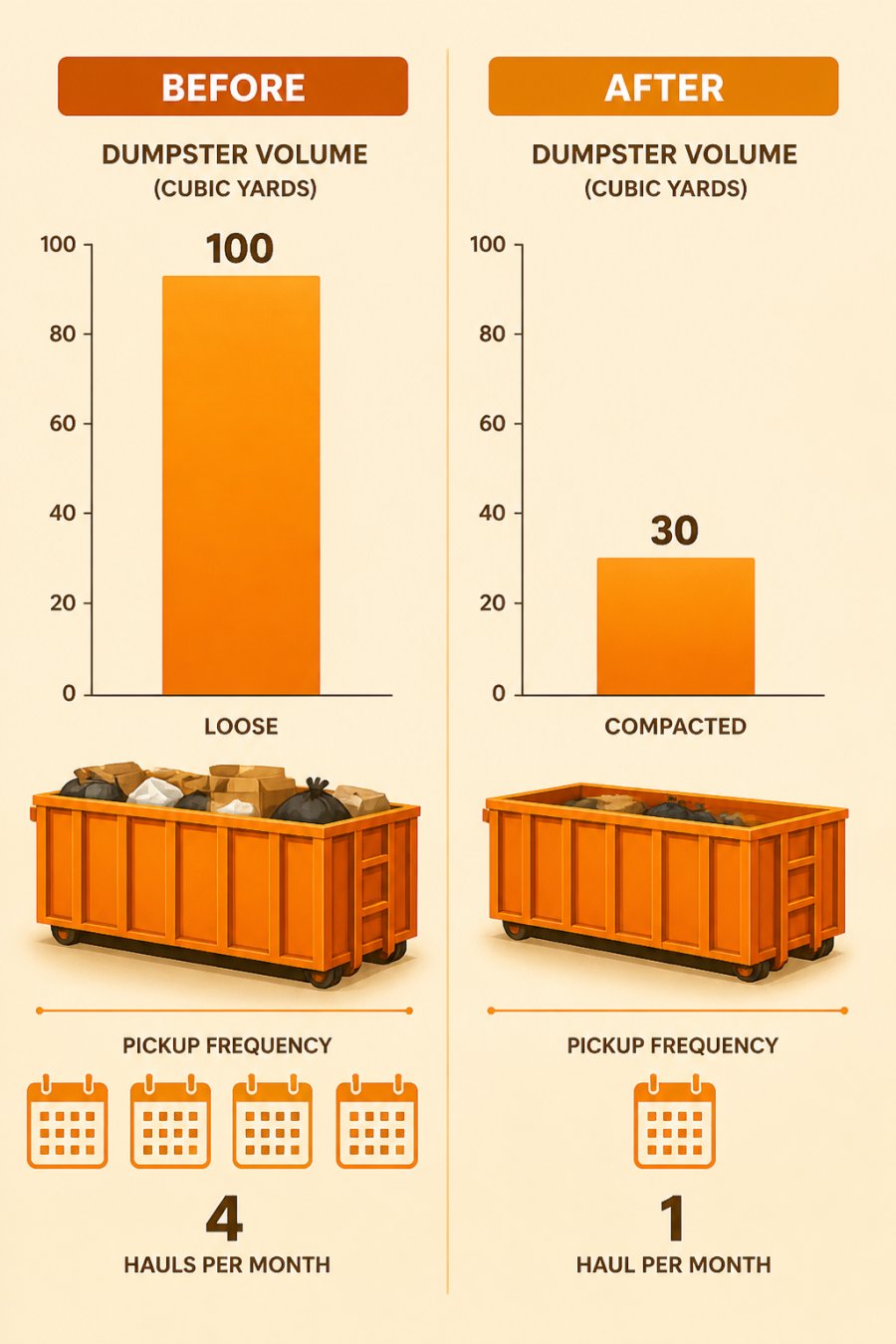
Volume reduction is the headline benefit. Mobile dumpster compaction can reduce roll-off dumpster volume by up to 70%, so the same container absorbs roughly three times the loose material. A warehouse running four pickups a month on a single roll-off can often drop to one.
That math changes your whole waste footprint: fewer containers in the yard, less overflow on the pavement, and no scramble when a busy shipping week outpaces your pickup schedule. The sites that benefit most generate steady, high-volume cardboard and packaging waste.
Lower Disposal and Hauling Costs
Disposal fees track volume and weight, and hauling fees track trips. Compaction attacks both. Junk Crusher clients see up to a 56% reduction in dumpster fees after switching to on-site crushing, because they stop paying to transport empty space.
The revenue side matters too. Separating cardboard before compaction keeps that value intact.
Fewer Pickups and Labor Savings
Every pickup costs money and staff time: someone coordinates the truck, keeps the dock clear, and manages the container before and after. Cutting pickups from weekly to monthly reclaims those hours.
Labor savings add up in smaller ways: less time breaking down boxes by hand, walking waste to an overflowing container, and cleaning up debris that blew out of an open dumpster.
Mobile Dumpster Compaction: A Flexible Option for Warehouses
Mobile dumpster compaction brings the crushing equipment to your existing dumpster instead of requiring a permanent compactor. A service truck arrives on schedule, compacts the contents on site, and leaves. You keep your current container and hauler relationship.
That flexibility solves a problem permanent equipment can't. Warehouses with tight yards, leased buildings, or seasonal volume swings often can't justify a fixed compactor and its concrete pad. Mobile service scales up during peak season and down when volume drops.
We built Junk Crusher around this model for exactly that reason. Our mobile service serves construction sites, distribution centers, and manufacturing facilities across the region, and it works alongside the hauler you already use. If you need additional capacity for a specific project, we also offer dumpster rental to pair with compaction.
The trade-off is scheduling. Mobile compaction runs on a route, so you plan around service days rather than compacting on demand.
Trash Compactor Safety: Training and Regulatory Considerations
Safety is where warehouse compaction projects go wrong, and the failures are predictable. A hydraulic compactor generates crushing force measured in tons, so anyone working near one must understand the pinch points, control sequence, and lockout procedure before they touch it. Treat safety as an operating discipline.
Start With the Hazards, Not the Rulebook
Four hazards account for most compactor incidents in warehouse settings:
- Pinch and crush points at the ram, the charge chamber opening, and the container connection.
- Stored energy in the hydraulic system that can release when a line is opened or a jam is cleared.
- Unexpected startup during maintenance when power is not properly isolated.
- Slips and falls around self-contained units where liquid waste collects.
Walk your floor and mark each of these before anyone operates the equipment. A hazard map posted at the machine beats a binder in the office.
Training That Actually Sticks
Every operator should be able to demonstrate four things before running a cycle unsupervised:
- How to start, stop, and emergency-stop the cycle.
- How to isolate and verify zero energy using lockout/tagout before any maintenance or jam clearing.
- Why they must never reach into the chamber, even with the power off, without following the lockout procedure.
- How to recognize an overload condition and what to do instead of forcing more material in.
Retrain at onboarding, after any near-miss, and at least annually. Document it, if a regulator or insurer asks, the log is your proof.
The Regulatory Frame
The Occupational Safety and Health Administration guidelines on machine guarding cover the guarding and lockout requirements that apply to this equipment, and they are worth reviewing before you install anything. Beyond guarding, plan for the practical hazards: wet or slippery floors around a self-contained unit, sharp edges on compacted metal, and the temptation to overload a container past its rated capacity. Post the operating procedure at the machine and enforce it.
Mobile Service Shifts the Burden, Not the Responsibility
For mobile compaction, the safety burden shifts mostly to the provider, but not entirely. Keep the area around the dumpster clear on service day, keep people away while it is being compacted, and make sure your team knows the schedule. If your site uses a 20 or 25 yard dumpster for overflow, treat it the same way: clear access, no climbing, no loading while the truck is on site.
A Simple Pre-Shift Check
Before each shift, the operator should confirm the guards are in place, the emergency stop works, the chamber is clear of debris, and the area around the unit is dry and unobstructed. Two minutes of checking prevents most reportable incidents.
Trash Compactor Pros and Cons for Warehouse Managers
Compaction isn't automatically the right call for every facility. Here's the honest breakdown.
Pros:
- Up to 70% reduction in waste volume per container
- Fewer pickups and lower hauling costs
- Less labor spent on waste handling
- Lower carbon footprint from fewer truck trips
Cons:
- Mobile service depends on route scheduling
The decision usually comes down to volume and consistency. A warehouse generating steady cardboard and packaging waste almost always benefits; a facility with low, irregular waste may not justify even mobile service.
| Waste Profile | Best Fit | Why |
|---|---|---|
| High-volume cardboard | Auger or stationary compactor | Continuous feed handles bulk material |
| Mixed dry warehouse waste | Stationary compactor | Reliable, lower upfront cost |
| Wet or odorous waste | Self-contained compactor | Sealed design contains liquids |
| Seasonal or tight-site volume | Mobile dumpster compaction | No install, scales with demand |
| Low, irregular volume | Standard dumpster service | Compaction won't pay back |
Choosing the Right Compactor for Your Warehouse Size and Waste Profile
Selection starts with two measurements: how much waste you generate per week, and what kind. Get those wrong and no amount of equipment research fixes it. Here is a framework you can actually run.
Step 1: Profile Your Waste Stream
Before you look at equipment, answer these five questions:
- Volume per week. How many cubic yards of loose waste leave your dock in a typical week? A common pattern is to estimate from your current dumpster size and pickup frequency.
- Material mix. What percentage is corrugated cardboard, stretch wrap, pallets, packaging foam, and mixed trash?
- Bulkiness. Do you generate irregular items that will not fit a standard charge chamber without pre-breaking?
- Recyclable value. How much of the stream is clean, sorted cardboard that a recycler will pay for or accept separately?
Write the answers down. They drive every decision that follows.
Step 2: Match the Design to the Material
| Waste Profile | Best Fit | Why |
|---|---|---|
| High-volume cardboard | Auger or stationary compactor | Continuous feed handles bulk material |
| Mixed dry warehouse waste | Stationary compactor | Reliable, lower upfront cost |
| Wet or odorous waste | Self-contained compactor | Sealed design contains liquids |
| Seasonal or tight-site volume | Mobile dumpster compaction | No install, scales with demand |
| Low, irregular volume | Standard dumpster service | Compaction will not pay back |
Cardboard and film compact well in almost any unit. Bulky irregular items may need pre-breaking to fit the chamber.
Step 3: Size by Throughput and Space
For a small warehouse with modest cardboard volume, mobile compaction is usually the pragmatic first step. You test the savings without committing capital.
Space kills more projects than budget. Measure the pad area, truck approach, and clearance around the container before committing to a design. If your yard cannot accommodate a permanent unit, mobile service keeps the option open.
Step 4: Run the Numbers Before You Buy
This is the step most guides skip, and it is the one that decides the project. Build a simple comparison:
Current annual waste cost = (hauling cost per pickup × pickups per year) + (disposal cost per ton × tons per year) + (labor hours per week spent on waste handling × hourly rate × 52).
Projected annual cost with compaction = the same three lines, adjusted for fewer pickups, lower transported volume, and reduced labor hours.
The difference is your annual savings. If it does not, mobile service is often the better first move because it carries no capital outlay.
Our team walks facility managers through this calculation before recommending anything, because the answer depends on your numbers, not a generic rule.
Step 5: Plan for Maintenance and Downtime
Whatever you choose, ask two questions before you sign: what does preventive maintenance look like, and how fast can a service call happen when the unit goes down? A compactor idle for a week costs more than the maintenance contract. Build a service schedule into the decision, not on top of it.
Installation, Site Planning, and Operational Disruption
Mobile compaction sidesteps most of this: no pad, no wiring, no construction. The service truck needs access to your existing dumpster, which you already have. For warehouses that can't absorb a construction project, that's often the deciding factor.
Disruption is the concern we hear most from operations managers, and it's fair. Mobile service typically fits your existing schedule with minimal interruption. That's why many facilities start there and only consider permanent equipment once the savings are proven.
Conclusion
Waste is one of the few operating costs a warehouse can cut without touching production, and compaction is the lever most facilities leave untouched. The challenge is choosing the right approach for your volume, waste stream, and site constraints without overcommitting to equipment you may not need.
That's where Junk Crusher comes in. Clients see up to a 56% reduction in dumpster fees, less dock downtime, and a smaller carbon footprint from fewer truck trips.
Get started with Junk Crusher and book a crush to see what compaction does for your waste line.
Frequently Asked Questions
What are the pros and cons of using a trash compactor?
Pros include reduced waste volume, lower disposal costs, fewer pickups, and improved site organization. Cons can include upfront equipment costs, maintenance requirements, and the need for employee training. For warehouses with high waste volume, the savings on hauling often outweigh the initial investment. Mobile compaction services can provide benefits without equipment ownership.
How do industrial trash compactors work?
Industrial trash compactors use hydraulic pressure to compress waste into a smaller volume. Mobile compaction services bring the equipment to your dumpster on-site.
How can a trash compactor help reduce warehouse waste pickups?
By compressing waste, a compactor fits more material into each dumpster. This means fewer pickups are needed to handle the same amount of waste. For warehouses, this can reduce hauling trips, lower fuel consumption, and decrease labor time spent managing waste. Mobile compaction services can reduce dumpster volume by up to 70%, directly cutting pickup frequency.
What safety practices should warehouse teams follow when using a trash compactor?
Mobile compaction services handle operation with trained personnel, reducing risk for warehouse staff.


