
7 DIY Yard Drainage Solutions for Beginners
Quick Summary
DIY yard drainage starts with finding why water pools: check for flat low spots, compacted clay soil, downspouts emptying at the house, or slopes pointing toward it. Then match that cause to a fix such as a French drain, swale, dry well, or catch basin. Call 811 before digging.
- Walk the yard during or after heavy rain to find low spots and where water flows from.
- Dig a 12-inch test hole and time how long water takes to drain to check soil.
- Use about 1 inch of drop per 8 feet of run for a French drain.
- Trench 12 to 18 inches deep and about 12 inches wide for a 4-inch pipe.
- Call 811 to have underground utility lines marked before you dig.
Table of Contents
- Diagnosing Why Your Yard Holds Water
- Choosing the Right DIY Yard Drainage Solution
- Building a DIY French Drain Step by Step
- Yard Drainage for Standing Water: Swales, Dry Wells and Catch Basins
- DIY Drainage Solutions for a Sloped Yard
- Cheap DIY Yard Drainage Solutions and Realistic Cost Ranges
- Frequently Asked Questions
Diagnosing Why Your Yard Holds Water
Standing water after rain softens soil near your foundation, kills grass, and leaves a muddy path. Before you dig, figure out why the water is pooling, the cause decides which fix will work.
Walk your yard during or right after a heavy rain. Note the low spots and trace where water flows from, often a roof downspout, a neighbor's higher lot, or a driveway sloping toward your lawn.
Common causes include:
- Flat or dipped ground where water has nowhere to go
- Compacted clay soil that doesn't let water soak in
- Downspouts that empty right at the house
Checking Soil Type and How Fast Water Soaks In
Sandy soil lets water pass through quickly; clay holds water and drains slowly.
Dig a hole about 12 inches deep and 12 inches wide in a spot that stays wet. Fill it, let it drain completely, then fill it again and time how long it takes to empty. If water is still there after several hours, drainage is poor and you'll need a solution that moves water away.
Choosing the Right DIY Yard Drainage Solution
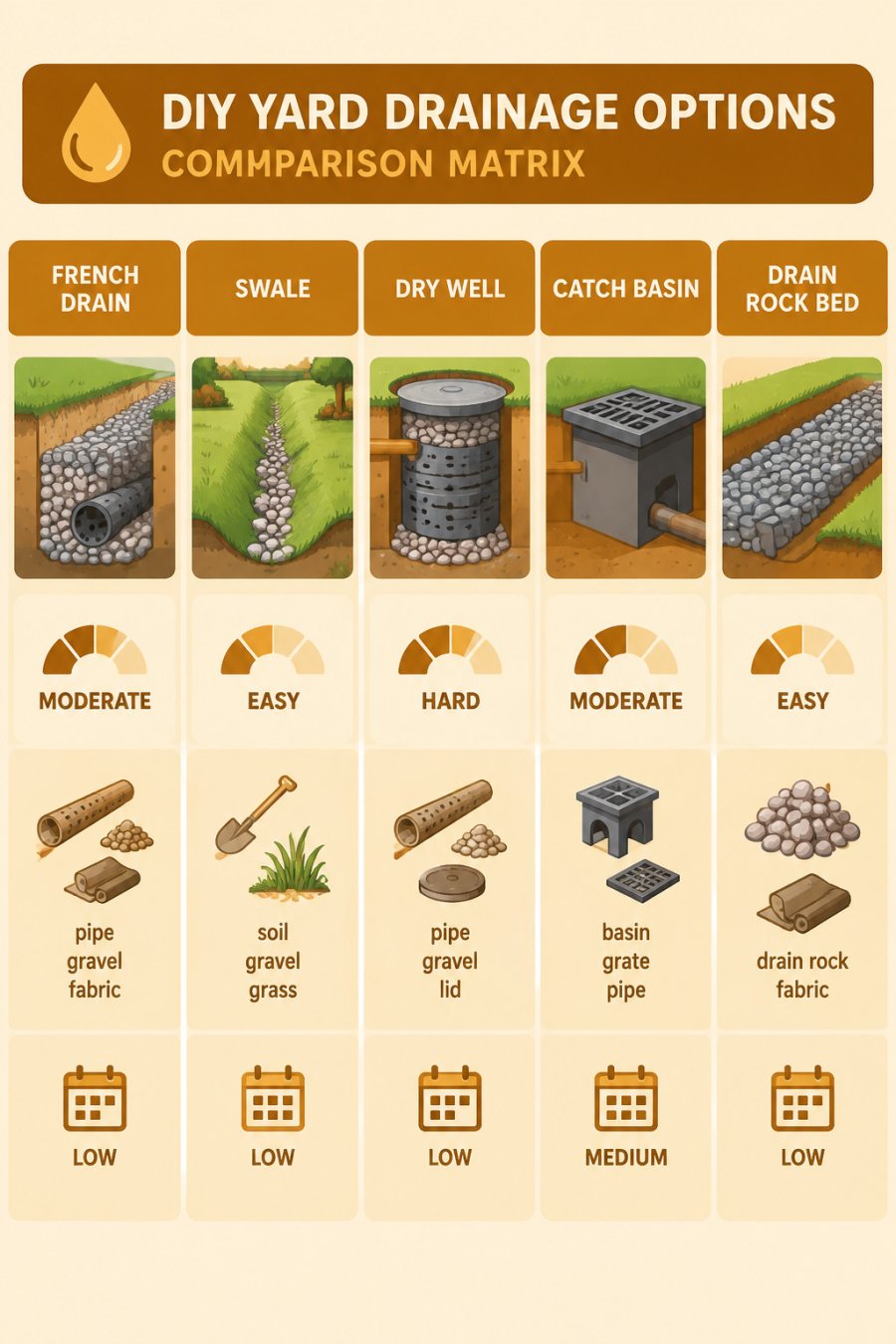
Most beginner projects fall into a few types. Pick the one that matches the problem you found. The table below maps common causes to suitable DIY methods; the notes after it explain the sizing and site checks that determine whether a method will work.
| Solution | Best For | Project Complexity | Main Materials |
|---|---|---|---|
| French drain | Wet areas that stay soggy; moving water away from a foundation or fence line | Moderate | Gravel, perforated pipe, filter fabric |
| Swale | Gently sloped lawns with runoff; redirecting surface water across a yard | Low to moderate | Grading tools, grass or rock lining |
| Dry well | Small spots that pool after storms; a single downspout or low point | Moderate | Gravel, buried container or pit |
| Catch basin | Water coming off a hard surface; a driveway or patio outlet | Moderate | Grate, basin, connecting pipe |
| Drain rock bed | Low spots with light flow; a temporary or decorative fix | Low | Drain rock, landscape fabric |
A French drain suits a soggy strip along a fence or foundation. A swale suits a lawn where water sheets across it. If a downspout dumps water at the house, a simple extension may be the cheapest fix.
Matching the Cause to the Fix
Match what you saw during your yard walk to one of these patterns:
- Water pooling in a flat or dipped area with no clear inlet: Start with a French drain or dry well. A dry well means less digging for a small spot with reasonably draining soil; a French drain moves water farther away from a long, narrow wet area.
- Water running off a downspout and pooling near the foundation: Start with a downspout extension or a catch basin at the outlet. A French drain is overkill unless water still pools after you move the discharge at least 4 to 6 feet from the house.
- Water sheeting across a lawn from a higher neighbor or slope: A swale intercepts surface flow and carries it around the house rather than letting it soak in at the low point.
Slope and Sizing Basics for Beginners
A trench that is too shallow or too flat will not carry water. Use these measurements as a starting point:
- Trench depth: 12 to 18 inches for a French drain; deeper if you are below the frost line or the outlet is far away.
- Trench width: About 12 inches for a 4-inch pipe. Wider trenches move more water but require more digging and gravel.
- Pipe diameter: 4-inch perforated pipe is standard for most residential French drains; use 3-inch only for very short runs with light flow.
To check your fall, stretch a string line from the start of the trench to the outlet with a line level at the middle. Adjust until the level reads true, then measure the gap between string and ground at each end, it should match your planned drop.
Soil Type and Infiltration Testing
Your soil decides whether a dry well, rain garden, or French drain will work. Sandy soil lets water pass through quickly. Clay holds water and drains slowly.
Homeowners with clay soil usually need a French drain or swale leading to a legal outlet; sandy soil often supports a dry well. A percolation test from a local soil professional gives a clearer answer, but the bucket test is a reasonable first check.
Permits, Utility Locating, and Legal Outlets
Before you dig, call 811 to have underground utility lines marked, free in most areas and it prevents striking a gas, electric, or water line. Check with your local building department about permits for grading changes, storm system connections, or work near a property line. Where water may legally drain matters too: discharging onto a neighbor's property or into a sanitary sewer can violate local rules.
Building a DIY French Drain Step by Step
A French drain is a gravel-filled trench that carries water to a safe outlet, one of the most common DIY drainage projects.
- Mark the path. Run a string line from the wet area to where water can exit, keeping about 1 inch of drop per 8 feet.
- Dig the trench. Aim for 12 to 18 inches deep and about 12 inches wide.
- Line the trench. Place filter fabric along the bottom and sides to keep soil out of the gravel.
- Add gravel. Put in 3 to 4 inches of drain rock, then lay the perforated pipe with holes facing down.
- Cover and finish. Add more gravel, fold the fabric over, backfill with soil, and finish with sod or mulch.
Watch out: Call 811 before you dig to have utility lines marked. Striking a gas or electric line is dangerous and expensive.
Materials and Tools Checklist
- Perforated drain pipe, 4 inches in diameter
- Filter fabric
- Washed drain rock or crushed gravel
Yard Drainage for Standing Water: Swales, Dry Wells and Catch Basins
When water pools in one spot, you have three simple options.
A swale is a shallow, wide channel that guides water across the yard.
A dry well is a buried gravel-filled pit that collects water from a single low spot and lets it soak into the ground below.
A catch basin is a box with a grate on top, set at the lowest point, with a pipe carrying water to an outlet.
DIY Drainage Solutions for a Sloped Yard
A sloped yard drains naturally but can still cause problems: water rushes downhill fast and can wash out soil or cut channels across the lawn.
Slow the water down with terraced beds, mulch, and groundcover.
Make sure the ground next to your home slopes away from the foundation, a common guideline is about 6 inches of drop over the first 10 feet. If the slope goes the wrong way, add soil to correct it.
Cheap DIY Yard Drainage Solutions and Realistic Cost Ranges
Many of the cheapest fixes take a few hours and basic tools: extending a downspout, regrading a small area, and adding a drain rock bed. Keep costs down by matching project size to the problem and avoiding heavy equipment rental unless you truly need it.
Beginner Shopping List and Typical Cost Ranges
| Material | Typical Unit | Common Price Range (USD) | Notes |
|---|---|---|---|
| Perforated drain pipe, 4-inch diameter | 10-foot section | $10-$20 | Sold in rigid or flexible form; flexible is easier for curves |
| Filter fabric (landscape fabric) | 3-foot by 50-foot roll | $15-$30 | Buy non-woven fabric, not solid plastic sheeting |
| Washed drain rock or crushed gravel | Cubic yard | $30-$60 | Washed rock drains better; crushed gravel compacts |
| Catch basin with grate | Each | $20-$50 | Plastic basins are cheaper; concrete lasts longer |
| Dry well kit (prefabricated) | Each | $50-$150 | Includes basin and lid; gravel sold separately |
| Downspout extension | 4-foot section | $5-$15 | Flexible or rigid; cheap and fast to install |
| String line and stakes | Set | $5-$10 | Basic layout tools |
| Line level | Each | $5-$10 | Essential for checking fall |
Common Price Range (USD)
Where Costs Add Up
Excavated soil is heavy and bulky, and hauling it away adds cost if you have no place on your property to reuse it. For general tips on managing debris and getting the most from a dumpster, see dumpster rental and compaction tips. Our dumpster rentals, including 20 and 25 yard dumpsters, and dumpster compaction service can help you keep the cleanup simple.
Tool rental is another cost to plan for. For short runs a shovel is often enough. A wheelbarrow and hand tools are worth buying if you plan more than one project.
When to Hire a Professional
Consider hiring a professional for a large trench, a slope change near a foundation, a drain connecting to a storm system, cutting into a paved surface, or if you are unsure about permits or legal outlet requirements. A grading or outlet mistake can send water into the wrong place. Most projects in this guide are manageable with hand tools and a weekend of work, but knowing when to call for help keeps the project cheap in the long run.
Frequently Asked Questions
What are some DIY yard drainage solutions I can do myself?
The most common beginner-friendly options are a French drain, a shallow grass swale, a gravel-filled drainage trench, and a dry well for small catchment areas. Each works by moving surface water away from where it pools. A French drain suits water that seeps in from one direction, while a swale suits gently sloped lots where you can shape the ground. Start with the simplest option that matches your diagnosis, and check your local utility and permit requirements before digging any trench deeper than a few inches.
Can I dig a hole and fill it with gravel for drainage?
A gravel-filled pit can work as a dry well for small amounts of runoff, but it only helps if the surrounding soil absorbs water at a reasonable rate. Before digging, run a simple percolation test: dig a hole about 12 inches deep, fill it with water, and time how long it takes to drain. If it stays full for more than a day or two, the soil is too dense for a dry well. Line the sides with landscape fabric, fill with washed crushed gravel, and direct a downspout or channel into it. Keep the bottom above the water table and call 811 before digging to locate underground utilities.
How do I improve drainage in a yard with no slope?
A flat yard usually needs water collected and moved, not just redirected. A perforated pipe French drain set in gravel, with a slight fall of about 1 inch per 8 feet toward an outlet, is the most reliable choice. Where the lot is completely flat, a catch basin connected to a drain line can collect runoff at low points. Add soil amendments to improve infiltration over time, and avoid grading that pushes water onto a neighbor's property.
What is the easiest way to drain a soggy backyard?
For most homeowners, the easiest first step is redirecting roof and surface water rather than trenching. Extend downspouts several feet from the foundation, add splash blocks, and reshape the soil so it slopes away from the house at roughly 6 inches over 10 feet. If the yard still stays wet after these changes, a shallow swale or a short French drain along the low side is the next step. Clear debris from existing outlets each season so the system keeps working.


